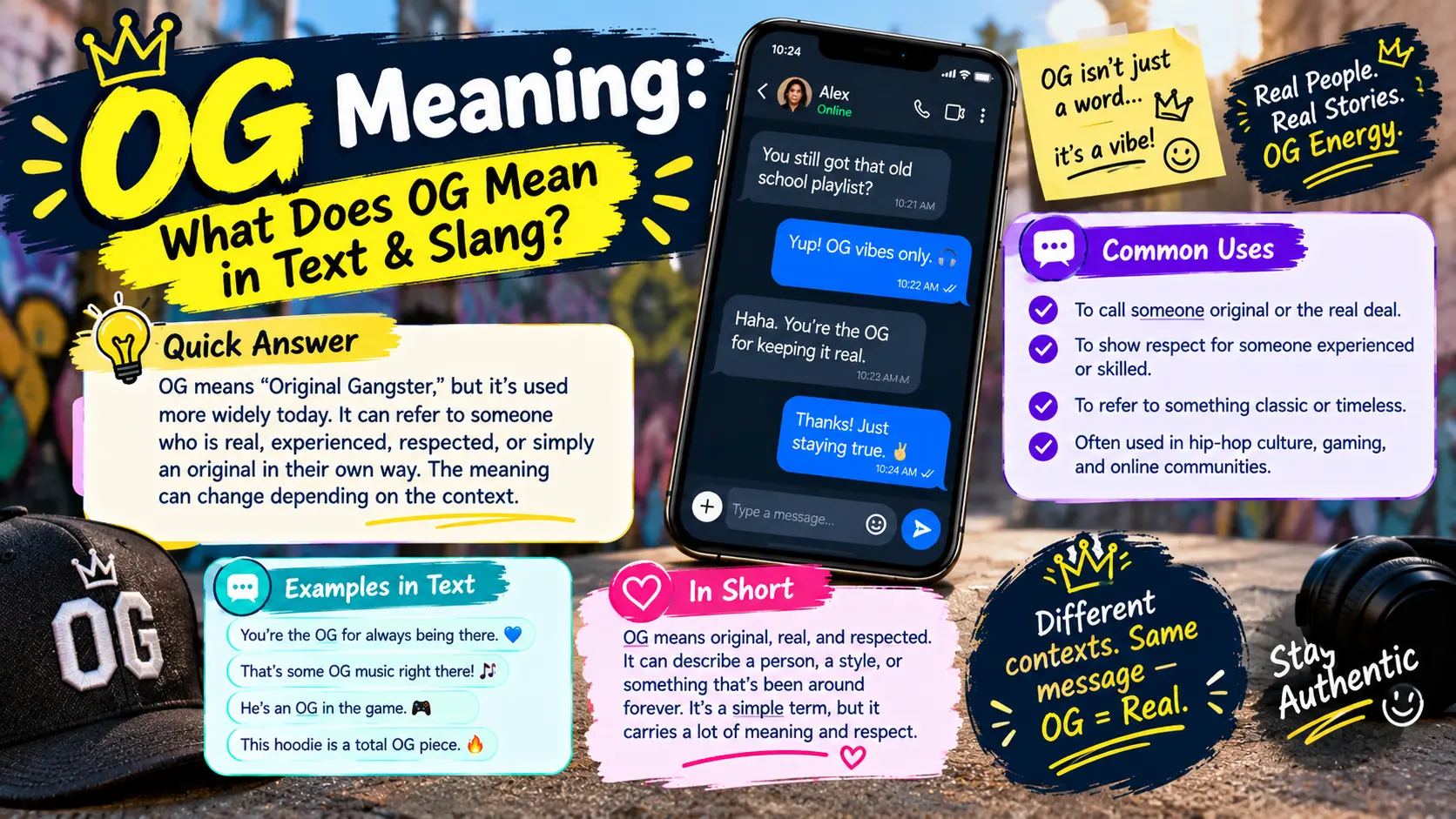
OG Meaning: What Does OG Mean in Text & Slang?
If someone calls you an OG, they are usually giving you respect. You may see the word in a text message, Instagram caption, TikTok comment, gaming chat, or everyday conversation and wonder what it really means.
The most common OG meaning is “Original Gangster.” However, modern speakers rarely use it only in its literal historical sense. Today, OG often describes someone who has been around for a long time, knows their stuff, helped establish something, or deserves recognition because of their experience.
For example, someone might call a longtime friend an OG because they have been there since the beginning. A fan might call an early artist an OG because they helped shape a music scene. On social media, OG can simply mean original, authentic, respected, or old-school.
The exact meaning depends heavily on context. That is why understanding the tone behind the word matters as much as knowing its dictionary definition.
OG Meaning: Quick Meaning
OG commonly means “Original Gangster,” but in modern informal English it often means an original, veteran, respected, or longtime person.
Depending on the situation, OG can describe:
- Someone who has been involved from the beginning
- A longtime member of a community
- A respected veteran
- Someone considered authentic or genuine
- An old-school person or thing
- A person who has earned respect through experience
- Something considered the original version
Here are a few natural examples:
“She’s an OG in the beauty community.”
“You’ve been here since day one. You’re an OG.”
“That restaurant is an OG around here.”
In these examples, OG is generally complimentary. It suggests history, authenticity, experience, or respect.
Origin & Background of OG
The original phrase behind OG is “Original Gangster.” The expression became strongly associated with American street culture and hip-hop, particularly through music and popular culture during the late twentieth century.
Over time, the word moved beyond its original cultural setting. Hip-hop helped introduce OG into wider mainstream vocabulary, where people began using it to describe respected veterans and people who had been involved from an early stage.
The meaning gradually became less connected to actual gang activity. Today, someone can be called an OG in sports, gaming, fashion, business, music, cooking, online communities, or friendship circles.
Social media accelerated this change. Platforms such as Instagram, TikTok, YouTube, and online forums made it common to describe early creators, longtime followers, and influential community members as OGs.
For example, an early gamer might be called an OG because they played a particular game before it became popular. A longtime follower might proudly say, “I’ve been following her since 2016. I’m an OG.”
The word therefore developed an important modern association with being there before everyone else.
Real-Life Conversations
WhatsApp Conversation
Person A:
“Do you remember our old school group?”
Person B:
“Of course. We’ve known each other forever.”
Person A:
“That’s why you’re an OG 😂”
Here, OG expresses affection and respect for a longtime friendship.
Instagram DM
Person A:
“You still have that original sneaker collection?”
Person B:
“Yep. Had it before everyone started talking about them.”
Person A:
“Okay, OG status confirmed 🔥”
The speaker is using OG to recognize that the other person was interested before something became mainstream.
TikTok Comments
Person A:
“Anyone else remember her videos from 2018?”
Person B:
“OG followers know 😂”
In this case, OG refers to people who have followed the creator for a long time.
Text Message
Person A:
“Who taught you how to cook like that?”
Person B:
“My grandmother.”
Person A:
“Respect to the OG ❤️”
Here, OG is affectionate and respectful rather than referring to anything criminal.
Emotional & Psychological Meaning
Calling someone an OG often communicates more than simple familiarity.
It can express respect, admiration, loyalty, nostalgia, and recognition. The word acknowledges someone’s history and suggests that their experience has value.
There is also a psychological element to the term. People naturally value belonging and shared history. Saying “you’re an OG” can make someone feel recognized as part of a group.
Imagine joining an online community years ago when only a few people participated. As the community grows, newer members may recognize you as one of the original participants. Calling you an OG gives your history social value.
I have seen this kind of language appear naturally whenever people talk about old friendships, favorite creators, childhood interests, or communities they joined early. The word often carries a warm sense of “you were here before it became popular.”
That emotional layer explains why OG feels stronger than simply saying “old” or “experienced.”
Usage in Different Contexts
Social Media
On social media, OG frequently refers to early followers, original creators, longtime fans, or people who remember an older version of a trend.
You might see:
“OG fans remember this song.”
“Only the OG followers know this.”
It can also describe something from an earlier era that people still admire.
Friends & Relationships
Among friends, OG is often playful and affectionate.
Someone might say:
“That’s my OG.”
This can mean “that’s my longtime friend” or “that’s someone I deeply respect.”
The expression is especially common when people have shared history.
Work and Professional Settings
OG is much more informal at work.
A colleague might casually say:
“Ask Maria. She’s an OG here.”
This means Maria has been with the organization for a long time and knows how things work.
However, in a formal email or professional report, phrases such as experienced colleague, longtime member, or founding member are usually clearer.
Casual vs Serious Tone
OG is overwhelmingly informal.
It works well in:
- Text messages
- Social media
- Gaming chats
- Friendly conversations
- Informal online communities
It can sound inappropriate or overly casual in formal documents, academic writing, official announcements, or serious professional communication.
When NOT to Use It
Although OG is usually positive today, it has a cultural history that should not be ignored.
Because OG originally stood for “Original Gangster,” the word comes from language associated with street and gang culture. Its modern use is much broader, but some audiences may still associate it with that background.
Avoid using OG if you are unsure whether the person understands the expression.
It is also better to avoid it in highly formal communication. Calling a senior executive “the OG of the company” might be funny among coworkers but could sound too casual in a formal presentation.
Context matters especially across generations and cultures. A younger internet user may immediately understand OG as “original” or “veteran,” while another person may interpret the phrase more literally.
Common Misunderstandings
OG Does Not Always Mean Gangster
The biggest misunderstanding is assuming that every use of OG means someone is involved with gangs.
In modern internet English, OG usually has a broader meaning related to being original, established, experienced, or respected.
OG Does Not Simply Mean Old
An OG does not necessarily have to be old.
A person can become an OG because they joined a community early, created something influential, or gained recognition through experience.
OG Can Describe Things
The word is not limited to people.
Someone might say:
“The original PlayStation was the OG.”
Here, OG refers to something considered the classic or original version.
OG Is Usually Positive
In most casual modern contexts, calling someone an OG is a compliment.
However, tone can change meaning. Sarcasm, joking, or criticism can make the expression less flattering.
See Also: Futz Meaning: What Does “Futz” Mean in Text and Conversation?
“OG” and “Original” Are Not Always Identical
When people say OG, they often imply more than simply “first.”
There can be an additional sense of authenticity, reputation, history, or respect.
Comparison Table
| Expression | Meaning | Typical Tone | Example |
|---|---|---|---|
| OG | Original, longtime, respected person | Casual | “He’s an OG in gaming.” |
| Original | First or authentic version | Neutral | “This is the original design.” |
| Veteran | Someone with substantial experience | Neutral/Formal | “She’s a veteran journalist.” |
| Old-school | Traditional or from an earlier era | Casual | “He’s old-school.” |
| Newbie | Someone inexperienced or new | Casual | “I’m still a newbie here.” |
| Newcomer | Someone who recently joined | Neutral | “She’s a newcomer to the community.” |
| OG fan | Longtime or early fan | Casual | “I’m an OG fan of the band.” |
| OG version | Original or classic version | Casual | “I prefer the OG version.” |
| OG friend | Longtime trusted friend | Casual | “She’s one of my OG friends.” |
Key Insight
The central idea behind OG is not simply age. It is usually about history, authenticity, experience, or being there from the beginning. That distinction makes the expression useful in many modern conversations.
Variations and Types of OG
1. OG Person
Meaning: A longtime or respected person.
Someone who has established themselves in a particular group may be called an OG.
2. OG Friend
Meaning: A longtime and trusted friend.
This version often carries emotional warmth because it highlights shared history.
3. OG Fan
Meaning: Someone who supported a person, artist, team, or brand early on.
It is particularly common in fandom communities.
4. OG Member
Meaning: An original or early member of a group.
This can apply to clubs, online communities, gaming groups, or organizations.
5. OG Creator
Meaning: An early or influential content creator.
The phrase often recognizes someone who was producing content before a particular trend became mainstream.
6. OG Version
Meaning: The original or classic version of something.
For example, people might refer to an older product, game, song, or design as the OG version.
7. OG Style
Meaning: A classic or original style associated with an earlier period.
It can suggest nostalgia and authenticity.
8. OG Status
Meaning: Recognition for being an established or longtime participant.
Someone might jokingly say, “I have OG status here.”
9. OG Crew
Meaning: The original group of friends or members.
The phrase often appears in music, sports, gaming, and social communities.
10. Real OG
Meaning: Someone considered genuinely authentic, experienced, or respected.
This expression intensifies the compliment.
How to Respond When Someone Uses It
Your response can depend on the relationship and tone.
Casual Replies
- “Haha, you already know!”
- “OG since day one.”
- “Always been here.”
- “You know the history.”
- “That’s right 😂”
Funny Replies
- “OG certification approved.”
- “My membership card finally arrived.”
- “Been OG before it was cool 😂”
- “Respect the original!”
- “I accept this title.”
Mature Replies
- “I appreciate that.”
- “We’ve definitely been around for a while.”
- “Thank you. Experience has its perks.”
- “I guess the history speaks for itself.”
Respectful Replies
- “Much respect.”
- “Appreciate you saying that.”
- “That means a lot.”
- “Respect to you too.”
The best response depends on whether OG is being used seriously, affectionately, or as a joke.
Regional & Cultural Usage
Western Culture
In American and broader Western internet culture, OG is widely understood as an informal term for someone original, established, experienced, or respected.
Hip-hop, sports, gaming, and social media have played major roles in spreading the expression.
Asian Culture
Across many Asian online communities, OG is commonly borrowed from global internet slang.
You may see it in English-language posts, gaming groups, fandoms, and social media conversations. The meaning is generally closer to veteran, longtime member, or original fan than the literal “Original Gangster.”
Local language and community norms can still influence how naturally the term is used.
Middle Eastern Culture
In Middle Eastern online communities where English slang is common, OG may appear in gaming, social media, music, and youth-oriented conversations.
It is generally understood through global internet culture, especially when used among English-speaking younger audiences.
Global Internet Usage
The internet has helped separate OG from its original cultural context.
Today, someone can be an OG in almost anything: cooking, gaming, fashion, fitness, fandoms, business, music, or online communities.
Gen Z vs Millennials
Both Gen Z and Millennials commonly recognize OG, but context can differ.
Younger users may use it casually to mean original, authentic, or respected. Millennials may also associate the term more strongly with its hip-hop and earlier internet-era origins.
Neither interpretation is automatically correct in every conversation. The surrounding words and community usually provide the clearest clue.
Is OG Safe for Kids?
Generally, children may encounter OG as ordinary internet slang meaning “original,” “longtime,” or “respected.”
However, parents should explain that the abbreviation originally relates to the phrase “Original Gangster.” Understanding that background helps children recognize why the term appears in different contexts.
The meaning of OG in a particular message should always be judged by the surrounding conversation.
For younger children, simple explanations such as “someone who has been around from the beginning” are usually enough.
FAQs About OG Meaning
What does OG mean in text?
In text messages, OG usually means original, longtime, experienced, or respected. It can describe a person, group, or thing.
What does OG stand for?
OG originally stands for “Original Gangster.” In modern slang, it commonly has the broader meaning of someone or something original, established, or respected.
Is calling someone OG a compliment?
Usually, yes. Calling someone an OG often shows respect for their experience, authenticity, or history.
Does OG mean old?
Not necessarily. OG is more about being original, established, or involved from an early stage than simply being old.
What does OG mean on Instagram?
On Instagram, OG often refers to an early follower, longtime creator, original fan, or someone who has been part of a community for a long time.
What does OG mean on TikTok?
On TikTok, OG commonly describes early creators, longtime users, original trends, or people who remember a trend before it became widely popular.
Can OG describe an object?
Yes. People can call an object, product, song, game, or style OG when they mean the original or classic version.
Conclusion
Understanding OG meaning is really about understanding how language changes with culture.
Although OG originally came from “Original Gangster,” modern speakers often use it to express ideas such as originality, experience, authenticity, loyalty, and respect. Someone can be an OG friend, an OG fan, an OG creator, or simply an OG member of a community.
The word is casual, flexible, and especially common online. Its exact meaning depends on who is saying it, what they are talking about, and the relationship between the people involved.
So when someone calls you an OG, look at the context before taking it literally. In most modern conversations, they are recognizing your history and giving you a little respect for being there from the beginning.