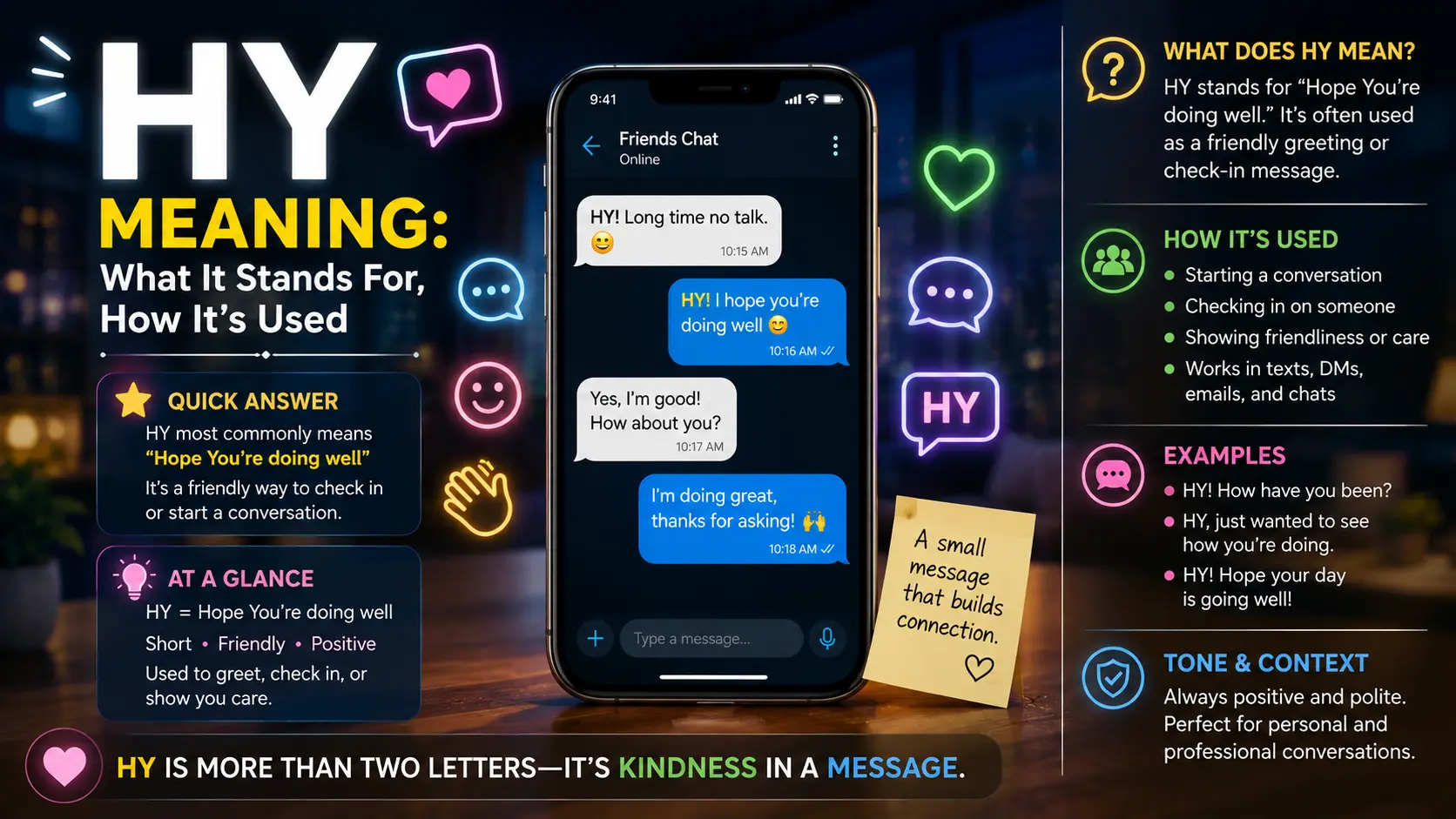
HY Meaning: What It Stands For, How It’s Used
Quick Answer
HY most commonly means “Hell Yeah” in American texting and online slang. It is an enthusiastic way to say “yes,” “absolutely,” or “definitely.” The expression adds more emotion and excitement than a simple “yes.”
For example, if someone asks, “Are you coming to the concert?” a reply such as “HY!” communicates strong agreement. However, abbreviations can have different meanings depending on the conversation, platform, and community.
TL;DR
- HY usually means “Hell Yeah” in casual American texting.
- It expresses strong agreement, excitement, or enthusiasm.
- It is mainly used in texts, DMs, comments, chats, and informal online conversations.
- HY is generally more expressive than simply saying “yes.”
- Because the abbreviation can be ambiguous, context matters.
- It is usually best avoided in formal workplace, academic, or professional communication.
What Does HY Mean in American English?
In contemporary American digital communication, HY commonly stands for “Hell Yeah.” It functions as an emphatic affirmative response rather than a neutral “yes.”
The phrase combines agreement with emotional energy. Someone using HY is often communicating that they strongly approve of an idea, invitation, opinion, or question.
Common Interpretations
The most common interpretation of HY is “Hell Yeah.” It can communicate several closely related ideas:
- Absolutely
- Definitely
- Of course
- Yes, definitely
- I agree
- I’m excited about that
- That sounds great
For example:
“Want to get pizza tonight?”
“HY!”
Here, HY means much more than a neutral “yes.” It suggests enthusiasm.
Another example:
“Did you like the movie?”
“HY, it was amazing.”
The abbreviation can therefore act as an emotional intensifier.
Less Common Meanings
Although “Hell Yeah” is a common slang interpretation, HY does not have one universal definition. In other settings, it may represent different words, phrases, usernames, organizations, technical terms, or personal abbreviations.
That is why you should not automatically interpret every appearance of HY as slang. The surrounding words, relationship between the speakers, and communication platform can provide important clues.
How HY Appears in Daily Communication
HY is primarily associated with informal digital communication. It works particularly well when people want to communicate quickly while still showing personality.
Typical Contexts
You may see HY in:
- Text messages
- Group chats
- Direct messages
- Social-media comments
- Gaming chats
- Online communities
- Casual conversations
- Memes and humorous posts
For example:
Friend: “You coming out tonight?”
Reply: “HY!”
Or:
Friend: “Would you do that again?”
Reply: “HY 😂”
The exact emotional tone depends on punctuation, capitalization, emojis, and the surrounding conversation.
Visual Style
HY may appear in several forms:
- HY — energetic or emphatic
- hy — more casual or understated
- HY!!! — highly enthusiastic
- HY 😂 — enthusiastic and playful
- HY bro — strongly informal
Capitalization does not necessarily change the definition. Instead, it often changes how strongly the message feels.
Historical Roots of Expressive Agreement
The meaning behind HY is connected to a much older human habit: using intensified expressions to communicate strong agreement.
Spoken Origins
Long before texting existed, people used expressions such as “absolutely,” “of course,” “definitely,” and stronger colloquial phrases to make their agreement more emotionally noticeable.
“Hell yeah” developed within informal spoken English as an emphatic affirmative expression. It became particularly associated with casual American speech, where expressive and conversational language often plays an important role in social interaction.
Shift to Abbreviation
Text messaging changed how people communicate. Instead of typing a complete phrase, users began shortening familiar expressions into compact forms.
A phrase such as “Hell yeah” can therefore be reduced to HY, particularly when both participants already understand the slang.
This follows the broader pattern of digital shorthand such as LOL, OMG, IDK, BTW, and TBH.
Why Americans Use HY Instead of “Yes”
HY is not simply a shorter version of “yes.” It also carries attitude and emotion.
Emotional Efficiency
One major advantage of HY is emotional efficiency. A single two-letter abbreviation can communicate agreement, excitement, confidence, and informality simultaneously.
Compare:
“Yes.”
with:
“HY!”
The first may sound neutral. The second suggests considerably more enthusiasm.
Digital communication lacks facial expressions and vocal tone, so abbreviations, punctuation, and emojis can help restore some of the emotion normally present in face-to-face conversation.
Cultural Preference
American informal communication often values language that feels direct, energetic, and conversational. Expressions such as “heck yeah,” “absolutely,” “for sure,” and “hell yeah” can make agreement feel more personal.
HY fits naturally into this style because it is short while preserving the emotional character of the original expression.
Emotional and Psychological Meaning of HY
Although HY is only an abbreviation, its use can communicate meaningful social information.
Emotional Associations
HY may suggest:
- Excitement
- Confidence
- Approval
- Enthusiasm
- Celebration
- Strong agreement
- Playfulness
For example, replying “HY!” to good news can communicate genuine excitement without requiring a longer message.
However, tone is always contextual. In some conversations, an exaggerated response may be playful rather than completely serious.
Social Signals
Using HY can also signal familiarity and informality. People generally use slang abbreviations more freely with friends, peers, and online communities than with strangers or authority figures.
Therefore, HY can indirectly communicate that the conversation is relaxed.
HY Meaning Across Age Groups
Different generations may recognize or use digital abbreviations differently.
Younger Users
Younger internet users are generally more accustomed to rapidly evolving slang, shortened expressions, memes, and platform-specific language.
They may understand HY from context even if they do not use it regularly. Its meaning can also overlap with other emphatic expressions such as “fr,” “bet,” “yep,” or “absolutely,” depending on the community.
Older Users
Older adults may be less familiar with HY as a texting abbreviation, especially if they do not regularly participate in slang-heavy online spaces.
That does not mean they cannot understand it. Context often makes the intended meaning relatively easy to infer, particularly when HY appears as a direct response to a yes-or-no question.
HY in Social Media and Online Culture
Social media has accelerated the development and spread of short expressions.
Platform-Specific Use
HY can appear in comments, captions, DMs, and conversational threads. Its frequency and interpretation may vary between communities.
A gaming community may use abbreviations differently from a general social-media audience. Likewise, a private group chat can develop its own shorthand that outsiders may not immediately understand.
Meme Culture
Internet memes frequently depend on exaggerated reactions. Because “Hell Yeah” already communicates strong enthusiasm, HY can work effectively as a short reaction to humorous, exciting, surprising, or relatable content.
The abbreviation may also appear alongside GIFs, reaction images, emojis, or repeated punctuation to strengthen the emotional message.
HY Compared to Similar Expressions
HY belongs to a broad group of affirmative expressions, but each has a slightly different tone.
| Expression | Typical Tone | Meaning |
|---|---|---|
| HY | Very casual, enthusiastic | Strong yes |
| Yes | Neutral | Agreement |
| Yeah | Casual | Agreement |
| Absolutely | Strong, polished | Definite agreement |
| Definitely | Confident | Certain agreement |
| Of course | Friendly/confident | Natural agreement |
| For sure | Casual | Strong agreement |
| Heck yeah | Enthusiastic, softer | Very strong yes |
| LOL yes | Playful | Amused agreement |
The important distinction is register. HY is much more informal than “yes,” “certainly,” or “absolutely.”
Cross-Cultural Perspectives on Short Affirmations
Short affirmative expressions exist in many languages and cultures, although their exact forms and emotional implications differ.
Global Parallels
People around the world shorten expressions in digital communication. English speakers may use abbreviations, while speakers of other languages may use local slang, initials, phonetic spellings, or internet-specific expressions.
The underlying purpose is similar: communicate agreement quickly while preserving emotional tone.
Cultural Limits
An abbreviation that feels natural in one community may seem confusing or inappropriate in another.
Even within English-speaking countries, slang can differ. American internet slang may not always carry exactly the same associations for British, Australian, Canadian, or other English-speaking audiences.
Misunderstandings and Misuse of HY
Because HY is short and context-dependent, misunderstandings are possible.
Common Confusions
A reader unfamiliar with slang might interpret HY as:
- A typo
- A person’s initials
- A company or organization abbreviation
- A technical abbreviation
- An unrelated acronym
- A different slang expression
If the surrounding conversation does not involve agreement or enthusiasm, another meaning may be more likely.
When to Avoid It
Avoid HY when clarity and professionalism are more important than casual expression.
This includes:
- Formal business emails
- Academic assignments
- Job applications
- Official correspondence
- Customer-service communication
- Legal or professional documents
In these situations, “yes,” “certainly,” “absolutely,” or another clear expression is usually a better choice.
How HY’s Meaning Has Shifted Over Time
Digital slang rarely remains completely static. Its popularity and interpretation can change as communication platforms evolve.
Early Use
The underlying phrase “hell yeah” predates modern texting. It has long been used as an emphatic expression of agreement in informal spoken English.
The abbreviated form became possible as text messaging, internet forums, instant messaging, and social media encouraged users to shorten common expressions.
Current Use
Today, HY can function as a compact digital reaction. However, its recognition is not universal, and its popularity can vary by age group, online community, and platform.
This means the safest approach is always to read HY in context rather than assuming one meaning automatically.
Is HY a Symbol of Modern Identity?
Abbreviations can reveal more than what someone wants to say. They can also reflect how they participate in digital culture.
Digital Identity
The slang someone uses can contribute to their online voice. Choosing HY instead of “yes” may make a message feel more relaxed, expressive, humorous, or internet-oriented.
In this sense, slang becomes part of a person’s digital communication style.
Social Belonging
Shared slang can also create a feeling of belonging. When people understand the same abbreviations and references, communication becomes faster and can feel more socially connected.
However, slang is not a requirement for belonging. People can communicate naturally without using abbreviations.
FAQs About HY Meaning
What does HY usually stand for?
HY usually stands for “Hell Yeah” in casual American texting and online slang. It expresses strong agreement, enthusiasm, or excitement.
Is HY appropriate for work messages?
Generally, HY is better suited to informal communication. In professional messages, use “yes,” “absolutely,” “certainly,” or another clear expression instead.
Can HY ever mean something else?
Yes. HY can have different meanings in technical, organizational, personal, or specialized contexts. The surrounding conversation determines the intended meaning.
Is HY rude or offensive?
HY itself is not necessarily directed as an insult, but its common expansion contains a mild-to-strong profanity. Because of that, it may be inappropriate in formal or highly professional environments.
Do older adults use HY?
Some older adults use HY, especially those familiar with texting and online slang. Others may not recognize it immediately, so clearer language can be preferable when communicating with a broad audience.
Conclusion
HY most commonly means “Hell Yeah” in American texting and online slang. It is an emphatic form of agreement that communicates more enthusiasm and emotion than a simple “yes.”
Its meaning depends heavily on context, relationship, platform, and tone. While HY works naturally in casual texts, DMs, group chats, and social media, it is generally better to use conventional language in professional or formal communication.
Ultimately, HY demonstrates how modern digital language makes communication shorter without necessarily making it less expressive.