DTR Meaning: What Does DTR Stand For in Text?
Quick Answer
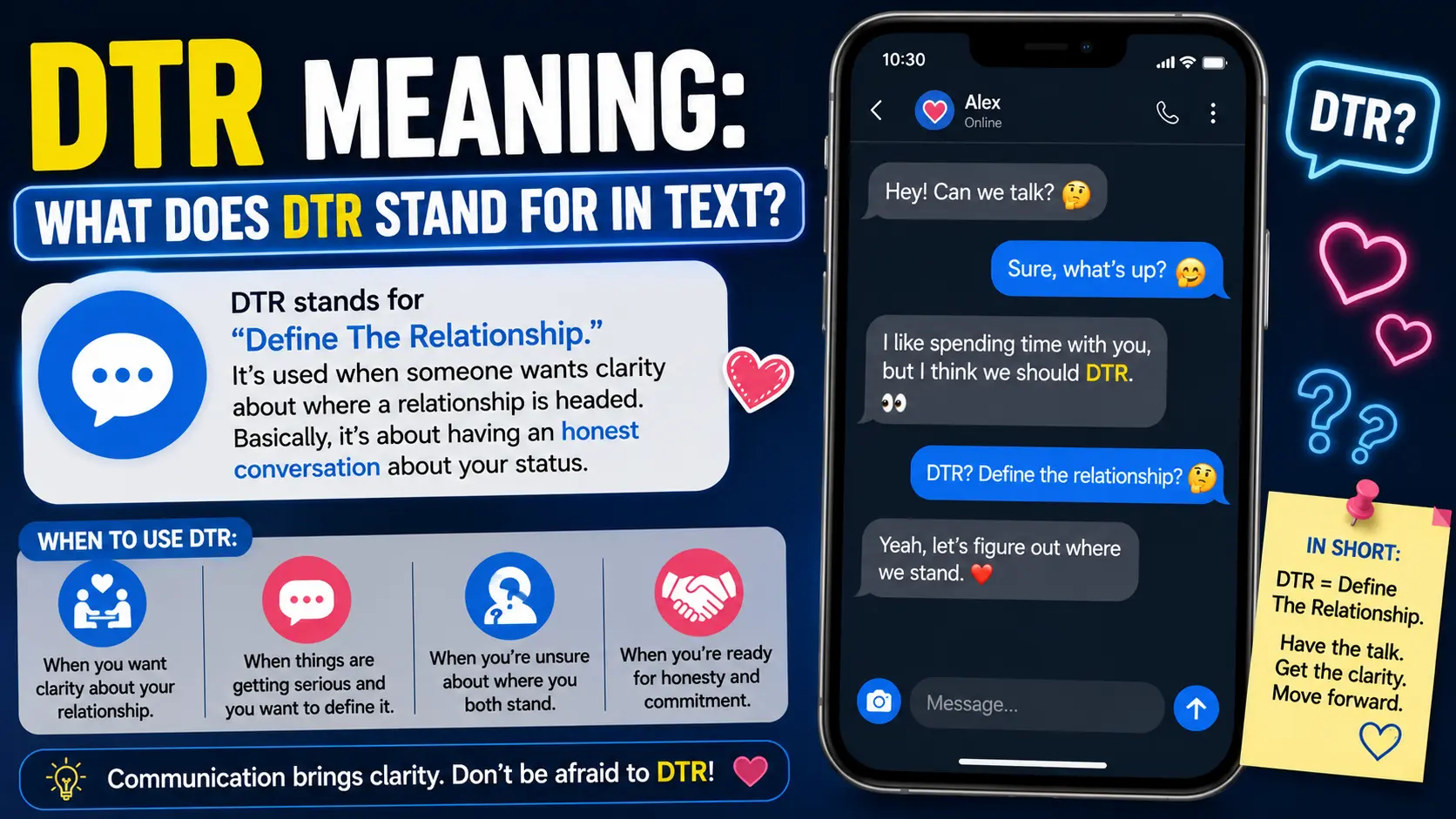
DTR stands for “Define the Relationship.” In texting and modern dating, it usually refers to a conversation where two people clarify what their relationship is, what they expect from each other, and whether they are dating exclusively or becoming official.
The exact meaning can depend on context. Most commonly, however, DTR is connected with romantic relationships and dating, especially when two people have been seeing each other but have not clearly discussed their relationship status.
TL;DR
- DTR = Define the Relationship.
- It is most often used in dating and romantic conversations.
- A DTR conversation helps people understand where a relationship is going.
- DTR does not automatically mean marriage, exclusivity, or a serious commitment.
- Someone may use DTR when a casual relationship starts becoming more emotionally significant.
- The phrase can also be used more broadly when people want to clarify expectations or boundaries.
What Does DTR Stand For?
DTR Meaning and Definition
DTR is an abbreviation for “Define the Relationship.” It describes the process of having an honest conversation about the nature or status of a relationship.
For example, someone might text, “I think we should DTR,” meaning they want to discuss what the two people are to each other. The conversation could involve questions such as whether they are officially dating, seeing other people, or interested in pursuing something more serious.
DTR is especially useful when actions and expectations are no longer completely clear. Two people might spend a lot of time together, communicate every day, or act like a couple without actually agreeing on what their relationship means.
What “Define the Relationship” Means
“Define the relationship” does not necessarily mean choosing a permanent label. Instead, it means creating clarity around expectations.
One person might consider the relationship casual while the other sees it as becoming serious. A DTR conversation gives both people an opportunity to explain how they feel and what they want.
Depending on the situation, the outcome might be dating exclusively, becoming boyfriend and girlfriend, remaining casual, continuing to get to know each other, or deciding that the relationship is not heading in the same direction.
Why People Use the Acronym DTR
DTR is convenient because “Define the Relationship” is relatively long for casual digital communication. Like many texting abbreviations, DTR provides a short way to describe a familiar social situation.
Instead of saying, “We need to have a conversation about what our relationship actually is,” someone can simply say, “We need to DTR.”
The abbreviation has also become recognizable within modern dating vocabulary. It can sound more casual than saying “relationship-status discussion,” even though the underlying conversation can be emotionally important.
What Does DTR Mean in Text Messages?
Common Texting Examples
DTR frequently appears in messages between people who are dating or developing romantic feelings.
Common examples include:
- “I think it’s time we DTR.”
- “Are we going to DTR soon?”
- “We’ve been seeing each other for months, but we never DTR’d.”
- “I’m nervous about having the DTR conversation.”
- “She wants to DTR and figure out where this is going.”
In these examples, DTR usually refers to clarifying romantic expectations rather than simply discussing whether two people like each other.
How DTR Is Used in Conversations
DTR can appear as both a verb and a noun-like expression.
Someone might say they want to DTR, meaning they want to define the relationship. They might also refer to “the DTR talk” or “the DTR conversation.”
The phrase can also appear indirectly. For example, a person might say, “We should probably talk about us,” without using the acronym at all. That can still be a DTR conversation because the purpose is essentially the same: gaining clarity about the relationship.
Reading the Tone Behind DTR
The tone of DTR depends heavily on the conversation.
A message such as “Can we DTR?” may sound serious because the person wants an important conversation. On the other hand, friends might jokingly use DTR when discussing a confusing social situation.
DTR itself is not automatically positive or negative. It simply signals a desire for clarity. The emotional meaning comes from why the conversation is happening and what each person wants.
DTR Meaning in Dating and Relationships
When Someone Wants to Define the Relationship
A person may want to DTR when the relationship has progressed beyond casual interaction but has not received a clear label.
For example, two people might regularly go on dates, communicate throughout the day, meet each other’s friends, and develop emotional closeness. Eventually, one person may wonder whether they are actually a couple.
That uncertainty often creates the need for a DTR conversation. Rather than making assumptions, the two people can discuss their expectations directly.
DTR and Exclusivity
DTR and exclusivity are related, but they are not identical.
Exclusivity means the people involved have agreed not to pursue romantic or sexual relationships with other people, depending on the boundaries they establish. A DTR conversation may include exclusivity, but it does not have to.
For example, two people might define their relationship as exclusive dating. Another pair might decide they enjoy each other’s company but are not ready for exclusivity.
The important point is that DTR is the conversation, while exclusivity is one possible outcome of that conversation.
DTR vs. Becoming Official
Becoming “official” is another possible result of a DTR conversation, but the terms are not interchangeable.
A DTR discussion asks what the relationship means and what both people want. Becoming official usually means agreeing to a recognized romantic relationship.
Someone can have a DTR conversation without immediately becoming an official couple. The discussion may simply establish that both people want to continue dating and revisit the question later.
DTR Does Not Always Mean Commitment
One of the biggest misconceptions about DTR is that it automatically means serious commitment.
It does not.
DTR is fundamentally about understanding the relationship. The people involved may decide they want a committed relationship, casual dating, exclusivity, or something else entirely.
The purpose is not to force a particular outcome. It is to replace uncertainty with an honest understanding of each person’s expectations.
How to Know When Someone Wants to DTR
Signs the Relationship Needs a Conversation
Certain situations naturally create a need for a DTR discussion.
These can include spending significantly more time together, developing stronger feelings, discussing future plans, becoming physically or emotionally intimate, or feeling confused about whether either person is seeing others.
Another sign is when the relationship starts functioning like a partnership without an agreed label. If both people behave as though they are a couple but have never discussed it, a DTR conversation may help resolve that uncertainty.
Common Situations That Lead to a DTR Talk
A DTR conversation might happen after:
- Several weeks or months of dating
- A noticeable increase in emotional closeness
- One person develops stronger feelings
- Questions about exclusivity arise
- Friends start asking, “What are you two?”
- Future plans begin involving both people
- One person wants more clarity
- Dating-app activity becomes a source of uncertainty
There is no universal deadline for having a DTR conversation. The right timing depends on the people and the relationship.
Questions People Ask During a DTR Conversation
A DTR discussion can include practical questions such as:
- “What are we?”
- “Are we dating exclusively?”
- “Are you still seeing other people?”
- “What are you looking for right now?”
- “Do you see this becoming a relationship?”
- “How do you feel about where this is going?”
These questions can help uncover expectations that may otherwise remain unspoken.
The Origins and Evolution of DTR
From Traditional Courtship to Modern Dating
The underlying idea behind DTR is much older than the acronym itself.
People have always needed to understand whether a relationship was casual, serious, exclusive, or moving toward marriage. Traditional courtship often relied on clearer social expectations and labels.
Modern dating has introduced more relationship arrangements and fewer universally understood rules. As a result, people may need explicit conversations to determine what a particular connection means.
How Dating Culture Popularized DTR
The acronym became particularly useful in environments where dating relationships could develop without immediately receiving a formal label.
College culture, online communication, dating advice, and popular media helped make the concept more recognizable. The phrase offered a simple way to describe a conversation that many people already experienced.
Instead of asking whether someone was “courting” or formally pursuing a relationship, modern daters might ask whether they have had the DTR talk.
The Rise of DTR Through Texting and Social Media
Texting helped abbreviations become part of everyday communication. DTR fits naturally into this environment because it compresses a longer phrase into three letters.
Social media and dating platforms also contributed to relationship ambiguity. People can connect, flirt, date, communicate, and remain undefined for varying lengths of time.
As these patterns became common, language developed around them. DTR became a convenient term for the moment when people decide to clarify what is happening.
The Emotional Meaning Behind DTR
Why Defining a Relationship Can Feel Important
Relationship labels can provide clarity, security, and shared expectations.
When two people understand how they view the relationship, they can make decisions with better information. They may also have a clearer understanding of boundaries, communication, and future expectations.
For some people, the absence of a label is comfortable. For others, uncertainty can become stressful. A DTR conversation allows both preferences to be acknowledged.
Feelings People May Have Before a DTR Talk
It is common for people to feel nervous before discussing relationship status.
Someone might worry about rejection, embarrassment, mismatched feelings, or changing an enjoyable relationship. Another person might feel excited because the conversation could confirm that their feelings are mutual.
These emotions are normal because a DTR conversation can reveal information that neither person previously knew for certain.
DTR as a Form of Honest Communication
At its healthiest, DTR is less about obtaining a particular label and more about communicating honestly.
Both people have an opportunity to express what they want without assuming that the other person feels the same way.
Good DTR conversations allow room for different answers. Clarity does not always mean hearing exactly what you hoped to hear.
DTR Beyond Romantic Relationships
Can Friends Have a DTR Conversation?
Although DTR is strongly associated with dating, the basic concept can apply to friendships.
Friends may occasionally need to discuss boundaries, expectations, communication patterns, or changes in their relationship. Someone might jokingly describe this as a friendship DTR.
However, this is a broader and less standardized use. When people simply say “DTR” without additional context, romantic relationships remain the most common interpretation.
DTR in Casual Relationships
DTR can be particularly relevant in casual relationships because expectations may be less obvious.
Two people may enjoy spending time together without initially discussing exclusivity, emotional expectations, or long-term intentions.
A DTR conversation can clarify whether both people are comfortable with the existing arrangement or whether their expectations have changed.
DTR in Professional or Social Settings
Outside dating, DTR can occasionally be used as shorthand for defining roles, expectations, or boundaries.
For example, a team might informally discuss how responsibilities should be divided. However, this usage is much more dependent on context and is less common than the dating meaning.
When DTR appears in ordinary texting without additional explanation, “Define the Relationship” is generally the interpretation most people expect.
See Also: Green FN Meaning: What It Means in Text and Slang
DTR in American Dating Culture
Individual Choice and Relationship Labels
Modern American dating culture often emphasizes personal choice. People may choose from a wide range of relationship structures and labels rather than following one universal progression.
This flexibility can be empowering, but it can also create ambiguity.
DTR conversations help people establish their own definitions rather than relying on assumptions about what dating automatically means.
Changing Expectations Around Exclusivity
Dating no longer necessarily follows a single predictable sequence.
Two people might date casually before becoming exclusive. Others may become exclusive quickly. Some may remain non-exclusive while developing a meaningful emotional connection.
Because there is no universal timeline, discussing expectations becomes increasingly important.
How Modern Dating Apps Affect DTR Conversations
Dating apps can increase the number of potential connections while making relationship status less obvious.
A person may continue matching with others even while developing a connection with someone. Unless exclusivity is explicitly discussed, each person may have a different understanding of what is acceptable.
This is one reason DTR conversations remain relevant in contemporary dating.
DTR on Social Media and in Pop Culture
DTR in Memes and Online Conversations
Online culture frequently turns relationship uncertainty into humor.
People may use DTR in memes, posts, comments, and jokes about situations where two people clearly behave like a couple but refuse to define the relationship.
This humorous use reflects a familiar experience: the relationship feels obvious to everyone except the people involved.
Dating Shows and Podcasts
Dating shows and relationship podcasts have also popularized conversations about labels, exclusivity, commitment, and emotional expectations.
Although not every program uses the acronym DTR, the underlying concept appears frequently. Participants are often asked to explain what they want from another person and where a relationship is heading.
How Younger Generations Use DTR
Younger people may use DTR alongside other dating vocabulary associated with texting, social media, and online dating.
The acronym can be used seriously, casually, or humorously depending on the speaker and situation.
Rather than being a rigid technical term, DTR functions as convenient relationship shorthand.
DTR Meaning Across Different Contexts
| Context | Meaning of DTR | Typical Use |
|---|---|---|
| Dating | Define the Relationship | Clarifying romantic status |
| Texting | Define the Relationship | Starting or discussing a relationship talk |
| Friendship | Define the Relationship | Discussing boundaries or expectations |
| Casual Dating | Define the Relationship | Clarifying intentions or exclusivity |
| Social Media | Define the Relationship | Discussing relationship ambiguity |
| Work/Social | Context-dependent | Clarifying roles or expectations |
The context matters because acronyms can have multiple meanings. However, dating and texting are the contexts where DTR most commonly means “Define the Relationship.”
DTR vs. Similar Relationship Terms
DTR vs. Exclusivity
DTR is the conversation; exclusivity is a possible relationship agreement.
A DTR talk might result in exclusivity, but it does not have to. The two people may decide to remain casual or continue dating without exclusivity.
DTR vs. Making It Official
“Making it official” generally refers to becoming an established couple.
DTR is broader. It is the conversation that explores the relationship status and expectations before, during, or instead of becoming official.
DTR vs. Commitment
Commitment describes a level of dedication or responsibility within a relationship.
DTR simply means defining what the relationship is. A DTR conversation can lead to commitment, but commitment is not required.
DTR vs. “What Are We?”
In everyday language, “What are we?” is essentially the same question that a DTR conversation addresses.
DTR is simply the abbreviated phrase for the broader discussion about relationship status and expectations.
Common Misunderstandings About DTR
Does DTR Always Mean a Serious Relationship?
No. DTR does not guarantee that the relationship will become serious.
It simply means the people involved are discussing what the relationship currently is or what they want it to become.
Why DTR Can Feel Like Pressure
A DTR conversation can feel intimidating when one person believes there is a “correct” answer.
But there does not have to be one predetermined outcome. The goal should be mutual understanding rather than pressure.
A healthy conversation gives both people space to communicate honestly.
How Miscommunication Happens
Miscommunication can happen when people assume that certain behaviors automatically indicate exclusivity or commitment.
For example, frequent texting may feel romantic to one person but casual to another. Spending weekends together may feel like a relationship to one person while the other considers it dating.
DTR helps replace assumptions with direct communication.
When Is the Right Time to DTR?
After Dating for a While
There is no universal number of dates or weeks that determines when someone should DTR.
For some people, clarity becomes important after a few dates. For others, it may take several months.
The best indicator is usually whether uncertainty has become important enough to discuss.
When Feelings Become More Serious
A DTR conversation can make sense when feelings deepen.
If someone realizes they want a stronger emotional connection or a more committed relationship, communicating that change can prevent misunderstandings.
When Relationship Expectations Change
People’s expectations can evolve.
Someone who initially wanted casual dating may later want exclusivity. Another person may realize they prefer to remain casual.
A DTR conversation can help both people understand these changes.
When You Need Clarity
Ultimately, the right time to DTR is when you need a clearer understanding of the relationship.
Waiting indefinitely can sometimes make uncertainty more difficult than having an honest conversation.
How to Have a Healthy DTR Conversation
Choose the Right Time and Place
A serious relationship discussion is usually easier when neither person is rushed, distracted, or already upset.
The goal is to create enough space for both people to speak openly.
Be Honest About Your Expectations
Instead of focusing only on what you think the other person wants, explain your own expectations.
You might say that you enjoy the relationship and want to understand whether both people are looking for the same thing.
Listen to the Other Person
DTR should be a two-way conversation.
Listening matters just as much as explaining your own feelings. The other person may have expectations that are different from yours, and understanding those differences is part of gaining clarity.
Respect Different Relationship Goals
Not every DTR conversation ends with two people wanting the same thing.
One person may want exclusivity while the other wants something casual. Neither preference automatically makes someone wrong.
The important part is determining whether the two people’s goals are compatible.
How DTR Meaning Has Changed Over Time
From Dating Slang to Common Vocabulary
DTR began as shorthand for a familiar relationship conversation but became increasingly recognizable through digital communication and dating culture.
It is now commonly understood by many people as a quick way to describe defining an uncertain relationship.
Generational Differences in DTR Usage
Different generations may prefer different expressions.
Some people might say “Where is this going?” or “What are we?” rather than using DTR. Others may use the acronym naturally in texts and online conversations.
The underlying idea remains essentially the same: clarify the relationship and expectations.
DTR in Modern Dating Culture
In 2026, DTR remains relevant because modern dating can involve flexible labels, dating apps, casual relationships, and different expectations around exclusivity.
The acronym may not appear in every conversation, but the need for relationship clarity has not disappeared.
FAQs About DTR Meaning
What does DTR mean in texting?
In texting, DTR usually means “Define the Relationship.” It refers to discussing the status, expectations, boundaries, or future direction of a romantic relationship.
What does DTR mean in dating?
In dating, DTR means having a conversation about what two people are and what they want from the relationship. It can involve exclusivity, labels, commitment, or future intentions.
Is DTR the same as being exclusive?
No. DTR is the conversation, while exclusivity is one possible outcome. Two people can DTR and decide they are not ready to be exclusive.
Does DTR mean you are officially in a relationship?
Not necessarily. A DTR conversation can lead to becoming official, but it can also result in continuing to date casually or deciding that the relationship is not a match.
Why is a DTR conversation important?
A DTR conversation can reduce assumptions and help both people understand their relationship status and expectations.
When should you have a DTR conversation?
There is no universal timeline. A good time is when uncertainty becomes significant, feelings become stronger, or your expectations about the relationship change.
Is asking someone to DTR a bad sign?
No. Asking to DTR is not inherently negative. It often means someone wants clarity and honest communication rather than continuing to rely on assumptions.
Why can DTR conversations feel awkward?
They can feel awkward because people may worry about rejection, mismatched expectations, or changing the relationship. Discussing feelings directly can naturally feel vulnerable.
Is DTR still commonly used in 2026?
Yes. DTR remains a recognizable term in modern dating and texting, although people may also use phrases such as “What are we?” or “Where is this going?”
Conclusion
DTR means “Define the Relationship,” and its primary use is to describe a conversation about the status and expectations of a romantic connection.
It does not automatically mean exclusivity, commitment, or becoming official. Instead, DTR creates an opportunity for two people to communicate honestly about what they want and whether their expectations align.
In modern dating, where relationships can develop without clear labels, DTR remains useful because clarity can be just as important as chemistry.