Elope Meaning: Definition, Examples & Modern Usage
The word elope often sounds romantic, dramatic, or even secretive. If you have seen someone say, “They decided to elope,” you may wonder whether it simply means getting married privately or whether it implies running away together.
Today, elope generally means to get married without a large traditional wedding, often privately and sometimes unexpectedly. The couple may tell only a few people, travel somewhere special, or simply choose a small ceremony instead of a big celebration.
People search for elope meaning because the word has changed over time. Its older meaning was strongly connected with leaving home secretly, especially when someone left with a romantic partner without parental approval. Modern English is usually much less dramatic.
Understanding the word also requires some cultural context. An elopement can be a deeply meaningful decision rather than an impulsive escape. For some couples, it means focusing on their commitment instead of the cost, pressure, guest list, or expectations surrounding a traditional wedding.
Elope Meaning: Quick Definition
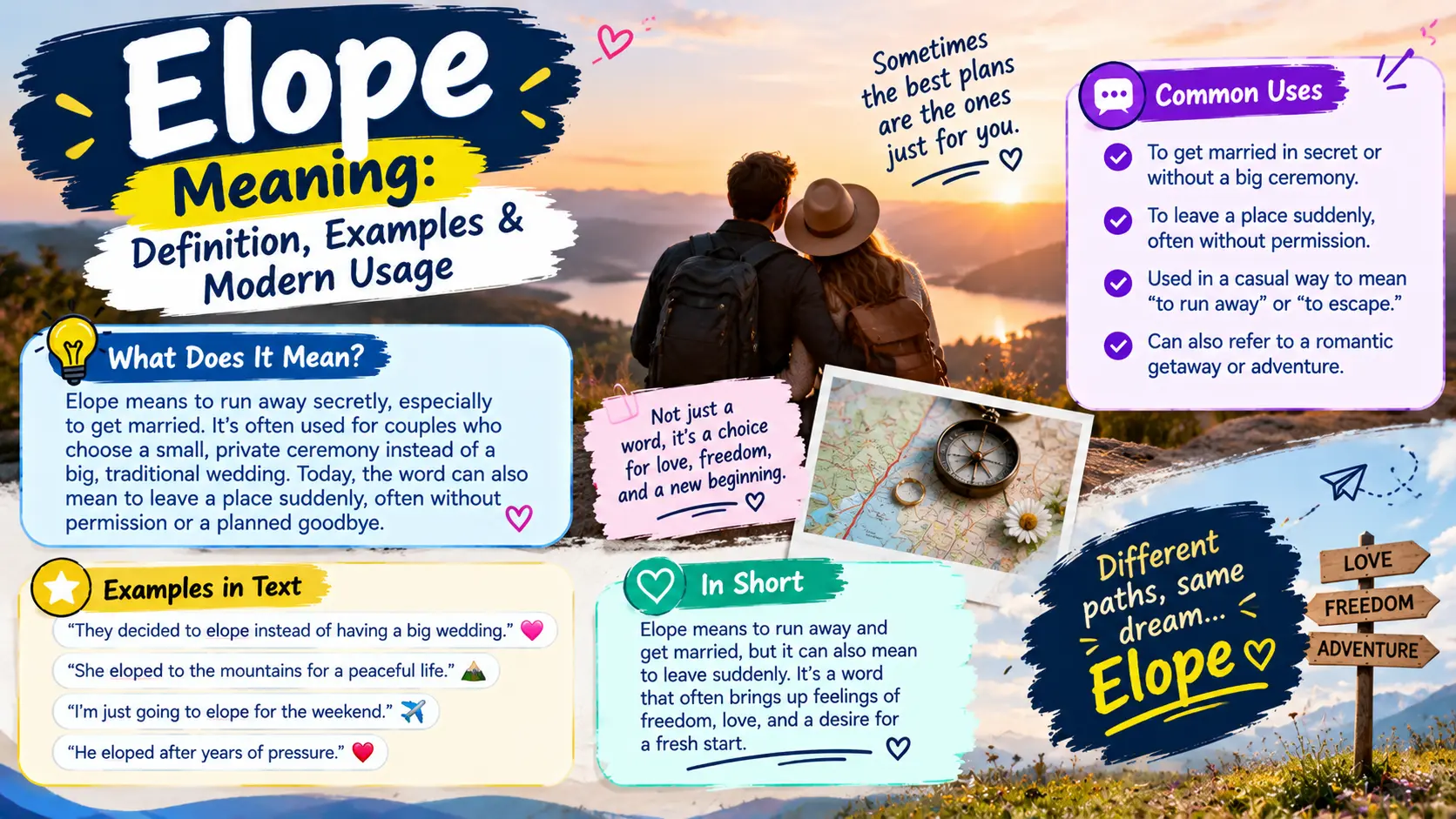
Elope means to run away secretly with a romantic partner to get married, or in modern usage, to marry privately without having a large conventional wedding.
In simple terms:
- Elope: To get married privately, often without a traditional wedding.
- Elopement: The act or occasion of getting married in this way.
- Eloped: The past tense of elope.
- Eloping: The present participle of elope.
Here are a few natural examples:
“They decided to elope in Hawaii.”
“My sister eloped last weekend and only told us afterward.”
“We are thinking about eloping instead of having a huge wedding.”
The important point is that elope does not always mean running away secretly anymore. Modern speakers often use it simply for a small, private wedding.
Origin & Background of Elope
The history of elope is more dramatic than its modern meaning.
The word comes from the Anglo-French term aloper, which was associated with running away or escaping. It entered English with the idea of leaving secretly, particularly in romantic situations.
Historically, an elopement could involve a young couple leaving together because their relationship or marriage was not approved by their families. Social expectations, parental authority, class differences, and financial circumstances could all influence such decisions.
Over centuries, the word became closely connected with couples who left secretly to marry.
Modern society has softened that association.
Today, a couple can say they are eloping even when their families know about the plan. They might have a courthouse ceremony, exchange vows on a beach, marry in the mountains, or invite only a handful of people.
Social media has also influenced how people understand the word. Photos of intimate ceremonies in beautiful locations have helped make elopement feel less like an act of rebellion and more like a deliberate alternative to a traditional wedding.
The emotional meaning has changed too. What once suggested escape can now suggest simplicity, intimacy, freedom, and personal choice.
Elope in Real-Life Conversations
1. WhatsApp Conversation
Person A:
“Wait, you guys are getting married already?”
Person B:
“Next month! We decided to elope instead of planning a huge wedding.”
Person A:
“Seriously? Does your family know?”
Person B:
“Yep. Everyone knows. We just want something small and personal.”
Here, elope means having a private or very small wedding, not necessarily keeping the marriage secret.
2. Instagram DM
Person A:
“Your engagement pictures are beautiful! Are you planning the wedding?”
Person B:
“Thank you! Actually, we’re thinking about eloping.”
Person A:
“Like running away and getting married? 😂”
Person B:
“Kind of! But our parents know. We just don’t want a giant ceremony.”
The conversation shows one of the most common misunderstandings: assuming that eloping always involves secrecy.
3. TikTok Comments
Person A:
“We skipped the traditional wedding and eloped at the beach.”
Person B:
“Honestly, that sounds perfect.”
Person C:
“I thought eloping meant disappearing without telling anyone 😭”
Person A:
“That was the old idea. These days it can just mean a small private wedding.”
This reflects how social media frequently explains and reshapes everyday vocabulary.
4. Text Messages
Person A:
“Have you picked a wedding venue yet?”
Person B:
“Nope.”
Person A:
“Why not?”
Person B:
“We’re considering eloping.”
Person A:
“Wow. That’s a big decision.”
Person B:
“Yeah, but we think it suits us better.”
Here, the word communicates a personal wedding choice rather than necessarily suggesting family conflict.
Emotional & Psychological Meaning
The emotional meaning of elope depends heavily on context.
For one person, it may represent romantic spontaneity. For another, it may represent privacy and independence. Someone else may associate it with avoiding the financial and social pressure of a traditional wedding.
There can also be a strong feeling of authenticity behind the decision.
A large wedding often involves expectations from relatives, friends, traditions, venues, clothing, food, photography, and hundreds of small decisions. Eloping can allow a couple to focus on the relationship itself.
I have seen the word used casually in conversations where the real message is not “we want to disappear,” but rather, “we want this moment to belong to us.”
That distinction matters.
In modern communication, words often carry emotional associations beyond their dictionary definitions. Elope can communicate independence, intimacy, adventure, romance, or even humor depending on who says it and why.
Usage in Different Contexts
Social Media
On Instagram, TikTok, and other platforms, elope often appears alongside wedding photography, travel, engagement content, and relationship posts.
Examples include:
“We eloped in the mountains.”
“Thinking about eloping somewhere beautiful.”
“Our little elopement was everything we wanted.”
The word can therefore have a romantic and adventurous tone online.
Friends and Relationships
Among friends, elope is usually informal.
A friend might say:
“If wedding planning gets any crazier, I’m going to elope.”
This may not be a literal announcement. It can simply be a humorous way of expressing frustration with wedding planning.
Work and Professional Settings
The word can appear in professional settings when discussing someone’s wedding, but it is still a personal term rather than business vocabulary.
For example:
“Sarah will be away next week because she is eloping.”
However, in formal workplace communication, a clearer phrase such as “getting married privately” may be more appropriate if the audience may not understand the word.
Casual vs. Serious Tone
Elope can be completely serious:
“We decided to elope after years of planning.”
It can also be playful:
“Let’s just elope and skip all this drama.”
Context determines whether the speaker is announcing an actual marriage plan or joking about one.
When NOT to Use “Elope”
Although elope is common, it is not suitable for every situation.
When Someone Is Simply Getting Married Traditionally
If a couple is having a normal large wedding, calling it an elopement can be misleading.
When You Mean Dating or Moving In Together
Elope specifically relates to marriage. It does not simply mean running away with a boyfriend or girlfriend.
In Sensitive Family Situations
If someone secretly married because of serious family conflict, casually joking about their decision as an “elopement” may minimize their experience.
When Speaking to Someone Unfamiliar With the Modern Meaning
Because the historical meaning involves secrecy and running away, some people may interpret the word differently.
When clarity matters, say:
“They had a private wedding.”
That removes ambiguity.
Common Misunderstandings About Elope
1. Elope Always Means Secret Marriage
Not necessarily.
Modern English often uses elope for a small or private wedding, even when family members and friends know about it beforehand.
2. Elope Means You Are Running Away
Historically, this association is important. Today, however, the physical act of running away is usually not the main idea.
3. Eloping Means You Have No Wedding Ceremony
That is also incorrect.
An elopement can include vows, formal clothing, photographs, a celebrant, rings, and a beautiful ceremony.
4. Eloping Is Always Impulsive
Not at all.
Some couples carefully plan their elopement months in advance.
5. Elope Is Always Romantic
The word can be romantic, humorous, neutral, or emotionally complicated depending on context.
Elope vs. Similar and Related Expressions
| Expression | Meaning | Typical Tone |
|---|---|---|
| Elope | Marry privately, traditionally associated with running away to marry | Romantic / informal |
| Get married | Enter into marriage | Neutral |
| Have a private wedding | Marry with a small group or limited audience | Clear / neutral |
| Run away together | Leave a place together, sometimes romantically | Emotional / dramatic |
| Secret marriage | Marriage kept hidden from others | Serious / private |
| Courthouse wedding | Marriage ceremony conducted through a courthouse or civil process | Practical / formal |
| Big wedding | Traditional wedding with many guests and celebrations | Social / celebratory |
| Divorce | Legally end a marriage | Opposite life event |
Key Insight
The central distinction is privacy versus secrecy. An elopement can be private without being secret. A couple may tell everyone about their plans while still choosing an intimate ceremony.
Variations and Types of Elope
1. Traditional Elopement
A couple leaves quietly to get married, reflecting the older meaning of the word.
2. Modern Elopement
A couple deliberately chooses a small wedding instead of a large traditional celebration.
3. Destination Elopement
The couple travels to another city, country, beach, mountain, or other meaningful location to marry.
4. Courthouse Elopement
The couple has a simple civil marriage ceremony, often with very few guests.
5. Private Elopement
The ceremony is intentionally limited to the couple or a tiny group of trusted people.
6. Adventure Elopement
The couple combines marriage with an outdoor experience such as hiking, camping, or visiting a scenic location.
7. Secret Elopement
The couple keeps the marriage plans hidden from family or friends until after the ceremony.
8. Intimate Elopement
The emphasis is on emotional closeness rather than secrecy or adventure.
9. Family Elopement
A couple has a small ceremony with immediate family members instead of a large guest list.
10. Spontaneous Elopement
The marriage happens with relatively little advance planning, although modern elopements are often carefully organized.
How to Respond When Someone Uses “Elope”
Your response depends on the relationship and the situation.
Casual Replies
- “Wow, that’s exciting!”
- “Seriously? When?”
- “That sounds romantic!”
- “So you’re skipping the big wedding?”
Funny Replies
- “Should I start packing your bags? 😂”
- “Well, that’s one way to avoid seating charts!”
- “No wedding drama? I’m listening. 😂”
- “So the guest list is officially two people?”
Mature Replies
- “If that feels right for both of you, I understand.”
- “That sounds like a thoughtful decision.”
- “A private ceremony can be really meaningful.”
- “What made you choose an elopement?”
Respectful Replies
If the person is sharing something deeply personal, avoid making assumptions.
A simple response works well:
“I’m happy for you. I hope the day feels exactly the way you want it to.”
Regional & Cultural Usage
The meaning of elope is broadly recognizable in English-speaking communities, but its emotional associations can vary considerably.
Western Culture
In countries such as the United States, Canada, the United Kingdom, and Australia, eloping is commonly associated with intimate weddings, personal freedom, travel, and avoiding the expense or pressure of a large ceremony.
The modern meaning is often positive or neutral.
Asian Culture
In many Asian communities, marriage can involve significant family participation and traditional ceremonies. As a result, elope may still carry stronger associations with marrying without family approval.
However, younger couples and internationally influenced social media communities may use the word more broadly for small destination or private weddings.
Middle Eastern Culture
Marriage can have substantial family and cultural significance across many Middle Eastern communities. Therefore, elope may sometimes imply going against family expectations rather than simply choosing a smaller ceremony.
The exact interpretation depends greatly on the country, family, religion, and individual circumstances.
Global Internet Usage
Online, the modern romantic meaning is increasingly common.
People may use elope when discussing destination weddings, courthouse ceremonies, minimalist weddings, or private celebrations.
Generational Differences
Older speakers may be more familiar with the historical association of secretly running away to marry.
Younger speakers are more likely to encounter eloping through wedding content, travel posts, TikTok videos, and Instagram photography, where it often means choosing an intimate wedding experience.
Is “Elope” Safe for Kids?
Yes, the word itself is not inherently inappropriate for children.
It is simply vocabulary describing marriage, traditionally involving the idea of running away to marry and now often referring to a private wedding.
For younger children, a simple explanation is enough:
“Elope means getting married privately, often with a small ceremony.”
Older children can also learn about the historical meaning and how words change over time.
FAQs About Elope Meaning
What does “elope” mean in simple words?
Elope means to get married privately, traditionally by running away together, although modern usage often simply means having a small wedding.
Does elope mean secretly getting married?
Not always. Modern couples can elope while their families and friends know about the marriage plans.
Is eloping the same as running away?
Historically, the word strongly suggested running away to marry. Today, eloping often means choosing a private or intimate wedding.
Can you elope and have a wedding ceremony?
Yes. An elopement can include vows, rings, a celebrant, photographs, and a formal ceremony.
What is the noun form of elope?
The noun is elopement, meaning the act or occasion of eloping.
Can “elope” be used jokingly?
Yes. Someone might say, “Let’s just elope,” as a humorous response to stressful or complicated wedding planning.
What does “we eloped” mean?
“We eloped” generally means “we got married privately,” although the exact circumstances depend on context.
Conclusion
Understanding elope meaning is easier when you separate its history from its modern use. Traditionally, the word described couples who secretly ran away to marry. Today, it commonly describes a private, intimate, or unconventional wedding.
The word can carry feelings of romance, independence, adventure, privacy, and personal choice. It can also be used humorously when someone wants to escape the stress of planning a large wedding.
So when someone says, “We decided to elope,” do not automatically assume they disappeared secretly. They may simply have chosen a smaller, more personal way to celebrate their commitment.