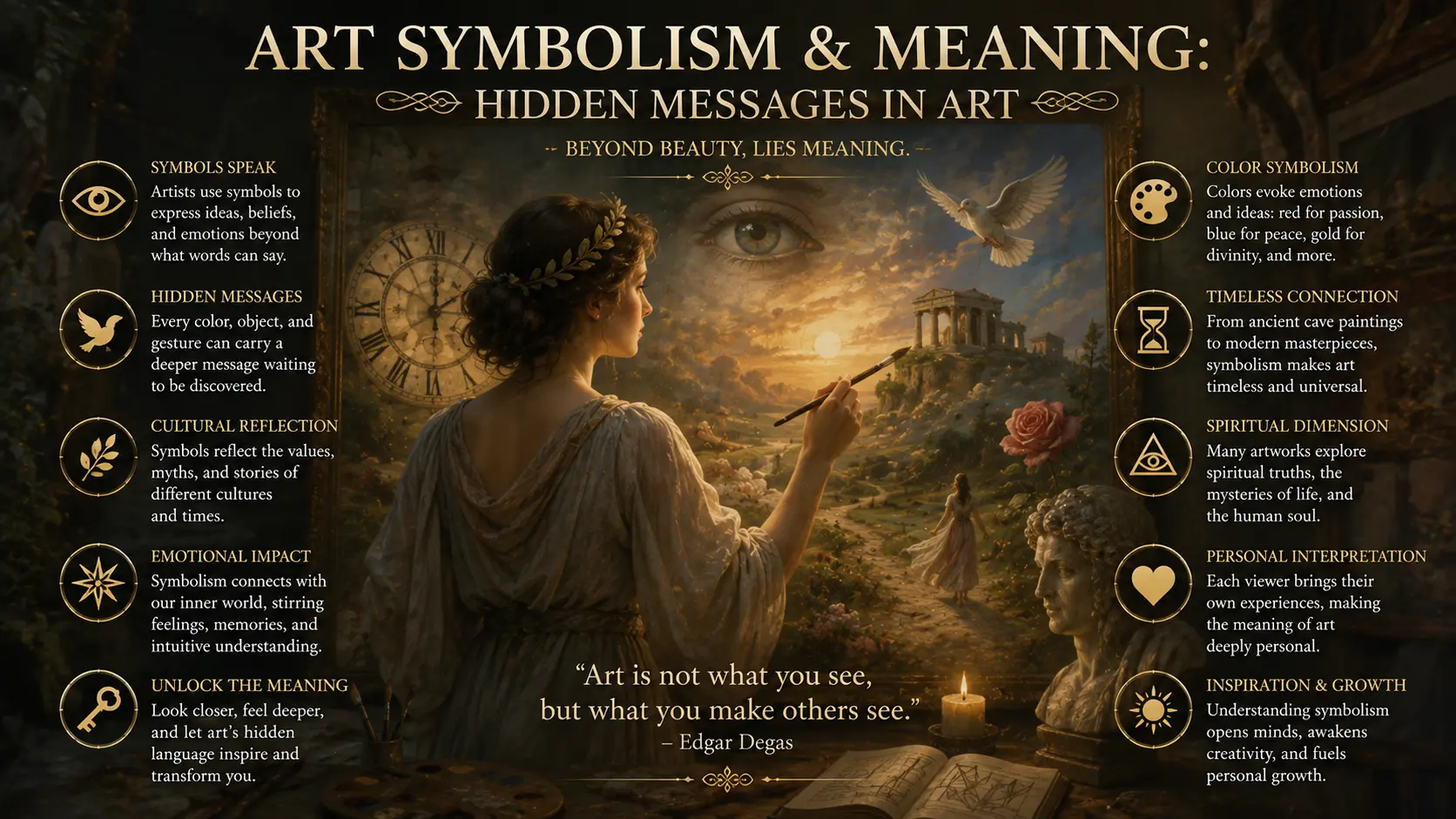
Art Symbolism and Meaning: Hidden Messages in Art
Art often communicates far more than what appears on the surface. A painting, sculpture, illustration, photograph, or decorative design can contain colors, objects, animals, gestures, landscapes, and patterns that represent ideas beyond their literal appearance. This practice of giving visual elements deeper meanings is known as symbolism in art.
Symbols can represent love, death, hope, power, transformation, spirituality, identity, or human connection. However, there is rarely one universal meaning for every symbol. Its interpretation can change according to culture, historical period, religion, artistic style, and the personal experience of the viewer.
Understanding art symbolism therefore involves more than identifying an object. It requires looking at context, composition, color, history, emotion, and intention. This guide explores the major forms of symbolism in art and explains how hidden visual messages can be interpreted.
What Is Symbolism in Art?
Definition of Symbolism in Visual Art
Symbolism in visual art is the use of images, objects, colors, shapes, gestures, or scenes to communicate ideas beyond their literal meaning. An artist may paint a rose simply because it is beautiful, but the rose may also suggest love, mortality, secrecy, or remembrance.
Symbols can be obvious or subtle. A crown may suggest authority, while a broken mirror might suggest fractured identity or change. A bird flying toward the sky can represent freedom, while a closed door may symbolize an ending or an unknown future.
Some symbols are widely recognized because they have been used repeatedly across generations. Others are highly personal and can only be fully understood through the artist’s own story.
Why Artists Use Symbols and Hidden Meanings
Artists use symbolism because visual communication can express complicated emotions and concepts without explaining them directly. A single image can sometimes communicate an idea that would require many sentences to describe.
Symbolism also allows viewers to participate in the meaning of an artwork. Instead of receiving one direct message, viewers can interpret visual clues and form their own understanding.
How to Interpret Symbols in Context
The most important rule of interpreting symbolism is never isolate one symbol from the rest of the artwork. A snake, for example, can symbolize danger, healing, transformation, wisdom, temptation, or rebirth depending on its surroundings.
Consider the artwork’s title, historical period, culture, religious background, colors, placement of objects, facial expressions, and overall mood. The same symbol can communicate completely different ideas in different contexts.
Symbolism in Ancient Art
Ancient civilizations used visual symbols extensively to communicate religious beliefs, political authority, social identity, and ideas about death and the afterlife.
Egyptian Art and Sacred Symbols
Ancient Egyptian art is famous for its rich symbolic language. The ankh represented life, while the scarab was associated with regeneration and renewal. The eye of Horus became connected with protection, healing, and well-being.
Animals also carried sacred meanings. Cats were associated with divine qualities and protection, while falcons could represent power and heavenly authority.
Egyptian artwork was not merely decorative. Its symbols often connected earthly life with religious beliefs about gods, kingship, death, and eternity.
Greek and Roman Art
Greek and Roman artists frequently used gods, heroes, plants, animals, and objects as symbolic references. The olive branch could represent peace, while laurel was associated with victory and honor.
Attributes helped viewers identify mythological figures. A trident could point toward Poseidon, while an owl could be associated with Athena and wisdom.
Roman art also used symbolism to communicate political power. Statues, coins, monuments, and mosaics could portray rulers as strong, victorious, divine, or worthy of public loyalty.
Indigenous and Tribal Art Traditions
Indigenous and tribal artistic traditions around the world contain symbolic systems connected to ancestry, nature, spirituality, community, and identity.
Animals may represent clan relationships, protective forces, stories, or qualities admired by a community. Geometric patterns can preserve cultural knowledge and traditional narratives.
Because these symbols are deeply connected to specific communities, they should be interpreted respectfully rather than treated as having one universal meaning.
Religious and Spiritual Symbolism in Art
Religion has influenced artistic symbolism for thousands of years. Sacred art often uses recognizable visual elements to communicate theological ideas, spiritual narratives, moral teachings, and beliefs about life and death.
Christian and Biblical Symbolism
Christian art contains many recurring symbols. The cross represents the crucifixion and central beliefs of Christianity, while the dove is commonly associated with peace and the Holy Spirit.
The lamb can represent Christ and sacrifice, while the fish became an important early Christian symbol. Light can symbolize divine presence, truth, holiness, or spiritual revelation.
Artists also use halos, angels, crowns, grapes, bread, water, and other imagery to communicate biblical themes.
Hindu and Buddhist Symbolism
Hindu and Buddhist art contains extensive symbolic imagery. The lotus is particularly important and can represent purity, spiritual development, and awakening.
In Buddhist traditions, the wheel can symbolize teachings and the path toward liberation. Buddha images often use specific hand gestures, known as mudras, that communicate different teachings or qualities.
Hindu artwork frequently uses deities, animals, weapons, flowers, and geometric forms to represent particular divine attributes and philosophical concepts.
Islamic Geometric and Decorative Symbolism
Islamic art is well known for geometric patterns, arabesques, calligraphy, and intricate decorative designs. Although interpretation varies by tradition and artwork, these forms can communicate ideas of order, harmony, infinity, and beauty.
Calligraphy is especially significant because sacred and literary texts can become part of the visual composition. Repeated patterns can create a sense of continuity and seemingly endless structure.
Symbolism in Eastern Art Traditions
Eastern art traditions demonstrate how symbolism can become closely connected with philosophy, spirituality, nature, and cultural values.
Chinese Art and Cultural Symbols
Chinese art frequently features symbolic animals, plants, landscapes, and objects. The dragon has traditionally been associated with power, strength, auspiciousness, and imperial authority in many contexts.
The phoenix can represent renewal, harmony, and prosperity. Bamboo can suggest resilience and integrity, while the lotus is associated with purity and spiritual qualities.
Colors can also carry cultural meanings, making context especially important when interpreting Chinese artwork.
Japanese Art and Visual Meaning
Japanese art often emphasizes nature, impermanence, simplicity, and seasonal change. Cherry blossoms are among the most recognizable examples of symbolic imagery.
Because cherry blossoms bloom beautifully but briefly, they can evoke the temporary nature of life. Cranes may represent longevity and good fortune in traditional contexts.
Japanese artistic traditions also frequently use empty space, simplicity, and asymmetry as meaningful visual elements rather than treating them as missing details.
Indian Art and Sacred Imagery
Indian art includes an enormous range of religious, cultural, and regional symbolism. Lotus flowers, elephants, peacocks, sacred animals, mandalas, and divine figures frequently appear in traditional artwork.
The elephant can represent strength, wisdom, prosperity, or divine qualities depending on the context. Mandalas can express ideas of cosmic order, meditation, and spiritual structure.
Indian symbolism demonstrates how a single visual element can operate simultaneously at cultural, religious, philosophical, and artistic levels.
Symbolism in Medieval and Renaissance Art
European medieval and Renaissance artists developed sophisticated systems of visual symbolism, particularly in religious paintings.
Religious Imagery and Iconography
Artists used specific objects to identify saints, biblical figures, and religious themes. A palm branch, for example, could symbolize martyrdom, while lilies could represent purity in certain Christian artworks.
This visual language helped audiences understand complex religious narratives, especially when literacy was limited.
Symbols of Power, Wealth, and Status
Portraits often communicated social position through clothing, jewelry, architecture, books, weapons, animals, and other objects.
A wealthy person’s portrait might include expensive fabrics or elaborate furnishings to communicate status. A sword could suggest military authority, while a book could indicate education or intellectual achievement.
Hidden Meanings in Renaissance Paintings
Renaissance artists sometimes incorporated symbols that rewarded careful observation. Flowers, gestures, animals, architectural details, and objects could contribute additional meanings to an otherwise straightforward scene.
These symbols often related to morality, mortality, love, religion, knowledge, or social expectations.
Colors and Their Symbolic Meanings in Art
Color is one of the most powerful symbolic tools available to artists. However, color meanings are strongly influenced by culture and context.
Red, Orange, and Yellow
Red can suggest passion, love, danger, sacrifice, energy, or power. Its emotional intensity makes it useful for attracting attention and creating tension.
Orange can communicate warmth, creativity, enthusiasm, transition, or vitality. Yellow may symbolize happiness, sunlight, optimism, intellect, or caution depending on how it is used.
Blue, Green, and Purple
Blue is frequently associated with calmness, spirituality, trust, distance, or sadness. Its meaning can change dramatically according to the surrounding imagery.
Green often connects with nature, renewal, fertility, growth, and balance. Purple has historically been associated with spirituality, royalty, mystery, and luxury in many artistic traditions.
Black, White, and Gold
Black may symbolize mystery, death, elegance, grief, authority, or the unknown. White can represent purity, peace, innocence, simplicity, or emptiness.
Gold often suggests wealth, divinity, illumination, achievement, or sacred importance. In religious artwork, gold can visually separate sacred subjects from ordinary earthly surroundings.
Nature Symbolism in Art
Nature provides artists with an almost universal source of symbolic imagery.
Animals and Their Meanings
Animals can represent human characteristics or spiritual concepts. Lions may suggest courage and authority, while butterflies often symbolize transformation and renewal.
Birds can represent freedom, communication, spirituality, or transition. Snakes may represent danger, wisdom, healing, transformation, or rebirth.
The meaning depends heavily on the culture and artistic context.
Flowers and Plants
Flowers are commonly used to express emotions and stages of life. Roses may symbolize love, while lilies can represent purity in particular traditions.
Wilted flowers can suggest mortality or the passing of time. Growing plants may communicate renewal, resilience, hope, or new beginnings.
Sun, Moon, Water, and Mountains
The sun commonly represents life, energy, illumination, truth, or spiritual awakening. The moon can suggest mystery, intuition, cycles, femininity, or change.
Water can symbolize cleansing, emotional depth, transformation, or life itself. Mountains can represent stability, spiritual ascent, obstacles, achievement, or connection between earth and sky.
Objects and Their Hidden Meanings in Art
Ordinary objects can become powerful symbols when placed intentionally within an artwork.
Keys, Mirrors, Books, and Clocks
A key can symbolize access, knowledge, opportunity, or secrets. A mirror may represent self-reflection, identity, vanity, or truth.
Books can suggest knowledge and wisdom, while clocks often remind viewers of time, mortality, urgency, or change.
Crowns, Weapons, and Jewelry
Crowns commonly symbolize authority, achievement, royalty, or leadership. Weapons may represent conflict, defense, power, aggression, or sacrifice.
Jewelry can communicate wealth and social position, but it can also represent love, commitment, family heritage, or personal identity.
Doors, Windows, and Pathways
A door can symbolize transition, opportunity, separation, or a new stage of life. A window may represent perception, freedom, distance, or access to another world.
Paths often symbolize journeys. A straight path may suggest clarity, while a winding road can represent uncertainty, growth, or life’s unpredictable direction.
Symbolism in Modern and Contemporary Art
Modern and contemporary artists often move away from traditional symbolic systems and develop highly personal visual languages.
Abstract Symbols and Personal Expression
Abstract art may use shapes, colors, lines, and textures instead of recognizable objects. A particular shape may represent an emotion or memory meaningful only to the artist.
Viewers can still interpret these elements, but they should distinguish between personal interpretation and documented artistic intention.
Social and Political Symbolism
Artists frequently use visual symbols to comment on inequality, identity, war, environmental issues, consumer culture, and political power.
A familiar object can be transformed into a symbol of a larger social issue. This makes contemporary art a powerful tool for questioning assumptions and encouraging discussion.
Surrealism and Hidden Visual Messages
Surrealist art often combines unrelated objects, unusual landscapes, and dreamlike scenes. These combinations can challenge ordinary logic and encourage psychological or metaphorical interpretation.
A melting object, distorted body, floating figure, or impossible landscape may symbolize time, anxiety, desire, memory, or uncertainty.
Symbolism in Literature and Visual Art
Shared Symbols Across Different Art Forms
Literature and visual art frequently rely on the same symbolic ideas. Light can represent knowledge in both a novel and a painting, while a journey can symbolize personal transformation in either medium.
These shared symbols create connections between storytelling traditions.
Metaphors, Allegory, and Visual Storytelling
A metaphor compares one idea with another, while allegory uses characters, events, or images to communicate a deeper message.
Visual art can create allegory without words by combining symbolic characters, objects, colors, and actions into a single composition.
How Written and Visual Symbols Work Together
When literature and art are combined, symbols can reinforce one another. An illustration may visually expand a metaphor found in a poem or story.
This relationship is especially powerful because viewers can experience meaning through both language and imagery.
Symbolism in Tattoos and Personal Art
Tattoos are among the clearest examples of personal symbolism.
Common Tattoo Symbols and Meanings
Popular tattoo symbols include butterflies for transformation, roses for love, birds for freedom, mountains for strength, and anchors for stability.
However, these meanings are not fixed. A person may choose a symbol because it represents a particular memory or relationship.
Personal Symbols and Life Experiences
Personal art often transforms ordinary objects into meaningful reminders. A particular flower may represent a loved one, while a specific animal may symbolize an important life experience.
The strongest personal symbols are often meaningful because of the story attached to them rather than because of a universal dictionary definition.
Choosing Symbols With Personal Significance
When selecting a personal symbol, consider what the image means to you rather than relying only on popular interpretations.
Researching cultural and religious associations is also important, especially when adopting a symbol from a tradition that is not your own.
Symbolism in Weddings and Home Décor
Wedding Symbols and Their Meanings
Wedding art and decoration often use flowers, rings, candles, colors, arches, and other visual elements to represent love, commitment, unity, prosperity, and new beginnings.
Different cultures have their own wedding symbolism, so the same color or flower can carry different meanings across communities.
Home Décor and Emotional Expression
Art displayed inside a home can reflect identity, memories, values, and aspirations. Family photographs can symbolize connection, while landscapes may evoke travel, peace, or belonging.
Decorative objects can also become personal symbols through emotional associations built over time.
Everyday Objects as Visual Symbols
A handmade item, inherited painting, souvenir, or family heirloom can carry meaning far beyond its material value.
Its symbolic importance often comes from the memories and relationships connected to it.
Dream Symbolism and Art
Why Dreams Inspire Symbolic Art
Dreams naturally contain unusual combinations of people, places, emotions, and objects. Artists often use this dreamlike quality to explore unconscious thoughts and feelings.
Dream imagery can provide a flexible visual language for uncertainty, desire, fear, memory, and transformation.
Common Dream Images in Artwork
Water, flying, falling, doors, mirrors, animals, darkness, light, and unfamiliar landscapes are common motifs in dream-inspired art.
Their meanings are not universal. A particular dream symbol should be interpreted in relation to the dreamer’s emotional experience and the artwork’s broader context.
Interpreting Personal and Universal Symbols
Some symbols have broad cultural associations, while others are highly personal. A snake may have one meaning in a religious tradition and another meaning for an individual artist.
The best interpretation considers both levels instead of assuming one fixed definition.
How to Interpret Symbolism in Art
Consider the Artist and Historical Context
Begin by researching when, where, and why the artwork was created. Historical circumstances can reveal meanings that are not immediately obvious.
An object associated with wealth in one century may have a different significance in another.
Examine Color, Composition, and Objects
Look at where symbols appear and how they interact. An object placed in the center may receive greater visual importance than one hidden in the background.
Notice color relationships, lighting, size, repetition, contrast, and direction of movement.
Look for Repeated or Contrasting Symbols
Repeated imagery often signals an important theme. Contrasting symbols can also create meaning, such as light against darkness or growth against decay.
Rather than focusing on one isolated detail, look for the visual story created by the entire composition.
Life Lessons and Emotional Meaning in Art
Transformation and Personal Growth
Many artworks use changing seasons, butterflies, journeys, doors, and rising figures to represent transformation.
These symbols can remind viewers that growth often involves leaving behind an earlier version of oneself.
Love, Loss, and Human Connection
Portraits, flowers, hands, letters, empty chairs, and personal objects can symbolize relationships and emotional memory.
Art can preserve feelings associated with people who are present, absent, or remembered.
Hope, Resilience, and New Beginnings
Light emerging from darkness, seeds growing from soil, birds taking flight, and paths leading toward distant horizons can symbolize hope.
These images communicate the possibility of change even during difficult periods.
Modern Applications of Art Symbolism
Digital Art and Visual Storytelling
Digital artists use color, icons, animation, typography, and composition to create symbolic messages. Because digital images can combine multiple media, they offer new ways to communicate complex ideas.
Branding, Advertising, and Graphic Design
Businesses use symbols constantly. Logos, colors, shapes, mascots, and typography can influence how people perceive a brand.
A simple visual mark can communicate reliability, energy, luxury, friendliness, innovation, or environmental awareness.
Social Media and Contemporary Visual Culture
Modern audiences encounter symbolic images every day through social media, memes, emojis, illustrations, photography, and short-form video.
Visual symbolism has therefore become part of everyday communication rather than something limited to museums and galleries.
Frequently Asked Questions About Art Symbolism
What Is the Most Common Symbol in Art?
There is no single symbol used universally across all art traditions. Flowers, animals, light, water, birds, and religious objects are among the most frequently recurring symbolic elements.
Why Do Artists Use Symbolism?
Artists use symbolism to communicate ideas, emotions, beliefs, memories, and stories indirectly. Symbols can make artwork more layered and encourage viewers to think beyond its literal subject.
Can the Same Symbol Have Different Meanings?
Yes. A symbol can have completely different meanings across cultures, religions, historical periods, and individual experiences. Context is essential when interpreting symbolism.
How Can I Interpret a Symbol in a Painting?
Start with the artwork’s historical and cultural context. Then examine its colors, objects, composition, title, subject matter, and emotional atmosphere before deciding what the symbol may represent.
Conclusion: Finding Meaning Beyond the Image
Art symbolism transforms ordinary visual elements into carriers of deeper meaning. A flower can become a reminder of mortality, a bird can suggest freedom, a doorway can represent transition, and a color can influence the emotional atmosphere of an entire composition.
Yet symbolism should never be treated as a rigid dictionary. Meanings evolve across cultures and historical periods, while individual artists may create symbols that are deeply personal.
The most rewarding way to understand symbolic art is to remain curious. Look closely, investigate the context, notice relationships between visual elements, and allow multiple interpretations to coexist. When you learn to read these visual clues, artwork becomes more than an image—it becomes a language of ideas, emotions, memory, culture, and human experience.