Celibate Meaning: Definition, Uses & Examples
The word celibate can sound formal or old-fashioned, so it is understandable when someone comes across it online and wonders what it actually means.
In simple terms, celibate describes a person who chooses or is expected to abstain from sexual activity. Depending on the context, celibacy may be connected to religion, personal beliefs, relationships, lifestyle choices, or a temporary period in someone’s life.
People often search for celibate meaning because the word appears in social media discussions, relationship conversations, religious content, dating profiles, and casual comments. It can also be confused with words such as single, abstinent, virgin, or asexual, even though these terms do not mean exactly the same thing.
Understanding the distinction matters because describing someone as celibate can communicate something about their sexual choices or commitments. The meaning is usually straightforward, but the reason behind celibacy can be deeply personal.
Celibate Meaning: Quick Definition
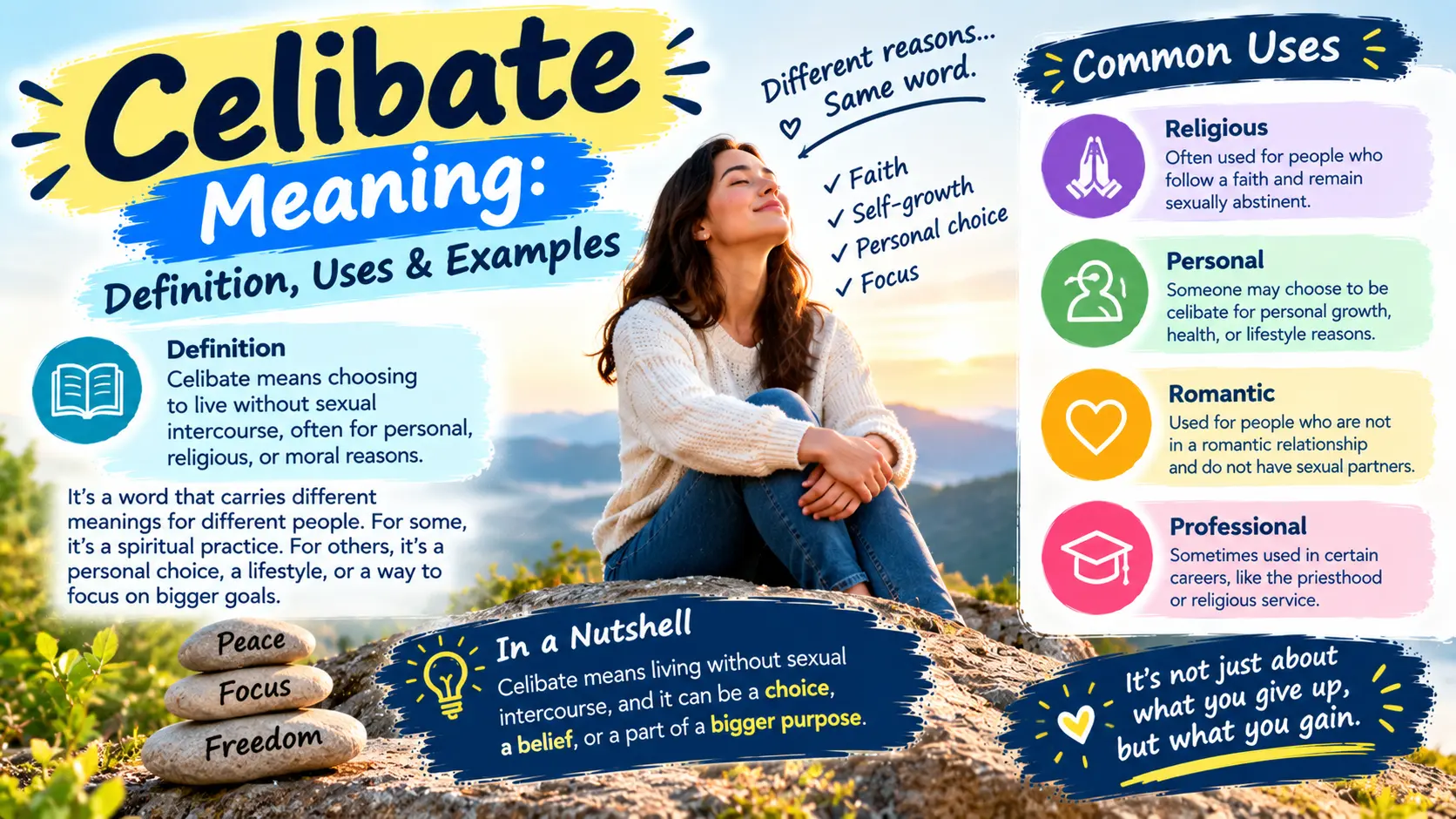
Celibate means choosing or being committed to abstaining from sexual activity, often for religious, spiritual, personal, or lifestyle reasons.
A person who practices celibacy may be unmarried, dating, divorced, widowed, or simply choosing not to have sex for a particular period.
Here are a few simple examples:
“He has decided to remain celibate for personal reasons.”
“She is currently living a celibate lifestyle.”
“The priest has taken a vow of celibacy.”
The important point is that celibate does not simply mean single. A single person may still be sexually active, while a celibate person intentionally abstains from sexual activity.
Origin & Background of Celibate
The word celibate has a long history and is connected to the Latin word caelibatus, meaning a state of unmarried life or celibacy.
Over centuries, the concept became strongly associated with religious traditions. In Christianity, for example, celibacy has historically been connected with certain forms of religious service, particularly within the Catholic priesthood and religious orders.
However, celibacy is not limited to Christianity. Different religious and philosophical traditions have included forms of sexual abstinence, especially among people pursuing spiritual discipline, religious devotion, or a life focused on particular practices.
The modern meaning has expanded beyond religion.
Today, someone may describe themselves as celibate because they want to focus on personal growth, recover emotionally after a relationship, follow a spiritual commitment, avoid sexual relationships for a period, or simply live according to personal values.
Social media has also changed how people discuss the concept. Terms such as voluntary celibacy, intentional celibacy, and celibate lifestyle appear in online conversations about dating, relationships, boundaries, and self-development.
At the same time, internet discussions sometimes use the word loosely. Someone might say they are “taking a break from dating” and call it celibacy, while another person may use the term specifically to describe abstaining from sexual activity.
That difference in personal definition is one reason context matters.
Real-Life Conversations
WhatsApp Conversation
Person A:
“I’ve decided to stay celibate for a while.”
Person B:
“Do you mean you’re not dating anyone?”
Person A:
“Not exactly. I can still date. I just don’t want to have sex right now.”
Here, Person A is making an important distinction. Celibacy concerns sexual abstinence, while being single concerns relationship status.
Instagram DM
Person A:
“Your post mentioned being celibate. What does that mean for you?”
Person B:
“For me, it means choosing not to have sex while I focus on myself.”
Person A:
“That makes sense. I thought it automatically meant you couldn’t date.”
Person B:
“No, everyone defines their boundaries a little differently.”
This conversation shows why asking rather than assuming can prevent misunderstandings.
TikTok Comments
Commenter:
“I’m trying celibacy this year.”
Reply:
“So you’re not dating anyone?”
Commenter:
“I can date. I’m just choosing to abstain from sex.”
The comment section illustrates a common misunderstanding between celibacy and being single.
Text Messages
Person A:
“Why aren’t you seeing anyone?”
Person B:
“I’m intentionally celibate right now.”
Person A:
“Is that permanent?”
Person B:
“No. It’s a personal decision for this stage of my life.”
The phrase right now makes the temporary nature of the decision clear.
Emotional & Psychological Meaning
Celibacy can have different emotional meanings depending on the person.
For one individual, it may represent spiritual devotion. For another, it may be a way to establish stronger personal boundaries. Someone else might choose celibacy after a difficult relationship because they want time to reflect before becoming sexually involved with another person.
It is therefore risky to assume that celibacy automatically indicates sadness, fear, religious devotion, rejection of relationships, or a negative experience.
People make intimate decisions for many different reasons.
Psychologically, some people describe celibacy as giving them a greater sense of control over their boundaries. Others appreciate having fewer romantic distractions while concentrating on education, career goals, family, spirituality, or personal development.
A personal-style example might look like this:
I once came across a conversation where someone explained that they were not avoiding love. They simply wanted to stop rushing into physical intimacy and understand what they actually wanted from relationships. For that person, celibacy was less about rejection and more about creating space to think.
That distinction is important. Celibacy can be a personal boundary rather than a statement against relationships.
Usage in Different Contexts
Social Media
On social media, celibate often appears in posts about dating, self-care, spirituality, boundaries, and personal transformation.
Someone might write:
“Choosing peace and celibacy this season.”
The tone here may be reflective or motivational rather than religious.
Friends and Relationships
Among friends, the word may be used to explain someone’s current approach to dating.
For example:
“I’m dating, but I’m celibate right now.”
This tells friends that dating and sexual activity are being treated as separate decisions.
Work and Professional Settings
Celibate is rarely necessary in ordinary professional communication.
There are situations where the topic may arise, particularly in religious, academic, counseling, cultural, or social research contexts. Otherwise, discussing someone’s sexual choices at work can be unnecessarily personal.
Casual vs Serious Tone
The word itself is relatively neutral, but the surrounding conversation determines the tone.
A serious conversation may involve religious commitments or personal boundaries.
A casual social media post may use celibate more playfully or conversationally.
Because the topic involves sexuality, however, it is usually better to avoid making assumptions about another person’s private life.
When NOT to Use It
Avoid calling someone celibate simply because they are single.
Being unmarried does not automatically mean a person is celibate.
You should also avoid using the word as a joke when discussing someone else’s private relationships. Sexual choices can be sensitive, and humor that seems harmless to one person may feel intrusive to another.
Cultural and religious sensitivity is also important. In some communities, celibacy is connected to deeply held spiritual commitments.
Another issue is assuming that celibacy has the same definition for everyone. Some people use it specifically to mean abstaining from sexual intercourse, while others use it more broadly to describe avoiding sexual relationships.
If someone tells you they are celibate, their own explanation should take priority.
See Also: Symbolism for Change: Spiritual Meaning & Life Lesson
Common Misunderstandings
Celibate Means Single
This is the most common misunderstanding.
A person can be single without being celibate. Likewise, someone can date while practicing celibacy.
Celibate Means Virgin
Not necessarily.
A virgin generally refers to someone who has not had sexual intercourse, while celibacy describes a current or chosen practice of sexual abstinence.
Someone who has previously had sex can later choose celibacy.
Celibacy Always Means Religious Devotion
Religion is an important historical context, but modern celibacy can also be personal.
People may choose it for lifestyle, emotional, spiritual, or relationship reasons.
Celibate Means Someone Does Not Want Love
That is also incorrect.
A celibate person may still want companionship, romance, marriage, affection, or a long-term relationship.
Celibacy primarily concerns sexual behavior or commitment, not someone’s capacity for love.
The Word Is Always Permanent
Celibacy can be lifelong or temporary.
Someone might practice it for several months, several years, or indefinitely.
Comparison Table
| Term | Meaning | Main Difference |
|---|---|---|
| Celibate | Abstaining from sexual activity, often by choice or commitment | Focuses on sexual abstinence |
| Single | Not currently married or in a committed relationship | Describes relationship status |
| Virgin | Someone who has not had certain sexual experiences | Usually refers to sexual history |
| Abstinent | Refraining from a particular activity, especially sex | Broader term for intentional avoidance |
| Asexual | Experiencing little or no sexual attraction | Describes sexual orientation, not a decision |
| Chaste | Practicing sexual restraint according to personal or moral standards | Can have religious or moral associations |
| Married | Legally or socially joined as spouses | Describes marital status, not sexual behavior |
| Sexually active | Engaging in sexual activity | Generally contrasts with sexual abstinence |
Key Insight
Celibate, single, virgin, and asexual are not interchangeable words. They describe different aspects of a person’s life, including current behavior, relationship status, sexual history, and sexual attraction.
Variations and Types of Celibacy
1. Religious Celibacy
Meaning: Celibacy practiced because of religious commitment.
It may involve vows, spiritual discipline, or dedication to religious service.
2. Personal Celibacy
Meaning: Celibacy chosen for individual reasons.
A person may decide that abstaining from sex fits their current values or priorities.
3. Temporary Celibacy
Meaning: Celibacy practiced for a specific period.
Someone might choose it for several months while focusing on personal goals or emotional recovery.
4. Lifelong Celibacy
Meaning: A decision or commitment to remain celibate throughout life.
This may occur within certain religious traditions or as a deeply personal choice.
5. Intentional Celibacy
Meaning: Deliberately choosing sexual abstinence.
The emphasis is on conscious decision-making rather than simply not having a sexual partner.
6. Spiritual Celibacy
Meaning: Celibacy connected to spiritual development or religious practice.
For some people, it creates more time and emotional space for spiritual priorities.
7. Relationship Celibacy
Meaning: Remaining romantically connected while choosing sexual abstinence.
A couple may mutually decide to practice celibacy within their relationship.
8. Dating Celibacy
Meaning: Dating while maintaining a personal commitment to sexual abstinence.
This demonstrates that celibacy does not automatically mean avoiding romance.
9. Voluntary Celibacy
Meaning: Celibacy entered into by personal choice.
The term emphasizes that the person actively chooses the lifestyle.
10. Institutional Celibacy
Meaning: Celibacy associated with rules or expectations within an organization or religious institution.
Its meaning depends on the specific tradition and its rules.
How to Respond When Someone Uses It
If someone tells you they are celibate, the best response depends on your relationship and the tone of the conversation.
Casual Replies
“Got it. Thanks for explaining.”
“That makes sense.”
“I respect your choice.”
Funny Replies
If you are close friends and the person is comfortable joking about the subject:
“Okay, boundary officially understood!”
“Message received loud and clear.”
Keep humor respectful. Sexual boundaries are not a good place for jokes if you do not know the person’s comfort level.
Mature Replies
“I understand. What does celibacy mean for you personally?”
“That sounds like a thoughtful decision.”
“I respect the boundaries you’ve chosen.”
Respectful Replies
“Thanks for trusting me enough to share that.”
“I respect your decision.”
“You don’t have to explain anything you’re uncomfortable discussing.”
A respectful response recognizes the person’s autonomy instead of treating their choice as something that needs to be defended.
Regional & Cultural Usage
Western Culture
In many Western settings, celibacy can appear in religious conversations, dating discussions, wellness communities, and social media.
The modern usage is often broader than its traditional religious meaning.
Asian Culture
In many Asian communities, conversations about sex and relationships can be more private because family expectations, cultural traditions, and social norms may influence how openly people discuss intimacy.
The word may therefore appear more often in formal, educational, religious, or online contexts than in everyday family conversations.
Middle Eastern Culture
In many Middle Eastern communities, discussions surrounding relationships, marriage, and sexual behavior can be closely connected to religious and cultural values.
The meaning of celibate remains essentially the same, but the social context surrounding the word can differ considerably between families, communities, and countries.
It is important not to treat the Middle East as culturally uniform. Individual attitudes vary widely.
Global Internet Usage
Online, celibate has become easier to encounter outside traditional religious discussions.
People use the term in posts about dating breaks, boundaries, spirituality, self-reflection, and lifestyle choices.
Internet culture has also encouraged shorter and more casual expressions, which can sometimes blur distinctions between celibacy, abstinence, and being single.
Generational Differences
Younger internet users may use celibate in a more casual or humorous way than older speakers.
Millennials may be more familiar with the traditional religious meaning, although this varies greatly by background.
Gen Z users may encounter the word through TikTok, Instagram, podcasts, dating discussions, and online communities, where it can be used to describe a temporary personal decision.
The basic definition, however, remains stable.
Is Celibate Safe for Kids?
The word celibate is not inherently inappropriate for children, but it relates to sexual behavior and should be explained according to the child’s age and level of understanding.
For a younger child, a simple explanation may be enough:
“Celibate means choosing not to have sexual relationships.”
Older children and teenagers may benefit from a more complete explanation that distinguishes celibacy from being single, virginity, and sexual orientation.
Parents and educators should focus on factual, age-appropriate language rather than shame or judgment.
FAQs About Celibate Meaning
What does celibate mean in simple words?
Celibate means choosing or committing to abstain from sexual activity. It may be temporary or lifelong and can have religious or personal reasons.
Does celibate mean single?
No. Celibate and single are different. A person can be single without being celibate, or they can date while choosing celibacy.
Can a married person be celibate?
Yes. A married person can mutually choose sexual abstinence for personal, spiritual, medical, or other reasons.
Is celibate the same as a virgin?
No. Virginity generally concerns someone’s sexual history, while celibacy concerns a person’s current or chosen abstinence from sexual activity.
Is celibacy always religious?
No. Religious celibacy is an important traditional form, but people can also choose celibacy for personal, emotional, spiritual, or lifestyle reasons.
Can celibacy be temporary?
Yes. Many people use the term to describe a period of intentional sexual abstinence rather than a lifelong commitment.
Is celibate the same as asexual?
No. Asexuality describes sexual attraction or orientation, while celibacy describes abstaining from sexual activity. An asexual person may or may not be celibate.
Conclusion
Understanding celibate meaning is easier when you separate it from words such as single, virgin, and asexual. At its core, celibate describes a person who chooses or commits to sexual abstinence, whether for religious, spiritual, personal, or temporary reasons.
The word can carry different emotional and cultural meanings, so context matters. If someone describes themselves as celibate, it is better to respect their definition rather than make assumptions about their relationships or private life.
Language becomes more meaningful when we understand not only what a word means, but also why someone chose to use it. Celibacy can represent faith, boundaries, reflection, discipline, or simply a personal decision for a particular chapter of life.