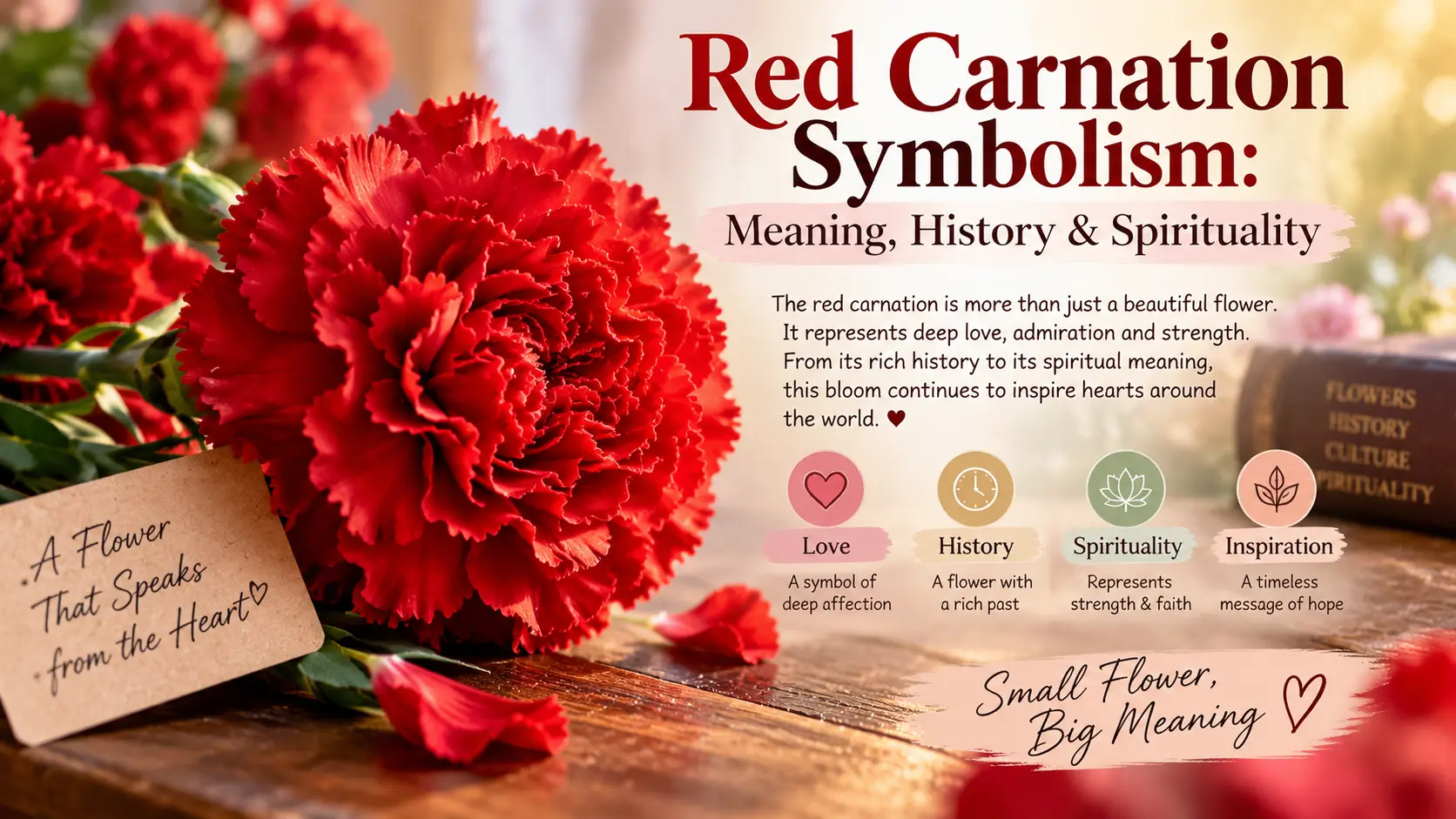
Red Carnation Symbolism: Meaning, History & Spirituality
Quick Answer
Red carnation symbolism is most commonly connected with love, admiration, devotion, affection, remembrance, courage, and deep emotional attachment. The exact meaning can change depending on the occasion, cultural background, color intensity, and personal intention.
In the United States, red carnations have several recognizable associations. They can represent romantic love and admiration, while also appearing in Mother’s Day traditions, memorial arrangements, civic events, celebrations, and expressions of remembrance. Their bright red color naturally adds themes of passion, vitality, strength, and emotional intensity.
Spiritually, some people interpret the red carnation as a symbol of heart-centered energy, devotion, emotional courage, protection, and renewed appreciation for life. These spiritual interpretations are personal rather than universal religious rules.
TL;DR
- Love: Red carnations can express romantic affection and heartfelt attachment.
- Admiration: They may communicate respect, appreciation, or esteem.
- Devotion: The flower is often associated with loyalty and enduring emotional bonds.
- Courage: Its strong red color can symbolize confidence, strength, and determination.
- Remembrance: Red carnations may be used to honor someone or preserve a meaningful memory.
- Motherly love: Red carnations have a particularly strong connection with Mother’s Day traditions.
- Spirituality: They can represent passion, life energy, devotion, and emotional strength.
- Modern use: They appear in bouquets, ceremonies, weddings, tattoos, artwork, memorials, and personal gifts.
What Red Carnations Look Like and Why Their Appearance Matters
Red carnations are recognizable for their layered, ruffled petals and rich red coloring. Their flowers often have a soft, frilled appearance that contrasts with their relatively slender stems. This combination gives carnations an interesting symbolic balance: they can look delicate while representing strong and lasting emotions.
The visual character of the flower contributes to its meaning. Red suggests passion, vitality, courage, and powerful feeling, while the intricate petals can suggest affection, beauty, and emotional complexity. Because carnations can remain attractive for a relatively long time after being cut, they are also naturally associated with endurance and lasting sentiment.
The exact shade matters as well. A bright red carnation may feel energetic and passionate, while a deep or dark red carnation can communicate a more serious sense of devotion, longing, dignity, or profound affection.
The Core Symbolism of Red Carnations Today
The central meaning of a red carnation can be summarized as deep feeling expressed with strength and sincerity. Unlike flowers that are commonly associated with only one emotion, red carnations can communicate several related ideas.
They may represent romantic love, admiration for another person, family devotion, respect, remembrance, or emotional resilience. Their versatility allows them to appear in both joyful and solemn settings.
In modern symbolism, the red carnation can therefore be understood as a flower of strong attachment. It can celebrate someone who is loved, honor someone who is remembered, or symbolize feelings that have remained meaningful over time.
Love, Devotion, Admiration, and Affection
One of the strongest associations of the red carnation is love. Its red color makes it naturally suitable for expressing romantic affection, especially when the sender wants a flower that communicates warmth and emotional intensity.
Red carnations can also represent devotion. Giving one may symbolically communicate, “I care deeply about you,” or “My feelings remain strong.” This makes the flower appropriate for anniversaries, relationship milestones, Valentine’s Day, or personal moments of appreciation.
Admiration is another important meaning. A red carnation does not have to be romantic. It can express genuine respect for someone’s character, achievements, strength, or influence. Context determines whether the emotion is primarily romantic, familial, respectful, or commemorative.
What the Red Color Adds to Carnation Symbolism
Color strongly influences flower symbolism. Red is traditionally connected with passion, energy, courage, love, desire, vitality, and emotional intensity.
When red is combined with the carnation’s traditional associations, the result is a symbol that feels emotionally powerful. A red carnation can suggest affection that is not casual but deeply felt.
Red can also symbolize determination and strength. For this reason, the flower may sometimes be interpreted beyond romance as a representation of courage, resilience, commitment, and the willingness to stand firmly for something meaningful.
Red Carnations Compared With Other Red Flowers
Red flowers often share themes of love and passion, but each flower can create a different emotional impression.
Red roses are especially strongly associated with romantic love and passion. Their symbolism is often direct and unmistakably romantic.
Red tulips can express love while carrying a somewhat simpler, cleaner, and more elegant visual character. They may suggest sincerity and affection.
Red poppies can have meanings connected with remembrance, sacrifice, and commemoration, particularly in historical contexts.
Red chrysanthemums have different meanings depending on cultural tradition and can be connected with love, honor, celebration, or remembrance.
Red carnations occupy a flexible position. They can represent love, admiration, devotion, remembrance, and respect, making them suitable for a broader range of emotional situations.
What Does a Dark Red Carnation Symbolize?
A dark red carnation generally creates a deeper and more serious emotional impression than a lighter red variety.
It can symbolize profound love, lasting devotion, strong admiration, emotional depth, or intense attachment. In some personal interpretations, its darker color may also suggest mature love rather than the excitement of a new relationship.
Dark red carnations can work particularly well when the intention is to communicate seriousness and depth. In memorial or ceremonial settings, their rich color can also contribute to an atmosphere of dignity and respect.
However, there is no single universal dictionary meaning for every shade. The intended message depends on the relationship, occasion, and surrounding flowers.
Ancient History and Early Symbolic Associations
Carnations have a long history of cultivation and cultural appreciation. Their scientific name, Dianthus, is associated with ancient Greek terminology and is commonly interpreted in connection with ideas such as divine or heavenly flower.
Ancient traditions surrounding flowers often connected beauty with the divine, ceremony, nature, and human emotion. Carnations consequently developed a history that extends beyond their modern use as decorative flowers.
It is important to avoid treating every ancient reference as proof of a single fixed symbolism. Flower meanings changed between societies and periods. What can be said more confidently is that carnations have been valued for beauty, fragrance, ceremony, and emotional expression for centuries.
Victorian Flower Language and Red Carnations
During the Victorian era, flowers became an important part of a symbolic communication system often called the language of flowers or floriography. People used flowers to convey feelings that could be difficult or socially awkward to express directly.
Red carnations became associated with love, admiration, affection, and emotional attachment within this tradition. Different carnation colors could carry different symbolic suggestions, making color an important part of the message.
Victorian flower language should be viewed as a historical cultural practice rather than a universal code. Modern interpretations often borrow from Victorian symbolism while adapting it to contemporary relationships and celebrations.
Red Carnations and Mother’s Day Traditions
Red carnations have a particularly important connection with Mother’s Day in the United States. The flower became associated with honoring mothers through traditions linked to Anna Jarvis and early Mother’s Day observances.
A widely recognized tradition developed in which red carnations could be worn or displayed in honor of a living mother, while white carnations became associated with mothers who had died. Practices have varied over time and between communities.
This history gives the red carnation a meaning that extends beyond romance. It can symbolize motherly love, gratitude, family devotion, and appreciation.
Civic Honor, Remembrance, and State Symbolism
Red carnations can also appear in civic and ceremonial settings. Their strong color and durable blooms make them suitable for public displays, commemorations, formal gatherings, and occasions involving honor.
In the United States, carnations have also developed associations with particular people, causes, traditions, and regional identities. These meanings are often historical or situational rather than universal.
The broader symbolic idea is honor expressed through a recognizable flower. A red carnation placed at a ceremony can therefore communicate respect, appreciation, remembrance, or solidarity depending on the event.
Romantic Meaning and Relationship Symbolism
In romantic relationships, red carnations can represent deep affection and continued devotion. They can be used when someone wants to express love without choosing the more expected red rose.
The flower may be especially meaningful when it has a personal history between two people. A particular bouquet, color, or arrangement can become associated with an anniversary, first date, special celebration, or memorable moment.
Red carnations can also symbolize lasting commitment. Their symbolism works well for long-term relationships because devotion does not necessarily imply the excitement of a new romance; it can represent affection that has developed and endured.
Mourning, Memorials, and Remembrance
Although red carnations are often associated with love, they can also appear in mourning and memorial contexts. In these settings, the meaning usually shifts from romantic passion toward love that continues through remembrance.
A red carnation at a memorial can represent respect for the person who died, affection for their memory, or the enduring emotional connection felt by those who remain.
The flower’s rich color can create a sense of dignity and emotional seriousness. When combined with white flowers, greenery, or other memorial flowers, the symbolism can become more reflective and ceremonial.
Political and Social Symbolism of Red Carnations
Red carnations have appeared in various political and social movements around the world. One of the best-known historical examples is the Carnation Revolution in Portugal in 1974, when carnations became associated with the peaceful military-led movement that ended the Estado Novo dictatorship.
The flower’s meaning in that context was shaped by a specific historical event. It should not be generalized into a universal political meaning for every red carnation.
More broadly, red carnations can become symbols of solidarity, social change, remembrance, or collective identity when a community adopts them for a particular cause or event.
Red Carnation Meanings Across Different Cultures
Flower symbolism is strongly influenced by culture. A red carnation may represent love in one setting and remembrance or ceremonial honor in another.
In European traditions, carnations have a long association with flower language, celebrations, religious imagery, and historical events. In the United States, their meaning is especially connected with Mother’s Day, affection, remembrance, and ceremonial use.
In other societies, carnations can appear in weddings, festivals, funerals, religious ceremonies, or everyday gifting. The safest interpretation is therefore contextual: the same flower can carry different meanings depending on who gives it, why it is given, and where it is used.
Emotional and Psychological Meaning
From an emotional perspective, red carnations can evoke feelings associated with warmth, attachment, appreciation, passion, and vitality.
The color red is visually strong and often attracts attention. Because people frequently associate red with powerful emotions, a red flower can feel more intense than flowers in softer colors.
The personal meaning can be even more important than traditional symbolism. If someone received red carnations from a loved one during an important moment, the flowers may later represent that memory regardless of traditional flower-language definitions.
Red Carnation Spiritual Meaning
Spiritually, red carnations are sometimes interpreted as symbols of life force, devotion, emotional courage, love, and heartfelt connection. These meanings are personal and vary across spiritual traditions.
Passion and Life Energy
The red color can symbolize vitality, passion, and the energy to engage fully with life. A red carnation may therefore serve as a personal reminder to value experiences, relationships, and emotional authenticity.
Devotion and Faithfulness
Because carnations are often associated with lasting affection, they can symbolize faithfulness and sincere devotion. Spiritually, some people view this as a reminder to remain committed to their values and relationships.
Protection and Emotional Strength
The bold red appearance can also represent inner strength and emotional courage. Someone using the flower symbolically may see it as a reminder to protect what matters while remaining emotionally open.
Personal Growth and Renewal
A red carnation can also represent renewed appreciation for life. In personal spiritual interpretation, it may symbolize moving forward while carrying love and wisdom from the past.
Red Carnations in Dreams and Personal Interpretation
Dream symbolism is highly individual. Seeing a red carnation in a dream does not have one scientifically established meaning.
Depending on the dream, the flower might represent love, admiration, memory, family, emotional intensity, or an important relationship. A blooming carnation could feel different from a wilted one, while receiving a bouquet could carry a different emotional message from finding a single flower.
The strongest clue is usually the dreamer’s emotional response. Feelings of comfort, sadness, excitement, nostalgia, or peace may reveal more about the dream’s personal meaning than a generic symbolism dictionary.
Red Carnations in Tattoos and Personal Style
Red carnations can make meaningful tattoo designs because their symbolism combines beauty with emotional depth.
A person might choose a red carnation tattoo to represent a mother, partner, family member, personal transformation, remembrance, or an important chapter of life.
The flower can also be combined with names, dates, ribbons, butterflies, hearts, leaves, handwritten text, or other botanical elements. The final symbolism depends on the individual story behind the design.
Red Carnations in Home Decor, Art, and Media
In interior design and visual art, red carnations can introduce a sense of warmth, passion, elegance, and visual energy.
They can be displayed in vases, table arrangements, paintings, photography, seasonal decorations, and floral installations. Their textured petals also create visual interest when photographed or illustrated.
In media, a red carnation can work as a visual symbol of romance, remembrance, character identity, historical context, or emotional intensity. Its meaning is usually established by the surrounding story rather than by the flower alone.
Red Carnations in Weddings and Celebrations
Red carnations can be used in weddings to express love, devotion, commitment, and admiration. They can appear in bouquets, centerpieces, floral arches, boutonnieres, and reception decorations.
Their relatively structured blooms also make them useful for larger floral arrangements. Pairing red carnations with white flowers can create a classic contrast, while combining them with greenery can produce a more natural appearance.
At anniversaries and other relationship milestones, the flower can emphasize the idea of love that continues over time.
Red Carnations as Gifts: When and Why to Give Them
Red carnations can be appropriate when the intended message involves strong affection, appreciation, or remembrance.
Common occasions include:
- Mother’s Day
- Anniversaries
- Romantic celebrations
- Birthdays
- Valentine’s Day
- Appreciation gestures
- Memorial events
- Celebrations of achievement
- Ceremonial occasions
- Personal moments of gratitude
The relationship matters. A red carnation given to a romantic partner may communicate passion, while one given to a mother may communicate gratitude and family love.
Red Carnation Symbolism by Context
| Context | Common Interpretation |
|---|---|
| Romance | Love, passion, devotion |
| Mother’s Day | Motherly love, gratitude, appreciation |
| Friendship | Admiration and heartfelt appreciation |
| Memorials | Remembrance, respect, enduring love |
| Weddings | Commitment, devotion, affection |
| Celebrations | Joy, admiration, emotional warmth |
| Spiritual use | Life energy, devotion, courage |
| Tattoos | Personal love, memory, identity |
| Civic ceremonies | Honor, remembrance, solidarity |
| Personal gifts | Appreciation and strong affection |
These meanings are common associations rather than universal rules. Personal and cultural context can change the message.
Common Misunderstandings About Red Carnation Meaning
One common misunderstanding is that red carnations always mean romantic love. While romance is an important association, the flower can also represent family love, admiration, remembrance, gratitude, and respect.
Another misconception is that every flower color has one fixed meaning everywhere. Flower symbolism changes across cultures and historical periods.
It is also useful to distinguish traditional symbolism from spiritual interpretation. A spiritual meaning can be personally meaningful without being a universally established religious teaching.
How Red Carnation Symbolism Has Evolved Over Time
The symbolism of red carnations has changed as societies and traditions have changed. Earlier associations developed through religious, cultural, botanical, and artistic traditions, while Victorian floriography gave flowers a more formal symbolic vocabulary.
Later, the carnation became connected with Mother’s Day traditions, public ceremonies, historical movements, memorial practices, and personal expression.
Today, red carnations have a layered symbolic identity. They can mean romance in one situation, family devotion in another, and remembrance or solidarity in a third.
Red Carnation Symbolism in the United States Today
In the United States, red carnations remain recognizable as flowers associated with love, appreciation, Mother’s Day, remembrance, ceremonies, and celebration.
Their meaning is often shaped by the occasion rather than by a strict symbolic code. A florist’s arrangement for an anniversary may communicate something different from a memorial arrangement containing the same flower.
This flexibility helps explain why carnations continue to appear in both everyday and formal settings. Their symbolism is familiar without being limited to one emotional message.
Frequently Asked Questions About Red Carnations
What does a red carnation symbolize?
A red carnation commonly symbolizes love, admiration, devotion, affection, and remembrance. Its exact meaning depends on the occasion and relationship between the giver and receiver.
What does a dark red carnation mean?
A dark red carnation can suggest deep love, mature devotion, strong admiration, and emotional intensity. It often creates a more serious impression than a lighter red flower.
Are red carnations romantic?
They can be. Red carnations are traditionally associated with romantic love and affection, but they can also express family love, admiration, gratitude, and remembrance.
What do red carnations mean on Mother’s Day?
In U.S. Mother’s Day traditions, red carnations have been associated with honoring living mothers. They can therefore symbolize gratitude, motherly love, and appreciation.
What is the spiritual meaning of a red carnation?
Spiritually, some people interpret red carnations as symbols of passion, devotion, vitality, emotional courage, and heartfelt connection. These interpretations are personal rather than universally established.
What does a red carnation symbolize in a tattoo?
A red carnation tattoo may represent love, remembrance, family, devotion, admiration, or an important personal memory. The meaning is usually connected to the story chosen by the person receiving the tattoo.
Can red carnations symbolize remembrance?
Yes. In memorial and commemorative settings, red carnations can symbolize enduring love, respect, and remembrance for someone who has died.
Conclusion: The Enduring Meaning of the Red Carnation
Red carnation symbolism brings together love, devotion, admiration, courage, remembrance, and emotional strength. Its rich color gives the flower an energetic presence, while its long history adds layers of cultural and historical meaning.
From Victorian flower language and Mother’s Day traditions to weddings, memorials, tattoos, and spiritual reflection, the red carnation continues to adapt to different situations. Its meaning is rarely limited to one emotion.
Ultimately, the most meaningful interpretation comes from context and personal intention. A red carnation can represent passionate love, gratitude toward a mother, respect for someone remembered, devotion to a relationship, or the strength to move forward while honoring the past.