Eel Symbolism: Spiritual Meaning, History & Uses
Quick Answer
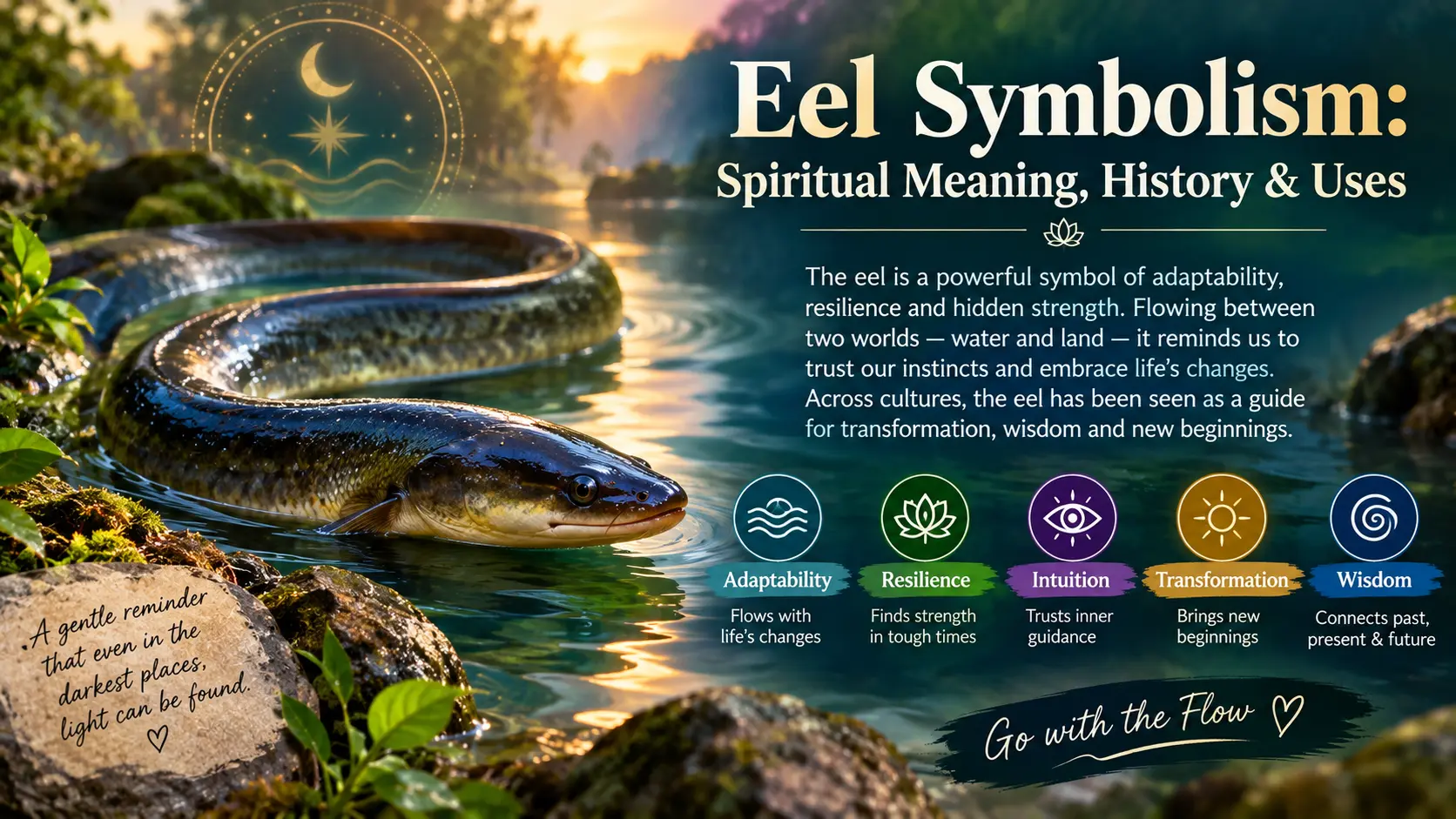
Eel symbolism commonly represents adaptability, mystery, transformation, survival, hidden emotions, energy, and the ability to move through uncertain situations. Because eels live beneath the surface of water and have an unusual, flexible body, people often associate them with what is unseen, difficult to understand, or constantly changing.
The meaning can be positive or negative depending on the context. An eel may represent resilience and transformation, while its slippery movement can also suggest secrecy, evasiveness, or deception. In dreams, tattoos, art, folklore, and modern design, its meaning depends heavily on the surrounding imagery and the individual’s personal associations.
TL;DR
- Adaptability: Eels can symbolize flexibility and the ability to adjust to changing conditions.
- Mystery: Their underwater lifestyle often connects them with hidden knowledge and the unknown.
- Transformation: Their unusual life cycles can inspire meanings related to growth and major life transitions.
- Survival: An eel can represent persistence, endurance, and finding a way forward.
- Energy: Electric eels are particularly associated with power, intensity, and protection.
- Shadow symbolism: An eel may represent uncertainty, hidden emotions, fear, or avoidance.
- Dream symbolism: Seeing an eel in a dream may reflect change, emotional complexity, or something difficult to grasp.
- Modern meaning: Eels appear in tattoos, artwork, jewelry, food culture, environmental symbolism, and popular media.
What Does an Eel Symbolize?
Eels have a distinctive appearance and behavior that naturally invite symbolic interpretation. Their long bodies, fluid movement, aquatic habitat, and ability to navigate spaces that are difficult for humans to observe make them powerful images of adaptability and mystery.
Adaptability and Survival
An eel can symbolize the ability to adjust when circumstances change. Instead of moving in a rigid, predictable way, an eel bends and moves with its environment.
Symbolically, this can represent a person who knows when to change direction, remain patient, or find another route around an obstacle. The eel therefore becomes an image of survival through flexibility rather than force.
Mystery and the Hidden World
Because eels often spend significant periods beneath the water’s surface, they can symbolize things that remain hidden.
This association can apply to secret knowledge, unconscious feelings, unexplored possibilities, or situations that are not immediately clear. An eel appearing in symbolic artwork may suggest that something important exists beneath the obvious surface.
Transformation and Change
Eels have complex life cycles involving different environments and stages of development. This makes them useful symbols for transition and transformation.
In a spiritual or personal context, an eel can represent leaving one stage behind and adapting to another. Its symbolism may be especially meaningful during periods of relocation, career changes, emotional growth, or personal reinvention.
Energy, Power, and Protection
Electric eels add another layer to eel symbolism. Their ability to generate electrical discharges makes them striking symbols of energy, personal power, boundaries, and sudden impact.
An electric eel can therefore represent energy that is normally invisible but becomes noticeable when activated. Symbolically, this may suggest inner strength, self-protection, or the importance of recognizing one’s own personal limits.
Slipperiness and Deception
The eel’s smooth, difficult-to-grasp body has also contributed to less positive interpretations.
An eel can symbolize evasiveness, unpredictability, secrecy, or deception when the surrounding context emphasizes uncertainty. This does not mean eels universally represent dishonesty; rather, the physical quality of being difficult to hold has influenced certain metaphorical associations.
What an Eel Represents at First Sight
At first sight, an eel often creates a strong impression because its body looks very different from that of familiar land animals. Its elongated shape and fluid movement can evoke images of water, movement, mystery, and hidden strength.
The first symbolic impression may therefore be one of movement without a fixed direction. Unlike an animal that appears firmly grounded, the eel seems to flow through its environment. This can make it a useful symbol for people experiencing periods in which life feels fluid or unpredictable.
Its appearance can also produce contrasting emotions. Some people may see beauty and elegance in its movement, while others may associate its appearance with discomfort or fear. These emotional reactions matter because symbolism is often shaped by cultural experience as much as by the animal itself.
Eel Symbolism in the United States
In the United States, eel symbolism does not have one universally established meaning. Instead, interpretations vary according to context, region, cultural background, and whether the reference involves ordinary eels, electric eels, food, folklore, or popular media.
Common modern associations include adaptability, mystery, danger, elusiveness, and unusual power. The electric eel is particularly recognizable as an image of energy because of its ability to produce electrical discharges.
Common Cultural Associations
American audiences may encounter eel imagery through aquariums, nature documentaries, fishing, cuisine, environmental education, tattoos, fantasy art, and entertainment.
Consequently, an eel can represent anything from an intriguing aquatic creature to an image of something difficult to understand. Its meaning is usually determined by the story or visual setting around it.
Eels in American Language and Idioms
The physical characteristics of eels have influenced figurative language involving slipperiness and difficulty holding onto something.
When people describe a person or situation as “slippery,” the underlying metaphor suggests something difficult to grasp, control, or predict. Eel imagery can reinforce this idea visually, although it should not be treated as a universal cultural interpretation.
Positive and Negative Interpretations
A positive interpretation may emphasize resilience, flexibility, independence, energy, and transformation.
A negative interpretation may emphasize avoidance, secrecy, instability, or deception. The difference often comes down to whether the eel is shown as successfully navigating its environment or escaping from something.
Adaptability and Survival Symbolism
One of the strongest symbolic themes associated with eels is adaptability. Their body allows them to move through environments where a rigid body shape would be less useful.
As a metaphor, this suggests that survival does not always require confrontation. Sometimes the more effective response is to bend, adjust, wait, redirect, and continue.
For someone going through a difficult transition, eel symbolism can therefore serve as a reminder that flexibility is not the same as weakness. Adapting to circumstances can be a form of strength.
Mystery, Secrecy, and the Hidden Life
Water is frequently used symbolically to represent emotions, the subconscious, and things that exist beneath conscious awareness. An animal living within that environment naturally inherits some of those associations.
The eel’s hidden movements can therefore represent unspoken feelings, private thoughts, secrets, or questions without immediate answers. An eel appearing in artwork may encourage attention toward what is beneath the surface rather than what is immediately visible.
This interpretation is especially relevant when eel imagery appears alongside dark water, caves, shadows, or nighttime scenes. The visual environment can strengthen the theme of mystery.
Transformation and Life Changes
The eel’s unusual life history has contributed to its symbolic connection with transformation. Eels may pass through multiple stages and environments during their development and migration.
Symbolically, this resembles the human experience of moving from one identity or life situation to another. The eel can represent growth that happens gradually, movement between worlds, and adaptation to unfamiliar surroundings.
Its symbolism may feel particularly relevant during major life changes. Starting a new career, moving to another place, ending one chapter, or developing a new understanding of oneself can all be represented through the metaphor of an eel moving into a new environment.
Eels in Ancient History and Early Interpretations
Eels have fascinated humans for centuries because of their unusual appearance and mysterious reproductive biology. Before modern scientific knowledge explained their life cycles, their behavior could seem almost supernatural.
Ancient Curiosity About Eels
Ancient observers often encountered animals whose behavior they could not fully explain. Eels were particularly intriguing because they were associated with water, movement, and hidden habitats.
This fascination encouraged stories and theories about where eels came from and how they reproduced. Such historical curiosity contributed to their broader symbolic association with mystery and the unknown.
See Also: Red Carnation Symbolism: Meaning, History & Spirituality
Eels in Classical Thought and Natural History
Classical writers discussed eels as part of their observations of the natural world. Some ancient explanations of eel reproduction were incorrect by modern scientific standards, but they demonstrate how unusual the animal appeared to early observers.
Rather than treating these old beliefs as established spiritual facts, they are better understood as examples of how people attempted to make sense of a mysterious creature.
Eels in Indigenous and North American Contexts
Eels occur in different waterways across North America, and aquatic animals can hold important cultural significance for Indigenous communities. However, there is no single Indigenous meaning of the eel that applies across all nations.
Regional and Cultural Differences
Indigenous traditions are diverse, with distinct languages, histories, teachings, and relationships to particular landscapes. An eel or eel-like aquatic animal may have different significance depending on the community and region.
For this reason, broad statements claiming that “Native Americans believe eels symbolize one specific thing” can be misleading. Cultural symbolism should always be connected to a specific tradition when reliable documentation exists.
Respectful Interpretation of Indigenous Symbolism
When discussing Indigenous symbolism, it is important to distinguish documented cultural teachings from modern spiritual interpretations.
A respectful approach recognizes that Indigenous knowledge is community-specific and culturally situated. General eel symbolism can be discussed without attributing an unsupported universal meaning to Indigenous peoples.
Polynesian Eel Stories and Transformation
Eels appear in traditional stories from parts of Polynesia, where relationships between people, animals, landscapes, ancestors, and natural forces can be deeply interconnected.
The Eel as a Transforming Figure
In some Polynesian traditions, eel figures appear in stories involving transformation, relationships, origins, or the creation of important plants and cultural elements.
One well-known example is the story associated with Sina and the eel, particularly in Samoan and other Polynesian traditions, where the eel is connected with transformation and the origin of the coconut in versions of the story.
Cultural Meaning of Eel Stories
These stories should be understood within their specific cultural traditions rather than reduced to a generic “eel spiritual meaning.”
Nevertheless, they demonstrate why the eel can become a powerful narrative figure: it can connect water, transformation, ancestry, loss, renewal, and the continuing relationship between humans and nature.
Eel Symbolism in Japanese Culture and Food
Eel has a notable place in Japanese food culture, particularly through dishes featuring unagi, or freshwater eel.
Eel as a Symbol of Strength and Vitality
Eel has traditionally been associated in Japanese food culture with nourishment and vitality. The custom of eating unagi during particularly hot periods is connected with the idea of maintaining strength and stamina.
This gives eel an association with energy, endurance, nourishment, and vitality, although these cultural associations should not be confused with a universal spiritual belief.
Unagi and Seasonal Food Traditions
Unagi is commonly enjoyed grilled and served with a sweet-savory sauce, often over rice. Its cultural meaning is strongly connected with food traditions, seasonal customs, and culinary heritage.
For symbolic interpretation, this creates another dimension: an eel may represent sustenance and renewed energy rather than mystery or danger.
The Eel as a Shadow Symbol
Eel imagery can also function as a shadow symbol. In symbolic language, a shadow does not necessarily mean something evil. It can represent aspects of life that are uncomfortable, hidden, ignored, or not yet understood.
Fear of the Unknown
An eel moving beneath dark water can represent uncertainty. You may see its movement without knowing exactly where it is going.
As a metaphor, this can reflect the experience of facing an unknown future or entering a situation without complete information.
Hidden Emotions and Uncertainty
An eel can also represent emotions that are difficult to identify. Feelings such as anxiety, uncertainty, jealousy, grief, or anticipation may exist beneath the surface before a person consciously understands them.
Deception and Elusiveness
When an eel repeatedly escapes or disappears, its symbolism can shift toward avoidance or deception.
In this interpretation, the eel asks a symbolic question: What are you struggling to understand, confront, or hold onto?
Eel Symbolism in Dreams
Dream interpretation is personal rather than scientifically fixed. An eel dream does not have one universal meaning, and the dreamer’s emotions, experiences, and circumstances are important.
Seeing an Eel in a Dream
Seeing an eel may symbolize something mysterious or difficult to understand. It could represent a situation that feels fluid, unpredictable, or emotionally complicated.
If the dream feels peaceful, the eel may reflect adaptability and natural movement. If it feels frightening, the symbolism may lean toward uncertainty or hidden concerns.
Being Chased or Attacked by an Eel
A threatening eel in a dream may represent something you are trying to avoid or something that feels difficult to control.
The dream does not prove that a particular external person or event is dangerous. Instead, it may provide a symbolic image for the dreamer’s own feelings about uncertainty or pressure.
Catching or Holding an Eel
Successfully catching an eel can symbolize gaining control over something previously difficult to understand.
Because eels are associated with slipperiness, holding one may represent grasping an opportunity, understanding a complicated situation, or confronting uncertainty directly.
An Eel in Clear or Dirty Water
Clear water may create associations with clarity and emotional awareness, while murky water can suggest confusion or uncertainty.
These interpretations are symbolic rather than fixed rules. The emotional atmosphere of the entire dream matters more than one isolated detail.
Dead Eel Dream Meaning
A dead eel may symbolize the ending of a difficult period, the loss of an old pattern, or the conclusion of a transformation.
For some people, it may instead represent lost energy or an opportunity that has passed. Personal circumstances determine which interpretation feels relevant.
Slipperiness, Deception, and American Idioms
The eel’s physical slipperiness has influenced its metaphorical potential. Something described as “slippery” can be difficult to understand, catch, control, or rely upon.
This symbolism can be applied to circumstances rather than automatically to people. An eel in a story may represent an elusive answer, an unstable situation, or a person who avoids direct confrontation.
However, symbolic language should not be used as evidence that a particular person is dishonest. It is a metaphor, not a factual assessment.
Electric Eel Symbolism
Electric eel symbolism is distinct from ordinary eel symbolism because its most remarkable characteristic is its ability to produce powerful electrical discharges.
Power and Energy
The electric eel can symbolize stored energy, intensity, sudden action, and hidden strength.
Its symbolism suggests that something may appear quiet or ordinary while containing considerable power beneath the surface.
Protection and Boundaries
Electricity can also symbolize defense. An electric eel may therefore represent the importance of establishing boundaries and protecting personal space.
In personal symbolism, this can translate into the idea of knowing when to conserve energy and when to respond decisively.
Sudden Change and Emotional Impact
An electrical discharge is sudden and difficult to ignore. Consequently, electric eel imagery can represent unexpected events, powerful emotions, or a moment that dramatically changes circumstances.
Eel Tattoos and Personal Symbolism
Eel tattoos can carry highly individual meanings. Some people may choose the design because they appreciate marine life, while others may connect with its symbolic qualities.
What an Eel Tattoo Can Represent
Common symbolic themes include:
- Adaptability
- Resilience
- Transformation
- Mystery
- Hidden strength
- Independence
- Energy
- Connection with water
An electric eel tattoo can emphasize power and energy, while a traditional eel swimming through waves may emphasize movement and transformation.
Eel Tattoo Design Ideas and Meanings
A minimalist eel may communicate simplicity and mystery. A detailed eel surrounded by water can emphasize the relationship between the creature and its environment.
Combining an eel with lightning, flowers, waves, moon imagery, or geometric patterns can create additional layers of personal symbolism.
Eels in Jewelry, Decor, and Visual Design
Eel imagery can work particularly well in visual design because of its unusual silhouette. Its long, flowing shape can create a sense of movement.
In jewelry and decorative art, an eel may represent fluidity, individuality, mystery, or connection with water. Curved eel forms can also complement contemporary designs that favor organic shapes.
In home decor, eel imagery may be chosen simply because it creates an unusual aquatic theme. Symbolism is therefore not always necessary; aesthetic appreciation can be the primary reason.
Eel Symbolism in Pop Culture and Digital Media
Modern entertainment often uses eel-like creatures to communicate mystery, danger, unusual intelligence, transformation, or otherworldly qualities.
Digital artwork can exaggerate these characteristics. An eel may appear as a fantastical creature with glowing eyes, electricity, magical abilities, or supernatural movement.
Because of this, younger audiences may associate eel imagery with fantasy and gaming as much as with traditional symbolism. Modern meaning is therefore increasingly shaped by visual storytelling, memes, games, animation, and online art.
Ecological Symbolism: Eels, Water, and River Health
Eels can also have an important ecological meaning. Their complex life cycles and migrations connect different aquatic environments.
Eels as Symbols of Connection
An eel that travels between different habitats can symbolize connection between places, ecosystems, and stages of life.
This makes the animal a useful metaphor for continuity. What happens in one part of a river or aquatic system can affect life elsewhere.
Migration and Life Cycles
Eel migration demonstrates that animals can depend on multiple environments during their lives.
Symbolically, this reinforces themes of movement, persistence, and returning to important places.
Environmental Awareness
Because eels depend on healthy aquatic ecosystems, their presence can also inspire environmental symbolism.
An eel can therefore represent the importance of clean waterways, connected habitats, biodiversity, and responsible stewardship of natural resources.
Common Misunderstandings About Eel Symbolism
One common misunderstanding is that every culture assigns eels the same spiritual meaning. In reality, symbolism varies considerably across cultures and historical periods.
Another mistake is assuming that every eel represents deception because eels are slippery. That interpretation is only one possible metaphor.
It is also important to distinguish documented cultural traditions from modern spiritual interpretations. A symbolic meaning found in contemporary wellness or spiritual writing should not automatically be presented as an ancient or universal belief.
How Eel Symbolism Has Changed Over Time
Historically, eels were mysterious animals whose life cycles were poorly understood. Their hidden habitats and unusual appearance encouraged curiosity and speculation.
Modern science has explained many aspects of eel biology, but the symbolic fascination remains. Today, eels can represent adaptability, environmental connection, energy, transformation, mystery, and personal resilience.
The meaning has therefore shifted from simply being associated with an unexplained aquatic creature toward a much broader collection of natural, cultural, psychological, and artistic ideas.
Is Eel Symbolism Positive or Negative?
Eel symbolism can be either positive or negative depending on context.
Positive interpretations often focus on:
- Adaptability
- Survival
- Transformation
- Vitality
- Energy
- Flexibility
- Hidden strength
Negative interpretations may focus on:
- Secrecy
- Uncertainty
- Evasiveness
- Fear
- Deception
- Emotional confusion
Neither interpretation is automatically correct. A peaceful eel moving through clear water creates a different symbolic impression from an eel emerging from dark water or attacking someone in a story.
What Eel Symbolism May Mean in Everyday Life
Eel symbolism can serve as a useful metaphor when life feels uncertain or constantly changing. Its greatest lesson may be the value of remaining flexible without losing your sense of direction.
The eel does not need to move in a straight line to keep progressing. This can represent the reality that personal growth is rarely perfectly linear.
It may also encourage deeper awareness. Something that appears confusing on the surface may become easier to understand when you take time to look beneath it.
FAQs About Eel Symbolism
What is the spiritual meaning of an eel?
Eels are commonly interpreted as symbols of adaptability, mystery, transformation, survival, and hidden strength. Spiritual interpretations vary, so the surrounding context and personal experience matter.
What does an eel symbolize in dreams?
An eel in a dream may symbolize something mysterious, emotionally complicated, or difficult to control. A peaceful dream may emphasize adaptability, while a frightening dream may reflect uncertainty or avoidance.
Are eels a symbol of transformation?
Yes, eels can be interpreted as symbols of transformation because of their complex life cycles and movement between different aquatic environments. They can represent transition, adaptation, and personal change.
What does an electric eel symbolize?
An electric eel commonly represents power, energy, protection, boundaries, and sudden impact. Its electrical ability gives it a stronger association with invisible energy than ordinary eel imagery.
Is seeing an eel considered a good sign?
There is no universal rule that seeing an eel is either good or bad. In symbolic interpretation, it may represent resilience and change, or it may draw attention to uncertainty and something hidden beneath the surface.
What does an eel tattoo symbolize?
An eel tattoo can symbolize adaptability, transformation, mystery, resilience, water, independence, or hidden strength. The design elements surrounding the eel can add further personal meaning.
Conclusion
Eel symbolism is shaped by the animal’s unusual body, aquatic environment, complex life cycle, and remarkable ability to adapt. Across modern interpretations, the eel can represent mystery, transformation, survival, flexibility, hidden strength, and energy.
Its symbolism is also naturally dual-sided. The same qualities that suggest resilience can suggest evasiveness, while the hidden life of an eel can represent either fascinating mystery or uncomfortable uncertainty.
Ultimately, the most meaningful interpretation depends on context. Whether an eel appears in a dream, tattoo, story, artwork, cultural tradition, or natural environment, it can serve as a powerful reminder that life does not always move in a straight line, and adaptation can itself be a form of strength.