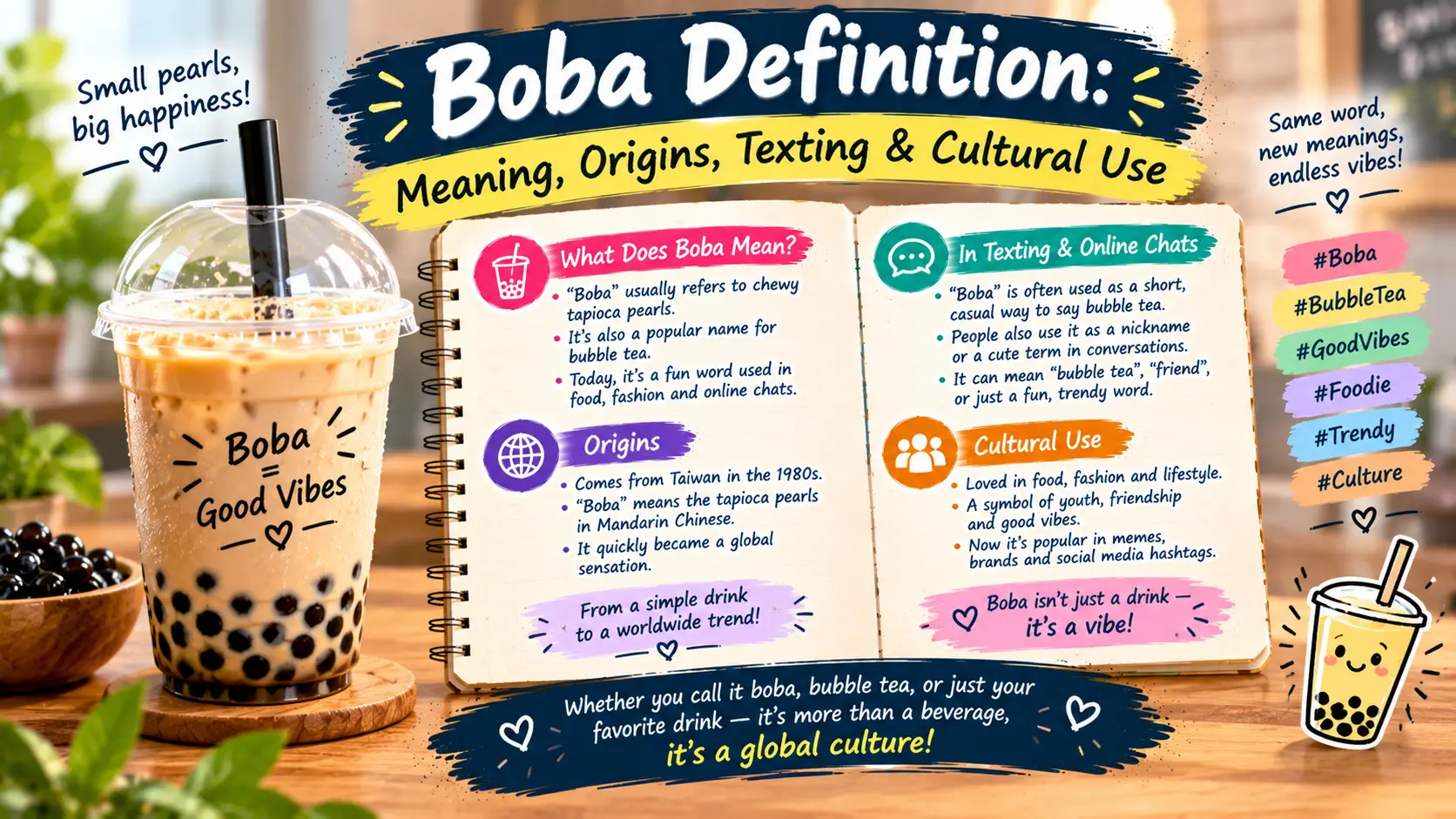
Boba Definition: Meaning, Origins, Texting & Cultural Use
What Does “Boba” Mean?
Simple Definition of Boba
Boba commonly refers to bubble tea, a Taiwanese beverage typically made with tea, milk or fruit flavors, and chewy tapioca pearls. In everyday American English, however, the word can refer either to the entire drink or specifically to the chewy pearls added to it.
The meaning depends on context. Someone might say, “Let’s get boba,” meaning they want a bubble tea drink, while another person might say, “I love the boba in this drink,” referring specifically to the tapioca pearls.
What “Boba” Refers to Today
Today, boba is both a food term and a cultural expression. It is widely used in cafés, restaurants, menus, social media posts, conversations, and online communities.
In the United States, especially, “boba” has become a familiar word associated with customizable drinks, café culture, friendship, Asian American communities, and youth culture.
Boba as a Drink and Ingredient
The word can describe different things depending on how it is used. Boba tea, bubble tea, milk tea, and similar drinks may contain tapioca pearls, fruit jellies, popping pearls, or other toppings.
Strictly speaking, boba often refers to the chewy tapioca balls themselves. In casual American usage, though, “boba” frequently means the entire beverage.
Where Did the Word “Boba” Come From?
Taiwanese Origins
Modern boba culture has its roots in Taiwan, where bubble tea developed in the late 20th century. Tea was already an important part of Taiwanese food and beverage culture, and creative tea shops began experimenting with cold drinks, milk, flavors, and chewy toppings.
The addition of tapioca pearls helped create a distinctive drinking experience. Instead of simply consuming a flavored beverage, customers could also enjoy a chewy texture through a wide straw.
The Development of Bubble Tea
Bubble tea developed into many variations rather than remaining a single standardized drink. Milk teas, fruit teas, flavored teas, and different toppings became common.
As the beverage spread, its terminology also changed across regions. Some communities favored bubble tea, while others adopted boba as the everyday term.
How the Term Spread Internationally
Boba eventually moved beyond Taiwan and became popular throughout East Asia and other parts of the world. Taiwanese immigrants and Asian communities also helped introduce the beverage to American cities.
Over time, dedicated tea shops appeared in many U.S. communities, turning boba from a relatively unfamiliar beverage into a recognizable part of contemporary food culture.
See Also: ONB Meaning in 2026: What Does “On B” Mean in Text?
Boba vs. Bubble Tea: What’s the Difference?
Why People Use Both Terms
Boba and bubble tea often refer to the same general type of beverage, but the words can emphasize different things.
“Bubble tea” is a broader and internationally recognizable name for the drink category. “Boba” is particularly common in American casual speech and often has a stronger association with tapioca pearls.
Regional Differences in Usage
Language varies from place to place. Some people naturally say “bubble tea,” while others almost always say “boba.”
In the United States, “boba” has become especially common in areas with established Asian American communities and large café cultures. Neither term is universally required.
Does “Boba” Mean the Drink or the Pearls?
It can mean either one.
For example, “I bought a boba” may refer to the entire drink, while “The boba is chewy” may refer specifically to the tapioca pearls.
The surrounding sentence usually makes the intended meaning clear.
What Does “Boba” Mean in Texting and Online Conversations?
Is Boba Actually Slang?
Boba is not primarily a slang acronym or secret texting abbreviation. It is fundamentally a food and beverage term.
Online, however, people use the word casually and creatively. Its meaning may extend beyond the literal drink to represent an outing, craving, friendship, or lifestyle.
How “Boba” Appears in Text Messages
A text such as “Want boba?” generally means “Do you want to get bubble tea?”
Other examples include:
- “I need boba” — expressing a craving.
- “Boba after class?” — suggesting a casual outing.
- “Got my boba!” — sharing an experience or purchase.
- “Let’s go for boba” — suggesting social time together.
Meaning Based on Conversation Context
The emotional meaning can change according to the conversation. A message about boba may simply discuss food, but it can also communicate friendliness, relaxation, spontaneity, or a desire to spend time together.
For that reason, boba can function as more than a noun in casual digital communication.
Boba Meaning in American Culture
Asian American Identity and Representation
Boba has developed an important place in some Asian American communities. Boba shops can provide spaces where food, language, family traditions, friendship, and contemporary Asian American identity overlap.
This does not mean every Asian American person has the same relationship with boba. Cultural experiences are diverse, and boba should not be treated as a universal representation of Asian identity.
Youth and Gen Z Culture
Boba has become particularly visible among younger Americans. Its colorful appearance, customization options, specialty cafés, and social-media-friendly presentation have helped it become part of contemporary youth culture.
The drink can therefore represent both a food choice and a social experience.
Boba as a Social Experience
Going out for boba is often a casual activity with friends, classmates, coworkers, or family members. The café becomes a place to talk, study, relax, or simply try new flavors.
This social element contributes to the cultural meaning attached to the word.
Emotional and Psychological Associations of Boba
Comfort and Enjoyment
Boba is often associated with comfort, indulgence, and enjoyment. Sweet flavors and chewy textures can make the drink feel like a small reward during a busy day.
Someone saying “I need boba” may therefore be expressing a simple craving or a desire for a comforting treat rather than communicating a deeper symbolic message.
Treats, Rewards, and Self-Care
People sometimes purchase boba after completing work, finishing school, meeting a friend, or getting through a stressful day.
In this sense, boba can become part of a personal reward routine. The meaning comes from the person’s experience rather than from a universal psychological definition.
Friendship and Social Connection
Boba is also strongly associated with social connection. Meeting someone for a drink creates an easy, informal reason to spend time together.
A boba invitation can therefore carry a subtle message of companionship and shared enjoyment.
See Also: Dead Squirrel in Your Yard: Spiritual Meaning & Symbolism
The Cultural Significance of Boba
Taiwanese and East Asian Connections
The modern boba phenomenon is closely connected to Taiwanese beverage culture and the broader history of tea in East Asia.
Recognizing these origins is important because the worldwide popularity of boba did not begin with American social media. Its contemporary global identity developed from an established Taiwanese food and beverage tradition.
Asian American Cultural Expression
In the United States, boba has also become connected with Asian American businesses, neighborhoods, social spaces, and creative communities.
For some people, a boba shop may represent familiarity and cultural connection. For others, it is simply a convenient place to buy a favorite drink.
Globalization of Boba Culture
Boba demonstrates how a regional food can become global while developing new meanings in different places.
Today, shops may offer flavors and combinations influenced by local tastes, while still retaining recognizable elements of the original beverage tradition.
Boba in Social Media and Pop Culture
TikTok, Instagram, and Online Trends
Boba is naturally suited to visual social media because drinks can feature bright colors, layered liquids, distinctive cups, toppings, and oversized straws.
Photos and short videos can turn an ordinary beverage into lifestyle content, food content, or café content.
Boba-Themed Memes and Content
Online creators frequently use boba imagery in memes, illustrations, stickers, emojis, merchandise, and humorous posts.
The visual appearance of the drink makes it easy to recognize, giving “boba” a strong digital identity beyond its literal meaning.
Boba as a Lifestyle Symbol
For some younger consumers, boba can symbolize casual socializing, café culture, customization, and modern Asian-inspired food culture.
However, these associations are cultural trends rather than fixed definitions.
Boba in Fashion, Art, Decor, and Branding
Boba-Inspired Designs
The recognizable shape of a boba cup has become a popular design element. Artists and brands may use tapioca pearls, straws, cups, and tea colors as visual themes.
These designs can appear on stationery, phone accessories, posters, clothing, and digital illustrations.
Merchandise and Fashion
Boba-themed merchandise often uses playful graphics and humorous references. Clothing and accessories may feature cartoon drinks, tapioca pearls, or phrases connected with boba culture.
This shows how a beverage can develop into a recognizable visual identity.
Cafés, Packaging, and Visual Identity
Boba businesses often invest heavily in distinctive packaging and branding. Transparent cups, colorful labels, illustrated characters, and creative drink names help businesses stand out.
The visual presentation has become an important part of the modern boba experience.
Common Misunderstandings About the Meaning of Boba
Is Boba the Same as Bubble Tea?
In everyday American conversation, boba and bubble tea are often used interchangeably.
Technically, however, boba can refer specifically to the chewy tapioca pearls, while bubble tea describes the broader drink category.
Is Boba a Slang Word?
Boba is not primarily slang. It is a commonly used term associated with a beverage and its toppings.
Its casual use on social media may give it a slang-like cultural feel, but that does not make the word itself a secret code or texting abbreviation.
Why Context Can Change the Meaning
Words often develop broader meanings through everyday use. Boba is a good example because the same word can describe an ingredient, a drink, a café outing, or a broader cultural trend.
The surrounding words usually reveal which meaning is intended.
Is “Boba” Offensive or Culturally Sensitive?
Cultural Appreciation vs. Cultural Reduction
Using the word boba is generally a normal way to refer to the beverage. The important distinction is between appreciating a food tradition and reducing an entire culture to one trendy product.
Boba has genuine Taiwanese and broader Asian cultural connections, but it should not be presented as a complete representation of Asian culture.
Why Context Matters
Context determines whether a reference is respectful, humorous, commercial, or stereotypical.
Using “boba” to order a drink is ordinary. Using the term to make assumptions about someone’s ethnicity or identity is a different matter.
Understanding Boba Without Stereotypes
A balanced understanding recognizes both sides: boba is a popular beverage enjoyed by people around the world, and it also has meaningful historical and cultural roots.
Enjoying boba does not require a particular identity, just as liking the beverage does not automatically represent someone’s cultural background.
How the Meaning of Boba Has Changed Over Time
From Taiwanese Beverage to Global Trend
Boba began as part of Taiwan’s modern beverage culture and eventually became an international phenomenon.
As it traveled across countries and communities, the word acquired new associations with cafés, social media, youth culture, entrepreneurship, and Asian American communities.
Changes in American Usage
In the United States, “boba” has increasingly become a familiar everyday term. Many people who have never studied the beverage’s Taiwanese history still recognize the word immediately.
This is an example of how borrowed food terminology can become integrated into everyday American English.
Why Boba Has Become More Than a Drink
The modern meaning of boba includes food, social activity, visual culture, business, identity, and entertainment.
Its popularity shows how a simple beverage can become a cultural symbol when people repeatedly connect it with experiences and communities.
Boba Meaning by Context in the USA
The meaning of boba can be understood differently depending on where and how the word appears:
| Context | Common Meaning |
|---|---|
| Restaurant or café | Bubble tea or a specific boba drink |
| Food conversation | Tapioca pearls or bubble tea |
| Text message | A casual invitation or reference to the drink |
| Social media | Beverage, trend, lifestyle, or meme |
| Friendship | A casual activity with someone |
| Youth culture | Café culture and social experience |
| Asian American context | Possible connection to community and cultural identity |
| Fashion or art | A recognizable boba-inspired visual theme |
The safest interpretation is always based on context rather than assuming that “boba” has one hidden meaning.
Why Is Boba So Popular With Gen Z?
Customization and Personal Expression
Boba drinks can be highly customizable. Customers may choose tea bases, sweetness levels, ice levels, toppings, milk options, and flavors.
That personalization fits modern preferences for products that feel individually selected.
Social Media Appeal
The visual appearance of boba works particularly well on platforms built around photographs and short videos.
A colorful drink can become part of a café visit, outfit post, study session, or casual social update.
Café Culture and Community
Boba shops often function as informal meeting places. Friends can meet there without the formality associated with a restaurant.
This makes boba particularly compatible with social routines among students and young adults.
Nostalgia and New Food Trends
Boba can combine familiarity with novelty. Someone may return to a favorite childhood or teenage drink while also experimenting with new flavors.
That balance between comfort and discovery helps explain its continuing popularity.
FAQs About Boba
What does boba mean in texting?
In texting, boba usually means bubble tea or the tapioca pearls used in the drink. A message such as “Want boba?” generally means “Do you want to get bubble tea?”
Is boba slang or just a drink?
Boba is primarily a food and beverage term, not a secret slang abbreviation. Its casual use on social media can give it additional cultural associations, but the basic meaning remains connected to bubble tea.
What is the difference between boba and bubble tea?
Bubble tea generally describes the complete beverage category, while boba can refer either to the drink or specifically to the chewy tapioca pearls. In everyday American speech, the two terms are frequently interchangeable.
Does boba have cultural meaning?
Yes. Boba has Taiwanese roots and has developed additional meanings within Asian American and global popular culture. Its cultural significance varies from person to person and community to community.
Is calling something “boba” offensive?
Using “boba” to refer to the beverage is generally ordinary and not inherently offensive. The important issue is avoiding stereotypes or treating boba as a simplistic representation of an entire culture.
Why is boba so popular in the USA?
Boba combines customizable flavors, distinctive textures, attractive presentation, café culture, and social experiences. These qualities have helped it become a familiar part of American food and youth culture.
Why is boba associated with Gen Z?
Boba fits naturally with Gen Z interests in customization, visual food culture, social cafés, and shareable experiences. Social media has also helped make boba recognizable as both a drink and a lifestyle trend.
Conclusion: Understanding the Meaning of Boba
Final Takeaway
Boba generally means bubble tea or the chewy tapioca pearls associated with it, depending on context. Although the word is now common in American English, its modern history is closely connected to Taiwan and the worldwide development of bubble tea culture.
In texting and social media, “boba” usually retains its literal meaning while sometimes suggesting friendship, relaxation, a casual outing, or contemporary café culture. Understanding the context makes the intended meaning easy to recognize.