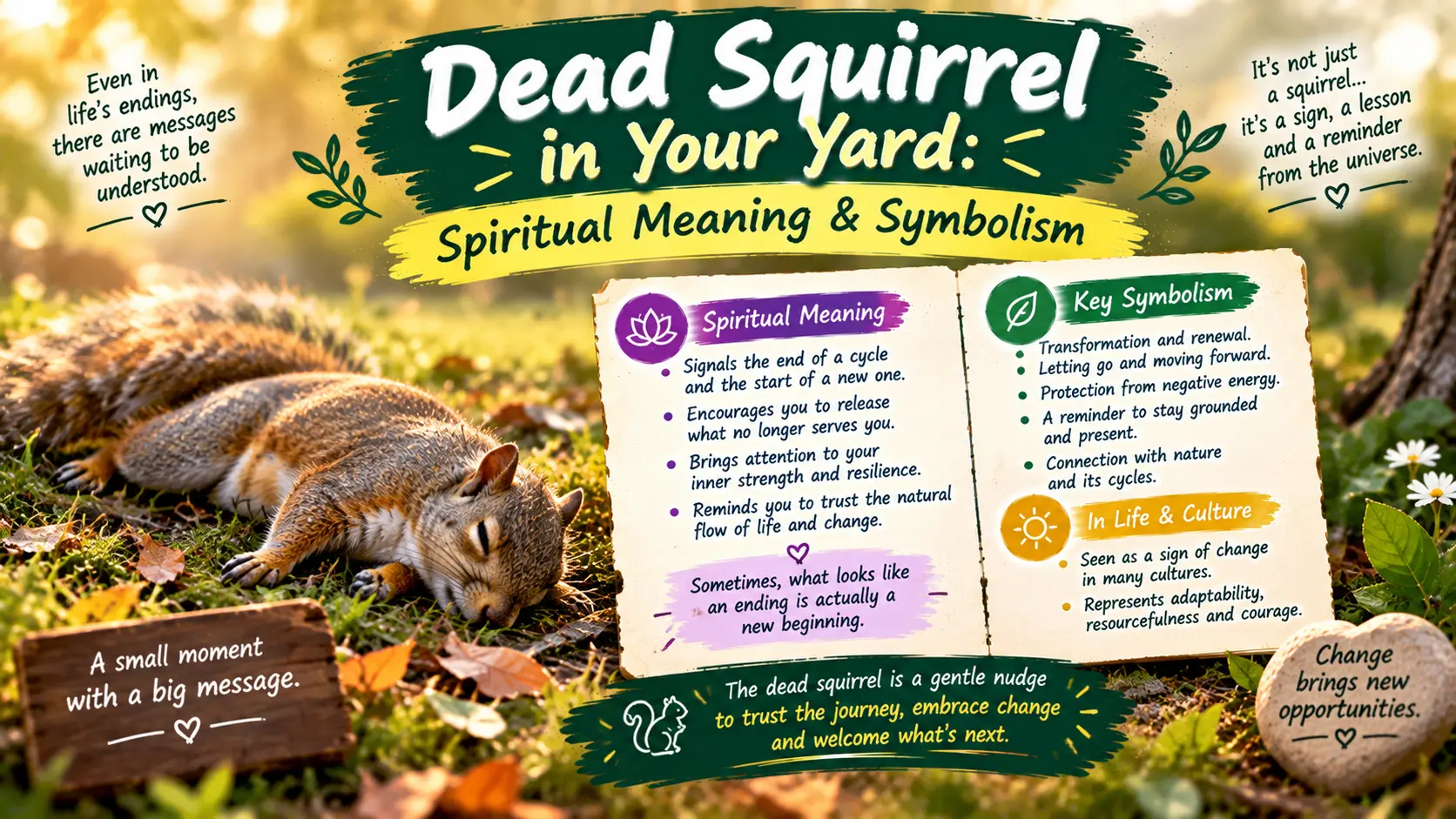
Dead Squirrel in Your Yard: Spiritual Meaning & Symbolism
Finding a dead squirrel in your yard can be an unsettling experience. Because squirrels are commonly associated with activity, preparation, gathering, home, and survival, seeing one lifeless can feel especially meaningful. For people interested in spirituality, the experience may prompt questions about change, endings, protection, or personal transformation.
A spiritual interpretation does not necessarily mean that the event predicts something negative. Symbolism is personal and cultural, and the same experience can represent different things to different people. In many modern interpretations, a dead squirrel can symbolize the end of a phase, the need to release something, or a reminder to reconsider how you are using your time and energy.
At the same time, there is usually a natural explanation for finding a dead animal outdoors. Spiritual reflection and practical understanding can exist together without assuming that the event is a supernatural warning.
Quick Answer
Spiritually, a dead squirrel in your yard may symbolize endings, change, release, preparation, or a transition in your personal life. Because squirrels are traditionally associated with resourcefulness, gathering, security, and preparation, their death can symbolically represent a period when an old way of preparing for the future no longer serves you.
It is not automatically a sign of bad luck or impending death. The meaning depends heavily on your personal circumstances, emotional response, cultural background, and the context in which you encountered it.
TL;DR
A dead squirrel can symbolize change, closure, transformation, letting go, or reassessing priorities. Squirrels commonly represent preparation, resourcefulness, and protection, so their death may be interpreted as the ending of an old pattern.
There is no universal spiritual meaning. Treat the symbolism as a tool for reflection rather than a prediction of future events.
What Does a Dead Squirrel in Your Yard Mean Spiritually?
A dead squirrel can carry symbolic meaning because squirrels are energetic animals that spend much of their lives gathering food, moving between places, protecting resources, and preparing for future needs. Seeing the opposite state—stillness and death—naturally creates a strong symbolic contrast.
From a spiritual perspective, this contrast may represent the completion of a cycle. Something that once required constant attention may be reaching its natural conclusion. This could relate to a habit, relationship, responsibility, goal, emotional pattern, or stage of life.
Another interpretation involves releasing excessive preparation. Squirrels are famous for storing food and preparing for uncertain conditions. Symbolically, a dead squirrel might encourage you to examine whether you are spending too much energy worrying about the future instead of living in the present.
Core Spiritual Meanings
Some of the most common symbolic themes associated with a dead squirrel include:
- Endings: One chapter may be closing.
- Transformation: An old identity or habit may be changing.
- Release: Something unnecessary may need to be let go.
- Reflection: The event may encourage you to slow down and reconsider priorities.
- Preparation: It can remind you to prepare wisely without becoming controlled by fear.
- Resourcefulness: The squirrel’s traditional symbolism may highlight how you manage your energy and resources.
These interpretations should be viewed as symbolic rather than guaranteed messages from a supernatural source.
Themes of Change, Preparation, and Release
The squirrel is often viewed as an animal of preparation. It gathers, stores, protects, and plans. Symbolically, its death may therefore raise a question: What are you preparing for, and is that preparation still necessary?
For someone going through a major transition, the experience may feel like confirmation that an old period is ending. For another person, it may simply inspire appreciation for impermanence and the importance of using the present moment wisely.
What Does a Squirrel Symbolize Spiritually?
Before interpreting its death, it helps to understand the symbolism commonly associated with the living squirrel.
Squirrels are energetic, alert, adaptable, and highly practical animals. Their behavior makes them natural symbols for qualities such as preparation, persistence, resource management, and survival.
Resourcefulness and Preparation
One of the strongest squirrel associations is preparation. Squirrels collect food and create reserves that can help them survive changing conditions.
Spiritually, this can represent planning ahead, saving resources, building stability, and thinking about long-term consequences. A dead squirrel can symbolically turn that message around, asking whether preparation has become excessive or whether an old strategy needs to change.
Energy, Movement, and Adaptability
Squirrels are rarely associated with stillness. They climb, run, search, hide, and quickly react to their surroundings.
Because of this, squirrel symbolism can represent movement, adaptability, curiosity, and active problem-solving. A dead squirrel may therefore symbolize the need to pause after a period of constant activity.
Home, Security, and Abundance
Squirrels often live close to trees, gardens, parks, and residential environments. Their behavior around food and shelter can connect them symbolically with home and security.
In spiritual interpretations, this can make a dead squirrel near your home especially meaningful. It may prompt reflection on your sense of safety, stability, family responsibilities, or material concerns.
Why Squirrels Have Symbolic Meaning in American Culture
Squirrels are extremely familiar in the United States. They are commonly seen in backyards, city parks, forests, gardens, and suburban neighborhoods.
Because people encounter them frequently, squirrels have developed strong everyday associations with food gathering, trees, seasons, persistence, and playful activity.
Everyday Associations With Squirrels
In everyday American culture, squirrels are often associated with:
- Saving and storing
- Gathering food
- Being energetic
- Preparing for winter
- Protecting resources
- Living close to homes
- Quick movement
- Curiosity and alertness
These ordinary associations can influence modern spiritual interpretations.
Squirrels in Folklore and Popular Culture
Animal symbolism often develops gradually through stories, observations, folklore, and cultural repetition. Squirrels appear in children’s stories, cartoons, seasonal imagery, nature discussions, and popular media.
As a result, people may unconsciously connect squirrels with liveliness and activity. Seeing a dead squirrel can feel emotionally powerful precisely because it contrasts so sharply with those familiar images.
Historical and Ancient Views of Animal Death
Animal death has carried symbolic importance in many cultures throughout history. However, there is no single ancient interpretation that applies universally to every animal or every situation.
Some traditions viewed animals as connected to nature, seasonal cycles, spiritual lessons, or divine creation. Others treated animal encounters primarily through practical or ritual contexts.
Pre-Christian and Ancient Symbolism
Ancient societies frequently observed animals closely because animals were central to food, transportation, agriculture, hunting, and survival.
Animal behavior could therefore become part of mythology and symbolism. Death itself was sometimes interpreted as part of a larger cycle involving endings, renewal, fertility, seasonal change, or transformation.
It is important not to assume that every ancient culture interpreted a dead squirrel as a specific omen. Historical evidence does not support one universal meaning.
Death as a Symbol of Transition
Across many spiritual traditions, death can function symbolically rather than literally. It can represent the ending of one condition and the beginning of another.
Under this framework, a dead animal may encourage reflection on impermanence, transformation, closure, and renewal rather than predicting physical death.
Native American Perspectives on Squirrels
Indigenous cultures in North America are diverse, with different nations and communities having their own histories, languages, traditions, and relationships with animals.
For this reason, there is no single “Native American meaning” of a squirrel or a dead squirrel.
Traditional Animal Symbolism
Animals have important places in many Indigenous traditions, but their meanings vary significantly by nation and cultural context. Stories and teachings involving animals can communicate lessons about behavior, relationships, survival, responsibility, or the natural world.
Squirrels may appear in particular traditions or stories, but it is not accurate to claim one universal Indigenous interpretation.
A respectful approach is to recognize this diversity rather than combining separate traditions into one generalized spiritual system.
Spiritual Meaning of Finding a Dead Squirrel Near Your Home
Location can influence personal symbolism. Finding a dead squirrel in your yard may feel different from seeing one on a distant hiking trail because your home represents your personal environment.
The experience may lead you to reflect on boundaries, family, security, responsibilities, and your relationship with your immediate surroundings.
Home and Personal-Space Symbolism
A yard sits between private living space and the wider natural environment. Symbolically, it can represent the boundary between your inner world and the outside world.
A dead squirrel in this space may therefore encourage reflection on what is entering your life, what you are protecting, and what you may need to remove or release.
Possible Messages About Protection and Change
If you are already experiencing uncertainty at home, the event may naturally feel connected to those circumstances.
Instead of interpreting it as a warning, consider it an opportunity to ask whether your current routines, priorities, or relationships still support your sense of security.
Is a Dead Squirrel a Bad Omen?
A dead squirrel is not universally considered a bad omen. Spiritual traditions differ, and many modern interpretations focus on transformation rather than misfortune.
Fear can make unusual events seem more predictive than they really are.
Fear-Based Interpretations
People sometimes interpret dead animals as signs that something terrible is about to happen. This can create unnecessary anxiety, especially when there is no evidence connecting the event to future circumstances.
A symbolic interpretation does not need to be frightening. Death can represent completion, change, and renewal as much as loss.
More Balanced Spiritual Perspectives
A balanced interpretation asks what the experience personally represents rather than assuming it predicts an external event.
You might view it as a reminder to slow down, appreciate life, reconsider priorities, or release something that has reached its natural conclusion.
Emotional and Psychological Meaning
Your emotional reaction can be just as important as the symbolism you attach to the event.
Finding a dead animal may cause sadness, discomfort, curiosity, shock, or even fear. These reactions are normal responses to encountering death unexpectedly.
Common Emotional Reactions
People may experience:
- Sadness
- Uneasiness
- Surprise
- Curiosity
- Anxiety
- Compassion
- Reflection about mortality
Your reaction can provide clues about why the experience feels significant.
Why the Experience Can Feel Significant
The human mind naturally looks for patterns and meaning, particularly when something unusual happens close to home.
If you are already experiencing major changes, you may connect the event with those circumstances. That does not make the reflection meaningless, but it is useful to distinguish personal symbolism from objective prediction.
Common Situations and Their Possible Meanings
The circumstances surrounding the discovery can influence how people interpret it spiritually.
Finding a Squirrel in the Yard
A yard can symbolize personal space, daily life, family, and the boundary between home and nature.
A dead squirrel here may inspire thoughts about stability, changing routines, or the need to let go of an outdated pattern.
Finding One Near the Front Door
The front door can symbolically represent entrances, opportunities, boundaries, and transitions.
Some people may interpret a dead squirrel near the entrance as a reminder to consider what they are allowing into their lives and what they are ready to leave behind.
Finding One Near a Window or Garden
Windows can symbolize awareness and perspective, while gardens can represent growth and cultivation.
A dead squirrel in either area may encourage reflection on what you are watching, nurturing, protecting, or neglecting.
Seeing Dead Squirrels Repeatedly
Repeated encounters can feel especially meaningful. However, repetition does not automatically prove a supernatural pattern.
Before assigning spiritual significance, consider practical factors such as roads, predators, local wildlife activity, weather, or environmental changes.
Dead Squirrel Symbolism in Dreams
Dreams can use familiar animals as symbols because the brain connects images with memories, emotions, and personal experiences.
Dreaming of a Dead Squirrel
A dead squirrel in a dream may symbolize a perceived ending involving preparation, security, energy, or resources.
If the dream feels peaceful, it might suggest acceptance. If it feels frightening, it may reflect anxiety about losing stability or control.
Different Dream Contexts and Meanings
The surrounding details matter. A dream about burying a squirrel may suggest closure, while dreaming about discovering one unexpectedly may represent a realization you were not prepared for.
Dream symbolism is highly personal, so your own emotions and circumstances should receive more attention than generic dream dictionaries.
Spiritual Meaning vs. Natural Explanation
Spiritual reflection should not replace practical understanding.
Wild animals can die from natural causes, disease, injury, predators, environmental conditions, vehicles, or other factors. A dead squirrel in a yard does not require a supernatural explanation.
Common Natural Causes
Possible causes can include:
- Vehicle injuries
- Predation
- Falls or physical injuries
- Disease
- Severe weather
- Age-related causes
- Food or environmental problems
The exact cause cannot always be determined simply by looking at the animal.
Why Symbolism Does Not Replace Reality
A spiritual interpretation can provide personal reflection without claiming that nature has sent a guaranteed message.
This distinction is important because it allows you to appreciate symbolism while remaining grounded in observable reality.
Dead Squirrel Symbolism in the USA Today
Modern spiritual interpretations often combine traditional symbolism with personal psychology, social media trends, and contemporary ideas about signs.
Modern Spiritual Interpretations
Today, people may associate a dead squirrel with:
- Closing an old chapter
- Releasing unnecessary worries
- Changing financial habits
- Becoming more adaptable
- Ending excessive preparation
- Accepting natural cycles
These are reflective interpretations rather than universally established spiritual rules.
Social Media and Contemporary Symbolism
Social media has made symbolic interpretations more visible. A single unusual animal encounter can quickly become part of online conversations about signs, synchronicities, spirituality, or personal transformation.
However, viral interpretations should not automatically be treated as historical or religious facts.
Religious Perspectives on Animal Death
Religious traditions approach animals and death in different ways. Some focus on creation, stewardship, mortality, divine providence, or the distinction between human spiritual life and animal life.
Christian Interpretations
Christianity does not establish a universal teaching that finding a dead squirrel is a specific omen.
Christian perspectives may instead encourage ideas such as compassion for creation, humility, mortality, trust, and avoiding superstition.
General Biblical Themes of Life and Death
The Bible contains many references to animals, creation, life, death, and human responsibility toward the natural world.
However, a specific symbolic meaning for a dead squirrel should not be presented as a direct biblical teaching when Scripture does not establish one.
How Religious Views Differ From Spiritual Symbolism
Personal spirituality may interpret everyday experiences as symbolic messages, while organized religion may place greater emphasis on established theological teachings.
You can therefore find personal meaning in the experience without claiming that your interpretation is a formal religious doctrine.
How Personal Circumstances Can Shape the Meaning
The strongest symbolic interpretation often comes from your own life context.
Endings and New Beginnings
If you are finishing a relationship, changing careers, moving homes, or leaving behind an old habit, the dead squirrel may feel like a visual symbol of closure.
Its symbolism can become a reminder that endings are sometimes necessary before something new can develop.
Financial or Practical Concerns
Because squirrels are strongly associated with gathering and storing resources, their symbolism may feel particularly relevant when you are thinking about money, savings, work, or security.
The experience could inspire a practical question: Are you preparing wisely, or are you allowing fear about the future to control your present?
Emotional Transformation
The symbolism may also relate to emotional growth. You might be moving away from an old reaction pattern, releasing resentment, or becoming more comfortable with uncertainty.
In that sense, the squirrel represents not necessarily loss, but the transformation of an old way of living.
Common Misunderstandings About Dead Squirrel Symbolism
Spiritual symbolism can become confusing when metaphor is treated as literal prediction.
Assuming It Predicts Death
One of the most frightening interpretations is that a dead animal predicts the death of a person. There is no reliable basis for treating a dead squirrel as a prediction of someone’s death.
Death symbolism is often metaphorical and can refer to endings, transitions, or changes.
Confusing Symbolism With Supernatural Certainty
A meaningful experience can be personally significant without being a guaranteed supernatural message.
It is healthier to use symbolism for reflection rather than allowing it to create fear or certainty about events that have not happened.
Avoiding Fear-Based Conclusions
If the discovery makes you anxious, step back from dramatic interpretations. Look at the practical circumstances first, then consider what the experience personally brings to mind.
Spirituality does not have to be based on fear.
How Squirrel Symbolism Has Changed Over Time
Animal symbolism evolves as societies change. The same animal can represent survival in one era, prosperity in another, and humor or playfulness in modern popular culture.
Historical Views
Historically, animals were often interpreted through local ecology, mythology, agriculture, seasonal cycles, and religious traditions.
The meaning was strongly influenced by how people interacted with the natural environment.
Modern Spiritual Interpretations
Today, people frequently combine traditional symbolism with personal development concepts.
The squirrel may represent productivity, preparation, abundance, adaptability, or financial awareness. Its death can then symbolize the need to reassess those qualities rather than simply representing something negative.
Dead Squirrel Symbolism Comparison Table
| Symbolic Theme | Possible Meaning |
|---|---|
| Death | Completion or transition |
| Squirrel | Preparation and resourcefulness |
| Dead squirrel | Ending an old pattern |
| Yard | Personal space and everyday life |
| Home | Security and protection |
| Gathering | Saving and planning |
| Stillness | Rest after prolonged activity |
| Release | Letting go of what is no longer useful |
| Repeated encounters | Invitation to reflect, not necessarily an omen |
| Transformation | Moving from one stage of life to another |
FAQs
Is finding a dead squirrel a spiritual message?
It can be viewed symbolically as a reminder about change, endings, preparation, or release. However, there is no universal rule stating that every dead squirrel is a supernatural message.
Does a dead squirrel mean bad luck is coming?
No. A dead squirrel is not universally recognized as a sign of coming bad luck. A more balanced interpretation is to see it as a reminder of natural cycles, change, or personal reflection.
Does finding one mean someone will die?
No. There is no reliable basis for interpreting a dead squirrel as a prediction that someone will die. Symbolic references to death often represent endings, transitions, or transformation instead.
Should I perform a ritual or spiritual cleansing?
There is no universal requirement to perform a ritual. If a personal spiritual practice helps you feel peaceful, you may choose a simple reflective practice, but it should not be driven by fear.
What if I keep finding dead squirrels?
Repeated discoveries may have a practical environmental explanation, such as roads, predators, weather, or local wildlife patterns. Spiritually, you can use the repetition as an opportunity for reflection without assuming it is a supernatural warning.
Does the meaning change if it is near my house?
It may feel more personally significant because the home represents security and private life. Symbolically, it can encourage reflection on boundaries, stability, family, and changes happening in your personal environment.
Does Christianity interpret this differently?
Christianity does not provide a universal doctrine saying that a dead squirrel is a specific omen. Christian reflection may instead focus on creation, mortality, stewardship, compassion, and avoiding superstition.
What should I do if I find a dead squirrel?
Avoid unnecessary contact and keep children and pets away from it. Follow your local guidance for handling or reporting dead wildlife. Once the practical matter is addressed, you can reflect on any personal symbolism the experience holds for you.
Conclusion: Finding Meaning Without Fear
A dead squirrel in your yard can symbolize endings, transformation, release, preparation, and changing priorities, particularly because squirrels are commonly associated with resourcefulness, gathering, security, and constant activity.
There is no single spiritual interpretation that applies to everyone. Cultural traditions, personal beliefs, emotions, and circumstances all influence the meaning someone gives to an unusual encounter.
Most importantly, a dead squirrel does not have to be viewed as a prediction of tragedy. You can acknowledge the natural reality of animal death while using the experience as a quiet reminder to examine your life, release what no longer serves you, and approach change with greater awareness.