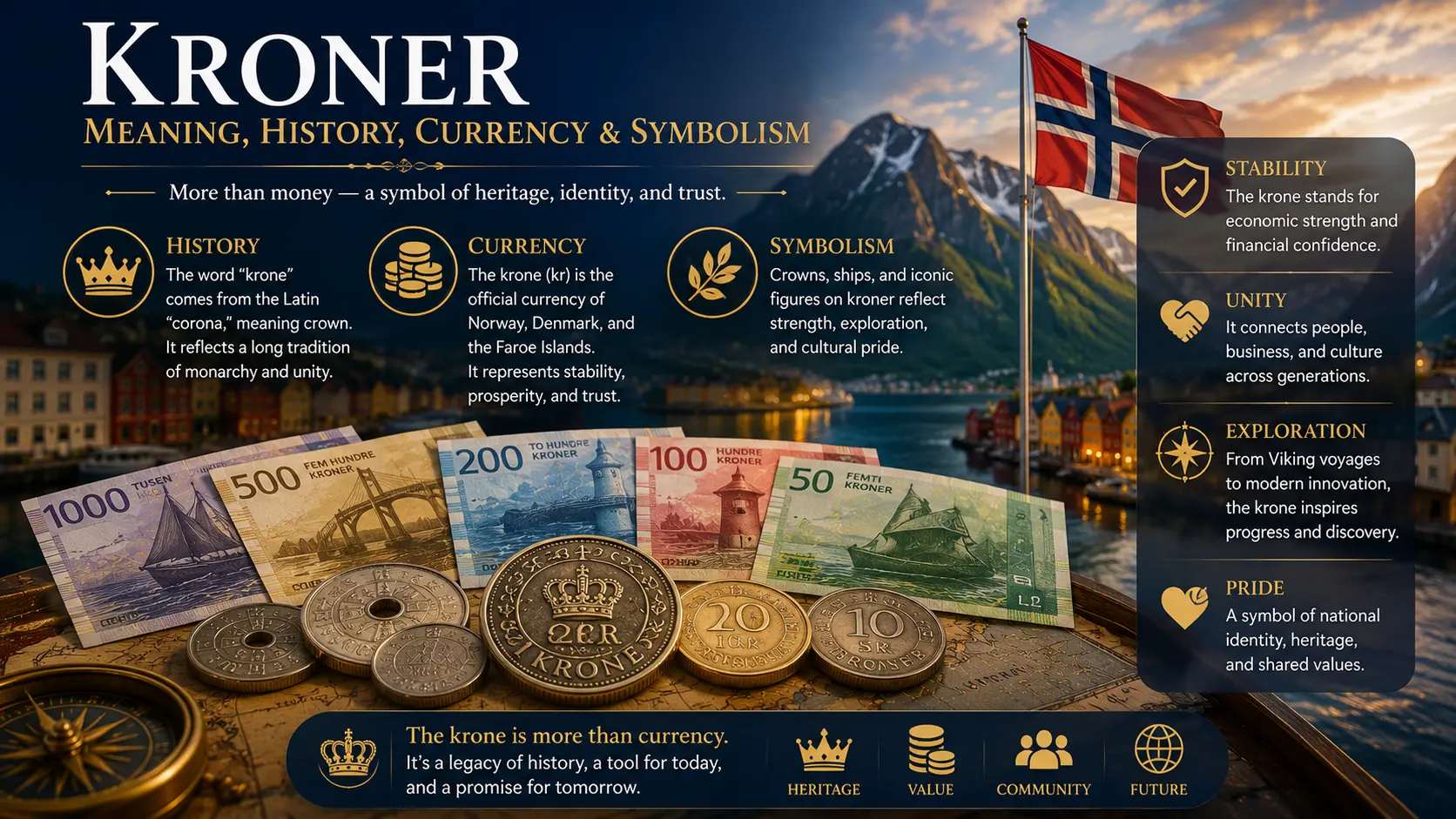
Kroner Meaning: History, Currency, and Symbolism
Quick Answer
“Kroner” is the plural form of “krone,” a currency name used primarily in Scandinavian countries. The word comes from a term meaning “crown,” connecting the currency to historical European monarchies and royal imagery. Today, kroner most commonly refers to currencies such as the Norwegian krone and Danish krone, while related forms such as krona are used in Sweden and Iceland.
In everyday American English, “kroner” generally refers to foreign Scandinavian currency, especially when discussing travel, exchange rates, international finance, or Nordic culture. Although the word has historical and symbolic associations with crowns, royalty, value, and national identity, it is primarily a currency term rather than a spiritual symbol.
TL;DR
- Kroner is the plural of krone.
- Krone literally relates to the word “crown.”
- Norway and Denmark use currencies called the krone.
- Kroner commonly means multiple units of a krone currency.
- Related currency names include krona and króna.
- The crown connection can symbolize authority, sovereignty, status, and value.
- In the United States, Americans usually encounter kroner through travel, currency exchange, news, and Scandinavian culture.
- Any spiritual meaning associated with kroner is generally symbolic or personal rather than a formal religious definition.
What Does “Kroner” Mean?
Literal Definition
The word kroner is the plural form of krone in Danish and Norwegian usage. In a currency context, it means more than one unit of a currency whose name derives from the word crown.
The connection is straightforward: krone is related to the Scandinavian and Germanic word for crown. A crown historically represented monarchy, sovereignty, and political authority, making it an appropriate name for a national currency introduced during an era when European kingdoms were closely connected to monetary systems.
For example, if someone says they have 500 kroner, they are referring to 500 units of a krone-based currency. The exact value depends on which country’s krone is being discussed.
Krone vs. Kroner
The distinction between krone and kroner is mainly grammatical.
Krone generally refers to one unit or to the currency itself, while kroner refers to multiple units. In English, however, people sometimes use “kroner” loosely when discussing Scandinavian money in general.
This can create confusion because the names and plural forms differ across Nordic languages. Norway and Denmark use krone/kroner, while Sweden commonly uses krona/kronor, and Iceland uses króna/krónur.
How the Word Is Used Today
Today, “kroner” is most often used in financial, travel, economic, and cultural contexts.
You might encounter the term when reading a Norwegian price, planning a trip to Denmark, checking an international exchange rate, discussing Nordic economies, or reading a story set in Scandinavia.
The word therefore has a practical modern meaning. Its royal origin is historically interesting, but someone mentioning “kroner” today is usually simply talking about money.
What Is a Krone Currency?
Meaning of Krone in Currency
A krone is a monetary unit whose name literally carries the idea of a crown. Several Nordic currencies adopted this terminology during the development of modern national monetary systems.
The name reflects an older European tradition of naming coins and currencies after rulers, royal imagery, territories, or political institutions. The crown was particularly meaningful because it represented the authority of the state and monarch.
Modern kroner, however, are national currencies governed by contemporary monetary institutions. Their practical function is the same as other currencies: they serve as units for prices, payments, savings, wages, trade, and financial transactions.
Countries That Use Krone or Kroner
The most familiar present-day currencies using the krone name include the Norwegian krone and Danish krone.
Norway uses the Norwegian krone, while Denmark uses the Danish krone. The Faroe Islands also use Danish kroner in their monetary system.
Other Nordic countries use closely related names rather than exactly the same word. Sweden uses the krona, while Iceland uses the króna.
This is why “kroner” should not automatically be interpreted as one universal currency. The country or context matters.
Krone, Krona, and Kroner Explained
These words are related but are not interchangeable in every situation.
- Krone — singular form associated with Danish and Norwegian currency.
- Kroner — plural form used in Danish and Norwegian.
- Krona — the Swedish currency name.
- Kronor — plural form of Sweden’s krona.
- Króna — Icelandic currency term.
- Krónur — Icelandic plural form.
All of these words ultimately connect to the broader crown concept.
What Does the Crown Symbol Mean?
Royal Origins of the Crown
The crown has been a powerful symbol across European history. It traditionally represented kingship, sovereignty, legitimacy, authority, and political power.
Because currencies are closely connected to the authority of governments, using a crown-related name for money carried an obvious symbolic connection. A currency represented not only economic value but also the institutional power behind it.
The symbolism became especially relevant in monarchies, where the crown served as a visible representation of the ruling institution.
Power, Authority, and Status
A crown commonly communicates rank and authority. It can suggest leadership, achievement, prestige, or a position above others.
When connected symbolically to currency, this creates an interesting association between authority and value. Money represents economic purchasing power, while a crown represents social or political power.
That does not mean every reference to kroner carries a hidden message about power. Rather, the historical name preserves an older linguistic connection between currency, monarchy, and national authority.
Why the Crown Became a Currency Symbol
The crown was a natural currency name in parts of Europe because royal imagery was deeply embedded in political and economic life.
Currency issued by a state could display portraits, coats of arms, crowns, or other symbols representing national authority. Naming the currency after the crown reinforced the idea that money was backed by the recognized political system.
Over time, the royal symbolism became less important to everyday users, while the word remained as a practical name for the currency.
Historical Origins of the Krone
Medieval European Roots
The concept behind the krone reaches back to the historical importance of the crown in European political culture.
For centuries, coins frequently featured rulers, royal insignia, religious imagery, and other symbols of authority. Currency was not simply a neutral economic object; it could also communicate who held legitimate power.
The word krone developed within this broader European linguistic and political environment. Its eventual use as a currency name reflects the long relationship between monarchy, state authority, and money.
The Scandinavian Monetary Union
A major development in Scandinavian currency history came with the Scandinavian Monetary Union, established in the 19th century by Denmark and Sweden, with Norway joining soon afterward.
The union helped standardize monetary systems among the participating countries. Although the political countries remained separate, their currencies were linked under a shared monetary framework.
This period is important because it demonstrates how the krone concept became associated with the emerging modern Scandinavian monetary identity.
Transition to Modern National Currencies
The Scandinavian Monetary Union eventually ended, and the participating countries developed separate national currencies.
The shared historical terminology nevertheless survived. Norway retained the krone, Denmark retained the krone, while Sweden continued with its related krona terminology.
This illustrates an important feature of language: political and economic systems can change while familiar words remain in everyday use.
Countries and Currencies Called Kroner
Norwegian Krone
The Norwegian krone is the currency of Norway. Its currency code is NOK.
When someone refers to Norwegian prices in “kroner,” they are talking about Norwegian monetary units. The currency is an important part of Norway’s modern financial system and is encountered by residents, travelers, businesses, and international investors.
Norwegian banknotes and coins also incorporate imagery connected to Norwegian history, culture, and national identity.
Danish Krone
The Danish krone is Denmark’s currency and uses the currency code DKK.
Danish kroner are used throughout Denmark and are also connected to the monetary arrangements of the Faroe Islands. Denmark’s currency history is strongly connected to its long-standing monarchy and broader Scandinavian heritage.
The continued use of the word krone provides a linguistic reminder of that history even though modern currency functions are primarily economic rather than royal.
Faroese and Related Uses
The Faroe Islands use Danish kroner as their currency. Faroese banknotes have distinctive local designs, although the monetary system remains connected to Denmark.
This provides another example of how currency can express both local identity and broader political relationships.
Historical Use in Other Countries
The krone family of currency names has appeared in other European countries and historical monetary systems.
Some countries used versions of the word that were later replaced, while others continue using related terms such as krona or króna. This broader history explains why several European currencies have names that sound similar.
The shared linguistic root is the crown, but each modern currency has its own history and economic identity.
Kroner Meaning in the United States
How Americans Encounter Kroner
Most Americans encounter kroner through international travel, currency conversion, Scandinavian news, movies, books, or discussions about Nordic economies.
A traveler visiting Norway or Denmark may need to understand prices in kroner rather than U.S. dollars. Likewise, Americans purchasing something from a Nordic business may see a price listed in NOK or DKK.
In these situations, “kroner” usually has no mysterious meaning. It simply identifies the currency denomination.
Kroner in Travel and Currency Exchange
Currency exchange is one of the most common American contexts for the word.
For example, an American planning a trip to Norway may search for the current dollar-to-NOK exchange rate. Someone traveling to Denmark may instead look for the dollar-to-DKK rate.
Because exchange rates change, the dollar value of a given number of kroner can vary over time. The number alone therefore does not tell you the U.S. dollar equivalent.
Common American Interpretations
In American English, “kroner” tends to sound foreign or distinctly Scandinavian.
Someone unfamiliar with Nordic currencies may recognize the word from travel content but not immediately know which country it belongs to. This is why context is especially important.
If the surrounding conversation mentions Norway, Denmark, or Scandinavian travel, “kroner” almost certainly refers to money.
Visual Appearance of Kroner
Coins and Their Designs
Kroner coins vary by country and denomination. Their designs can feature national symbols, monarchs, coats of arms, inscriptions, and distinctive Nordic imagery.
Coins are especially useful for understanding how currency can preserve cultural history. A small metal object can combine monetary function with national identity and historical symbolism.
The visual appearance changes over time as governments update currency designs, security features, and denominations.
Banknotes and National Symbols
Modern banknotes often contain much more than numerical values. They can showcase landscapes, historical figures, architecture, wildlife, cultural achievements, or national motifs.
Nordic banknotes are particularly interesting from a cultural perspective because their designs can communicate a country’s relationship with its history and natural environment.
Thus, the physical appearance of kroner can carry cultural meaning even when the currency itself is simply being used for everyday purchases.
Why Currency Designs Matter
Currency designs help establish a sense of national identity and trust.
When people see familiar national symbols on money, they recognize the currency as belonging to a particular political and economic community. Currency therefore operates simultaneously as a practical payment system and a visual expression of national identity.
Cultural and Symbolic Meaning of Kroner
Nordic Cultural Associations
Because the krone is strongly associated with Scandinavia, it can symbolically evoke Nordic culture, history, independence, monarchy, and national identity.
The association is especially strong because the word itself is connected to the crown. However, modern Nordic societies are complex and contemporary meanings should not be reduced entirely to royal symbolism.
For most people, kroner simply means money.
Wealth and Prosperity
Currency naturally develops associations with wealth, financial security, trade, and prosperity.
When combined with the crown’s traditional symbolism, kroner can be interpreted metaphorically as representing value, achievement, status, or material success.
These are symbolic interpretations rather than official definitions. The meaning depends heavily on how and where the word appears.
Heritage, Independence, and National Identity
National currencies can become symbols of a country’s independence and identity.
The continued use of krone terminology in Nordic countries connects modern financial life with historical traditions. It provides linguistic continuity between older European monetary systems and today’s national economies.
In this sense, kroner can represent heritage and continuity without necessarily carrying a specifically religious or spiritual message.
Spiritual Meaning of Kroner
Crown Symbolism and Inner Power
From a spiritual or symbolic perspective, the crown can represent elevated consciousness, leadership, dignity, or personal authority.
Because krone comes from the word for crown, someone interested in symbolic interpretations might connect kroner with ideas such as personal power, self-worth, recognition, and spiritual elevation.
However, these interpretations are metaphorical. There is no universal spiritual doctrine stating that seeing or using the word “kroner” has one specific spiritual meaning.
Wealth, Value, and Abundance
Money is commonly used as a symbol of abundance and material value.
Therefore, kroner might be interpreted symbolically as a reminder to consider how you understand wealth, security, success, or personal worth. For some people, money symbolism can encourage reflection on whether material prosperity is aligned with their deeper values.
This is a personal interpretation rather than an established meaning of the currency.
Why Spiritual Meaning Depends on Context
If “kroner” appears in a dream, meditation, artwork, or personal experience, the surrounding details matter more than the word alone.
For example, receiving kroner might symbolize reward or recognition to one person, while losing kroner might symbolize concerns about security or value to another.
Symbolic interpretation should therefore remain flexible rather than treating kroner as a fixed spiritual sign.
Modern Usage and Pop Culture
Travel, Media, and Online Discussions
Today, kroner appears frequently in travel guides, financial articles, exchange-rate websites, news reports, and international discussions.
It can also appear in novels, television shows, films, and online conversations involving Scandinavian settings.
The word immediately helps establish geographic context because readers often associate it with Nordic countries.
Financial and Economic Contexts
Economists, investors, journalists, and businesses may mention kroner when discussing Nordic economies, trade, inflation, interest rates, tourism, or currency movements.
In these contexts, the word is entirely technical.
For example, an economic report might compare the movement of the Norwegian krone against the U.S. dollar or euro. There is no symbolic interpretation required.
How “Kroner” Appears in Everyday Language
Everyday examples might include:
- “The ticket costs 200 kroner.”
- “I exchanged dollars for Norwegian kroner.”
- “The hotel price was listed in Danish kroner.”
- “How many kroner do I need for the trip?”
These examples show that the word is fundamentally a functional currency term.
Common Misunderstandings About Kroner
Is Kroner the Same as Crown?
The words are closely related, but they are not identical in modern usage.
Crown is the English word for the royal headpiece and the broader symbolic concept. Krone is a currency name derived from the same basic word.
Therefore, kroner has a historical connection to the crown but does not literally mean that someone is referring to a physical crown.
Krone vs. Kroner vs. Krona
One of the most common sources of confusion is assuming that every similar word identifies the same currency.
They do not.
Krone and kroner are associated especially with Denmark and Norway, while krona is used in Sweden. Iceland uses króna. Their names share a linguistic origin, but the currencies themselves are separate.
Is Kroner a Single Currency?
No.
“Kroner” is not the name of one single universal currency. It is a plural term used for currency units in particular Nordic monetary systems.
Always identify the country before calculating its value in U.S. dollars or another currency.
How Kroner Meaning Has Changed Over Time
Historical Meaning
Historically, the word’s crown connection carried stronger associations with monarchy, sovereignty, and political authority.
Currency itself was closely linked to rulers because monarchs often controlled or authorized the issuance of coins. A ruler’s image or royal emblem could communicate legitimacy.
Modern Financial Meaning
Today, the dominant meaning is much more practical.
When someone says “kroner,” they are generally referring to units of money, not monarchy. The word functions in ordinary financial conversations just like dollars, euros, or pounds.
Its historical symbolism remains interesting, but it is no longer necessary to understand the word’s everyday use.
From Royal Symbol to National Currency
The evolution of kroner demonstrates how language can preserve historical ideas while acquiring new practical meanings.
The crown once represented royal authority. The krone eventually became a modern currency name. Today, kroner primarily represent prices, payments, and economic value.
The older symbolism has not disappeared completely; it simply exists alongside the modern financial meaning.
Kroner Meaning in Context: Quick Reference
| Context | Meaning of “Kroner” |
|---|---|
| Norway | Norwegian currency units |
| Denmark | Danish currency units |
| Travel | Scandinavian money used for purchases |
| Currency exchange | A foreign currency denomination |
| History | A term connected to the crown |
| Culture | A symbol associated with Nordic heritage |
| Symbolism | Value, authority, status, or prosperity |
| Spiritual interpretation | Personal metaphor connected with crowns, value, or abundance |
| United States | Usually a reference to Scandinavian currency |
FAQs
What does kroner mean?
Kroner is the plural of krone, a currency term used particularly in Norway and Denmark. The word comes from a term meaning “crown.”
Is kroner the same as a crown?
No. Kroner is a currency term, while a crown is a royal symbol or headpiece. The two words share a historical linguistic connection.
Which countries use kroner?
Norway and Denmark use currencies called the krone, with kroner as the plural form. Other Nordic countries use closely related terms such as krona or króna.
What is the difference between krone and kroner?
Krone is generally singular, while kroner is plural in Danish and Norwegian. The distinction is similar to the difference between “dollar” and “dollars.”
Why is it called a krone?
The name comes from the word “crown,” reflecting historical European associations between monarchy, authority, and currency.
Does kroner have a spiritual meaning?
There is no universally recognized spiritual meaning for kroner. Symbolically, its connection to the crown may inspire ideas about authority, achievement, abundance, dignity, or personal value.
How do Americans understand the word kroner?
Americans generally understand kroner as Scandinavian currency, especially in contexts involving Norway, Denmark, travel, exchange rates, or Nordic culture.
Conclusion
The meaning of kroner is both practical and historically fascinating. In modern usage, it primarily refers to multiple units of a krone-based currency, particularly the currencies of Norway and Denmark. Related forms such as krona and króna appear elsewhere in the Nordic region.
The deeper history comes from the word crown, which has long represented sovereignty, authority, status, and value. That historical connection gives kroner an interesting cultural and symbolic dimension, although its everyday meaning today is overwhelmingly financial.
For Americans, the simplest interpretation is usually the correct one: kroner means Scandinavian money. When used symbolically, however, the crown connection can offer additional associations with value, power, heritage, achievement, and prosperity.