ICL Meaning: What It Means in Texting and Slang
Quick Answer
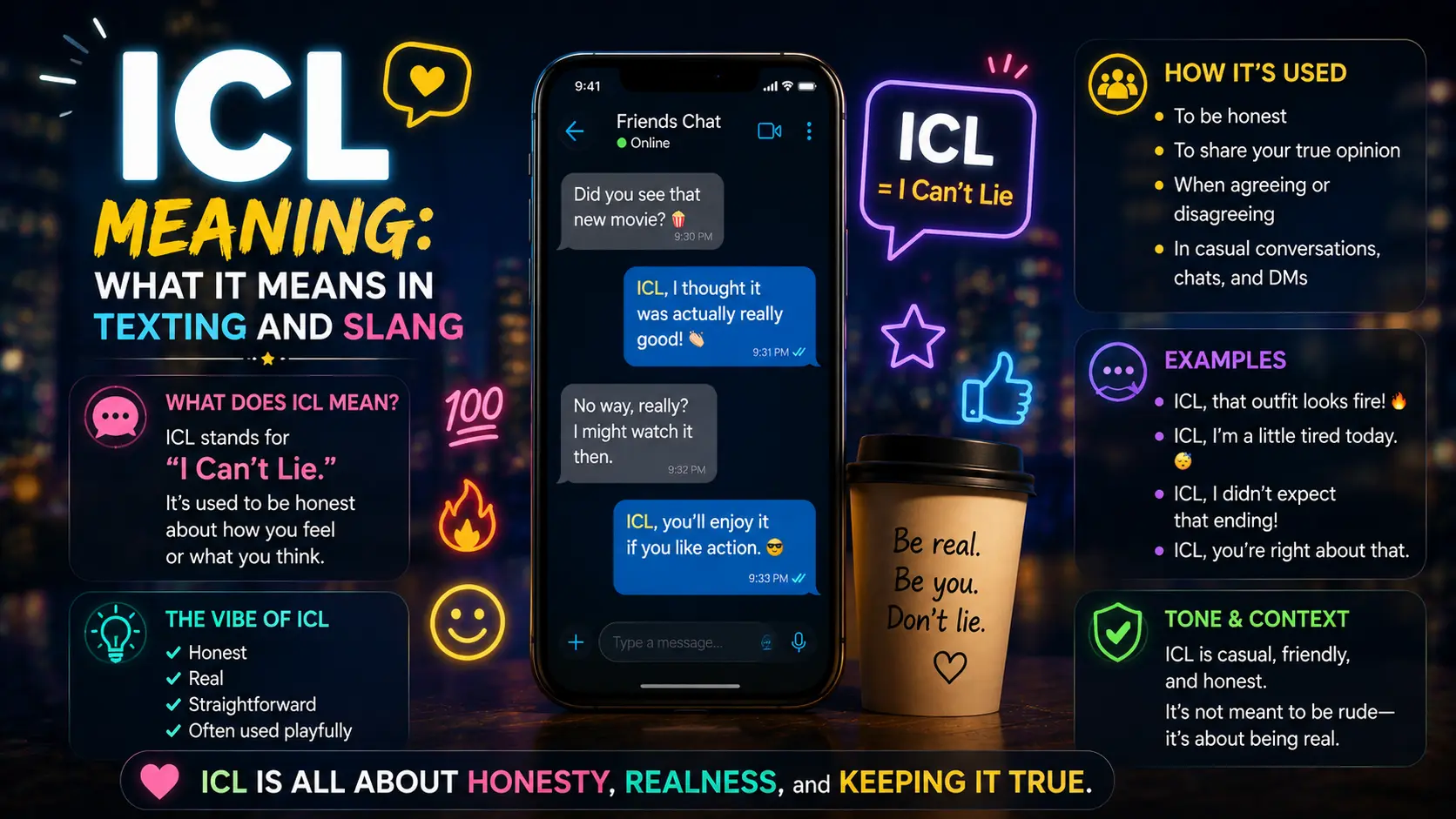
ICL usually means “I Can’t Lie” in texting and internet slang. People use it before an honest opinion, confession, reaction, or statement they want to emphasize. For example, “ICL, that movie was amazing” means “I can’t lie, that movie was amazing.”
The abbreviation is especially common in casual digital communication, including text messages, social media comments, direct messages, and online conversations. Its tone is generally informal and conversational.
TL;DR
- ICL most commonly stands for “I Can’t Lie.”
- It introduces an honest opinion, reaction, or admission.
- It is similar to NGL (“Not Gonna Lie”) and sometimes TBH (“To Be Honest”).
- ICL is mainly used in casual texting and social media.
- It can express sincerity, emphasis, agreement, surprise, or personal opinion.
- ICL is generally not appropriate for formal or professional writing.
What Does ICL Mean in Texting?
ICL Meaning in Everyday Messages
In everyday texting, ICL means “I Can’t Lie.” Someone typically uses it when they want to signal that what follows is their genuine opinion or an honest reaction.
For example, a person might text, “ICL, I was nervous before the interview.” Here, ICL tells the reader that the speaker is openly admitting something rather than trying to make the situation sound better than it was.
The phrase can also introduce a positive statement. “ICL, your new haircut looks great” simply emphasizes that the compliment is sincere.
What ICL Stands For
The three letters represent I Can’t Lie:
- I = I
- C = Can’t
- L = Lie
Although the full phrase is perfectly understandable in ordinary English, shortening it to ICL makes communication faster and fits the abbreviated style commonly found in digital conversations.
ICL does not usually represent a completely different phrase when it appears in casual texting. However, context can matter because abbreviations may have specialized meanings in particular communities or professional fields.
Simple Examples of ICL
Here are a few natural examples:
- “ICL, that was the best concert I’ve been to.”
- “ICL, I didn’t expect you to win.”
- “ICL, this restaurant is really good.”
- “ICL, I’m tired today.”
- “ICL, you were right about that.”
In each example, ICL functions as an informal signal of honesty or emphasis.
Where Did ICL Come From?
Origins of “I Can’t Lie”
The expression “I can’t lie” is much older than the abbreviation ICL. English speakers have long used phrases such as “I can’t lie” or “I can’t lie to you” before giving a personal opinion or admission.
The phrase works conversationally because it frames the following statement as candid. A speaker might say, “I can’t lie, I was disappointed,” to make clear that they are being direct about their feelings.
ICL is essentially a shortened digital version of this familiar expression rather than an entirely new phrase.
How ICL Became Internet Slang
As online communication became increasingly informal, users developed abbreviations that could communicate familiar expressions with fewer characters.
Texting culture helped popularize shortened expressions such as LOL, BRB, IDK, TBH, NGL, FR, and eventually ICL. Social media further encouraged these compact forms because users communicate through short comments, captions, messages, and replies.
ICL fits naturally into this environment because “I can’t lie” already works as a conversational introduction. The abbreviation simply makes the expression quicker to type.
The Role of Texting and Social Media
Social platforms have made slang more visible across different communities and age groups. An abbreviation that begins in one online group can quickly appear in comments, memes, messages, and short-form videos.
ICL benefits from this type of communication because its meaning can usually be understood from context. When someone writes “ICL, that’s actually impressive,” the reader can recognize that the writer is emphasizing a genuine reaction.
How ICL Is Used in American English
ICL in Text Messages
In American texting, ICL is most often used between friends, acquaintances, classmates, or other people who already communicate casually.
It can introduce almost any personal reaction:
“ICL, I thought you were going to be late.”
“ICL, I really like this song.”
“ICL, that answer makes sense.”
The abbreviation gives the message a relaxed, conversational quality.
ICL on Social Media
ICL can also appear in social media comments, captions, replies, and direct messages. Users may place it at the beginning of a sentence to make their opinion sound more candid.
For instance, a comment such as “ICL this might be your best post” communicates a positive opinion while adding an informal sense of sincerity.
ICL in Online Conversations
In online conversations, ICL can help establish the speaker’s attitude. Since text does not provide facial expressions or vocal tone, abbreviations sometimes help communicate how a statement should be interpreted.
ICL can therefore function as a small conversational cue: “I’m being honest with you.”
See Also: Mushroom Symbolism and Spiritual Meaning in the USA
What Does ICL Mean Emotionally?
Honesty and Sincerity
The strongest emotional association with ICL is honesty. When someone writes ICL, they often want the next statement to sound genuine rather than carefully filtered.
For example, “ICL, I missed talking to you” can make the statement feel more personal and vulnerable than simply saying “I missed talking to you.”
However, ICL does not guarantee that a statement is objectively true. It signals the speaker’s intention to present something as honest or candid.
Agreement and Emphasis
ICL can also strengthen agreement or emphasize a personal judgment.
Someone might write:
“ICL, you made the right decision.”
The phrase does not necessarily add new information. Instead, it adds emphasis and makes the speaker’s agreement feel more direct.
Surprise, Admiration, or Disbelief
Depending on the sentence, ICL can introduce surprise or admiration.
Examples include:
- “ICL, I didn’t think you’d actually do it.”
- “ICL, that was incredible.”
- “ICL, I wasn’t expecting that.”
The emotional meaning comes primarily from the words that follow ICL and the broader conversation.
ICL Tone and Context
When ICL Sounds Casual
ICL is naturally casual. It works particularly well when people are chatting quickly and do not need formal language.
Friends might use it when discussing music, food, relationships, entertainment, school, work experiences, or everyday events.
Its abbreviated spelling makes the conversation feel more like internet or texting language than traditional written English.
When ICL Adds Emphasis
ICL can make a statement feel stronger without changing its literal meaning.
Compare:
“That was a good game.”
with:
“ICL, that was a really good game.”
The second version communicates a stronger sense of personal conviction. The writer is highlighting that the opinion is sincere.
How Punctuation Changes the Tone
Punctuation can subtly affect how ICL feels.
“ICL, that was amazing.” sounds straightforward and sincere.
“ICL… that was amazing.” may sound more reflective or emotionally charged.
“ICL 😭 that was hilarious.” can make the statement feel playful and expressive.
The abbreviation stays the same, but surrounding punctuation, emojis, capitalization, and wording can change the perceived tone.
ICL Meaning on Social Media
TikTok, Instagram, and Snapchat
ICL can appear naturally on platforms where users communicate through short captions, comments, replies, and private messages.
A user may write “ICL this trend is getting old” or “ICL, I love this outfit.” In these cases, the abbreviation helps create an informal, conversational voice.
Its use can vary by community, age group, and platform, so not every user will recognize it immediately.
Comments, Captions, and Direct Messages
ICL is especially useful when someone wants to give an opinion without writing a longer introduction.
For example:
“ICL, this is underrated.”
That short sentence communicates both the opinion and the speaker’s desire to present it as candid.
ICL as Part of Internet Slang
ICL belongs to a larger group of internet abbreviations designed around speed, informality, and conversational expression.
Unlike technical acronyms, slang abbreviations such as ICL often depend heavily on social context. Their purpose is not only to save characters but also to reproduce the relaxed style of spoken conversation.
Examples of ICL in Conversation
Friendly Examples
Person A: “Did you like the new restaurant?”
Person B: “ICL, it was better than I expected.”
Here, ICL introduces a straightforward personal opinion.
Another example:
“ICL, you always know how to make me laugh.”
This use is warm and complimentary.
Serious or Emotional Examples
ICL can also introduce a more personal admission:
“ICL, I was pretty upset about what happened.”
Or:
“ICL, I didn’t know how to respond at the time.”
In these situations, ICL emphasizes openness and vulnerability.
Funny and Casual Examples
ICL is frequently used in humorous conversations:
“ICL, I opened the fridge three times and still expected new food to appear.”
Or:
“ICL, I only went to the gym for the air conditioning.”
The abbreviation can make a joke feel more spontaneous and conversational.
See Also: Glizzy Meaning in 2026: What It Stands For & Safer Alternative
ICL vs. Similar Texting Abbreviations
ICL vs. NGL
ICL means “I Can’t Lie,” while NGL means “Not Gonna Lie.”
They are extremely similar because both can introduce an honest opinion or admission.
For example:
- “ICL, this is pretty good.”
- “NGL, this is pretty good.”
In many casual situations, either one could work.
ICL vs. TBH
TBH means “To Be Honest.”
It serves a similar purpose but is slightly more general. TBH can introduce an opinion, admission, or direct response without necessarily sounding as conversational as “I can’t lie.”
ICL: “I Can’t Lie…”
TBH: “To Be Honest…”
Both emphasize sincerity.
ICL vs. IMO
IMO means “In My Opinion.”
The distinction is important. IMO specifically identifies something as the writer’s opinion, whereas ICL emphasizes honesty or candidness.
For example:
“IMO, the first movie was better.”
focuses on the person’s opinion.
“ICL, the first movie was better.”
focuses more on the speaker’s candid reaction.
ICL vs. FR
FR commonly means “For Real.”
It is often used to express agreement, emphasis, or sincerity.
For example:
“That was hilarious.”
“FR.”
ICL and FR can overlap emotionally, but they generally perform different conversational functions.
Common Misunderstandings About ICL
Is ICL Always Slang?
No. ICL can have other meanings in specialized contexts, particularly as an initialism or acronym.
However, when you see ICL in a casual text, social-media comment, or informal online conversation, “I Can’t Lie” is a common interpretation.
Context should always be considered before assigning a meaning to an abbreviation.
Can ICL Have Other Meanings?
Yes. Acronyms can have different meanings in technology, business, education, medicine, organizations, and other specialized fields.
For this reason, seeing the three letters ICL alone does not automatically establish one universal definition.
If the surrounding conversation is about texting or internet slang, “I Can’t Lie” is usually the more relevant interpretation.
Why Context Matters
The same abbreviation can mean different things in different environments. A message from a friend and a document from a professional organization may use ICL in completely different ways.
Look at the surrounding words, the platform, the subject of the conversation, and the relationship between the people communicating.
Is ICL Appropriate in Professional Communication?
Casual vs. Formal Conversations
ICL is primarily an informal abbreviation. It can be perfectly natural in a casual message but feel inappropriate in a formal email, business proposal, academic assignment, or official document.
Professional communication generally benefits from writing the complete phrase or choosing clearer formal wording.
When to Avoid ICL
Avoid ICL when your audience may not understand internet slang or when clarity and professionalism are especially important.
Instead of:
“ICL, I think we should change the plan.”
a professional message could say:
“To be honest, I think we should reconsider the plan.”
The second version is clearer for a broad professional audience.
Better Alternatives in Professional Writing
Depending on the intended meaning, alternatives include:
- To be honest
- In my view
- I believe
- Honestly
- In my opinion
- Based on my experience
These expressions communicate the same general idea while fitting formal writing better.
How ICL Has Changed Over Time
From “I Can’t Lie” to ICL
The underlying phrase existed long before internet slang. What changed was the way people communicated it.
Digital communication encouraged users to shorten familiar expressions. ICL represents the compressed form of an already familiar conversational phrase.
The Influence of Internet Culture
Internet culture has made abbreviations an important part of informal written communication. Users often combine shortened words, emojis, punctuation, memes, and slang to reproduce the speed and personality of spoken conversation.
ICL fits this communication style because it is short but still carries a recognizable emotional signal.
Will ICL Remain Popular?
Internet slang constantly changes. Some abbreviations remain popular for years, while others become less common as new expressions emerge.
ICL may continue to appear in casual digital communication, but its popularity can vary between platforms and generations. Its continued usefulness comes from the fact that “I can’t lie” is a simple and familiar conversational phrase.
Contextual Meanings of ICL in the USA
ICL Among Younger Users
Younger internet users are often exposed to abbreviations through texting, social media, gaming, memes, and online communities.
That does not mean every young person uses ICL. Slang preferences differ significantly between individuals and communities.
ICL in Online Communities
Different online communities develop their own communication habits. An abbreviation can be very familiar within one group while being unfamiliar to another.
Therefore, understanding ICL is less about memorizing one rigid definition and more about recognizing the conversational context in which it appears.
ICL Across Different Conversation Styles
The same abbreviation can sound sincere, funny, dramatic, supportive, or blunt depending on what comes after it.
For example:
“ICL, you’re right.” can signal agreement.
“ICL, I don’t like it.” can introduce criticism.
“ICL, that was hilarious.” can express enthusiasm.
The words surrounding ICL determine much of its emotional impact.
FAQs About ICL Meaning
What does ICL mean in texting?
ICL usually means “I Can’t Lie” in texting. It is used to introduce an honest opinion, admission, reaction, or personal statement.
What does ICL stand for?
ICL commonly stands for “I Can’t Lie.” It is an informal abbreviation used in texting and internet conversations.
Is ICL slang?
Yes, when it is used to mean “I Can’t Lie,” ICL is generally considered internet or texting slang rather than formal English.
Is ICL rude or disrespectful?
ICL is not inherently rude or disrespectful. Its tone depends on the statement that follows it and the overall context of the conversation.
What is the difference between ICL and NGL?
Both can introduce an honest statement. ICL means “I Can’t Lie,” while NGL means “Not Gonna Lie.” In many casual conversations, they can be used in similar ways.
Can ICL mean something other than “I Can’t Lie”?
Yes. ICL can function as an acronym or initialism for other terms in specialized contexts. The surrounding context determines which meaning is intended.
Is ICL appropriate for professional messages?
Usually, no. ICL is informal slang, so formal alternatives such as “to be honest,” “I believe,” or “in my opinion” are generally more suitable for professional communication.
Why do people use ICL instead of “I can’t lie”?
People use ICL because it is short, quick, recognizable, and fits the informal style of digital communication. It also gives messages a conversational feel.
How should I respond when someone says ICL?
Respond according to the statement that follows. If someone says, “ICL, I really liked it,” you can simply acknowledge their opinion, agree, disagree politely, or ask them to explain why.
Conclusion
ICL most commonly means “I Can’t Lie” in texting and internet slang. It is used to signal honesty, emphasize a personal opinion, or introduce a candid reaction.
Its popularity reflects a broader trend in digital communication toward shorter, faster, and more expressive language. While ICL works naturally in texts, comments, and social media, it is generally better to use the full phrase or a formal alternative in professional writing.
Ultimately, context is the key to understanding ICL. When it appears in a casual American text or online conversation, “I Can’t Lie” is often the intended meaning.