Purple Ribbon Meaning: Symbolism, Uses & Awareness
What Does a Purple Ribbon Mean?
Core Definition
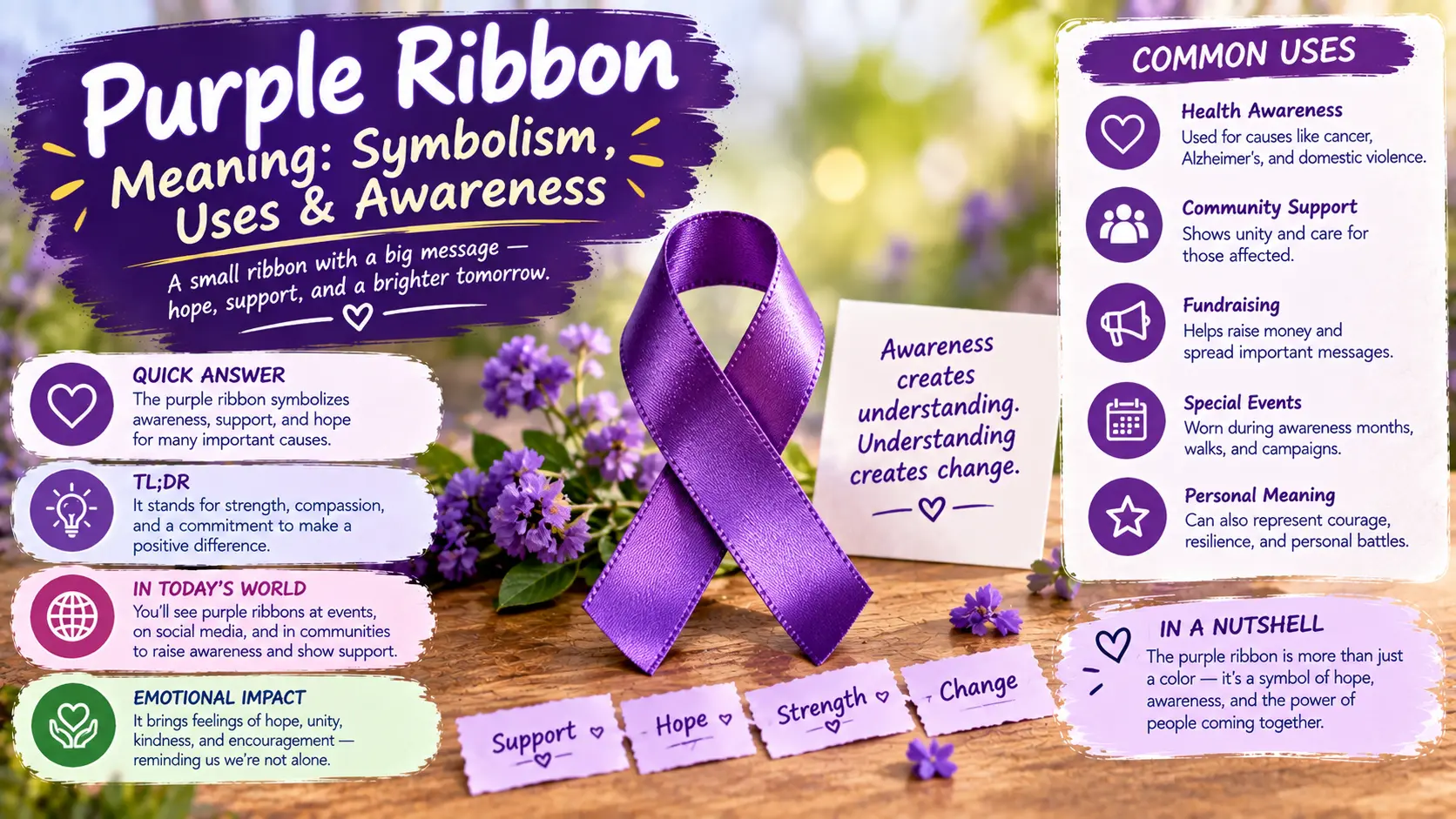
A purple ribbon is an awareness symbol used to show support, solidarity, remembrance, or advocacy for different causes. Unlike some awareness colors that are strongly associated with one specific issue, purple can represent several causes depending on the organization, campaign, country, and context.
Purple has also carried symbolic meanings for centuries. It is often associated with dignity, wisdom, compassion, strength, spirituality, transformation, and remembrance. When formed into an awareness ribbon, these qualities can become a visual expression of support for people and communities facing difficult circumstances.
The exact meaning should therefore be understood from its context. A purple ribbon worn at a fundraising event may represent a particular health condition, while the same color used during another campaign may support a completely different cause.
Common Symbolic Meanings
The purple ribbon commonly communicates awareness, hope, support, remembrance, courage, and solidarity. It can allow someone to express support without needing a long written explanation.
Its meaning may also be deeply personal. Someone might wear a purple ribbon to honor a loved one, participate in an awareness campaign, remember people affected by a particular issue, or simply demonstrate compassion toward a community.
Why Purple Is Used
Purple has a distinctive visual presence, making it easy to recognize on clothing, posters, websites, profile pictures, and event materials. Symbolically, it also combines associations traditionally connected with different colors.
Because purple has long been linked with royalty, spirituality, creativity, and reflection, organizations can use it to communicate seriousness while still creating a sense of hope and dignity.
What Is a Purple Awareness Ribbon?
Visual Characteristics
A traditional awareness ribbon is usually a narrow strip of material formed into a loop with crossed ends. A purple awareness ribbon uses a purple color that may range from soft lavender to deep violet.
There is no single universal shade of purple. Organizations may choose different shades depending on their branding, campaign materials, printing requirements, or intended emotional tone.
Where Purple Ribbons Appear
Purple ribbons can appear on lapels, shirts, bracelets, pins, banners, posters, websites, social-media graphics, fundraising materials, and event decorations.
Digital versions have become especially common. A purple ribbon may appear beside a hashtag, campaign message, profile image, or informational post to encourage people to learn about a cause.
Historical Meaning of the Color Purple
Ancient Associations With Purple
Purple has a long history as a meaningful color. In several ancient societies, purple dyes were difficult or expensive to produce, which contributed to associations with wealth, status, authority, and prestige.
Over time, purple developed additional associations with ceremony, spirituality, mystery, and reflection. These older meanings helped create a symbolic foundation for the modern use of purple in awareness campaigns.
Purple as a Symbol of Power and Dignity
Purple has often been connected with dignity and authority. This association can be especially meaningful when the color is used to represent people who are advocating for recognition, support, equality, or remembrance.
In awareness settings, the color can therefore suggest both compassion and strength. It does not necessarily communicate sadness alone; it can also represent resilience and determination.
From Tradition to Modern Symbolism
Modern symbolism has expanded beyond historical associations. Today, purple can represent individuality, creativity, emotional depth, spiritual reflection, hope, and transformation.
The awareness ribbon transformed the color into a compact visual message. Instead of purple simply being decorative, it can now communicate that a person is standing with a particular cause.
How Awareness Ribbons Became Popular
The Rise of Awareness Ribbons
Awareness ribbons became widely recognizable as a form of public advocacy during the late 20th century. Their simple design made them useful for communicating support at a glance.
The concept eventually expanded across health, social, humanitarian, and community campaigns. Different organizations began using different colors to distinguish their causes.
Why Colors Represent Different Causes
A color gives an awareness campaign an immediate visual identity. People can recognize a campaign symbol even before reading accompanying text.
However, the system is not completely standardized. The same color can represent multiple causes, which is why the surrounding message and organization remain important.
Adoption in the United States
In the United States, awareness ribbons became especially visible through charity events, nonprofit campaigns, public-service initiatives, fundraisers, and media coverage.
Their popularity also expanded with the growth of social media. Digital ribbons can now be shared globally within seconds, allowing awareness campaigns to reach audiences far beyond physical events.
Purple Ribbon Meaning in the United States
Common American Associations
In the United States, purple ribbons are associated with several awareness efforts. Depending on the campaign, they may represent Alzheimer’s and dementia awareness, domestic violence awareness, pancreatic cancer awareness, epilepsy awareness, lupus-related awareness, and other causes.
Because these associations overlap, a purple ribbon does not automatically identify one specific cause.
How Context Changes the Meaning
Context is one of the most important factors when interpreting a purple ribbon.
For example, a purple ribbon displayed alongside information about dementia will likely communicate support for dementia awareness. A purple ribbon at a different event could have an entirely different meaning.
When accuracy matters, look for the organization name, campaign slogan, event description, or accompanying symbol rather than relying on color alone.
See Also: Profound Definition & Hiatus Meaning Explained (2026)
What Causes Does a Purple Ribbon Represent?
Alzheimer’s and Dementia Awareness
Purple is widely recognized in connection with Alzheimer’s disease and dementia awareness. Purple-related branding is commonly used in campaigns that encourage education, support caregivers, promote understanding, and remember people affected by these conditions.
A purple ribbon in this context can represent compassion for individuals living with dementia as well as support for their families and caregivers.
Domestic Violence Awareness
Purple is also strongly associated with domestic violence awareness in the United States. Purple clothing, ribbons, and other symbols may be used during awareness campaigns to promote education, support survivors, and encourage communities to address domestic violence.
The ribbon can communicate solidarity while helping bring attention to an issue that may otherwise remain hidden.
Pancreatic Cancer Awareness
Purple is also used in pancreatic cancer awareness. Awareness campaigns can use purple imagery to encourage education, fundraising, support, and recognition of people affected by pancreatic cancer.
As with other causes, the specific campaign or organization should be checked when precise identification is important.
Epilepsy Awareness
Purple has also become associated with epilepsy awareness, particularly through campaigns connected with Purple Day and related initiatives.
In this setting, purple can help promote understanding of epilepsy and challenge misconceptions surrounding the condition.
Lupus and Other Health-Related Causes
Purple may also appear in campaigns connected with lupus and other health-related causes. Different organizations can adopt shades of purple or purple-based designs for their own awareness efforts.
This is another reason the phrase “purple ribbon” should not be treated as a single universal code.
Other Uses of Purple Ribbons
Beyond major health and social-awareness campaigns, purple ribbons can be used for memorials, community initiatives, fundraising events, victim-support campaigns, and other advocacy efforts.
A particular event may assign its own meaning to purple. Therefore, always consider the specific campaign before interpreting the symbol.
Emotional and Psychological Meaning of Purple
What Purple Can Communicate
Purple is often perceived as a color with emotional depth. It can communicate dignity, compassion, creativity, reflection, and strength.
When used in awareness campaigns, these qualities can make purple feel appropriate for causes involving remembrance, resilience, support, and transformation.
Feelings Associated With Purple
Different people may experience purple differently. Common associations include calmness, mystery, spirituality, empathy, seriousness, imagination, and hope.
A soft lavender may feel gentle and comforting, while a deep violet can appear more powerful or formal. These differences can influence the emotional tone of a campaign.
Purple as a Symbol of Strength and Hope
Purple can represent more than hardship. It can symbolize the determination to move forward, support others, and create positive change.
That combination of seriousness and hope makes purple particularly adaptable for awareness messaging.
Purple Ribbon Meaning in Modern Culture
Social Media and Online Awareness
Social media has transformed awareness ribbons into digital symbols. Users may add purple ribbons to posts, profile images, graphics, and campaign messages.
The advantage is visibility. A simple purple symbol can encourage others to ask questions, search for information, or share educational material.
Clothing, Jewelry, and Accessories
Purple awareness symbols can appear on pins, bracelets, necklaces, shirts, scarves, hats, and other accessories.
Some people wear them specifically for an awareness event, while others use them as an ongoing expression of support.
Fundraisers and Awareness Events
At charity walks, community gatherings, educational events, and fundraising campaigns, purple ribbons can help create a shared visual identity.
Large groups wearing the same color can communicate solidarity and make the campaign more visible to people outside the event.
Memorials and Community Campaigns
Purple can also appear in memorial displays or community campaigns. In these situations, the ribbon may communicate remembrance and respect rather than awareness alone.
The surrounding message usually provides the clearest indication of what the ribbon represents.
When Should You Wear or Display a Purple Ribbon?
Appropriate Situations
Wearing a purple ribbon can be appropriate when you are supporting an awareness campaign, attending a related event, honoring someone, participating in a fundraiser, or sharing educational information.
If you know the specific cause, pairing the ribbon with an appropriate message can make your support clearer.
How to Show Support Respectfully
The most respectful approach is to understand what the campaign represents before displaying its symbol. If an organization has specific guidance about its branding or fundraising materials, follow those instructions.
A simple ribbon can show solidarity, but learning about the cause and sharing reliable information can make the gesture more meaningful.
When Context or Explanation Is Helpful
If several causes use purple, explaining your intended meaning can prevent confusion.
For example, a social-media post can include the name of the awareness campaign rather than simply posting a purple ribbon without context.
Common Misunderstandings About Purple Ribbons
Why One Color Can Represent Multiple Causes
Awareness colors are not governed by one worldwide universal system. Different organizations may choose the same color for different campaigns.
Consequently, assuming that every purple ribbon has exactly the same meaning can lead to misunderstandings.
Confusion Between Different Awareness Campaigns
A person may recognize purple as an awareness color but incorrectly identify the specific cause.
The safest approach is to examine the campaign name, logo, event information, or accompanying text.
Does the Shade of Purple Change the Meaning?
Sometimes it can, but not always. Organizations may use different shades for branding purposes without creating a completely different symbolic meaning.
Unless a particular organization defines its shade specifically, the general context is usually more important than the exact color value.
See Also: Tenure Definition & Hiatus Meaning Explained (2026)
Purple Ribbon Symbolism Compared With Other Colors
Purple vs. Pink
Pink is widely associated with certain breast-cancer awareness campaigns, while purple is used across several different causes.
The important distinction is that neither color should automatically be interpreted without context.
Purple vs. Blue
Blue is also used for multiple awareness campaigns, including some health and social causes. Like purple, its meaning depends on the campaign.
Purple vs. Red
Red is frequently associated with campaigns involving heart health and other causes. Purple generally creates a different emotional impression, often emphasizing dignity, reflection, compassion, or resilience.
Purple vs. Green
Green can symbolize several health, environmental, and social causes. Purple and green can occasionally appear together in campaign materials, but their individual meanings still depend on context.
Why Awareness Colors Overlap
The overlap exists because awareness campaigns developed independently. Organizations may choose colors based on existing traditions, visibility, branding, symbolism, or community recognition.
For that reason, the color is a clue, not a complete definition.
Purple Ribbon Meaning Around the World
International Uses
Purple ribbons are used in awareness campaigns beyond the United States, but their exact associations can differ between countries.
A symbol that is strongly connected with one campaign in one region may have another meaning elsewhere.
Cultural Differences
Colors carry cultural associations that can vary considerably. Purple may represent spirituality, mourning, royalty, celebration, or other concepts depending on cultural and historical context.
This means international audiences may interpret a purple ribbon differently from an American audience.
Why Meanings May Vary by Region
Organizations often develop campaigns according to local history, public awareness, community needs, and existing symbolism.
Therefore, when participating in an international event, it is useful to check the local organization or campaign description before assigning a specific meaning to the ribbon.
Spiritual Meaning and Symbolism of Purple
Purple as a Symbol of Spirituality
In spiritual and symbolic traditions, purple is often connected with inner reflection, spiritual awareness, wisdom, mystery, and a sense of higher purpose.
These interpretations are symbolic rather than universal facts. Different spiritual traditions may understand purple in different ways.
Intuition, Wisdom, and Transformation
Purple is sometimes interpreted as a color of intuition, personal growth, transformation, and deeper understanding.
A purple ribbon may therefore have a personal spiritual meaning for someone who associates it with healing, change, remembrance, or emotional strength.
Personal Meaning and Interpretation
Personal symbolism can be meaningful even when it is different from an organization’s official meaning.
However, when a purple ribbon is being used for an established awareness campaign, the campaign’s recognized meaning should take priority over a private interpretation.
How Purple Ribbon Meaning Has Changed Over Time
Earlier Symbolism
Historically, purple carried associations with status, authority, spirituality, ceremony, and rarity.
These associations developed long before modern awareness ribbons existed.
Modern Awareness Culture
Modern awareness campaigns expanded purple’s meaning into areas such as support, advocacy, remembrance, education, solidarity, and hope.
The ribbon transformed an established color symbolism into a recognizable public-awareness tool.
Why Meanings Continue to Evolve
Symbolism changes as communities create new campaigns and organizations adopt visual identities.
Social media has accelerated this process because symbols can spread quickly and reach international audiences.
Purple Ribbon Etiquette: What to Know
Showing Support Without Misrepresenting a Cause
If you wear a purple ribbon, avoid implying that you represent an organization or campaign unless that is actually the case.
Showing personal support is different from officially representing a nonprofit, charity, or advocacy group.
Using Purple Ribbons Online
Digital purple ribbons can be useful for awareness posts, educational content, memorial messages, and fundraising campaigns.
For greater clarity, include the specific cause or campaign name whenever multiple meanings are possible.
Respecting Organizations and Awareness Campaigns
If an organization has rules about its logo, trademark, fundraising materials, or campaign branding, follow those guidelines.
Respectful awareness is not simply about using a color; it is also about accurately representing the people and cause behind the symbol.
FAQs About Purple Ribbon Meaning
Is the purple ribbon only for Alzheimer’s awareness?
No. Purple ribbons are associated with several causes, including Alzheimer’s and dementia awareness, domestic violence awareness, pancreatic cancer awareness, and epilepsy awareness. The exact meaning depends on context.
What does wearing a purple ribbon symbolize?
Wearing a purple ribbon can symbolize awareness, support, solidarity, remembrance, hope, or advocacy. Its specific meaning depends on the campaign or personal reason for wearing it.
What causes are represented by purple ribbons?
Purple ribbons are used for various causes, including Alzheimer’s and dementia awareness, domestic violence awareness, pancreatic cancer awareness, epilepsy awareness, and other campaigns.
Can I wear a purple ribbon without explaining it?
Yes. However, because purple represents multiple causes, adding a short explanation can help others understand what you are supporting.
Does the shade of purple matter?
Sometimes an organization may use a particular shade as part of its official branding. In general, however, the campaign and context matter more than the precise shade.
Is the purple ribbon used internationally?
Yes, purple ribbons and purple awareness symbols appear in campaigns in different countries. However, the specific meaning can vary by region and organization.
Can I use a purple ribbon on social media?
Yes. A purple ribbon can be used in social-media awareness posts when it accurately reflects the cause you are supporting. Adding the campaign name or educational information can reduce confusion.
What does a purple ribbon mean spiritually?
Spiritually, purple is often associated with wisdom, intuition, spirituality, transformation, reflection, and inner growth. A ribbon may take on these meanings personally, although awareness campaigns can have specific official meanings.
Conclusion
The purple ribbon meaning is broader than a single definition. It can represent awareness, support, remembrance, compassion, resilience, advocacy, and hope, while different organizations use purple for different causes.
Its historical associations with dignity, spirituality, authority, and reflection have helped make purple a powerful symbolic color. In modern culture, the ribbon adds another layer by turning that color into a recognizable expression of solidarity.
Because purple ribbons can represent multiple causes, context is essential. When you see or wear one, look at the accompanying campaign, organization, event, or message to understand what it specifically represents.