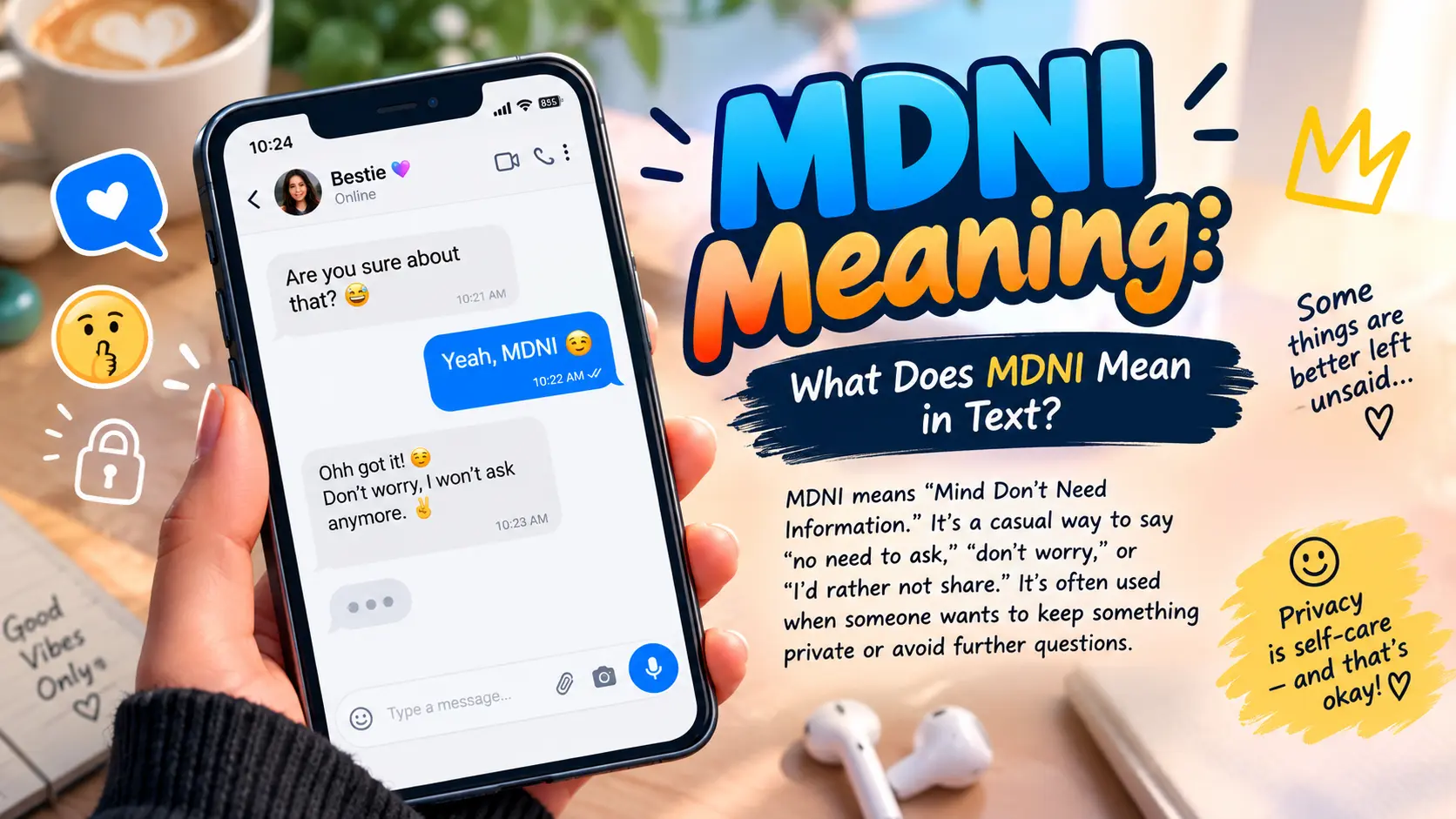
MDNI Meaning: What Does MDNI Mean in Text?
If you have ever seen “MDNI” in an Instagram bio, TikTok comment, online profile, or private community, you may have wondered what these four letters actually mean.
MDNI usually means “Minors Do Not Interact.” It is an internet abbreviation used to tell people under a certain age, commonly under 18, not to follow, comment, message, or otherwise engage with a particular account, post, or online space.
At first glance, MDNI can seem like another random piece of internet slang. However, it is slightly different from expressions such as LOL, BRB, or IDK. It communicates a clear personal or community boundary.
You may also see MDNI alongside terms such as 18+, Adults Only, DNI, or NSFW. Understanding how these expressions work together makes online conversations much easier to interpret.
MDNI Meaning: Quick Meaning
MDNI most commonly stands for:
MDNI = Minors Do Not Interact
In simple language, it means that people below the specified age should not engage with the person, content, account, or community.
The three parts are easy to understand:
- Minors: People below the legal or stated adult age.
- Do Not: A direct instruction or boundary.
- Interact: Engage through comments, messages, follows, participation, or other forms of contact.
Here are a few natural examples:
“18+ account, MDNI.”
“MDNI in the comments, please.”
“This community is adults only, MDNI.”
The exact meaning can depend on context. Some people may mean that minors should not follow them, while others may mean they should not comment, send messages, or participate in a particular community.
Origin & Background of MDNI
MDNI developed from the broader language of internet communities where users frequently establish personal boundaries.
The abbreviation is closely connected with DNI, which means “Do Not Interact.” By adding “Minors,” the speaker makes the restriction specifically about younger users.
Internet users often shorten longer phrases because social media encourages quick, compact communication. A sentence such as “People under 18 should not interact with this account” takes considerably more space than simply writing “MDNI.”
As social media communities became more specialized, these abbreviations became increasingly useful.
They can appear in profiles, pinned posts, captions, community descriptions, comment sections, and direct messages.
The growth of online fandoms, private communities, adult discussions, and creator spaces also contributed to the visibility of age-related boundaries.
One important point is that MDNI is generally a stated boundary rather than a technical security system. Writing MDNI on a public profile does not necessarily stop someone under 18 from viewing that profile.
It communicates the account owner’s expectation. It does not automatically enforce an age restriction.
Real-Life Conversations
Example 1: Instagram DM
Person A:
“Why does your bio say MDNI?”
Person B:
“It means minors do not interact. I keep this account for adults.”
Person A:
“Oh, I didn’t know what that meant.”
Person B:
“No worries. I just use it to make the boundary clear.”
This conversation shows how MDNI can function as a simple audience notice.
Example 2: TikTok Comments
Person A:
“Can anyone join this community?”
Person B:
“The bio says 18+ MDNI.”
Person A:
“So it is for adults only?”
Person B:
“Yeah, that’s what the label means.”
Here, the surrounding wording makes the meaning especially clear.
Example 3: WhatsApp Group
Person A:
“Can I add my younger cousin to the group?”
Person B:
“I wouldn’t. The group description says 18+ and MDNI.”
Person A:
“Okay, thanks for telling me.”
Person B:
“No problem. Better to follow the group rules.”
This example shows why understanding abbreviations can sometimes prevent awkward situations.
Example 4: Text Message
Person A:
“Someone wrote MDNI on their profile. What does it mean?”
Person B:
“Usually, ‘Minors Do Not Interact.’”
Person A:
“Oh, so it is an age boundary?”
Person B:
“Exactly. If they also wrote 18+, that makes it even clearer.”
See Also: Elope Meaning: Definition, Examples & Modern Usage
Emotional & Psychological Meaning
MDNI does not normally communicate an emotion such as happiness, sadness, anger, or excitement.
Instead, it communicates a boundary and an expectation.
Modern online communication can make personal boundaries difficult to express. People may receive messages from strangers, followers, and people outside their intended audience.
A short label can help establish expectations before an interaction happens.
From a psychological perspective, clear boundaries can reduce uncertainty. When someone writes MDNI, they are communicating who they want to engage with and who they do not want participating.
Imagine finding an account that discusses mature subjects. Before interacting, you notice “18+ MDNI” in the profile.
You immediately understand that the account is intended for adults.
In everyday communication, I have found that people often misunderstand abbreviations not because the abbreviation itself is difficult, but because they read it without considering the surrounding context. With MDNI, context is especially important because the exact boundaries may differ from one account to another.
Usage in Different Contexts
Social Media
MDNI is commonly found in social media profiles, captions, comments, and community descriptions.
Someone may use it to identify an account as intended for adults or to discourage interaction from minors.
Friends & Relationships
Friends may use MDNI while sharing information about an adult-only online community.
However, it is not usually necessary in ordinary conversations between close friends because people can simply explain the age restriction directly.
Work and Professional Settings
MDNI is generally not suitable for formal professional communication.
If a workplace needs to communicate an age requirement, clear wording is better.
For example:
“This event is restricted to participants aged 18 and over.”
This is more professional and immediately understandable.
Casual vs. Serious Tone
MDNI is an internet abbreviation, but that does not mean it should always be treated casually.
When someone uses MDNI in their profile or community rules, it generally represents a genuine boundary.
Ignoring it or making jokes about it may create unnecessary tension.
When NOT to Use It
Although MDNI is useful in certain online situations, there are contexts where using it can cause confusion.
Formal Communication
Avoid MDNI in formal letters, professional emails, school documents, or official notices unless the audience is already familiar with the abbreviation.
Writing the full phrase is clearer.
When You Mean Everyone Should Stay Away
If your intention is to tell everyone not to interact with you, MDNI may send the wrong message.
MDNI specifically identifies minors.
In that situation, a different phrase may be more appropriate.
When the Age Requirement Is Unclear
If you genuinely require users to be 18 or older, consider writing 18+ or Adults Only alongside MDNI.
This gives readers a clearer understanding of the requirement.
When Technical Protection Is Required
MDNI should not be considered a substitute for proper age verification, moderation, parental controls, or platform safety settings.
It communicates an expectation but does not necessarily prevent access.
With People Who Do Not Know Internet Slang
Not everyone knows what MDNI means.
If your audience includes older adults, professional contacts, or people who speak English as a second language, writing the full phrase may prevent confusion.
Common Misunderstandings
MDNI Means Adults Cannot Interact
This is one of the most common misunderstandings.
MDNI means minors should not interact. It does not normally tell adults to stay away.
MDNI Always Means Explicit Content
Not necessarily.
MDNI identifies an age-based boundary. It does not, by itself, explain exactly why a space is intended for adults.
The account may contain mature discussions, adult-oriented topics, private conversations, or other content the creator considers unsuitable for minors.
MDNI Automatically Blocks Minors
It does not.
MDNI is usually a written warning or boundary.
A person may still technically be able to view a public account or comment despite the label.
MDNI and NSFW Mean the Same Thing
They are related but have different purposes.
MDNI focuses on the audience and interaction.
NSFW generally warns that content may not be appropriate for viewing in certain environments.
MDNI Is Only Used on One Platform
No.
It can appear across different online communities and social platforms.
Its meaning generally remains the same, although the specific way people apply the boundary can vary.
Comparison Table
| Expression | Meaning | Main Purpose | Typical Tone |
|---|---|---|---|
| MDNI | Minors Do Not Interact | Establishes an age-based boundary | Direct |
| DNI | Do Not Interact | Tells someone not to engage | Direct |
| 18+ | Adults aged 18 and over | States an age requirement | Clear |
| Adults Only | Intended for adults | Identifies the intended audience | Formal |
| NSFW | Not Safe For Work | Warns about potentially unsuitable content | Informal |
| Minors DNI | Minors Do Not Interact | States the boundary in full | Very clear |
| Everyone Welcome | Broad audience invitation | Encourages participation | Friendly |
| Come Join | Invitation to participate | Encourages interaction | Casual |
Key Insight
The important distinction is that MDNI describes an age-based interaction boundary, while expressions such as NSFW primarily describe the nature or suitability of content. Seeing both together provides more context than either expression alone.
Variations and Types of MDNI
1. MDNI
Meaning: Minors Do Not Interact.
This is the shortest and most common form.
2. MDNI 18+
Meaning: Minors should not interact with an 18+ account or space.
The addition of 18+ makes the intended age group clearer.
3. 18+ MDNI
Meaning: Adults aged 18 and above are the intended audience.
This format is common in profile descriptions.
4. Minors DNI
Meaning: Minors, Do Not Interact.
It uses full words instead of the abbreviation.
5. MDNI Please
Meaning: A polite request for minors not to interact.
The word “please” makes the instruction sound somewhat softer.
6. MDNI in Replies
Meaning: Minors should not participate in the replies or comments.
The boundary may apply specifically to that discussion.
7. MDNI Account
Meaning: An account intended for adults.
The exact restrictions depend on the account owner.
8. MDNI Community
Meaning: A community intended for adults rather than minors.
This can apply to private groups, servers, forums, or other communities.
9. MDNI Content
Meaning: Content intended for an adult audience.
The label alone does not explain the specific reason for the age restriction.
10. MDNI + NSFW
Meaning: A combination indicating an adult-oriented audience and potentially unsuitable content.
Each abbreviation communicates a different piece of information.
How to Respond When Someone Uses It
Your response should depend on the situation and your relationship with the person.
Casual Replies
“Got it.”
“Thanks for clarifying.”
“Understood.”
These work well when you simply acknowledge the boundary.
Funny Replies
If you are clearly within the permitted audience and the situation is genuinely lighthearted, you might say:
“Four letters, message received.”
“Okay, boundary understood.”
Humor should never be used to pressure someone into changing a boundary.
Mature Replies
“Understood. I respect the boundary.”
“Thanks for making the audience requirement clear.”
These responses communicate maturity and respect.
Respectful Replies
If you are under the stated age restriction, the respectful response is generally to avoid interacting.
If you accidentally interacted before noticing the MDNI label, there is usually no need to argue about it. Simply stepping away is appropriate.
Regional & Cultural Usage
MDNI is primarily a form of global internet language, so its basic meaning tends to remain consistent across different countries.
However, the way people interpret age boundaries can be influenced by culture.
Western Culture
In Western online communities, MDNI can appear in social media bios, fandom spaces, private communities, creator accounts, and adult-oriented discussions.
The precise rules depend on the individual or community.
Asian Culture
Users across Asian countries may encounter MDNI on global platforms such as Instagram, TikTok, Discord, and other online communities.
Because English abbreviations travel across borders quickly, people may recognize MDNI even when English is not their first language.
Middle Eastern Culture
MDNI can also appear in global online spaces used by people in Middle Eastern countries.
Cultural attitudes toward age, privacy, relationships, and mature topics vary widely, so the abbreviation itself should not be treated as a complete explanation of someone’s cultural values.
Global Internet Usage
Internet culture has made abbreviations such as MDNI recognizable in many countries.
Still, recognition should never be assumed.
If you are communicating with a broad international audience, spelling out “Minors Do Not Interact” is usually clearer.
Gen Z vs. Millennials
Younger internet users may encounter MDNI more frequently because abbreviated communication is common across modern social platforms.
Millennials can also be familiar with it, particularly if they participate in online communities, fandoms, gaming groups, or social media.
The platform and community often influence slang more strongly than someone’s generation alone.
Is MDNI Safe for Kids?
The abbreviation itself is not harmful.
In fact, MDNI is generally used to communicate that a particular online space is not intended for minors.
Children and teenagers should understand that MDNI is a boundary rather than an invitation to investigate what lies behind it.
If an account says MDNI, 18+, or Adults Only, a minor should respect the stated restriction and avoid interacting with that account or community.
Parents or guardians can explain the phrase simply:
“MDNI means minors should not interact with this account or community.”
It is also important to remember that an MDNI label does not necessarily prevent someone from seeing public content. The effectiveness of the boundary depends partly on the platform’s privacy and age-related settings.
FAQs About MDNI Meaning
What does MDNI mean in text?
MDNI usually means “Minors Do Not Interact.” It is an internet abbreviation used to establish an age-related boundary.
What does MDNI mean on TikTok?
On TikTok, MDNI generally means “Minors Do Not Interact.” It may appear in a profile, comment, caption, or community-related context.
What does MDNI mean on Instagram?
On Instagram, MDNI generally tells minors not to interact with an account, post, or online community.
Is MDNI the same as 18+?
Not exactly. 18+ identifies an age requirement, while MDNI specifically tells minors not to interact.
Does MDNI mean NSFW?
No. MDNI means “Minors Do Not Interact,” while NSFW is generally used to warn that content may not be appropriate for work or general viewing.
What is the difference between DNI and MDNI?
DNI means “Do Not Interact.” MDNI means “Minors Do Not Interact.” MDNI specifically identifies minors as the group being asked not to engage.
Should minors interact with an MDNI account?
No. If an account clearly states MDNI, minors should respect the stated boundary and avoid following, commenting, messaging, or participating.
Conclusion
Understanding MDNI meaning is ultimately about understanding online boundaries.
The most common meaning of MDNI is “Minors Do Not Interact.” You may encounter it in social media bios, comments, captions, private communities, and online discussions.
The abbreviation itself is simple, but the message behind it can be important. It tells readers that the account owner or community has established an age-related expectation.
When you see MDNI, pay attention to the surrounding words. Look for terms such as 18+, Adults Only, or DNI because they can provide additional context.
Internet language changes quickly, but one communication principle remains constant: clear boundaries deserve clear understanding and respectful behavior.
Knowing what MDNI means helps you navigate online spaces more confidently, avoid unnecessary misunderstandings, and communicate with greater awareness.