Context Definition: Understanding Meaning, Use, and Alternatives
Quick Answer
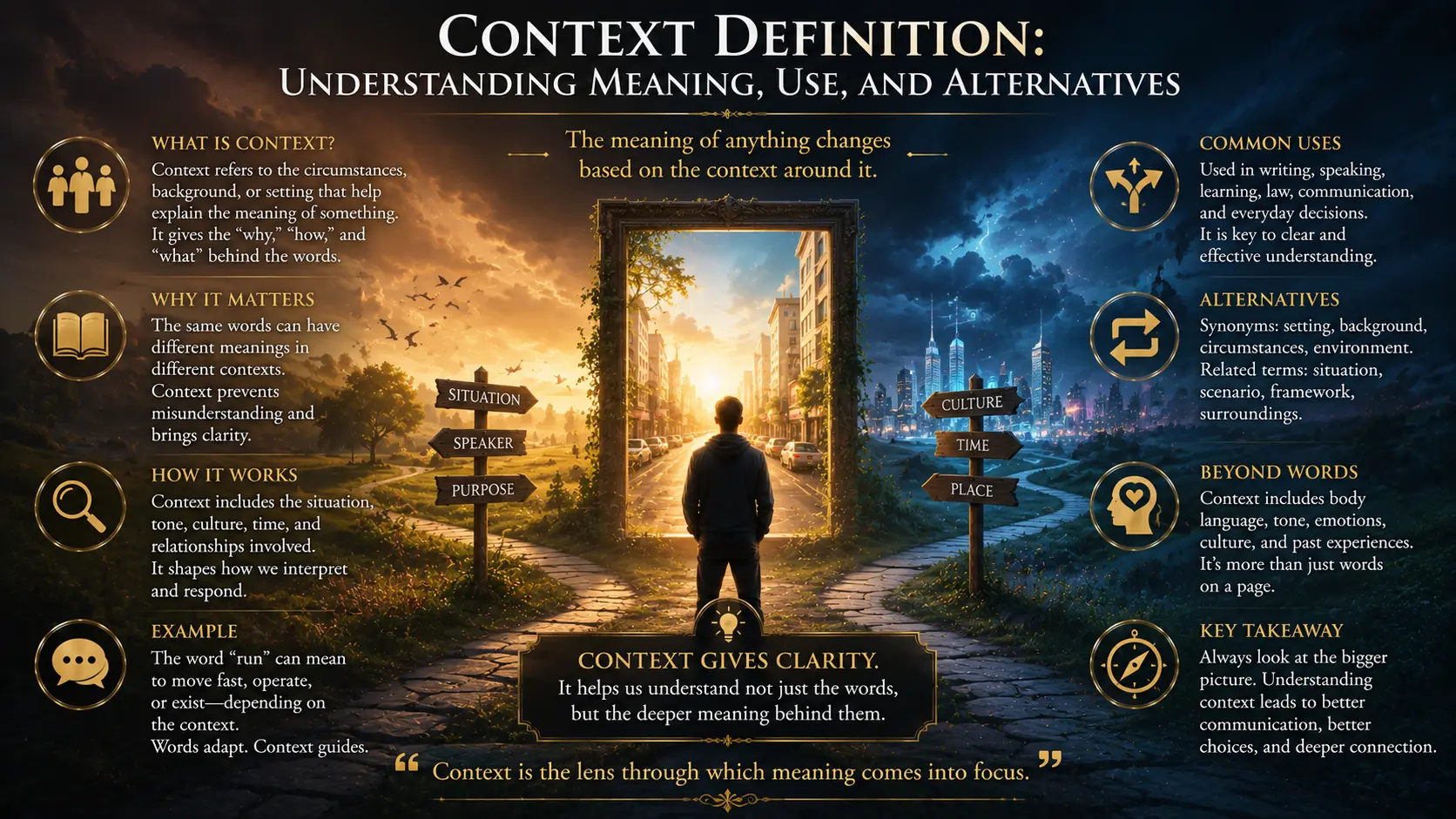
Context is the surrounding information, circumstances, conditions, or experiences that help explain the meaning of a word, statement, event, action, or situation. In simple terms, context tells us what is happening around something so we can understand it correctly.
For example, if someone says, “That was cold,” the context determines whether they mean the weather was cold, a drink was cold, or someone’s behavior was emotionally insensitive.
TL;DR
Context provides the surrounding details needed to understand something accurately. It can include time, place, culture, people, history, language, emotions, purpose, and circumstances. Context is important in communication, law, education, media, relationships, and everyday decision-making because the same words or actions can have different meanings in different situations.
What Is Context?
Context refers to the circumstances and surrounding information that give meaning to something. It helps us interpret words, behavior, events, images, decisions, and ideas rather than viewing them in isolation.
The meaning of a statement often depends on what came before it, who said it, where it was said, why it was said, and how it was delivered. Without those details, people may reach different or incorrect conclusions.
Core Elements of Context
Context can contain several important elements:
- Time: When something happened.
- Place: Where it happened.
- People: Who was involved.
- Culture: Shared beliefs, customs, and expectations.
- History: Events that happened previously.
- Purpose: The reason something was said or done.
- Language: The words, expressions, and meanings being used.
- Emotional state: Feelings that influence interpretation.
- Social circumstances: Relationships, roles, and expectations.
- Situation: The immediate circumstances surrounding an event.
These elements work together to create a fuller picture. A single sentence can therefore communicate something very different depending on its context.
Simple Example
Consider the sentence, “You’re early.”
If a teacher says it to a student arriving before class, it may be a compliment. If a friend says it after waiting for an hour, it could be sarcastic. If someone says it after an appointment was canceled, it might simply describe the timing.
The words remain identical, but the context changes the interpretation.
Historical Roots of the Idea of Context
The basic idea of context is much older than the modern word itself. People have always recognized that words, actions, traditions, and events must be understood in relation to their surrounding circumstances.
Ancient philosophers, historians, teachers, and legal thinkers regularly considered circumstances when interpreting statements and actions. Over time, this general idea became increasingly important in linguistics, philosophy, law, literature, and social sciences.
Early Foundations
Early systems of rhetoric and philosophy emphasized the importance of considering who was speaking, to whom, where, when, and for what purpose. These questions helped audiences understand arguments beyond their literal wording.
Historical interpretation also depended heavily on circumstances. A law, speech, poem, or political decision could not always be understood accurately without considering the society and period in which it was produced.
Shift Toward Formal Definitions
As modern academic disciplines developed, context became a more formal analytical concept. Linguistics began examining how surrounding words and situations influence meaning, while historians emphasized historical circumstances.
Social sciences expanded the idea further by examining how institutions, communities, culture, identity, and social relationships affect human behavior and interpretation.
Why Context Matters in the United States
Context plays an important role in American society because the United States contains diverse communities, regional traditions, languages, professions, and cultural experiences.
A phrase that seems ordinary in one community may have a different implication in another. Understanding context can therefore reduce unnecessary conflict and help people interpret differences more accurately.
Cultural Importance
American culture includes influences from many historical and cultural traditions. Regional expressions, generational slang, workplace customs, religious traditions, and community norms can all affect how people interpret language.
For this reason, understanding context is especially useful when discussing subjects involving culture, identity, history, politics, education, and social behavior.
Everyday Life
Context appears constantly in ordinary American life. People use it when interpreting conversations, text messages, advertisements, workplace instructions, news stories, classroom discussions, and social interactions.
For instance, the phrase “That’s interesting” can express genuine curiosity, polite disagreement, surprise, or sarcasm. The speaker’s tone and the surrounding conversation provide the context needed to determine its likely meaning.
Context in American Law and Justice
Context has a particularly important role in legal interpretation. Courts and attorneys may consider the circumstances surrounding a statement, action, agreement, dispute, or alleged offense.
Legal context can include the wording of a law, previous legal decisions, historical circumstances, the facts of a case, and the relationship between relevant events.
Legal Context Explained
In legal situations, isolated words may not always provide enough information. Courts may need to understand the complete circumstances surrounding a dispute.
For example, interpreting a contract may require looking at the language of the agreement alongside the circumstances in which it was created. Similarly, evidence or statements may have a different significance when considered alongside the broader facts of a case.
Why It’s Contested
Context can become controversial because different people may disagree about which surrounding facts deserve attention or how those facts should be interpreted.
This is particularly important when historical circumstances, constitutional language, legislative intent, or competing interpretations are involved. Context can clarify meaning, but it does not automatically produce one universally accepted interpretation.
Context in Language and Communication
Language rarely operates independently from its surroundings. Meaning is shaped by the words around a statement as well as by tone, relationships, circumstances, and shared knowledge.
This is why understanding a sentence literally is sometimes not enough.
Communication Layers
Communication can contain multiple layers of context:
- Literal context — the words immediately surrounding a statement.
- Situational context — what is happening at the time.
- Social context — relationships and social expectations.
- Cultural context — shared customs and values.
- Historical context — relevant events from the past.
- Emotional context — feelings influencing the interaction.
- Digital context — platform, audience, and surrounding online material.
Considering these layers can produce a much more accurate interpretation.
Miscommunication Risks
Removing context can cause people to misunderstand jokes, criticism, compliments, sarcasm, or instructions.
A short text message may sound rude because written communication lacks facial expressions and vocal tone. A social-media post can also appear offensive or confusing when a short excerpt is separated from the original discussion.
Context does not eliminate misunderstanding, but it provides additional information for interpreting meaning.
Emotional and Psychological Role of Context
Context affects not only intellectual interpretation but also emotional responses. People bring previous experiences and expectations into their understanding of situations.
The same event may therefore produce very different reactions among different individuals.
Emotional Associations
Words and experiences can carry emotional associations based on personal history. A particular song, location, phrase, or date may have positive meaning for one person and painful or uncomfortable meaning for another.
The surrounding personal context helps explain why people respond differently to apparently identical experiences.
Identity and Experience
Personal identity and life experience can influence how someone interprets communication. Age, education, community, professional experience, family background, and previous experiences may shape expectations.
This does not mean that every interpretation is equally accurate. Instead, it means that understanding someone’s perspective may require considering the context that informs it.
Context in Media and Digital Spaces
Digital communication has made context both more accessible and easier to lose. Social platforms allow information to spread rapidly, but posts can be copied, cropped, reposted, or quoted without their original surroundings.
As a result, digital audiences often need to reconstruct context before deciding what something means.
Digital Context Examples
Digital context may include:
- The original post
- The complete conversation
- The date and time
- The intended audience
- The platform
- Previous posts
- Attached images or videos
- Links and references
- Tone and formatting
- Whether the content is serious, satirical, or promotional
A screenshot showing only one sentence may provide much less information than the complete conversation.
Impact on Society
Loss of context can contribute to confusion, exaggerated reactions, and disagreements online. Headlines, short clips, and isolated quotations may encourage audiences to form opinions before seeing the complete material.
Developing context awareness is therefore an important part of digital literacy.
Alternatives and Related Concepts to Context
Several words overlap with context, but they are not always exact substitutes. The appropriate term depends on what kind of surrounding information is being discussed.
Common Alternatives
Common related terms include:
- Background — previous information that helps explain something.
- Setting — the time and place where something occurs.
- Circumstances — conditions surrounding an event.
- Environment — surrounding physical or social conditions.
- Framework — a structure used to understand an idea.
- Situation — the particular conditions existing at a given moment.
- Perspective — a person’s way of viewing something.
- Surroundings — things physically or conceptually around something.
Key Difference
Context is broader than many of these terms. Background usually focuses on previous information, while setting commonly describes time and place.
Context can include background and setting while also incorporating cultural, social, emotional, historical, linguistic, and situational information.
Context Across Cultures
Context does not work identically in every culture. Communication styles, social expectations, gestures, humor, politeness, and assumptions vary across societies.
Understanding cultural context can therefore prevent people from interpreting unfamiliar behavior solely according to their own expectations.
Cross-Cultural Patterns
A gesture considered friendly in one culture may be interpreted differently elsewhere. Similarly, direct communication may be viewed as honest and efficient in one cultural environment but overly aggressive in another.
Humor is another strong example. A joke may depend on cultural references that are obvious to one audience but meaningless to another.
Why This Matters
Cross-cultural awareness encourages people to ask, “What does this mean in its original context?” rather than immediately assuming that their own cultural interpretation is universal.
This approach is useful in international business, travel, education, diplomacy, online communication, and multicultural communities.
Misunderstandings and Misuse of Context
Although context is essential, it can also be misused. Saying that something needs context should not become an excuse for ignoring clear facts or avoiding legitimate criticism.
Good interpretation requires both surrounding information and careful attention to evidence.
Common Problems
Common mistakes include:
- Removing a statement from its original setting.
- Providing too little background.
- Adding irrelevant information.
- Assuming intentions without evidence.
- Treating personal interpretation as objective fact.
- Using context selectively to support a preferred conclusion.
- Confusing explanation with justification.
Balanced View
Context should clarify information rather than manipulate it. Relevant context helps people understand why something happened or what someone meant.
However, context does not automatically excuse harmful behavior, make a false statement true, or eliminate responsibility. It provides additional information that should be evaluated alongside other evidence.
How Context Changes Over Time
Context is not always fixed. Social norms, technology, language, institutions, and historical circumstances can change the meaning associated with words and events.
A phrase that once had a particular meaning may develop a new meaning generations later.
Forces of Change
Context can change because of:
- Technological developments
- Cultural change
- Political events
- Generational differences
- Changes in language
- Economic conditions
- Social movements
- New laws or institutions
- Major historical events
Understanding historical context can therefore prevent modern assumptions from being projected onto the past.
American Example
American expressions and cultural references frequently change across generations. A phrase popular among one generation may sound outdated or carry a different association for another.
Digital communication has accelerated this process by allowing slang, memes, abbreviations, and cultural references to spread rapidly across communities.
Context in Everyday American Life
Context is not simply an academic concept. People use contextual reasoning throughout their daily lives, often without consciously recognizing it.
Whether someone is deciding how to respond to a message or trying to understand a news report, they are often gathering contextual clues.
Common Situations
Context matters when:
- Reading a text message
- Understanding workplace instructions
- Interpreting a news headline
- Watching a movie
- Reading a historical document
- Understanding a joke
- Resolving an argument
- Interpreting a teacher’s feedback
- Evaluating an advertisement
- Understanding social-media content
Practical Awareness
A simple habit can improve contextual understanding: pause before judging isolated information.
Ask who created it, when it was created, what happened before it, who the intended audience is, and what circumstances surround it. These questions can reveal important details that are not obvious from the information alone.
Context Across Common Settings (Table)
| Setting | What Context Includes | Why It Matters |
|---|---|---|
| Conversation | Tone, relationship, words, situation | Helps identify intended meaning |
| Education | Subject, lesson, instructions, prior knowledge | Improves understanding |
| Law | Facts, wording, history, circumstances | Supports careful interpretation |
| Media | Source, date, headline, complete story | Reduces misleading conclusions |
| Social Media | Original post, replies, platform, audience | Prevents decontextualization |
| Workplace | Role, goals, policies, expectations | Clarifies instructions |
| History | Time period, culture, events | Explains past actions and ideas |
| Literature | Characters, setting, themes, period | Deepens interpretation |
| Relationships | Shared experiences, emotions, history | Reduces personal misunderstandings |
| Cross-Cultural Communication | Customs, language, norms | Encourages accurate interpretation |
FAQs
What is the simplest definition of context?
Context is the surrounding information or circumstances that help explain the meaning of something. It tells us what is happening around a word, statement, event, or action.
Why is context important in communication?
Context helps people understand what a speaker or writer actually intends. Without it, words can be interpreted literally, incorrectly, or differently from their intended meaning.
Can context change the truth of a statement?
Context generally does not change whether an objectively verifiable fact is true, but it can change what a statement means, how it should be understood, or how relevant it is to a particular situation.
Is context subjective?
Context can contain objective facts, such as dates, locations, and documented events. However, people may disagree about which information is relevant or how contextual details should be interpreted.
What’s the difference between context and background?
Background usually refers to information that explains what came before something. Context is broader and can include background, setting, circumstances, culture, relationships, history, language, and purpose.
Conclusion
The context definition is simple but powerful: context is the surrounding information and circumstances that help us understand meaning.
It explains why identical words can communicate different messages and why events cannot always be interpreted accurately in isolation. Context operates across language, culture, law, psychology, media, history, and everyday life.
The most useful approach is to look beyond the isolated statement and consider the circumstances surrounding it. At the same time, context should be used responsibly. It should add clarity, not distort facts or excuse unsupported conclusions.
Ultimately, understanding context means asking a fundamental question: “What else do I need to know to understand this correctly?”