Sans Meaning in English: Definition, Usage & Examples
Simple Definition of Sans
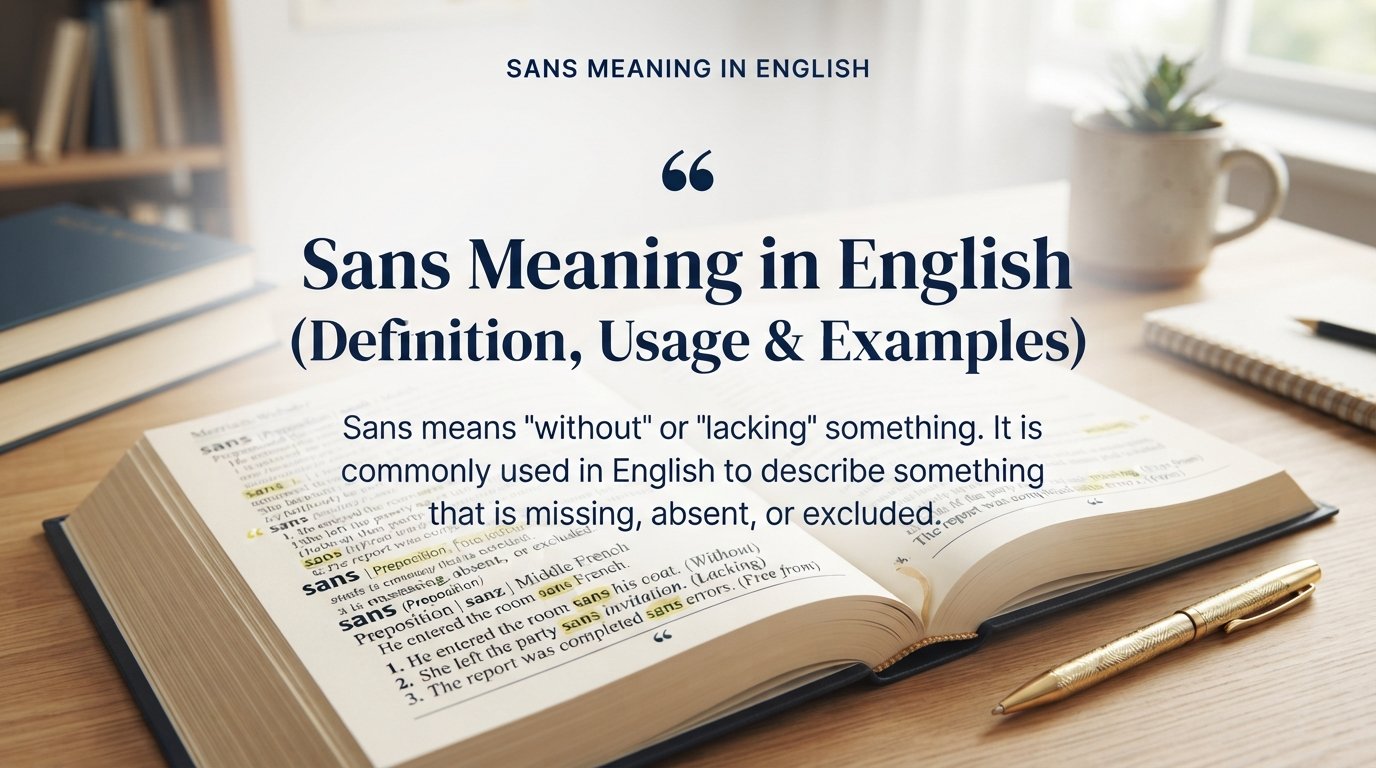
“Sans” means “without” or “in the absence of” something. It is a preposition that comes from French but is also used in English, particularly in writing, menus, descriptions, creative language, and expressions where a concise or slightly stylish tone is desired.
For example, “coffee sans sugar” means coffee without sugar. Likewise, “a life sans distractions” means a life without distractions.
The word usually introduces something that is missing, excluded, or intentionally left out. Although it can sound more sophisticated than “without,” its basic meaning is quite simple.
Sans vs. Without
The easiest way to understand sans is to treat it as a direct synonym for without in many contexts.
- Sans sugar = without sugar
- Sans shoes = without shoes
- Sans explanation = without an explanation
- Sans technology = without technology
However, the two words do not always create exactly the same tone. “Without” is neutral and extremely common, while “sans” can sound literary, formal, playful, stylish, or deliberately concise depending on the context.
What Sans Means in Different Contexts
The meaning of “sans” generally remains “without,” but its effect can change according to the situation.
On a restaurant menu, “sans cheese” is simply an instruction to leave cheese out. In creative writing, “a world sans hope” may sound more dramatic. In advertising, “sans added sugar” can create a polished or sophisticated impression.
So, while the definition stays consistent, the tone of “sans” depends heavily on where and how it is used.
How to Use “Sans” in a Sentence
Common Sentence Examples
“Sans” normally appears directly before the noun or noun phrase describing what is absent.
Examples include:
- She ordered the sandwich sans onions.
- He arrived sans jacket.
- The room was sans furniture.
- They enjoyed a quiet evening sans phones.
- The recipe works sans dairy products.
- He left sans explanation.
- The story feels incomplete sans its main character.
These examples show that “sans” can replace “without” without changing the basic meaning.
Formal and Casual Usage
“Sans” is not necessarily extremely formal, but it is less common in ordinary conversation than “without.” Most people would naturally say, “I want coffee without milk,” rather than “I want coffee sans milk.”
In writing, however, “sans” can be useful when the writer wants to be concise or create a particular voice. It is especially common in descriptive, humorous, literary, fashion, food, and lifestyle contexts.
When Sans Sounds Natural
“Sans” works best when the phrase is short and the meaning is immediately clear.
For example:
“A classic burger, sans pickles.”
This sounds natural because the construction is brief and familiar.
A much longer sentence can sometimes sound unnecessarily elaborate if “sans” is used repeatedly. In such cases, ordinary “without” is usually clearer.
Where Does the Word “Sans” Come From?
French Origin and Literal Meaning
The English word sans comes from French, where sans means “without.” It ultimately traces back through Old French to Latin sine, which also means “without.”
English has borrowed many French words over the centuries, especially after the Norman Conquest. “Sans” survived as a borrowed word and eventually became an established English term.
Its foreign origin is still noticeable because it has a slightly distinctive feel compared with the everyday word “without.”
How Sans Entered English
French had a major influence on English vocabulary, particularly in law, government, literature, fashion, cuisine, and culture.
Words borrowed from French did not always become equally common in everyday speech. Some became ordinary English vocabulary, while others remained specialized or stylistically marked.
“Sans” belongs largely to the second group. It is recognized and correctly used in English, but it is much less frequent than “without.”
How Its Meaning Has Remained Consistent
One interesting feature of “sans” is that its core meaning has remained remarkably stable.
Whether used in older literary writing or modern digital content, it generally communicates the idea of absence or exclusion.
The biggest change has been its stylistic role, rather than its definition. Modern writers may use it for humor, branding, menus, captions, or a deliberately polished tone.
Sans in Modern English
Everyday Written Usage
Modern English speakers encounter “sans” more often in writing than in spontaneous conversation.
You might see phrases such as:
- “Dinner sans dessert”
- “A weekend sans social media”
- “Coffee sans cream”
- “A room sans windows”
The word can make a short phrase sound more distinctive while keeping the meaning easy to understand.
Online and Social Media Usage
On social media, “sans” can be used creatively because short phrases are especially effective in captions and posts.
Someone might write “Monday sans motivation” as a humorous caption. Another person might describe a vacation as “two weeks sans work.”
In these cases, “sans” can contribute to a playful or slightly dramatic tone rather than simply communicating information.
Menus, Advertising, and Lifestyle Language
Food and lifestyle writing is another area where “sans” appears frequently.
Restaurants or food writers may use it to describe an item with a particular ingredient removed. Lifestyle content may use it to describe routines or experiences without something normally associated with them.
For example, “a morning sans caffeine” simply means a morning without caffeine. The choice of “sans” can make the phrase sound more editorial or attention-grabbing.
Sans in Literature and Formal Writing
Literary Uses of Sans
Writers can use “sans” to express absence in a compact way.
A phrase such as “a kingdom sans a king” immediately communicates that the kingdom exists without its ruler. In poetry and fiction, the word can contribute to rhythm, imagery, or a slightly old-fashioned atmosphere.
It can therefore be useful when the writer cares about both meaning and style.
Why Writers Choose Sans
There are several reasons a writer might choose “sans” instead of “without.”
It is shorter, which can be useful in headlines and compact descriptions. It can also sound more distinctive and may help establish a particular voice.
In humorous writing, “sans” can even make a simple absence sound intentionally dramatic.
The Formal or Elegant Tone of Sans
Although “sans” is not automatically formal, many readers perceive it as more polished or literary than “without.”
That perception comes partly from its French origin and partly from its historical use in writing. The exact tone depends on the surrounding words.
For example, “tea without sugar” sounds completely ordinary, while “tea sans sugar” sounds more stylized.
Sans vs. Similar Words and Phrases
Sans vs. Without
Sans and without are usually interchangeable.
The main difference is style. “Without” is the standard everyday choice, while “sans” is less common and can sound more literary, concise, or playful.
If clarity is your main goal, “without” is almost always the safest choice.
Sans vs. Minus
“Minus” can also indicate that something is absent, but it often suggests subtraction.
For example:
- “Coffee sans milk” emphasizes the absence of milk.
- “Ten minus two” describes mathematical subtraction.
- “The meal, minus the dessert” suggests that the dessert has been removed.
“Sans” is therefore closer to “without” than to “minus.”
Sans vs. Lacking
“Lacking” means not having enough of something or having something absent.
However, it functions differently grammatically.
Compare:
- “A room sans windows.”
- “A room lacking windows.”
Both can communicate absence, but “sans” is a preposition, while “lacking” functions as a participial adjective or verb form.
“Sans” is often more concise.
Sans in American English and Culture
How Americans Commonly Use Sans
In American English, “sans” is understood and accepted, but it is not as common as “without.”
It frequently appears in written material rather than everyday conversation. Americans may encounter it in restaurant descriptions, magazines, advertising, entertainment writing, captions, and humorous expressions.
Its relatively uncommon status is part of what gives it a noticeable stylistic quality.
Popular Expressions and Phrases
There is no single fixed American slang meaning for “sans.” Instead, the word is usually used according to its standard meaning of “without.”
Common constructions include:
- sans sugar
- sans cheese
- sans makeup
- sans shoes
- sans explanation
- sans technology
- sans distractions
The phrase around the word determines the exact meaning.
Why Sans Appears in Branding and Media
Brands and media writers often prefer language that is concise and memorable. “Sans” can help create a sophisticated, minimalist, or slightly unconventional voice.
A phrase such as “beauty sans complexity” can feel more distinctive than “beauty without complexity.”
This does not give the word a new dictionary definition. Instead, it demonstrates how word choice can influence perception.
Sans in Design, Typography, and Branding
What “Sans” Means in Typography
One of the most recognizable appearances of “sans” is in the term “sans serif.”
Here, “sans” retains its original meaning of “without.” Therefore, “sans serif” literally means “without serif.”
A serif is a small decorative stroke or extension found on certain letterforms. A sans-serif typeface does not have those strokes.
Sans Serif and Its Connection to the Word
The typography term demonstrates the original meaning particularly clearly.
Sans serif = without serifs.
This is why “sans” is not merely an obscure literary word. It also appears in a major design and typography term that many people encounter regularly.
Why Sans Suggests Simplicity and Modernity
In branding, the word “sans” can suggest simplicity because it literally communicates the removal or absence of something.
Combined with minimalist language or clean visual design, it can reinforce ideas such as simplicity, reduction, clarity, and modernity.
However, these are stylistic associations rather than additional dictionary meanings.
Common Misunderstandings About “Sans”
Is Sans an English Word?
Yes. “Sans” is an established English word, even though it was borrowed from French.
English contains thousands of borrowed words, and their origins do not prevent them from being English vocabulary.
Is Sans Always Formal?
No. “Sans” is often perceived as formal or literary, but it can also be humorous, casual, or playful.
For example, “Movie night sans popcorn” is perfectly understandable and can sound intentionally witty.
Does Sans Have a Different Meaning in Slang?
Generally, no separate universal slang meaning is associated with “sans.”
If someone uses it online, the intended meaning is usually still “without.” Any unusual interpretation normally comes from the surrounding context rather than from a new slang definition.
Common Phrases Using “Sans”
Sans Makeup and Sans Accessories
Fashion and beauty writing sometimes uses “sans” to describe a look without a particular cosmetic or accessory.
For example, “a natural look sans makeup” means a natural look without makeup.
The expression tends to sound more editorial than simply saying “without makeup.”
Sans Food Ingredients or Add-Ons
Food is one of the easiest contexts for understanding the word.
Examples include:
- Pizza sans mushrooms
- Pasta sans cheese
- Coffee sans sugar
- Burger sans onions
In each case, the ingredient following “sans” is excluded.
Sans Technology or Features
“Sans” can also describe something that lacks a particular technological feature.
For example, “a phone sans internet access” means a phone without internet access.
This construction is especially useful in comparisons, descriptions, and creative writing.
Creative Uses in Everyday Writing
Writers can use “sans” creatively to make ordinary phrases more memorable.
Examples include:
- “A vacation sans deadlines.”
- “A party sans drama.”
- “A morning sans alarm.”
- “A weekend sans responsibilities.”
The word gives these simple ideas a slightly stylized quality.
Examples of “Sans” in Context
Examples in Conversations
Although “without” is more natural in most conversations, “sans” can appear in playful speech.
Example:
“I’ll take the burger sans onions.”
The meaning is simply that the speaker wants the burger without onions.
Examples in Text Messages
In texting, “sans” can be used when someone wants to be humorous or concise.
Example:
“Coffee run, sans sugar for me ☕”
Here, “sans sugar” means “without sugar.”
Examples in Professional Writing
Professional writers may use “sans” when the tone allows for stylistic vocabulary.
Example:
“The revised package includes the standard features, sans the premium add-ons.”
However, in highly technical or instructional writing, “without” may be preferable because it is more universally familiar.
Examples in Creative Writing
Creative writing provides greater freedom.
Example:
“He entered the silent house, sans fear, despite the darkness.”
Here, “sans fear” means without fear and contributes to the literary tone.
Is “Sans” Formal or Informal?
When Sans Works Best
“Sans” works particularly well in short descriptive phrases, creative writing, menus, captions, lifestyle content, and humorous language.
It can add variety when “without” has already been used several times.
When “Without” Is Better
Use “without” when your priority is straightforward communication.
Instructions, everyday conversation, educational material, and highly accessible writing generally benefit from the familiar word “without.”
For example, “Do not use this product without protective equipment” is clearer than replacing “without” with “sans.”
How Context Changes the Tone
The same meaning can feel different depending on word choice:
- Without: neutral and natural
- Sans: concise, literary, stylish, or playful
- Minus: suggests subtraction or removal
- Lacking: emphasizes absence or deficiency
Understanding this difference helps you choose the word that best matches your audience.
Context Matters: Sans Meaning at a Glance
| Context | Meaning of Sans | Example |
|---|---|---|
| Everyday writing | Without | Coffee sans sugar |
| Menus | Without an ingredient | Burger sans onions |
| Formal or literary writing | In the absence of | A life sans distractions |
| Creative writing | Without | A world sans technology |
| Social media | Without, often playfully | Weekend sans work |
| Typography | Without | Sans serif |
| Branding | Without or lacking | Design sans unnecessary elements |
FAQs About Sans Meaning
What does “sans” mean in English?
“Sans” means “without” or “in the absence of.” It is commonly used before a noun or noun phrase to indicate that something is missing or excluded.
Is “sans” a French or English word?
“Sans” originated in French, but it is also an established word in English. English adopted it from French, and it continues to be used today.
Is “sans” formal or informal?
“Sans” is generally less common than “without” and can sound literary, polished, stylish, or playful. Its formality depends on the context.
Can I use “sans” instead of “without”?
In many sentences, yes. For example, “coffee sans milk” means “coffee without milk.” However, “without” is usually more natural in everyday conversation.
Is “sans” commonly used in American English?
Yes, Americans understand “sans,” but it is far less common than “without.” It appears particularly often in written, creative, food, lifestyle, and media contexts.
What does “sans” mean in texting?
In texting, “sans” normally still means “without.” Someone might use it for a humorous or stylish effect, such as “weekend sans responsibilities.”
What does “sans serif” mean?
“Sans serif” means “without serif.” In typography, sans-serif fonts do not have the small decorative strokes found on serif typefaces.
Is “sans” still correct English?
Yes. “Sans” remains a correct and recognized English word. It is simply less common in everyday speech than the word “without.”
Conclusion: Understanding the Meaning of Sans
The meaning of “sans” is simple: “without.” Although the word comes from French, it has an established place in English and continues to appear in literature, menus, advertising, social media, lifestyle writing, and typography.
The biggest difference between “sans” and “without” is not their basic meaning but their tone and frequency. “Without” is the natural everyday choice, while “sans” can make a phrase sound more concise, literary, sophisticated, or playful.
Understanding the context makes it easy to know when “sans” works naturally. Whether you encounter “sans sugar,” “sans makeup,” “sans explanation,” or “sans serif,” the central idea remains the same: something is present without something else.