PMO Meaning Texting (2026): Use, Context, and Nuances
Quick Answer
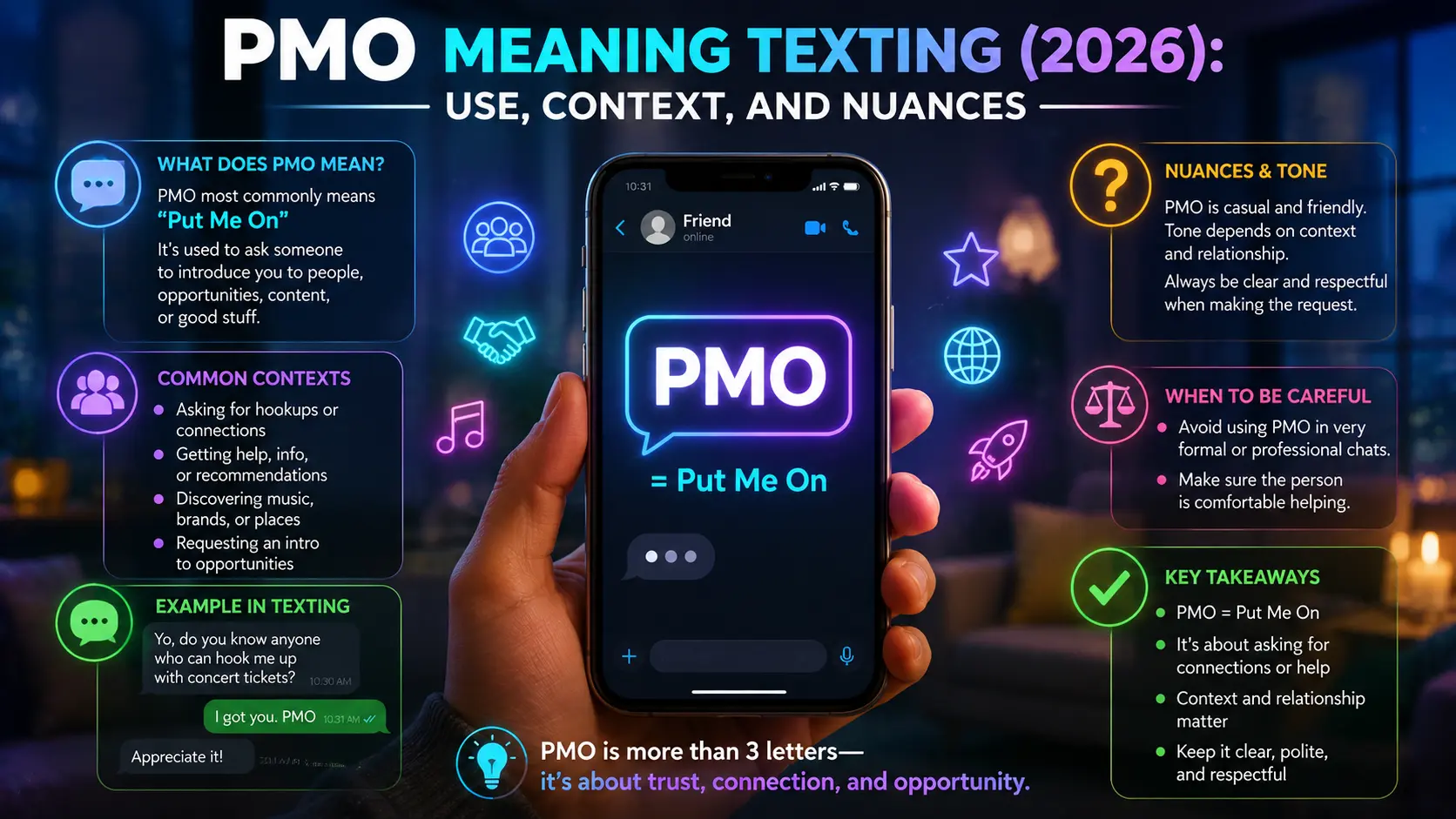
In texting, PMO usually means “put me on” or “pisses me off,” depending on the conversation. “Put me on” commonly means introduce me to, tell me about, recommend, or connect me with something, while “pisses me off” expresses anger or frustration.
For example, “PMO to some good movies” means “put me on to some good movies,” while “That PMO” can mean “that pisses me off.” Because the abbreviation has multiple meanings, the surrounding words and tone determine the intended meaning.
TL;DR
- PMO = “Put Me On” in recommendation or introduction contexts.
- PMO = “Pisses Me Off” when someone is expressing frustration.
- The phrase “PMO to…” often points toward “put me on to.”
- “That PMO” or “you PMO” may indicate “pisses me off.”
- PMO is informal and is mainly suited to texts, DMs, comments, and casual conversations.
- In professional communication, spelling out the intended meaning is usually clearer.
- PMO can have niche meanings, including adult or community-specific interpretations, so context is important.
What Does PMO Mean in Texting?
PMO is a flexible texting abbreviation whose meaning depends heavily on how it appears in a sentence. Unlike abbreviations with one dominant definition, PMO can represent different expressions used for completely different emotional purposes.
One of the most common modern uses is “put me on,” especially when someone wants a recommendation, introduction, explanation, or access to something interesting. Another familiar interpretation is “pisses me off,” which communicates irritation or anger.
Common Texting Definitions
The two major meanings of PMO in casual American texting are:
1. Put Me On:
Used when asking someone to recommend, introduce, explain, or expose you to something.
Example:
“PMO to some good restaurants.”
Meaning: “Put me on to some good restaurants.”
2. Pisses Me Off:
Used to express annoyance or frustration.
Example:
“Traffic really PMO.”
Meaning: “Traffic really pisses me off.”
The same three letters can therefore communicate curiosity and interest in one message and anger or irritation in another.
Why Context Is Everything
The easiest way to understand PMO is to examine the words surrounding it. If someone writes “PMO some new music,” the meaning is almost certainly “put me on,” because the person is requesting a recommendation.
If someone says “That PMO,” the meaning is more likely “that pisses me off.” Looking at the grammatical structure, subject, and emotional tone usually makes the intended definition clear.
PMO as “Put Me On” in American Slang
“Put me on” is an established informal expression in American English. In slang, it can mean to introduce someone to something, give them information, recommend something, or help them discover something they did not previously know about.
The shortened PMO version fits naturally into fast-moving digital conversations, where users often remove unnecessary words while preserving the central meaning.
Cultural Roots of “Put Me On”
The expression “put me on” has existed in American informal speech long before smartphones and social media. Depending on context, it has been associated with introducing someone to an experience, helping someone become informed, or bringing someone into the know.
Over time, youth culture, music communities, online conversations, and social media helped make abbreviated versions of informal expressions increasingly common. PMO is part of this broader pattern of compressing familiar phrases into short digital forms.
How It’s Used Today
Today, PMO can be used when someone wants a recommendation or wants another person to share something interesting.
Examples include:
- “PMO some good songs.”
- “PMO to your favorite shows.”
- “Can you PMO some sneaker brands?”
- “PMO your best study tips.”
- “PMO to a good place to eat.”
In these examples, PMO has a positive or neutral conversational tone. The person is essentially saying, “Show me what you know.”
See Also: Context Definition: Understanding Meaning, Use, and Alternatives
PMO as “Pisses Me Off” in Texts
The second major interpretation of PMO is “pisses me off.” Here, the abbreviation serves as a compact way to communicate annoyance.
This use is generally more emotional than “put me on.” It can appear when someone is complaining about a person, situation, event, inconvenience, or behavior.
Expressing Frustration Quickly
Texting encourages short, immediate expressions. Instead of typing an entire sentence such as “That really pisses me off,” someone may write:
“That PMO.”
Other examples include:
- “Slow internet PMO.”
- “When people do that it PMO.”
- “My schedule PMO today.”
- “That whole situation PMO.”
The abbreviation allows the writer to communicate frustration without spending much time typing.
Emotional Nuance
The intensity of PMO depends on the conversation. It can describe mild annoyance, strong frustration, or genuine anger.
For instance, “This app PMO 😂” may be a relatively lighthearted complaint. By contrast, “What you did PMO” may sound much more serious.
Emojis, punctuation, capitalization, and surrounding words can therefore change how strongly PMO feels.
Historical Roots of Acronyms Like PMO
PMO belongs to a much larger history of abbreviated communication. People have always developed shorter ways of communicating when a particular medium rewards speed and efficiency.
Digital communication simply accelerated this process.
Pre-Smartphone Origins
Abbreviated language existed before modern smartphones. Telegrams encouraged concise wording because messages were charged according to length in many systems. Later, classified advertisements, radio communication, instant messaging, and internet chat all encouraged forms of linguistic compression.
These environments helped establish the idea that shorter communication can still carry a complete meaning when participants understand the shared code.
Rise of Texting Slang
SMS texting dramatically expanded abbreviation culture. Expressions such as “LOL,” “BRB,” “IDK,” and “OMG” became widely recognized among digital users.
Social media then pushed the trend further. Character limits, rapid conversations, comments, gaming chats, and direct messages created environments where abbreviations could spread rapidly.
PMO fits into this larger evolution of informal digital shorthand.
PMO Meaning in the USA Today
In the United States, PMO is primarily an informal expression found in casual digital communication. Its interpretation is not necessarily uniform across every age group or community.
Generational Differences
Younger internet users may recognize PMO from TikTok, Instagram, Snapchat, group chats, gaming communities, or other social platforms.
Older users may be less familiar with the abbreviation or may interpret it differently because they encountered “put me on” or “pisses me off” in their full forms.
This means that age and online experience can influence how quickly someone understands PMO.
Regional and Social Influence
PMO does not have one fixed regional definition across the United States. Online communities often matter more than geography.
A person’s preferred social platform, friend group, age group, music community, gaming community, or internet subculture can influence which interpretation they recognize first.
Emotional and Psychological Signals of PMO
Abbreviations can communicate more than literal words. They can also provide clues about the speaker’s attitude, relationship with the recipient, and emotional state.
What PMO Communicates Emotionally
When PMO means “put me on,” it can communicate curiosity, enthusiasm, openness, or trust. Asking someone to “PMO” something can effectively mean, “I value your recommendation.”
When PMO means “pisses me off,” it signals irritation or frustration. The emotional intensity depends on the surrounding message.
Why People Use It Anyway
People use PMO because it is fast, recognizable, casual, and socially efficient within communities that understand it.
Digital communication often rewards brevity. Typing three letters can feel more natural than writing a longer phrase, particularly in fast-moving conversations.
Modern Usage: Texting, Social Media, and DMs
PMO is particularly suited to environments where informal communication dominates.
Where You’ll See PMO
You may encounter PMO in:
- Text messages
- Group chats
- Instagram comments
- TikTok comments
- Snapchat messages
- Discord conversations
- Gaming chats
- Online forums
- Social media DMs
The meaning should always be interpreted according to the surrounding conversation.
Platform-Specific Nuance
On recommendation-focused posts, “PMO” is more likely to mean “put me on.” For example, someone commenting “PMO to some good podcasts” is asking for suggestions.
In a complaint or argument, “PMO” is more likely to mean “pisses me off.” Platform culture can influence which meaning feels most natural, but no platform guarantees one specific definition.
See Also: Ambiguous Definition: Meaning, Usage, and the True Essence
Misunderstandings and Common Confusions
Because PMO has multiple meanings, misunderstandings are completely possible.
Why Confusion Happens
The problem is that both meanings are common enough to be recognized, but they are semantically unrelated.
Consider:
“PMO this.”
Without additional context, the reader may wonder whether the writer means “put me on” or “pisses me off.” The surrounding conversation must resolve the ambiguity.
How Americans Handle It
In casual conversations, people usually infer the intended meaning from context. If the message remains unclear, the simplest solution is to ask:
“What do you mean by PMO here?”
There is nothing unusual about asking for clarification when an abbreviation has multiple interpretations.
Sensitive or Controversial Meanings of PMO
Like many internet abbreviations, PMO can occasionally have meanings beyond mainstream texting slang.
Niche and Adult Contexts
Certain online communities may use PMO as shorthand for specialized or adult-related expressions. These meanings are not necessarily the intended interpretation in ordinary conversations.
Because abbreviations can overlap across communities, readers should avoid assuming a niche definition without supporting context.
Neutral Clarification Matters
When PMO appears in an unfamiliar conversation, context should come before assumptions.
If the surrounding words do not make the meaning obvious, asking for clarification is more reliable than automatically assigning an adult, offensive, or unusual interpretation.
How PMO’s Meaning Has Shifted Over Time
Internet slang changes quickly. Expressions that once required several words can become compressed, reinterpreted, or repurposed by different online communities.
Earlier vs. Current Usage
The underlying phrases “put me on” and “pisses me off” are older than the abbreviation itself. What has changed is the tendency to represent those phrases with three letters.
The rise of smartphones, social platforms, and rapid messaging has made compact abbreviations more practical and visible.
What’s Likely Next
Digital slang is constantly evolving. PMO may continue to retain its current meanings while acquiring additional niche uses.
However, widely understandable meanings tend to survive when they remain useful and recognizable. The safest approach is therefore to understand PMO as a context-dependent abbreviation rather than a word with one permanent definition.
PMO in Everyday American Contexts
In everyday American texting, PMO can appear in several simple situations.
If a friend says:
“PMO to some good movies.”
They are probably asking for movie recommendations.
If someone writes:
“This weather PMO.”
They are probably expressing frustration.
If a friend says:
“PMO your playlist.”
They are likely asking you to share or recommend music.
The most useful rule is simple: look at what comes before and after PMO. Requests, recommendations, and introductions usually point toward “put me on,” while complaints and emotional statements often point toward “pisses me off.”
When Should You Avoid Using PMO?
PMO is highly informal. Although it works naturally among friends and online communities, it is not always appropriate for every audience.
Situations to Skip PMO
Consider avoiding PMO in:
- Formal emails
- Job applications
- Academic writing
- Business proposals
- Customer-service communication
- Official documents
- Messages to people unfamiliar with texting slang
Using an abbreviation that the reader does not recognize can create unnecessary confusion.
Clear Alternatives
Instead of PMO, you can write the complete phrase:
For “put me on”:
- “Can you recommend some?”
- “Show me some good options.”
- “Tell me about it.”
- “Introduce me to…”
For “pisses me off”:
- “That really annoys me.”
- “That frustrates me.”
- “That makes me angry.”
Full wording is usually better when clarity matters more than casual style.
FAQs About PMO Meaning Texting
Is PMO rude in texting?
PMO is not automatically rude. When it means “put me on,” it can be completely friendly. When it means “pisses me off,” it expresses frustration and may sound stronger depending on the situation.
Does PMO always mean something negative?
No. “Put me on” is generally neutral or positive because it can mean asking someone for a recommendation or introduction. “Pisses me off” is the negative interpretation.
Is PMO used in professional messages?
It can appear accidentally or informally, but it is better avoided in professional communication. Spelling out the intended phrase makes your message clearer and reduces the chance of misunderstanding.
Can PMO have adult meanings?
Yes, PMO can have niche or adult interpretations in certain online communities. However, those meanings should not automatically be assumed in ordinary texting; the surrounding context determines the intended usage.
Should I ask what PMO means if unsure?
Yes. If the sentence does not provide enough context, asking is the safest option. A simple “What does PMO mean here?” can quickly prevent a misunderstanding.
Conclusion
PMO meaning in texting depends on context. The two most important interpretations are “put me on” and “pisses me off.” The first is commonly used when requesting recommendations, introductions, or information, while the second communicates annoyance or frustration.
Because PMO is informal and potentially ambiguous, pay attention to the words surrounding it, the tone of the conversation, and the relationship between the people communicating. When clarity matters, spelling out the phrase is always the safest choice.