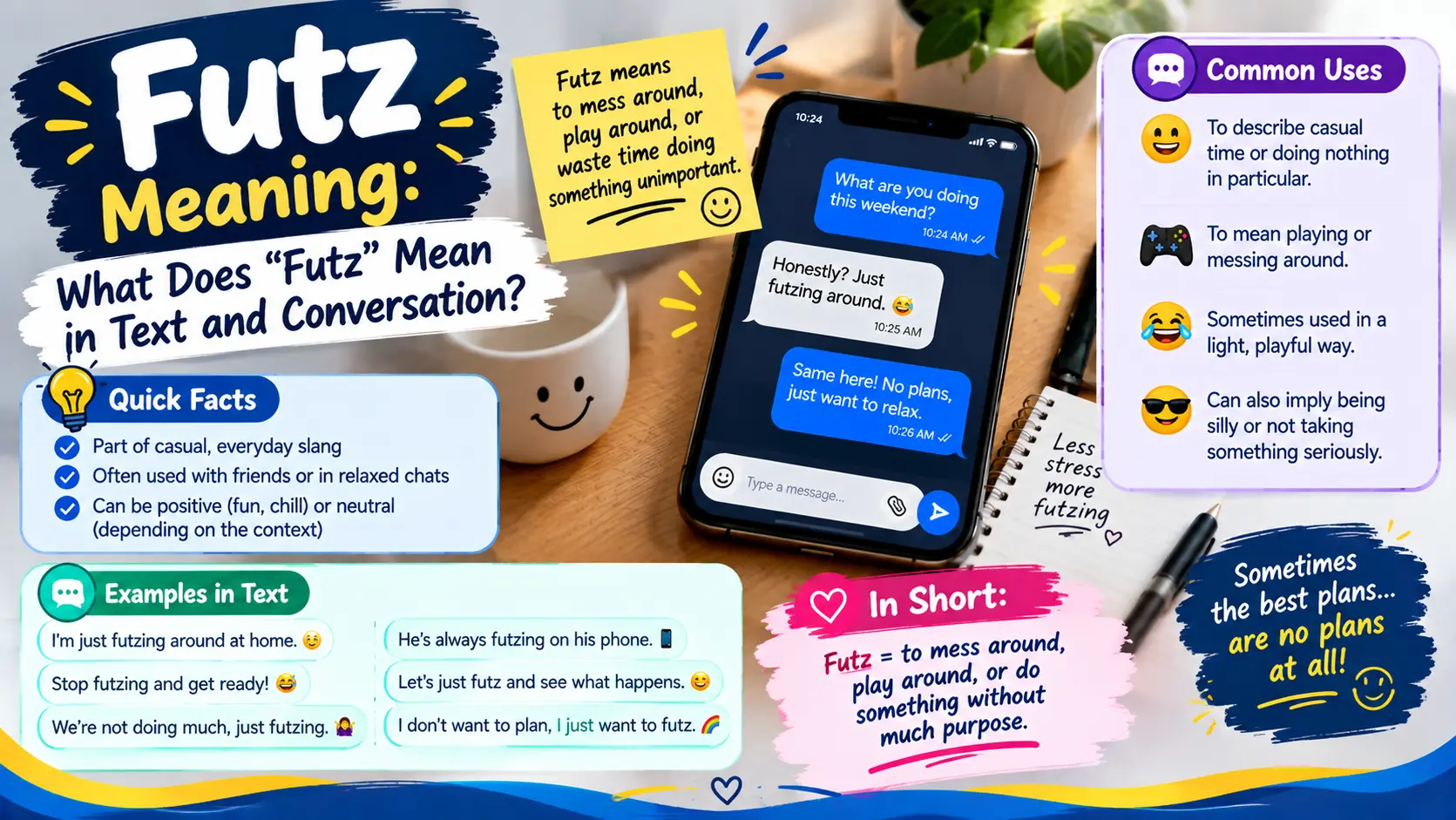
Futz Meaning: What Does “Futz” Mean in Text and Conversation?
Have you ever seen someone write, “Stop futzing around” and wondered whether they were joking, complaining, or actually annoyed?
The word futz is an informal American English expression that usually means to waste time, fool around, or spend time making small, unnecessary changes to something. It can also describe fiddling with an object, especially when the activity feels slow, pointless, or overly complicated.
For example, if someone keeps changing the settings on their phone without actually fixing anything, you might hear:
“Stop futzing with the settings.”
If a friend is taking forever to leave because they keep checking little things, someone might say:
“Why are you still futzing around?”
The expression is casual and often carries a little humor or mild frustration. Understanding the futz meaning is useful because the word can sound stronger or stranger than it actually is, especially to people who are unfamiliar with American slang.
Let’s look at what it means, where it came from, how people use it online, and when it is better to choose a different expression.
Futz Meaning: Quick Meaning
Futz is an informal verb. Its most common meanings are:
- To waste time
- To fool around
- To fiddle with something
- To make unnecessary changes
- To spend too much time on small details
- To deal with something in an inefficient or aimless way
Two common forms are “futz around” and “futz with.”
Futz around usually means wasting time or behaving without a clear purpose.
“We need to leave soon, so stop futzing around.”
Futz with usually means fiddling with, adjusting, or interfering with something.
“I spent twenty minutes futzing with the printer.”
The word is pronounced /fʌts/ and rhymes roughly with “cuts” and “nuts.”
Dictionary sources describe futz as an informal or slang verb meaning to waste time, fool around, fiddle, trifle, or tamper with something.
Origin & Background of Futz
The history of futz is surprisingly interesting because dictionaries do not give one completely certain explanation for its origin.
The American Heritage Dictionary suggests that the word may be a partial translation and alteration of the Yiddish expression arumfartsn zikh, meaning roughly “to fart around.” The Yiddish connection reflects the influence of Yiddish-speaking communities on American English.
Other dictionary sources have suggested a different possibility, describing futz as a euphemistic alteration of a stronger English swear word. Because the historical evidence allows more than one explanation, it is safest to say that the exact origin is uncertain, with Yiddish influence being one prominent theory.
The word became established in American slang during the twentieth century. Its everyday use gradually moved beyond simply describing someone who was wasting time.
Today, futz with something can mean spending unnecessary time adjusting, changing, or interfering with it.
That evolution is important. Modern speakers may use the word without knowing anything about its history. For them, it simply feels like a colorful alternative to “fiddle with,” “mess with,” or “waste time.”
Social media has also helped informal vocabulary travel quickly between communities. A person may encounter futzing around in a TikTok comment, a casual post, a text message, or an American TV show and then begin recognizing the expression in other contexts.
Real-Life Conversations
WhatsApp Conversation
Person A: Are you ready to go?
Person B: Almost. I’m just futzing around with my bag.
Person A: You’ve been “almost ready” for twenty minutes 😂
Person B: I know. Give me two minutes!
Here, futzing around suggests that Person B is spending too much time on little things instead of simply leaving.
Instagram DM
Person A: Did you finish editing the pictures?
Person B: Not really. I keep futzing with the brightness.
Person A: Honestly, they already look great.
Person B: I know, but I can’t stop adjusting everything.
In this example, futzing with describes repeatedly making small adjustments.
TikTok Comment
Person A: Why did he spend five minutes futzing with the camera before starting?
Person B: 😂 He wanted everything to be perfect.
The expression is mildly critical but also humorous.
Text Message
Person A: Are you still futzing around with that old laptop?
Person B: Yep. I think I can fix it.
Person A: You’ve said that three hours ago.
Person B: This time I actually mean it!
The word gives the exchange a playful, conversational tone.
Emotional & Psychological Meaning
The futz meaning is not only about wasting time. It often communicates an attitude toward that wasted time.
When someone says, “Stop futzing around,” they may be expressing mild impatience. They are usually not making a serious accusation. Instead, they are saying something like, “Focus,” “Get moving,” or “Stop worrying about these tiny details.”
That makes futz emotionally softer than many stronger expressions.
It can also reveal something about modern behavior. People frequently spend excessive time adjusting small details because they want things to feel perfect.
Think about someone editing a social media caption again and again, changing one word, then changing it back. A friend might laugh and say:
“You’re futzing with that caption way too much.”
The comment recognizes a familiar human habit: sometimes we keep making tiny changes because making changes feels easier than deciding that something is finished.
In my experience with everyday communication, words like futz are especially useful because they can point out this behavior without making the conversation unnecessarily serious.
See Also: Dead Flies in the House: Spiritual Meaning & Symbolism
Usage in Different Contexts
Social Media
On social media, futz can describe unnecessary editing, scrolling, adjusting, or experimenting.
“I’ve been futzing around with this video for hours.”
It sounds casual and conversational.
Friends and Relationships
Friends may use futz teasingly.
“Stop futzing around and come watch the movie.”
Depending on the relationship, it can sound affectionate rather than insulting.
Work and Professional Settings
The word is sometimes used in casual workplace conversation, especially in American English.
“I had to futz with the spreadsheet formatting.”
However, it is still informal. A professional report would usually use adjust, modify, troubleshoot, revise, or work on instead.
Casual vs. Serious Tone
Futz is overwhelmingly casual.
It works naturally in conversations, texts, informal emails, social media posts, and friendly discussions. It is less suitable for formal writing where precise professional vocabulary is expected.
When NOT to Use Futz
Although futz is generally mild, it is not appropriate for every situation.
Avoid it when writing highly formal documents, academic papers, official reports, or serious professional communications.
Instead of:
“We futzed around with the data.”
A formal version would be:
“We made several adjustments to the data.”
You should also be careful when speaking with people who may not know American slang. They may interpret the word differently or simply find it unfamiliar.
Cultural sensitivity matters too. Because the word has debated slang origins and sounds somewhat playful, it may not communicate the same tone across every English-speaking community.
When clarity matters more than personality, choose a straightforward alternative.
Common Misunderstandings About Futz
One common mistake is assuming that futz always means simply “waste time.”
That is true in expressions such as:
“Stop futzing around.”
But futz with can have a more specific meaning.
“Don’t futz with the settings.”
Here, the speaker means don’t fiddle with, interfere with, or unnecessarily change the settings.
Another misunderstanding is that futz always indicates serious laziness. It usually does not.
The speaker may simply be teasing someone for spending too much time on something minor.
Context controls the emotional intensity.
Compare:
“He spent all morning futzing around.”
This sounds critical.
Now compare:
“I was just futzing around with the new camera.”
This may simply mean experimenting casually.
The same word can therefore sound annoyed, amused, or completely neutral depending on the sentence.
Futz Comparison Table
| Expression | Meaning | Typical Tone | Example |
|---|---|---|---|
| Futz around | Waste time or fool around | Casual, mildly critical | “Stop futzing around.” |
| Futz with | Fiddle with or adjust something | Casual | “Don’t futz with the controls.” |
| Mess around | Play, experiment, or waste time | Very casual | “We were messing around.” |
| Fiddle with | Make small adjustments | Neutral/casual | “She fiddled with the settings.” |
| Tinker with | Experiment or make small changes | Neutral | “He tinkered with the machine.” |
| Waste time | Use time unproductively | Direct | “You’re wasting time.” |
| Focus | Concentrate on the task | Opposite idea | “Let’s focus and finish.” |
| Get on with it | Stop delaying and continue | Mildly impatient | “Come on, get on with it.” |
| Play around | Experiment or behave without seriousness | Casual | “I was just playing around.” |
| Tamper with | Interfere improperly | More serious | “Do not tamper with the device.” |
Key Insight
The special quality of futz is its middle-ground tone. It can communicate wasted effort or unnecessary fiddling without automatically sounding harsh. That makes it more expressive than simply saying “waste time.”
See Also: Smelling Urine: Spiritual Meaning and Symbolism Explained
Variations and Types of Futz
1. Futz Around
Meaning: Waste time or fool around.
It is probably the most recognizable form of the expression.
“We can’t futz around all afternoon.”
2. Futz With
Meaning: Fiddle with or adjust something.
It focuses on an object, system, setting, or task.
“Stop futzing with the remote.”
3. Futzing
Meaning: The ongoing act of wasting time or fiddling.
“He’s futzing around in the garage.”
4. Futzed
Meaning: The past form of futz.
“I futzed with the settings yesterday.”
5. Futzes
Meaning: Third-person singular present form.
“She always futzes with the lighting.”
6. Futz Around With Something
Meaning: Spend unnecessary time changing or experimenting with something.
“He keeps futzing around with the design.”
7. Futz Up
Meaning: Mess something up or interfere with it in a way that causes problems.
This form is less central than futz around and futz with, so context is especially important.
8. Futz About
Meaning: Waste time or behave aimlessly.
This form is more associated with British usage, where futz about may be understood as an American-style slang expression.
9. Futz With the Details
Meaning: Spend too much time making small adjustments.
It can suggest perfectionism or unnecessary attention to minor points.
10. Futz Around Online
Meaning: Spend time online without a clear purpose.
“I was supposed to study, but I ended up futzing around online.”
How to Respond When Someone Uses Futz
Your response depends on the relationship and the speaker’s tone.
Casual Replies
- “Haha, okay, I’m coming.”
- “I’m almost done!”
- “Give me a second.”
- “Yeah, I know. I’m working on it.”
Funny Replies
- “Futzing is part of my process.”
- “I’m professionally wasting time.”
- “Relax, I’m conducting important research.”
- “I prefer the term strategic procrastination.”
Mature Replies
- “You’re right. I’ll focus on it now.”
- “I got distracted by the small details.”
- “I’ll stop adjusting it and finish the task.”
- “Fair point. I should just make a decision.”
Respectful Replies
If someone tells you to stop futzing around, you can simply say:
“Understood. I’ll get back to it.”
This works particularly well when the person is genuinely frustrated.
Regional & Cultural Usage
Western Culture
In American English, futz is recognized as informal slang and is particularly natural in casual conversation. Dictionaries commonly label it informal, slang, or mainly US.
In Britain, people may encounter futz about or understand futz around, but it is not necessarily as central to everyday British vocabulary.
Asian Culture
English users in Asian countries may recognize futz through American entertainment, social media, films, television, or online conversations.
However, it may not be part of everyone’s everyday vocabulary. A simpler phrase such as “waste time” or “mess around” may be clearer.
Middle Eastern Culture
Among English-speaking communities in the Middle East, futz may appear in international online communication, particularly where American English is common.
Its meaning remains dependent on context, so learners should look at the surrounding sentence rather than translating the word literally.
Global Internet Usage
Online English has made expressions like futz easier to encounter outside the United States.
People may use it humorously when discussing technology, gaming, editing, cooking, social media, or everyday problems.
Gen Z vs. Millennials
Younger internet users may understand futz from memes, entertainment, or American online culture, but they do not necessarily use it frequently.
Millennials and older American speakers may be more likely to recognize it as an established informal expression.
The word is therefore better understood as casual American slang with long-standing usage, rather than as a brand-new Gen Z abbreviation.
Is Futz Safe for Kids?
Generally, futz is a mild informal word, and its common meanings are not inherently offensive.
A child might hear:
“Stop futzing around and get ready for school.”
The important point is context. Parents and teachers can explain that futz means waste time, fool around, or fiddle with something.
Because slang can have different historical associations, children should also learn that informal words are not always appropriate in formal settings.
For everyday language learning, however, futz is generally much less concerning than explicit profanity.
FAQs About Futz Meaning
What does futz mean in text?
Futz usually means to waste time, fool around, or fiddle with something. In texts, “futz around” often means delaying or being unproductive.
What does “futz around” mean?
Futz around means to waste time, fool around, or do something without a clear purpose.
What does “futz with” mean?
Futz with means to fiddle with, adjust, alter, or interfere with something, often unnecessarily.
Is futz a bad word?
Futz is an informal slang word, but its common modern use is generally mild. It is not usually treated like strong profanity.
Is futz an American word?
Yes. Dictionaries commonly identify futz as American or mainly US informal slang, although it can be understood elsewhere.
What is another word for futz?
Depending on context, alternatives include fiddle, tinker, mess around, fool around, waste time, tamper with, and play around.
What does “stop futzing around” mean?
It usually means stop wasting time, stop fooling around, and get focused on what you need to do.
Conclusion
The futz meaning is simple once you see it in context. It usually describes wasting time, fooling around, or fiddling unnecessarily with something.
The expressions “futz around” and “futz with” are especially common. They can communicate mild frustration without sounding excessively harsh, which is one reason the word has remained useful in informal American English.
Its history is also more interesting than its short spelling suggests, with dictionaries pointing to possible Yiddish influence while acknowledging uncertainty about the exact origin.
So, if someone says, “Stop futzing around,” they probably are not starting an argument. They are simply telling you to stop spending time on little things and get moving.
Once you understand that tone, futz becomes an easy and expressive word to recognize in texts, conversations, social media, and everyday English.