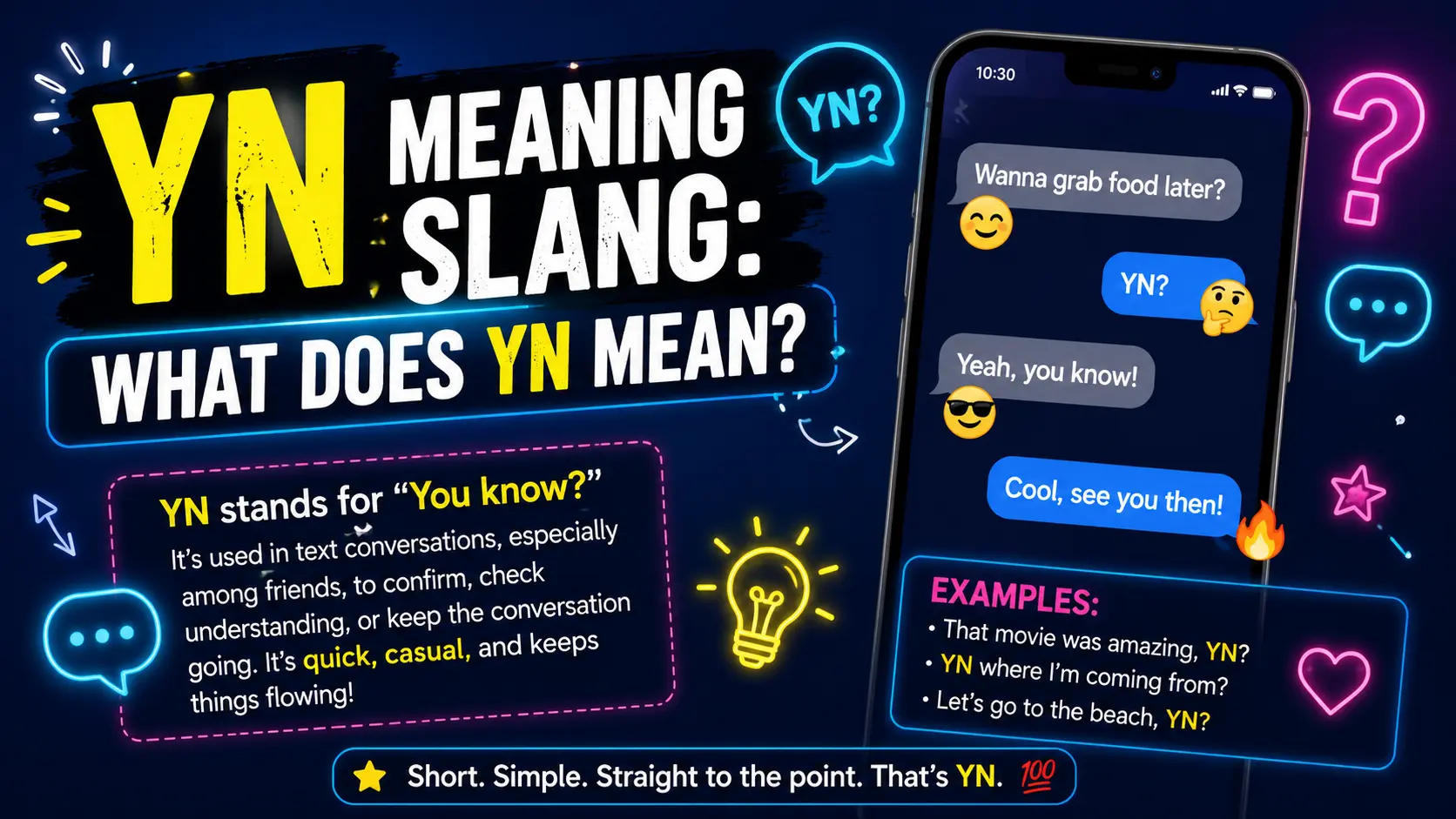
YN Meaning Slang: What Does YN Mean?
Quick Answer
YN usually means “your name” in online slang and fan-fiction communities. It is commonly used as a placeholder for the reader’s name in reader-insert stories, allowing the reader to imagine themselves as part of the story. For example, “YN walked into the room” means that the reader should mentally replace YN with their own name.
Today, YN can appear in fan fiction, TikTok content, social media captions, comments, memes, and other forms of digital storytelling. Its exact meaning can depend on context because YN may also represent other phrases or abbreviations in different communities.
TL;DR
- YN most commonly means “your name.”
- It is especially popular in fan fiction and reader-insert stories.
- YN allows readers to imagine themselves as a character.
- It can appear on TikTok, Instagram, X, and other platforms.
- YN and POV are related but not identical.
- Context is important because YN can have other meanings.
What Does “YN” Mean in Slang?
YN Definition and Basic Meaning
In modern internet slang, YN commonly stands for “your name.” The abbreviation is primarily associated with reader-insert writing, where authors create stories in which the reader becomes the central character.
Instead of giving the main character a fixed name, writers use YN as a placeholder. A sentence such as “YN smiled at him” invites the reader to imagine the sentence as “your name smiled at him.”
This style is particularly common in online fan communities. It can make fictional stories feel more personal because readers are encouraged to picture themselves directly inside the fictional world.
What YN Means in Texting
When YN appears in a texting or social-media conversation, its meaning depends heavily on the surrounding words. Someone discussing a fan-fiction character may use YN to mean “your name,” while another person may use the same letters as an abbreviation for something completely different.
For that reason, it is best not to automatically interpret every instance of YN as slang for “your name.” Look at the conversation, platform, and topic before deciding what the abbreviation means.
How YN Is Written and Used
YN is generally written in uppercase letters, although lowercase forms such as “yn” can also appear in casual online writing.
Examples include:
- “YN looked at him and smiled.”
- “Imagine YN meeting your favorite character.”
- “This YN story is actually so good.”
- “YN was definitely the main character here.”
The abbreviation works as a stand-in rather than a traditional nickname. Its purpose is to leave space for the reader’s identity.
Where Did “YN” Come From?
Origins in Fan Fiction and Reader-Insert Stories
The use of YN as “your name” is closely connected with internet fan fiction and reader-insert storytelling. Writers wanted a simple way to create stories in which the audience could imagine themselves interacting with established fictional characters.
Rather than inventing a new protagonist with a specific name and background, the writer could use a placeholder such as YN. Readers could then mentally replace that placeholder with their own name.
This approach became especially useful in stories involving celebrities, musicians, fictional characters, and other recognizable figures.
How Online Communities Popularized YN
As fan-fiction communities expanded across the internet, reader-insert conventions became increasingly familiar. Abbreviations helped writers communicate ideas quickly and consistently.
YN became recognizable within certain online communities because readers already understood what the letters represented. The abbreviation also worked well in titles, descriptions, tags, and story text.
Its popularity reflects a broader internet trend: online communities often create compact vocabulary that regular participants understand immediately.
The Evolution of YN in Digital Culture
YN gradually moved beyond traditional fan-fiction websites and into social platforms where storytelling became shorter and more visual.
Short-form videos, memes, captions, and fictional scenarios can now recreate the same reader-insert concept in just a few lines. A TikTok caption might use YN to establish the viewer as the main character in a hypothetical situation.
As a result, YN has become part of a wider digital storytelling vocabulary rather than remaining limited to long-form fan fiction.
YN Meaning in the USA
How Americans Use YN Online
In the United States, YN is most recognizable in internet-based communities, especially fan-fiction and fictional storytelling spaces. Younger internet users may encounter the abbreviation in videos, comments, fictional scenarios, and social-media posts.
However, YN is not necessarily a standard abbreviation that Americans use in everyday spoken conversation. Its familiarity is strongly influenced by a person’s online interests and the communities they participate in.
YN in U.S. Social Media Culture
American social-media culture has helped reader-insert formats become more accessible to mainstream audiences. Platforms built around short videos and quick interactions provide an easy environment for fictional scenarios.
A creator might write something like:
“POV: YN finally gets invited to the party.”
Here, YN represents the viewer or imagined protagonist. The phrase combines reader/viewer identification with a fictional scenario, which is a common format in online entertainment.
Common Contexts for YN
In U.S. internet culture, YN may appear in:
- Fan fiction
- Reader-insert stories
- TikTok scenarios
- Instagram captions
- Fictional edits
- Character-based memes
- Comments about fictional relationships
- Online storytelling communities
Its meaning is generally easiest to identify when the surrounding content involves characters, fictional situations, or imagined experiences.
See Also: What Does It Mean When Your Finger Itches Spiritually?
How “YN” Is Used on Social Media
YN on TikTok
TikTok has made fictional scenario formats highly visible. Creators can combine text, video, music, and character references to place viewers into an imagined situation.
YN may be used in captions such as:
- “YN walking into the room like…”
- “When YN finally meets him.”
- “YN has no idea what happens next.”
These examples treat the viewer as the imagined protagonist.
YN on Instagram
On Instagram, YN may appear in captions, reels, fan edits, fictional posts, and comments. Fan communities sometimes use the abbreviation when describing an imagined interaction between the reader and a favorite character.
The format is especially useful when a post is designed to encourage self-insertion or imagination.
YN on X and Other Platforms
On X and other text-heavy platforms, YN can appear in short fictional scenarios, jokes, fandom discussions, and posts referencing reader-insert content.
Because abbreviations can develop differently across communities, the surrounding conversation remains the best guide to the intended meaning.
YN in Comments, Captions, and Videos
The abbreviation is particularly effective in short-form content because it saves space. Instead of repeatedly writing “your name,” creators can use two letters.
This makes YN useful for quick fictional setups where the main goal is to establish a situation rather than explain the abbreviation itself.
YN in Fan Fiction and Reader-Insert Content
“Your Name” Meaning
The most important meaning of YN in fan fiction is “your name.” It tells the reader that they are intended to imagine themselves as the protagonist.
For example:
“YN opened the door and saw Harry standing outside.”
The reader is expected to mentally substitute their own name for YN.
How YN Represents the Reader
YN functions as a placeholder for the audience. Instead of asking readers to identify with an entirely separate fictional character, the story gives them a direct role.
This can make stories feel interactive even though the reader is not actually controlling events.
Why Writers Use YN Instead of a Character Name
Writers use YN because it provides flexibility. Every reader can imagine the same story with their own name, making the narrative feel more individualized.
It also avoids forcing the audience to identify with a protagonist whose name, personality, or background may not match their own.
YN vs. POV: What’s the Difference?
How YN Works
YN identifies the imagined person participating in the story. It essentially means “your name” and functions as a placeholder.
For example:
“YN walks into the classroom.”
The reader is expected to imagine themselves as YN.
How POV Works
POV means “point of view.” On social media, it is frequently used to introduce a particular perspective or scenario.
For example:
“POV: You walk into your favorite restaurant and see your best friend.”
POV establishes the perspective of the scenario, while YN can identify the person occupying the fictional role.
When YN and POV Overlap
YN and POV can appear together because both are useful for creating immersive scenarios.
A post might effectively communicate:
“POV: YN finally gets the message they’ve been waiting for.”
Here, POV establishes the scenario, while YN represents the imagined character.
Examples of YN in Text and Online Conversations
Common YN Examples
Here are several simple examples:
Example 1: “YN walked into the concert and saw their favorite singer.”
Meaning: The reader imagines themselves attending the concert.
Example 2: “Everyone noticed when YN arrived.”
Meaning: YN represents the reader’s imagined character.
Example 3: “YN had one question: What happens next?”
Meaning: The reader is placed directly into the fictional situation.
YN in Fan Fiction
In fan fiction, YN may appear throughout an entire story:
“YN woke up early and checked their phone. There was already a message waiting.”
The writer deliberately avoids giving the protagonist a fixed name so the reader can insert themselves into the story.
YN in Social Media Posts
Social-media examples are usually shorter:
- “YN finally gets their happy ending.”
- “YN at the party five minutes after arriving.”
- “YN realizing what just happened.”
- “Everyone looking at YN.”
The exact format varies according to the creator and community.
YN Context Table
| Context | Likely Meaning | Typical Use |
|---|---|---|
| Fan fiction | Your name | Reader-insert stories |
| Character edits | Your name | Imagined scenarios |
| TikTok scenarios | Your name | Viewer-centered content |
| Instagram fandom posts | Your name | Fictional interactions |
| Everyday texting | Context-dependent | May have another meaning |
| Workplace writing | Context-dependent | Usually an abbreviation rather than slang |
Why Do People Use “YN”?
Personalization and Imagination
The biggest attraction of YN is personalization. Instead of watching a fictional character experience an event, readers can imagine that they are the character.
This technique creates a stronger feeling of involvement and can make fictional content more engaging.
Convenience in Digital Writing
YN is also extremely convenient. Two letters are faster to type than repeatedly writing “your name.”
For online creators working with captions, short stories, comments, and scripts, concise language can make content easier to produce and consume.
Community and Internet Culture
Internet communities develop shared conventions. Once users understand that YN means “your name,” they can recognize the format immediately.
That shared understanding makes communication faster and helps different creators use similar storytelling techniques.
See Also: Rooster Spiritual Meaning and Symbolism Interpretation (USA)
Other Meanings of YN
Alternative Definitions and Abbreviations
Although “your name” is a major meaning in fan-fiction contexts, YN can have other interpretations depending on the community.
Abbreviations frequently overlap across texting, technology, organizations, education, entertainment, and other fields. Therefore, the letters alone cannot always establish a single definition.
Why Context Changes the Meaning
Context determines whether YN is slang, an abbreviation, a username, initials, or part of a specialized term.
For example, a fictional story using “YN” alongside character names strongly suggests the reader-insert meaning. A business document containing YN may indicate something entirely different.
How to Identify the Intended Meaning
Ask three simple questions:
- Where did you see YN?
- What words appear around it?
- Is the content fictional, social, professional, or conversational?
These clues usually make the intended meaning much easier to determine.
Common Misunderstandings About YN
YN vs. Similar Abbreviations
YN can be confused with other short internet abbreviations because many slang terms consist of only two letters.
The safest approach is to avoid assuming that every instance of YN means “your name.” Instead, consider the platform and subject of the conversation.
When YN Can Be Confusing
YN can be confusing when someone encounters it outside fan-fiction or reader-insert communities.
A person unfamiliar with online storytelling conventions might reasonably wonder whether YN is a person’s initials, a username, or another abbreviation.
Why Context Matters
Context is the key to understanding slang. Internet abbreviations rarely have one universal definition across every platform.
The same two letters can carry different meanings in different communities, so surrounding words and the purpose of the content should always be considered.
How YN Meaning Has Changed Over Time
Early Online Usage
The reader-insert concept developed alongside online fan communities that wanted to make fictional stories more immersive.
YN offered a straightforward way to represent the reader without creating a permanent character identity.
Modern Internet Usage
Today, reader-insert storytelling can appear across multiple formats, including short videos, social posts, edits, memes, and fictional scenarios.
This broader digital environment has made conventions such as YN more visible to people who may never visit traditional fan-fiction websites.
YN in Today’s Digital Culture
Modern YN usage reflects a larger shift toward interactive and personalized digital storytelling. Social-media creators increasingly create content designed for viewers to imagine themselves inside a scenario.
YN is one small example of how online language adapts to new forms of participation and entertainment.
FAQs About YN Meaning Slang
What does YN stand for in slang?
YN commonly stands for “your name,” particularly in fan fiction and reader-insert content. It acts as a placeholder for the reader’s name.
What does YN mean in texting?
In texting, YN can mean different things depending on context. In conversations involving fan fiction or fictional scenarios, it often means “your name.”
Is YN short for “your name”?
Yes. In reader-insert content, YN is commonly used as an abbreviation for “your name.”
What does YN mean in fan fiction?
In fan fiction, YN usually represents the reader as the main character. Writers use it so readers can imagine themselves participating in the story.
Is YN the same as POV?
No. YN means “your name,” while POV means “point of view.” They can appear together, but they serve different purposes.
Why do writers use YN?
Writers use YN to make stories more personalized and immersive. It allows readers to imagine themselves as the central character without assigning them a fixed name.
Do people use YN in everyday conversation?
YN is more common in online writing and digital communities than in ordinary spoken conversation. Its meaning also depends on the context in which it appears.
Conclusion
YN most commonly means “your name” in online slang, especially within fan fiction and reader-insert storytelling. It gives readers a way to imagine themselves as the protagonist rather than following a character with a predetermined identity.
The abbreviation has also adapted to social media, where fictional scenarios, short videos, captions, and fandom content can use the same concept. While YN is widely recognizable in these contexts, it is not universal, so context should always be considered before assuming its meaning.