Mitigate Definition, Meaning, and How to Use It
What Does “Mitigate” Mean?
Simple Definition in Plain English
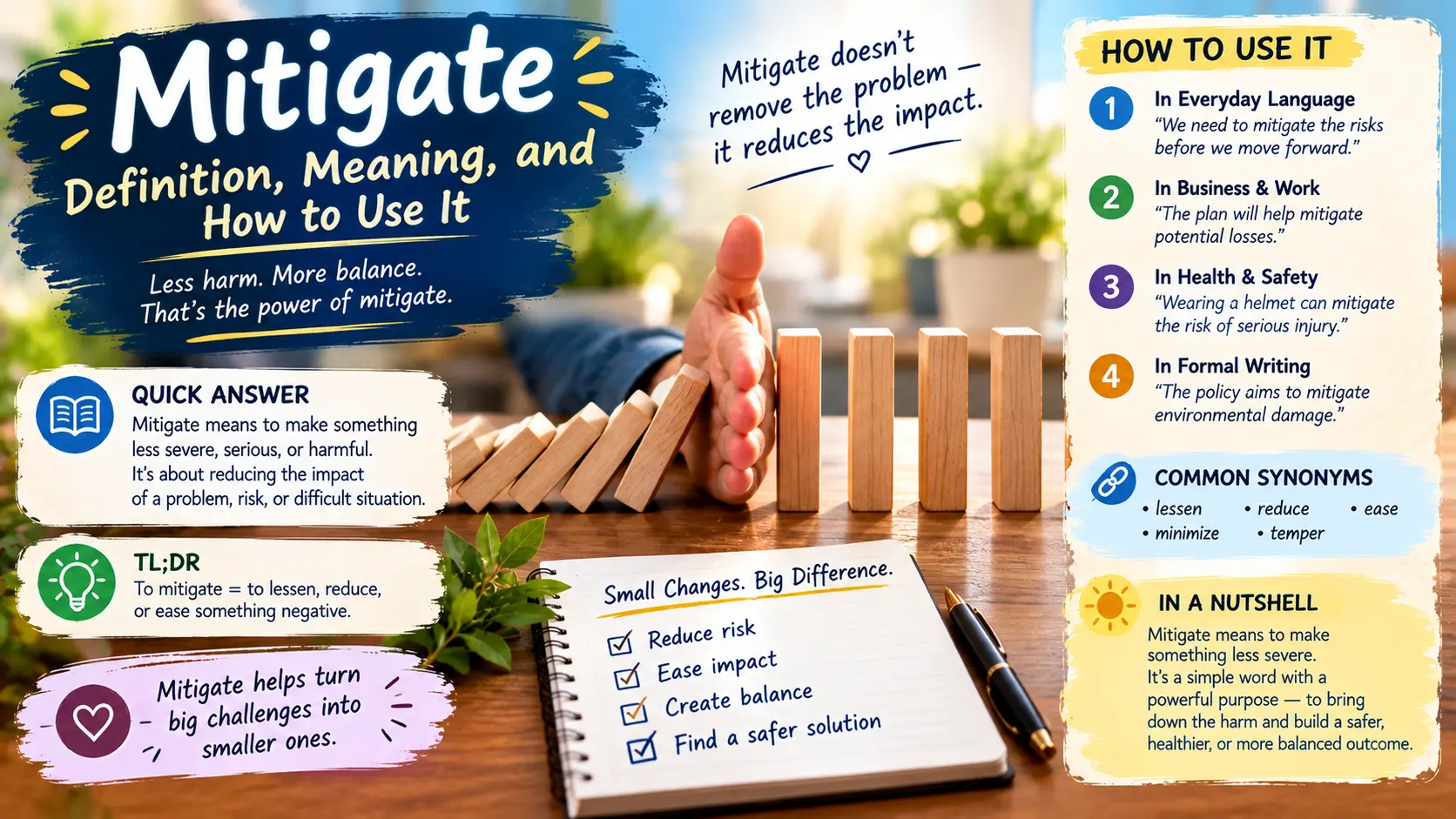
Mitigate means to make something less severe, harmful, painful, serious, or difficult. When you mitigate a problem, you do not necessarily remove it completely. Instead, you take action to reduce its negative effects.
For example, if heavy rain could cause flooding, building better drainage systems may mitigate the risk of flooding. The drainage may not prevent every possible flood, but it can reduce the likelihood or severity of the problem.
The word is commonly used when discussing risks, damage, problems, consequences, pain, conflict, and negative effects. It is especially common in professional, academic, legal, scientific, and government writing.
Mitigate vs. Reduce, Lessen, and Ease
These words have similar meanings, but mitigate often suggests deliberately taking action to make a negative situation less severe.
- Reduce: To make something smaller or lower.
- Lessen: To make something less intense or serious.
- Ease: To make something more comfortable or less difficult.
- Mitigate: To reduce the harmful severity or impact of something.
For example, “The medicine eased the pain” sounds natural in everyday conversation. “The company introduced safety measures to mitigate the risks” sounds more formal and emphasizes reducing potential harm.
What Mitigate Means in a Sentence
Here are several examples:
- The new policy may mitigate the effects of rising costs.
- Wearing protective equipment can mitigate the risk of injury.
- Trees can help mitigate urban heat.
- The manager took steps to mitigate the problem.
- Better planning can mitigate potential delays.
In each example, the goal is to make an unwanted situation less severe or damaging.
How to Use “Mitigate” in Everyday English
Common Situations Where It Is Used
“Mitigate” is most useful when talking about something negative that can potentially be reduced. Common subjects include risk, damage, harm, consequences, conflict, pain, financial losses, environmental effects, and operational problems.
You might hear it in a workplace meeting when someone discusses mitigating project risks. A government official might discuss measures designed to mitigate the effects of a natural disaster. A lawyer might use it when describing circumstances that reduce the seriousness of an action.
Although the word is perfectly correct in everyday English, alternatives such as reduce, limit, lessen, or ease may sound more conversational.
Mitigate in Everyday Sentences
Consider these examples:
Work:
“The team created a backup plan to mitigate possible delays.”
Finance:
“Saving an emergency fund can mitigate the effects of an unexpected expense.”
Safety:
“Warning signs can help mitigate the risk of accidents.”
Environment:
“Planting trees can help mitigate some effects of extreme heat.”
Relationships:
“Open communication may mitigate unnecessary conflict.”
Education:
“Extra tutoring can mitigate some learning difficulties.”
Common Collocations With Mitigate
A collocation is a combination of words that commonly appear together. Some frequent combinations with “mitigate” include:
- mitigate risk
- mitigate damage
- mitigate harm
- mitigate effects
- mitigate consequences
- mitigate losses
- mitigate problems
- mitigate threats
- mitigate conflict
- mitigate impact
- mitigate disruption
- mitigate exposure
“Mitigate risk” is particularly common in professional and business English.
What Is the Origin of the Word “Mitigate”?
Latin Roots and Original Meaning
The word mitigate comes from the Latin mitigare, meaning to make mild, soften, or lessen. It is connected with the Latin word mitis, meaning mild or gentle.
This origin helps explain why the modern word is associated with reducing severity. Something that is mitigated becomes less harsh or damaging.
How Mitigate Entered English
The word entered English through French and Latin-influenced vocabulary during the development of English. Like many formal English words with Latin roots, it became particularly useful in legal, academic, religious, governmental, and literary language.
Over time, its meaning became closely associated with reducing the seriousness or harmful consequences of something.
How Its Meaning Developed
The central idea has remained relatively stable. Whether used historically or today, “mitigate” generally involves making something less severe.
Modern English has expanded the contexts in which the word is used. Today, it can describe everything from environmental risks and cybersecurity threats to emotional distress, business losses, and public-health concerns.
The Core Meaning and Idea Behind Mitigation
Reducing Harm or Severity
The most important idea behind mitigation is reduction rather than complete removal.
Suppose a business faces the possibility of a computer system failure. Creating backups may mitigate the consequences of that failure. The backup does not necessarily prevent the original failure, but it can reduce the amount of damage caused by it.
This distinction makes “mitigate” particularly useful when a problem cannot be completely avoided.
Making a Difficult Situation Less Severe
Mitigation can involve practical actions, planning, prevention measures, or supportive interventions.
For example, installing stronger storm protection may mitigate property damage. Providing additional resources may mitigate the effects of a difficult situation. Negotiation may mitigate conflict by reducing its intensity.
The action can vary greatly, but the underlying purpose remains the same: make the negative outcome less serious.
Mitigation Does Not Always Mean Elimination
See Also: Fairy Rings in Grass: Spiritual Meaning & Symbolism
One of the most important points to remember is that mitigating something does not necessarily mean eliminating it.
If a company mitigates a security risk, the risk may still exist. If a treatment mitigates discomfort, the discomfort may not disappear completely. If a policy mitigates environmental damage, it may reduce the damage without stopping it entirely.
This is why “mitigate” is different from words such as eliminate, eradicate, or completely prevent.
Mitigate vs. Similar Words
Mitigate vs. Prevent
Prevent means to stop something from happening. Mitigate generally means to reduce its severity or impact.
For example:
- “The safety system prevented the accident.”
- “The safety system mitigated the damage caused by the accident.”
Prevention focuses on stopping an event, while mitigation focuses on limiting its negative consequences.
Mitigate vs. Avoid
Avoid means to stay away from something or prevent contact with it.
For example, a person may avoid a dangerous situation. If the situation cannot be avoided, they may take steps to mitigate the danger.
Therefore, avoidance and mitigation can sometimes work together.
Mitigate vs. Minimize
Minimize means to make something as small as possible or reduce it substantially.
“Mitigate” specifically carries the idea of making something less harmful, severe, or damaging.
The two words can overlap, especially in discussions about risk. However, “mitigate” often sounds more appropriate when the subject is a threat, consequence, or harmful effect.
Mitigate vs. Alleviate
Alleviate usually means to make pain, suffering, difficulty, or a burden less severe.
For example:
- “The treatment alleviated her discomfort.”
- “The new procedures mitigated the risks associated with the operation.”
Both words involve reducing severity, but “alleviate” is especially common with pain and suffering, while “mitigate” is widely used with risk and potential harm.
Examples of “Mitigate” in Different Contexts
Mitigate in Work and Business
Businesses frequently use “mitigate” when discussing risk management.
A company might diversify suppliers to mitigate supply-chain disruptions. A project manager might create contingency plans to mitigate delays. A financial team might establish controls to mitigate losses.
For example:
“The company introduced several safeguards to mitigate operational risks.”
Here, the safeguards are intended to reduce the possible consequences of operational problems.
Mitigate in Health and Safety
Health and safety discussions often use the word when describing actions that reduce exposure to danger.
Examples include:
- Safety training can mitigate workplace risks.
- Protective equipment can mitigate potential injuries.
- Better ventilation can mitigate exposure to certain airborne hazards.
The word does not imply that the danger has disappeared. It indicates that measures have been taken to reduce the danger or its potential consequences.
Mitigate in Law and Government
“Mitigate” is common in legal and governmental language because these fields frequently discuss risk, consequences, responsibility, and harm.
For example, policies may be designed to mitigate the effects of an economic problem. A court may consider circumstances that mitigate the seriousness of an offense.
The related noun mitigation is also common, especially in formal legal contexts.
Mitigate Environmental Risks
Environmental discussions frequently use phrases such as “mitigate climate impacts,” “mitigate pollution,” and “mitigate environmental damage.”
For example:
“Wetland restoration can help mitigate some effects of flooding.”
The statement means that restoration may reduce the severity or consequences of flooding rather than guarantee that flooding will never happen.
See Also: Meaning of the Color Pink: Spiritual & Symbolic Guide
Mitigate Problems in Daily Life
The word can also describe ordinary problem-solving.
You might mitigate travel delays by leaving early. You might mitigate the effects of a busy schedule by planning ahead. You might mitigate financial stress by preparing a budget.
Although these examples are grammatically correct, casual speakers may often choose simpler words such as reduce, limit, or lessen.
Mitigate in American English
How Americans Commonly Use the Word
In American English, “mitigate” is especially common in professional, business, government, legal, environmental, and technical communication.
Common expressions include:
- mitigate risk
- mitigate damage
- mitigate the impact
- mitigate potential problems
- mitigate negative effects
- mitigate consequences
The word is understood widely, although it tends to sound more formal than “reduce.”
Why It Appears in Professional Communication
Professional communication often deals with situations where complete prevention is unrealistic.
A business cannot always eliminate every risk, but it can mitigate risks. A government cannot necessarily prevent every natural disaster, but it can mitigate potential damage. A project team cannot guarantee that nothing will go wrong, but it can mitigate foreseeable problems.
This makes “mitigate” a useful word for describing risk-management strategies.
Mitigate in Professional and Public Language
The word can make communication more precise when the writer wants to emphasize reducing severity rather than eliminating a problem.
For example, saying “measures were introduced to mitigate the risk” communicates a different idea from “measures were introduced to prevent the risk.”
Mitigate in News, Politics, and Public Life
Common Political and News Usage
News organizations and public officials often use “mitigate” when discussing large-scale problems.
It may appear in reporting about:
- economic pressures
- environmental challenges
- public safety
- natural disasters
- infrastructure
- social problems
- international conflicts
- public policy
For example, an article might describe a policy intended to mitigate the economic effects of a crisis.
Risk Mitigation in Public Policy
Public policy frequently focuses on reducing the effects of problems that cannot be completely eliminated.
Emergency planning, infrastructure improvements, safety standards, and environmental measures can all be described as forms of mitigation when their purpose is to reduce potential harm.
Why the Word Is Common in Official Statements
“Mitigate” is concise and relatively precise. It allows officials to describe actions intended to reduce severity without claiming that a problem will disappear.
That distinction can be important in public communication.
Is “Mitigate” Formal or Casual?
Formal and Professional Usage
“Mitigate” is generally considered a formal or moderately formal word.
It is especially common in:
- business writing
- academic writing
- legal documents
- government communication
- technical reports
- journalism
- professional presentations
It is not an incorrect word for casual conversation, but simpler alternatives may sound more natural.
Can You Use Mitigate in Conversation?
Yes. There is nothing grammatically wrong with using “mitigate” while speaking.
For example:
“We need to do something to mitigate the problem.”
However, in relaxed conversation, someone might naturally say:
“We need to do something to reduce the problem.”
Both are correct. The second is simply more conversational.
When Simpler Words May Sound More Natural
Choose reduce, lessen, ease, or limit when speaking to a general audience and simplicity is more important than formal precision.
Choose mitigate when you want to emphasize the deliberate reduction of risk, harm, severity, or negative consequences.
Common Mistakes and Misunderstandings About “Mitigate”
What Mitigate Does Not Mean
“Mitigate” does not automatically mean:
- completely remove
- permanently solve
- guarantee prevention
- eliminate every risk
- make something disappear
If an action merely reduces the severity of a problem, “mitigate” may be appropriate.
Incorrect vs. Correct Usage
A common misunderstanding is treating “mitigate” as an exact synonym for prevent.
Less accurate idea:
“The precautions mitigated the accident from happening.”
Better:
“The precautions helped prevent the accident.”
Or:
“The precautions mitigated the damage caused by the accident.”
The distinction is important because you generally mitigate a risk, impact, effect, consequence, or harm, rather than simply using “mitigate” as a replacement for every instance of “prevent.”
Can Mitigate Mean Completely Prevent?
Usually, no. The standard meaning centers on making something less severe or harmful.
There can be contexts where mitigation measures contribute to preventing an outcome, but the word itself does not normally promise complete prevention.
How the Meaning of “Mitigate” Has Changed Over Time
Historical Meaning
The historical roots of “mitigate” center on the idea of making something milder or softer.
Its Latin origin reflects this basic concept, and the meaning carried into English while remaining connected to reducing harshness or severity.
Modern English Meaning
Today, “mitigate” is strongly associated with risk management and consequence reduction.
Modern examples frequently involve technology, business, environmental issues, safety, law, government, and public policy.
Then vs. Now
The fundamental meaning has remained remarkably consistent:
Then: Make something milder or less harsh.
Now: Reduce the severity, harm, risk, or impact of something.
The major change is not the core meaning but the range of situations in which the word is used.
Mitigate in a Quick Reference Table
| Word or Phrase | Meaning | Example |
|---|---|---|
| Mitigate | Reduce severity or harm | Steps can mitigate the risk. |
| Prevent | Stop something from happening | The barrier prevented entry. |
| Avoid | Stay away from something | We avoided the dangerous route. |
| Reduce | Make smaller or lower | We reduced the cost. |
| Lessen | Make less intense | The treatment lessened the discomfort. |
| Alleviate | Make pain or difficulty less severe | The medicine alleviated the pain. |
| Minimize | Make as small as possible | We minimized the potential loss. |
| Eliminate | Remove completely | The process eliminated the error. |
Frequently Asked Questions About Mitigate
What does mitigate mean in simple English?
Mitigate means to make something less severe, harmful, serious, or difficult. It usually involves reducing a negative effect rather than removing the problem completely.
Is mitigate a positive or negative word?
“Mitigate” is generally neutral in tone, although it is usually used in connection with a negative situation such as risk, harm, damage, or difficulty.
Does mitigate mean the same as prevent?
No. Prevent means to stop something from happening, while mitigate means to reduce its severity or harmful effects.
Is mitigate a formal word?
Yes. “Mitigate” is generally considered formal or moderately formal and is particularly common in professional, academic, legal, technical, and government writing.
What is an example of mitigate?
A simple example is: “The company created a backup system to mitigate the effects of a computer failure.” The backup system may not stop the failure, but it can reduce its consequences.
What is the opposite of mitigate?
Depending on the context, possible opposites include aggravate, worsen, intensify, increase, or exacerbate. These words suggest making a problem more severe rather than less severe.
What words are similar to mitigate?
Common synonyms include reduce, lessen, ease, alleviate, diminish, limit, moderate, minimize, and soften. The best choice depends on the specific context.
How do you use mitigate in a sentence?
A natural example is: “Taking preventive measures can mitigate the risk of serious damage.” Here, “mitigate” means reduce the potential severity of the damage.
Conclusion: Understanding the Meaning of Mitigate
Mitigate means to reduce the severity, harmful effects, risk, or consequences of something. It does not usually mean that a problem has been completely eliminated or prevented.
The word is particularly useful in formal English because it describes a realistic approach to difficult situations: identify a potential problem and take action to make its effects less serious.
Once you understand the difference between mitigate, prevent, avoid, reduce, alleviate, and eliminate, using the word becomes much easier. Whether you encounter it in business, news, law, environmental discussions, academic writing, or everyday problem-solving, its central idea remains the same: make something less severe or harmful.