
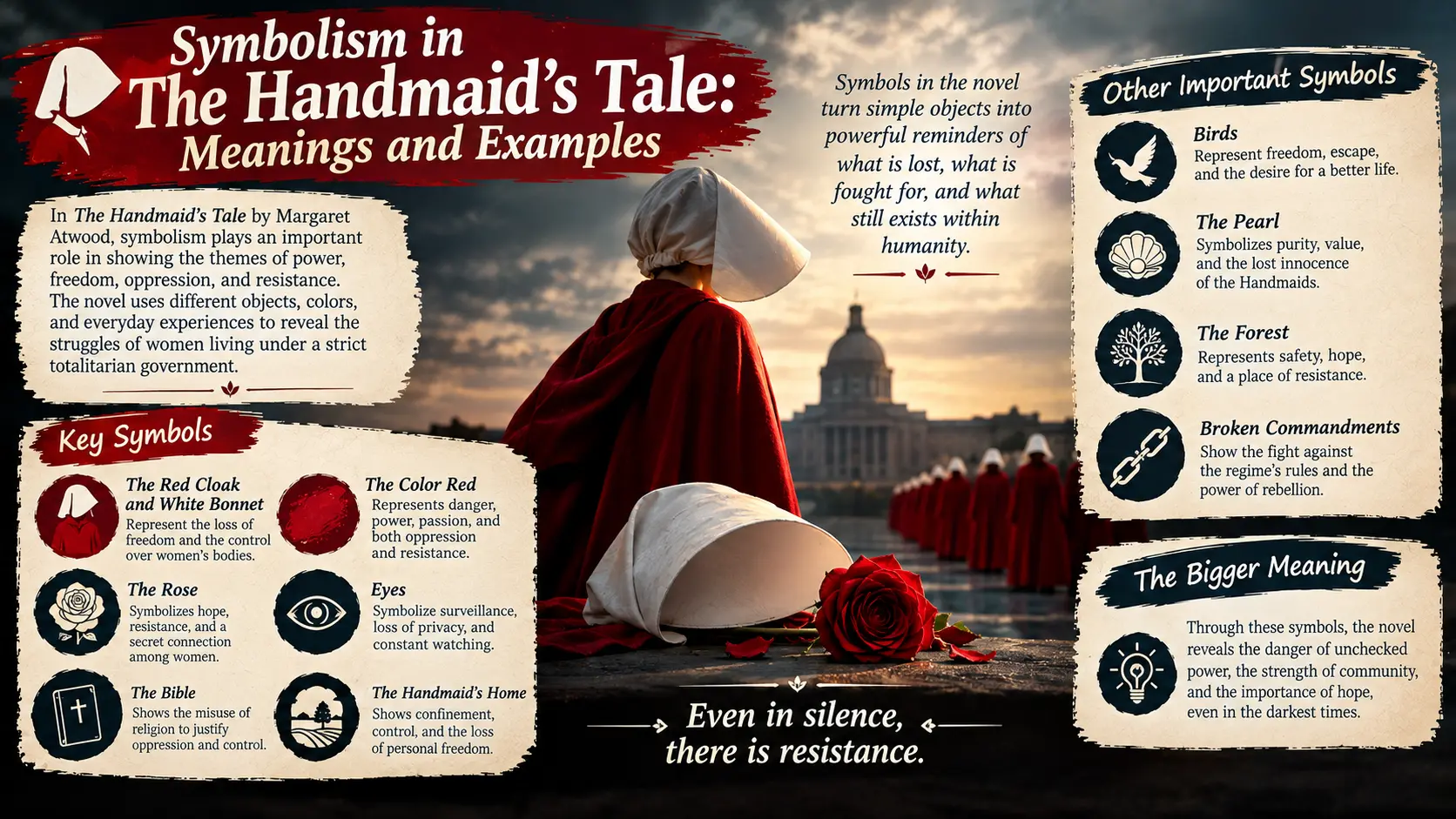
Symbolism in The Handmaid’s Tale: Meanings and Examples
In The Handmaid’s Tale by Margaret Atwood, symbolism reveals the deeper themes of power, oppression, identity, freedom, and resistance. Through colors, objects, clothing, and everyday experiences, Atwood shows how the totalitarian government of Gilead controls women’s bodies, restricts their choices, and attempts to erase their individuality.
Understanding symbolism in The Handmaid’s Tale helps readers recognize how power operates through fear, social expectations, and the control of personal identity. At the same time, the novel explores how memory, hope, and the desire for freedom can survive even under extreme oppression.
What Is Symbolism in The Handmaid’s Tale?
Symbolism is the use of objects, colors, places, and actions to communicate meanings beyond their literal purposes. In The Handmaid’s Tale, Atwood uses symbolism to explore gender inequality, political control, reproductive freedom, and the struggle to preserve individuality.
For example, the Handmaids’ red clothing represents their reproductive roles, while the Eyes symbolize constant surveillance. Flowers reveal the complicated relationship between beauty, fertility, and control. These symbols help readers understand Gilead’s oppressive structure without relying solely on direct explanations.
Atwood’s symbolism also encourages readers to question systems that use religion, tradition, or authority to justify injustice. The symbols connect the fictional society of Gilead with broader concerns about human rights and personal freedom.
The Meaning of the Color Red
Red is one of the most recognizable symbols in The Handmaid’s Tale. It is primarily associated with the Handmaids, whose clothing identifies them as women assigned to bear children for the ruling class. Red symbolizes fertility, reproduction, blood, and the government’s control over women’s bodies.
However, red also suggests danger, sacrifice, and suffering. The Handmaids’ uniforms make them easily identifiable while reducing their individuality to a single social function. Their appearance reflects a society that values their reproductive abilities more than their personal desires, memories, or ambitions.
Through this color, Atwood highlights the contradiction between the biological significance of reproduction and the injustice of forcing women into reproductive roles. Red becomes both a symbol of life and a reminder of the suffering caused by oppression.
The Symbolism of Blue in the Novel
Blue is associated with the Wives of powerful men, including Serena Joy. Their clothing distinguishes them from the Handmaids and reflects their social position within Gilead’s rigid hierarchy. While Handmaids are valued for fertility, Wives are recognized through marriage, status, and their connection to powerful men.
Blue can suggest dignity, calmness, and conventional ideas of purity. However, these associations contrast with the restrictions experienced by women in Gilead. Serena Joy possesses greater social privilege than Offred, yet she cannot escape the expectations and limitations imposed by the regime.
The contrast between red and blue reveals how Gilead divides women into categories and assigns them value according to their social roles. Atwood demonstrates that privilege does not necessarily mean freedom.
The Symbolic Meaning of White
White often represents purity, innocence, and religious authority. In The Handmaid’s Tale, the white wings surrounding the Handmaids’ faces are particularly significant because they restrict their peripheral vision and limit their ability to observe the world freely.
These coverings also prevent others from easily seeing their faces, reinforcing their isolation and uniform appearance. The white wings symbolize restricted freedom, controlled visibility, and the suppression of individuality.
White can also reflect Gilead’s carefully constructed image of religious righteousness. The regime presents its rules as morally justified, even when those rules produce suffering and injustice. Through this contrast, Atwood questions the use of religious language to disguise authoritarian power.
The Red Clothing of the Handmaids
The Handmaids’ red uniforms serve as a constant reminder of their assigned reproductive function. By requiring women to wear specific clothing, Gilead makes social divisions visible and reinforces the government’s authority over their lives.
The uniforms also make individual women appear interchangeable. Their personal histories, relationships, and ambitions are pushed aside in favor of their designated roles. Offred’s memories of her life before Gilead reveal the distance between the person she once was and the identity the regime forces upon her.
The red uniform symbolizes the loss of personal freedom, but it also highlights the difference between an imposed identity and a person’s inner self. Despite the government’s attempts to control her, Offred continues to remember her past and reflect on her experiences.
The Eyes as a Symbol of Surveillance
The Eyes are Gilead’s secret surveillance force, responsible for investigating suspected disobedience and enforcing the regime’s authority. Their presence creates uncertainty because citizens cannot always know who might be watching or reporting their behavior.
This uncertainty encourages people to monitor their own words and actions. Even ordinary conversations can become dangerous when trust is limited and punishment is unpredictable.
The Eyes symbolize surveillance, fear, mistrust, and the loss of privacy. Their power extends beyond physical observation because the possibility of being watched influences how people behave.
Through this symbol, Atwood demonstrates how authoritarian governments can control individuals not only through punishment but also through the fear of punishment. When people become afraid to speak openly, resistance becomes more difficult.
Flowers and Their Symbolic Meaning
Flowers play an important role in the novel, particularly through Serena Joy’s garden and Offred’s observations of the natural world. They connect beauty and growth with fertility, femininity, and the expectations imposed on women.
However, flowers also have meanings that extend beyond reproduction. Their changing appearance reflects vulnerability, renewal, desire, and the tension between natural life and Gilead’s rigid social order.
| Flower or Floral Image | Symbolic Meaning |
|---|---|
| Tulips | Beauty, seasonal renewal, and fertility |
| Red flowers | Reproduction, desire, and the control of women’s bodies |
| Serena Joy’s garden | Domestic expectations, social status, and controlled fertility |
| Flowers in bloom | Growth, vitality, and the possibility of renewal |
| Fading flowers | Fragility, vulnerability, and the limitations imposed by Gilead |
Flowers reveal the contrast between the beauty of nature and the harshness of a society that attempts to control women’s reproductive lives. Their presence also reminds readers that life continues to grow even within restrictive environments.
The Wall as a Symbol of Fear and Control
The Wall is one of the most disturbing symbols in The Handmaid’s Tale. The regime displays the bodies of executed people there, turning the structure into a public warning against disobedience. Its presence reminds citizens that challenging Gilead’s authority can have deadly consequences.
The Wall also represents the psychological barriers created by fear. People become cautious, suspicious, and reluctant to question the government because they know the possible cost of resistance.
For Offred, the Wall is a reminder of the violence surrounding her daily existence. It makes the regime’s power visible and reinforces the dangers of living in a society without meaningful freedom.
The Wall symbolizes punishment, intimidation, and the use of public violence to maintain political control. Through it, Atwood shows how fear can silence individuals and discourage collective resistance.
The Symbolism of Names and Identity
Names are central to the novel’s exploration of identity and power. Gilead assigns women names that reflect their relationships with powerful men, replacing their former identities with labels determined by the regime.
- Loss of individuality: Assigned names reduce women to their social functions rather than recognizing them as independent people.
- The meaning of Offred: Her name suggests possession by the Commander, reflecting the regime’s control over her identity.
- Names as signs of authority: The naming system reveals the unequal power relationship between men and women.
- Erasing the past: Replacing personal names weakens the connection between women and their former lives.
- Resistance through memory: Offred’s memories help her preserve a sense of self despite the identity imposed upon her.
Offred’s assigned name symbolizes the attempt to erase individuality, while her memories represent an important form of resistance. By remembering her past, she maintains a connection to the person she was before Gilead took control of her life.
Atwood uses names to demonstrate that identity is more than a label. It includes personal history, relationships, experiences, and the freedom to define oneself.
The Ceremony and Its Symbolism
The Ceremony is a state-controlled reproductive ritual in which a Handmaid is expected to have sexual intercourse with the Commander while his Wife is present. Gilead uses a selective interpretation of biblical teachings to justify the practice as a necessary duty.
The ritual removes personal choice from reproduction and places women’s bodies under government control. It also exposes the unequal power relationships between the Commander, his Wife, and the Handmaid.
The Ceremony symbolizes the loss of bodily autonomy and the use of religious ideology to justify oppression. Its formal, ritualized nature makes an act of coercion appear socially acceptable within Gilead.
Through this disturbing practice, Atwood criticizes systems that disguise injustice as duty or tradition. The Ceremony reveals how authoritarian power can invade even the most private aspects of human life.
Conclusion
Symbolism in The Handmaid’s Tale by Margaret Atwood reveals the novel’s central themes of oppression, power, identity, reproductive control, and resistance. Red clothing reflects the Handmaids’ assigned roles, blue highlights social divisions, the Eyes represent surveillance, and the Wall demonstrates the consequences of disobedience. Flowers and names further explore the relationship between identity, fertility, and personal freedom.
Together, these symbols reveal how Gilead uses fear, ideology, and social expectations to control individuals. Yet Offred’s memories and desire for freedom show that personal identity can endure even under oppressive conditions. Through its powerful symbolism, the novel encourages readers to question injustice and recognize the importance of human rights, dignity, and individual freedom.
Frequently Asked Questions (FAQs)
What is symbolism in The Handmaid’s Tale?
Symbolism is the use of objects, colors, places, and actions to communicate deeper meanings. Atwood uses symbols to explore oppression, political control, identity, and resistance in Gilead.
What does the color red symbolize in the novel?
Red primarily represents fertility, reproduction, and the control of women’s bodies. It can also suggest blood, danger, sacrifice, and suffering.
What does blue symbolize in The Handmaid’s Tale?
Blue is associated with the Wives of powerful men, including Serena Joy. It distinguishes their social position from that of the Handmaids and highlights Gilead’s rigid hierarchy.
What does white symbolize in the novel?
White can suggest purity and religious righteousness. The Handmaids’ white wings also represent restricted vision, isolation, and the suppression of individuality.
What do the Eyes represent in The Handmaid’s Tale?
The Eyes symbolize government surveillance and the fear of being watched. Their presence discourages open communication and makes resistance more dangerous.
What do flowers symbolize in the novel?
Flowers can represent beauty, fertility, femininity, and renewal. They also reveal how Gilead connects women’s identities with reproduction and domestic expectations.
What does the Wall symbolize in The Handmaid’s Tale?
The Wall symbolizes punishment, fear, and political intimidation. The displayed bodies warn citizens about the consequences of disobeying the regime.
What does the Ceremony symbolize?
The Ceremony symbolizes reproductive coercion and the loss of bodily autonomy. It demonstrates how Gilead uses religious interpretations to justify control over women.
What does the name Offred symbolize?
Offred’s name suggests that she belongs to the Commander. It represents the loss of her former identity and the regime’s attempt to define women through their relationships with men.
Why is symbolism important in The Handmaid’s Tale?
Symbolism helps readers understand the novel’s deeper criticism of authoritarianism, gender inequality, and the misuse of power. It also highlights the importance of identity, freedom, and resistance.