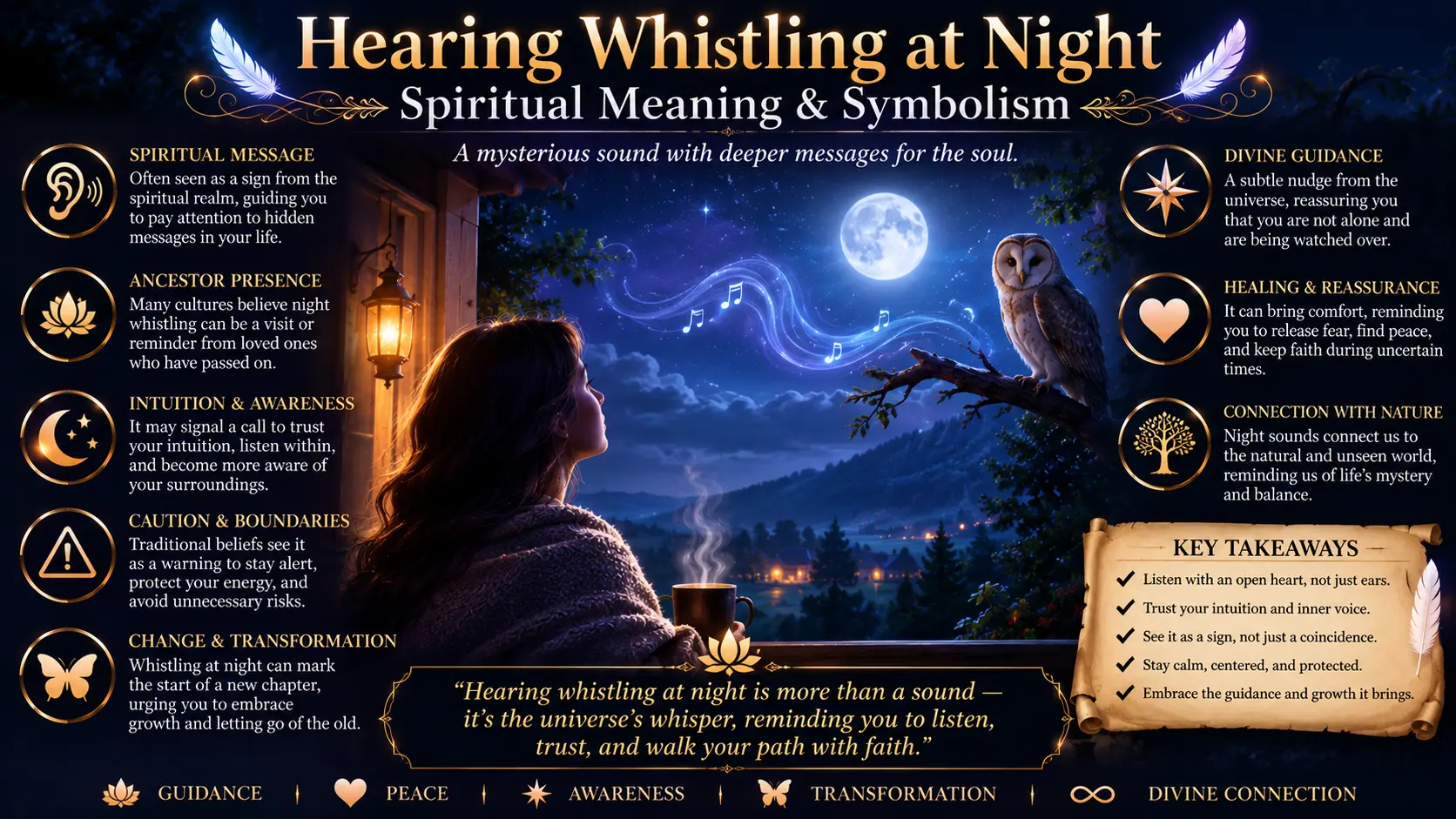
Hearing Whistling at Night: Spiritual Meaning & Symbolism
Quick Answer
Hearing whistling at night can be interpreted spiritually as a symbol of intuition, awareness, guidance, mystery, or an invitation to pay attention. In some traditional cultures and folklore, nighttime whistling has also been associated with warnings, unseen forces, or bad omens. However, there is no universal spiritual meaning, and a whistle may simply come from wind, animals, people, pipes, or distant sounds.
The meaning often depends on the circumstances, your emotional response, cultural background, and personal beliefs. Rather than automatically assuming that a nighttime whistle is supernatural, it can be helpful to consider both ordinary explanations and the symbolic meaning the experience holds for you.
TL;DR
- Spiritually: Night whistling can symbolize intuition, awareness, guidance, mystery, or change.
- Traditionally: Some folklore views nighttime whistling as a warning or an invitation to be cautious.
- Psychologically: Darkness increases alertness, making unfamiliar sounds feel more personal or threatening.
- Culturally: Interpretations vary widely between communities and traditions.
- Naturally: Wind, birds, animals, people, pipes, electronics, and distant sounds can all produce whistle-like noises.
- Personally: The strongest symbolic interpretation may come from what you were thinking or feeling when you heard it.
Table of Contents
What Does Hearing Whistling at Night Mean Spiritually?
Hearing an unexplained whistle at night can feel unusually meaningful because nighttime is naturally associated with quietness, mystery, reflection, and the unknown. When an unexpected sound breaks that silence, the mind immediately tries to determine where it came from and whether it carries a message.
In spiritual symbolism, a whistle can represent a call for attention. It may encourage you to become more aware of your surroundings, listen to your intuition, or notice something you have been overlooking. These interpretations are symbolic rather than proven supernatural explanations.
A Whistling Sound With No Visible Source
When you hear a whistle but cannot identify its source, the experience may feel mysterious. The absence of a visible person, animal, or object encourages the imagination to fill in the missing information.
Symbolically, this can represent something unseen but emotionally significant. Some people interpret it as a reminder to trust their instincts, while others see it as a metaphor for uncertainty or the unknown.
Why Nighttime Whistling Feels Significant
Night changes how humans perceive ordinary sounds. With less visual information available, hearing becomes more important, and a distant whistle can seem unusually close or distinctive.
Spiritually, nighttime is often associated with reflection, dreams, intuition, and hidden aspects of life. For that reason, a whistle heard after dark may feel more symbolic than the same sound heard during the daytime.
Spiritual Meaning vs. Everyday Causes
A meaningful experience does not necessarily require a supernatural cause. A sound can have a perfectly ordinary explanation while still becoming personally symbolic to someone who hears it.
A balanced interpretation considers both possibilities. First look for practical explanations, then consider whether the experience connects with a thought, emotion, decision, or life transition you are currently experiencing.
Spiritual Meanings of Hearing Whistling at Night
Nighttime whistling has several symbolic interpretations. These meanings are not universal rules; they are themes that appear in spiritual reflection, folklore, and personal symbolism.
Intuition and Inner Awareness
One common interpretation is that a whistle represents intuition calling for your attention. The sudden sound may symbolically encourage you to listen more closely to your inner feelings.
If you have been ignoring an instinct about a situation, the experience may prompt you to pause and reflect. The symbolism is less about predicting an event and more about becoming aware of what you already sense.
A Message to Pay Attention
A whistle is naturally a sound designed to attract attention. Because of this, it can symbolize an important reminder to notice what is happening around you.
You might interpret the experience as encouragement to slow down, observe your circumstances, or reconsider something you have been overlooking.
Presence Without a Visible Form
A distant or unexplained whistle can create the feeling that something is present even though nothing can be seen. Symbolically, this may represent the invisible parts of life, such as thoughts, emotions, memories, possibilities, or intuition.
This does not prove the presence of a spirit or supernatural being. Instead, the symbolism can be understood metaphorically as awareness of something that cannot be immediately seen.
Protection and Spiritual Guidance
Some people interpret unexpected sounds as reminders of spiritual protection or guidance. A whistle may therefore be viewed as a symbolic signal to remain aware and trust your path.
This interpretation is particularly meaningful when the experience produces calm rather than fear. The feeling associated with the sound can be as important as the sound itself.
Change, Transition, and New Beginnings
A whistle can also symbolize movement from one stage to another. Just as a whistle can signal the beginning or ending of an activity, hearing one at night may represent transition, closure, or a new beginning.
If you are currently experiencing major changes, the sound may become a personal symbol for leaving one chapter behind and entering another.
Is Hearing Whistling at Night a Warning?
In some folklore traditions, nighttime whistling has been treated cautiously. Certain beliefs associate whistling after dark with unwanted attention, misfortune, spirits, or warnings.
However, these ideas belong to specific cultural traditions and superstitions, rather than being universal spiritual laws. Hearing a whistle does not mean that something bad is going to happen.
Traditional Warning Interpretations
Traditional warning interpretations often developed in societies where nighttime was genuinely more dangerous. Strange sounds could indicate the presence of strangers, animals, or other potential threats.
Over time, practical caution sometimes became folklore. A simple warning to remain quiet or stay indoors could eventually develop into a belief that nighttime whistling itself carried supernatural consequences.
Fear-Based Beliefs and Superstitions
Fear can make an unexplained sound feel more significant than it actually is. Once a person believes that nighttime whistling is dangerous, hearing one may immediately trigger anxiety.
It is healthier to recognize the difference between a cultural superstition and an established fact. A frightening interpretation is not automatically a true interpretation.
A Modern Spiritual Perspective
Modern spiritual interpretations often take a less literal approach. Instead of treating a whistle as a prediction of bad luck, people may see it as a reminder to become more conscious and reflective.
The question becomes not “What terrible thing will happen?” but “What should I pay attention to right now?”
Historical Roots of Night Whistling Symbolism
Whistling has existed in human societies for a very long time. It has been used for communication, signaling, entertainment, work, music, and social interaction.
Because whistles can travel considerable distances, they naturally became associated with communication across physical space. At night, when visibility decreases, this signaling quality can take on an additional layer of mystery.
Ancient and Pre-Christian Beliefs
Many ancient cultures developed beliefs about nighttime, sounds, animals, and unseen forces. Darkness was often considered a boundary between the familiar world and the mysterious unknown.
Although specific beliefs varied greatly, unexpected nighttime sounds could become incorporated into stories about spirits, omens, ancestors, nature, or supernatural beings.
It is important not to combine every ancient tradition into one universal belief. Different societies had different explanations and symbolic systems.
European Folklore and Superstitions
European folklore contains many traditions involving nighttime sounds, supernatural beings, and warnings about certain behaviors after dark.
Whistling could be interpreted differently depending on the region. In some contexts it was simply a practical form of communication, while in others it became connected with superstition and caution.
How Folk Beliefs Reached America
European settlers brought many folk beliefs with them when communities formed in North America. Over generations, these ideas interacted with local environments and other cultural traditions.
As a result, American beliefs about nighttime sounds are not derived from a single source. They reflect multiple layers of folklore, regional customs, storytelling, and lived experience.
Hearing Whistling at Night in American Culture
American culture contains numerous stories about strange nighttime sounds. Rural environments, forests, mountains, and isolated communities naturally created opportunities for unfamiliar noises to become part of local storytelling.
Whistling could be associated with people communicating across distances, animals, wind, or unexplained events.
Indigenous Traditions and Cultural Context
Indigenous cultures across North America are extraordinarily diverse, so there is no single Indigenous interpretation of nighttime whistling.
Specific beliefs belong to particular nations, communities, and cultural traditions. It is therefore important to avoid presenting one group’s spiritual beliefs as representative of all Indigenous peoples.
Respectful interpretation requires recognizing that cultural symbolism has context and should not be generalized.
American Folklore and Rural Communities
In rural areas, whistles could serve practical purposes. People could use them to communicate across fields, signal others, or call attention without shouting.
At night, however, a whistle traveling through an otherwise quiet landscape could sound mysterious. Stories and superstitions naturally grew around these experiences.
Whistling in American Superstitions
Some American superstitions warn against whistling indoors or at night. These beliefs vary by family and region.
Such traditions can survive because they are repeated from one generation to another. Their continued existence shows the cultural power of folklore, not necessarily evidence of supernatural causation.
Night Whistling in Different Cultures
The symbolism of nighttime whistling changes considerably around the world. In one culture it may represent danger, while in another it can be associated with communication, celebration, or ordinary daily activity.
Understanding this variation helps prevent one interpretation from being treated as universal.
Latin American Folklore
Some Latin American traditions connect nighttime sounds and whistles with legendary figures, wandering spirits, warnings, or supernatural stories.
These traditions differ significantly by country and region. A well-known example is La Llorona, whose nighttime presence is part of a broader body of folklore involving grief, warning, and the supernatural.
European Cultural Beliefs
European folklore contains numerous superstitions surrounding whistling. Some traditions associate nighttime whistling with bad luck, while other communities have treated whistling as an ordinary form of communication.
The symbolism therefore depends heavily on regional history and local storytelling.
Asian Spiritual Perspectives
Across Asia, beliefs about nighttime sounds vary enormously. Different cultures have developed their own understandings of spirits, nature, ancestors, omens, and unusual sounds.
Rather than assigning one universal “Asian meaning,” it is more accurate to say that local traditions determine how a nighttime whistle may be interpreted.
African Folklore and Symbolism
African cultures likewise contain highly diverse traditions involving sound, communication, ancestors, animals, and spiritual symbolism.
Whistling can have practical and symbolic roles in different communities. Its meaning must therefore be understood within the specific cultural setting rather than through a single generalized interpretation.
Emotional and Psychological Meaning of Night Whistling
The experience of hearing a whistle at night can be powerful even when there is nothing supernatural involved. Human perception is strongly influenced by context.
Darkness, silence, uncertainty, and limited visual information can increase alertness and make ambiguous sounds feel more important.
Why the Sound Can Trigger Fear
The brain is naturally sensitive to unexpected sounds, particularly when the source cannot immediately be identified.
At night, reduced visibility makes it harder to confirm what produced the sound. This uncertainty can activate a stronger sense of caution, causing an ordinary noise to feel threatening.
Curiosity and Heightened Awareness
Not everyone reacts with fear. Some people become curious instead. An unusual whistle may make them listen more carefully and become more aware of their surroundings.
From a symbolic perspective, this heightened awareness can become a reminder to pay attention rather than react automatically.
Why the Experience Can Feel Personal
If you were thinking deeply about a relationship, decision, loss, or future plan when the whistle occurred, your brain may connect the sound with those thoughts.
This does not mean the sound was necessarily sent specifically to you. It means the experience became personally meaningful because of the emotional context surrounding it.
Common Spiritual Interpretations of Night Whistling
There is no single spiritual interpretation that applies to everyone. However, several themes repeatedly appear in personal and symbolic interpretations.
A Call to Trust Your Intuition
The whistle may symbolize an inner nudge to listen to yourself. If something has been bothering you quietly, the unexpected sound may encourage you to acknowledge it.
A Sign of Awareness and Attention
Because whistles naturally attract attention, they can represent a symbolic call to become more observant.
You might take the experience as an opportunity to examine what is happening in your life instead of moving through it automatically.
Symbol of Mystery and the Unknown
A whistle without an obvious source can symbolize life’s unanswered questions. Not everything has to be immediately understood.
The experience may encourage you to become comfortable with uncertainty while continuing to seek reasonable explanations.
Reminder to Slow Down and Reflect
Nighttime naturally creates an environment for reflection. A sudden whistle can interrupt a busy mental pattern and encourage you to pause.
Its spiritual meaning may therefore be simple: stop, listen, reflect, and become present.
Could Hearing Whistling at Night Have a Natural Cause?
Before interpreting a nighttime whistle spiritually, consider ordinary possibilities. Sound behaves differently at night, and environmental conditions can make distant noises surprisingly noticeable.
A practical explanation does not make the experience meaningless. It simply provides a grounded starting point.
Birds and Nocturnal Animals
Some birds and nocturnal animals produce calls that can resemble whistles. Their sounds may travel through quiet neighborhoods and natural areas.
If the sound repeats at particular times, an animal or bird becomes a reasonable possibility.
Wind, Pipes, and Household Sounds
Wind passing through gaps, vents, fences, trees, wires, or other structures can create high-pitched sounds.
Plumbing, heating systems, appliances, and other household equipment may also generate noises that resemble whistles.
Distant People, Traffic, and Other Sounds
A person whistling from a considerable distance may sound much closer or farther away depending on the environment.
Traffic, alarms, machinery, and other urban sounds can also become distorted as they travel through nighttime surroundings.
Why the Brain May Misidentify Sounds
When a sound is ambiguous, the brain attempts to identify it using incomplete information. Darkness removes much of the visual context that would normally help.
This is one reason why an ordinary environmental sound can feel mysterious or difficult to locate.
Table: Contextual Meanings of Hearing Whistling at Night
| Context | Possible Symbolic Meaning | Practical Consideration |
|---|---|---|
| A single whistle | Attention or awareness | Could be a person, animal, or environmental sound |
| Repeated whistling | Persistence or a recurring message | Check for repeating environmental sources |
| Distant whistle | Communication or connection | Sound can travel surprisingly far at night |
| Whistle during emotional reflection | Personal insight | Your emotional state may shape the symbolism |
| Whistle accompanied by fear | Caution or uncertainty | Fear can intensify reactions to ambiguous sounds |
| Whistle accompanied by peace | Guidance or reassurance | Personal symbolism may feel positive |
| Unidentified whistle | Mystery or the unknown | Investigate ordinary sources first |
Positive Spiritual Meanings of Night Whistling
Not every spiritual interpretation of nighttime whistling is negative. For some people, an unexpected sound can become a symbol of encouragement, awareness, and hope.
The emotional atmosphere surrounding the experience often influences its personal meaning.
Hope and Encouragement
A whistle can function symbolically like a signal that says keep going. If you are moving through a difficult period, the sound may become associated with resilience and hope.
Guidance During Uncertainty
When life feels unclear, people often look for meaningful reminders. A nighttime whistle may become a personal symbol encouraging you to remain patient and attentive.
Rather than predicting the future, it can serve as a reminder that uncertainty does not mean you are without direction.
Personal Growth and Transformation
A whistle can mark a transition from one moment to another. Symbolically, it may represent leaving an old pattern behind and becoming more conscious of a new direction.
This interpretation can be particularly meaningful during periods of personal growth.
Negative Interpretations and Superstitions
Some traditions associate nighttime whistling with negative events, unwanted attention, or supernatural danger. These beliefs can be culturally interesting, but they should not automatically be treated as predictions.
Bad Omens in Traditional Folklore
In some folk traditions, whistling after dark has been viewed as unlucky. Such beliefs often reflect old ideas about nighttime, silence, social behavior, and the unknown.
The existence of a superstition does not establish that the event actually causes misfortune.
Fear of Unseen Presences
An unexplained sound naturally creates a sense of uncertainty. Stories about spirits and unseen beings can make that uncertainty stronger.
If you already associate nighttime sounds with supernatural danger, your emotional response may be intensified.
Why Superstitions Should Be Viewed Carefully
Superstitions can be meaningful cultural traditions without being literal rules governing reality.
A healthy approach is to respect the cultural history while avoiding unnecessary fear. Symbolism can inspire reflection without becoming a source of anxiety.
How the Meaning of Night Whistling Has Changed
The meaning of nighttime whistling has evolved alongside society. A sound that once represented practical communication may later become part of folklore and eventually become a personal spiritual symbol.
From Survival Beliefs to Symbolism
Historically, nighttime sounds could have practical significance. In communities without modern lighting, communication systems, or electronic devices, people relied heavily on hearing.
Over time, practical concerns became woven into stories and beliefs, giving ordinary sounds additional symbolic meaning.
The Influence of Modern Culture
Movies, television, books, social media, and internet storytelling have amplified many supernatural interpretations of unexplained sounds.
Modern audiences may therefore encounter multiple versions of the same superstition, sometimes far removed from its original cultural context.
Personal Meaning in the Modern World
Today, many people interpret symbolic experiences individually. A nighttime whistle may remind one person of childhood, another of intuition, and another of a cultural tradition.
This makes personal context especially important when exploring spiritual symbolism.
How to Interpret Your Own Experience
If you recently heard whistling at night and want to understand its meaning, begin with curiosity rather than fear.
You can explore both the physical circumstances and the emotions surrounding the experience.
Consider What You Were Feeling
Ask yourself what you were thinking about immediately before hearing the sound.
Were you worried, hopeful, confused, peaceful, or making an important decision? Your emotional state may reveal why the experience felt meaningful.
Pay Attention to the Context
Consider where you were, what time it happened, whether the sound repeated, and whether you could identify its direction.
Context can often explain an experience that initially seems mysterious.
Separate Symbolism From Fear
A symbolic interpretation should help you reflect, not frighten you into believing something bad is inevitable.
If a particular interpretation creates intense fear, step back and consider alternative explanations before accepting it.
Reflect on What the Experience Means to You
Ultimately, symbolism is personal. You can ask yourself:
“What did this sound make me notice about my life?”
That question may be more useful than trying to find one universal definition.
Common Misunderstandings About Night Whistling
Nighttime whistling has accumulated many stories and interpretations, but several misconceptions are worth addressing.
It Is Not Automatically Supernatural
Hearing an unexplained whistle does not establish that a supernatural event occurred. Environmental sounds can be difficult to identify, especially at night.
A Spiritual Interpretation Is Not a Prediction
Symbolic meaning should not be confused with certainty about future events. A whistle can inspire reflection without predicting something that will happen.
Cultural Beliefs Are Not Universal Rules
A belief found in one culture may have a completely different meaning elsewhere. Cultural context matters when discussing spiritual symbolism.
FAQs About Hearing Whistling at Night
Is hearing whistling at night always spiritual?
No. A nighttime whistle can come from people, birds, animals, wind, household systems, machinery, or distant sounds. Some people may give the experience spiritual meaning, but that interpretation is personal.
Why does hearing whistling at night feel scary?
Darkness limits visual information and makes unfamiliar sounds harder to identify. The brain can become more alert when it cannot determine where a sound originated, which may increase feelings of fear or uncertainty.
Is whistling at night considered a bad omen?
Some folklore traditions consider nighttime whistling unlucky or cautionary, but these beliefs vary by culture and region. There is no universal rule that hearing a whistle means something bad will happen.
Can hearing whistling at night have a positive meaning?
Yes. Some people interpret it as a symbol of guidance, encouragement, intuition, awareness, hope, or transition. The emotional context of the experience can influence its personal meaning.
Does culture influence the meaning of night whistling?
Yes. Cultural traditions strongly influence how people interpret unusual nighttime sounds. A whistle may represent caution in one tradition and communication or ordinary activity in another.
Could there be a natural explanation for the sound?
Absolutely. Birds, animals, wind, pipes, vents, appliances, people, traffic, and distant machinery can all produce sounds that resemble whistling. Investigating these possibilities is a useful first step.
Conclusion: What Night Whistling May Symbolize
Hearing whistling at night can feel mysterious because sound becomes especially noticeable when darkness removes much of our visual information. Across folklore and personal spirituality, the experience has been connected with warnings, intuition, communication, mystery, guidance, and change.
There is no single meaning that applies to everyone. A balanced approach is to investigate practical explanations while remaining open to the personal symbolism the experience may hold.