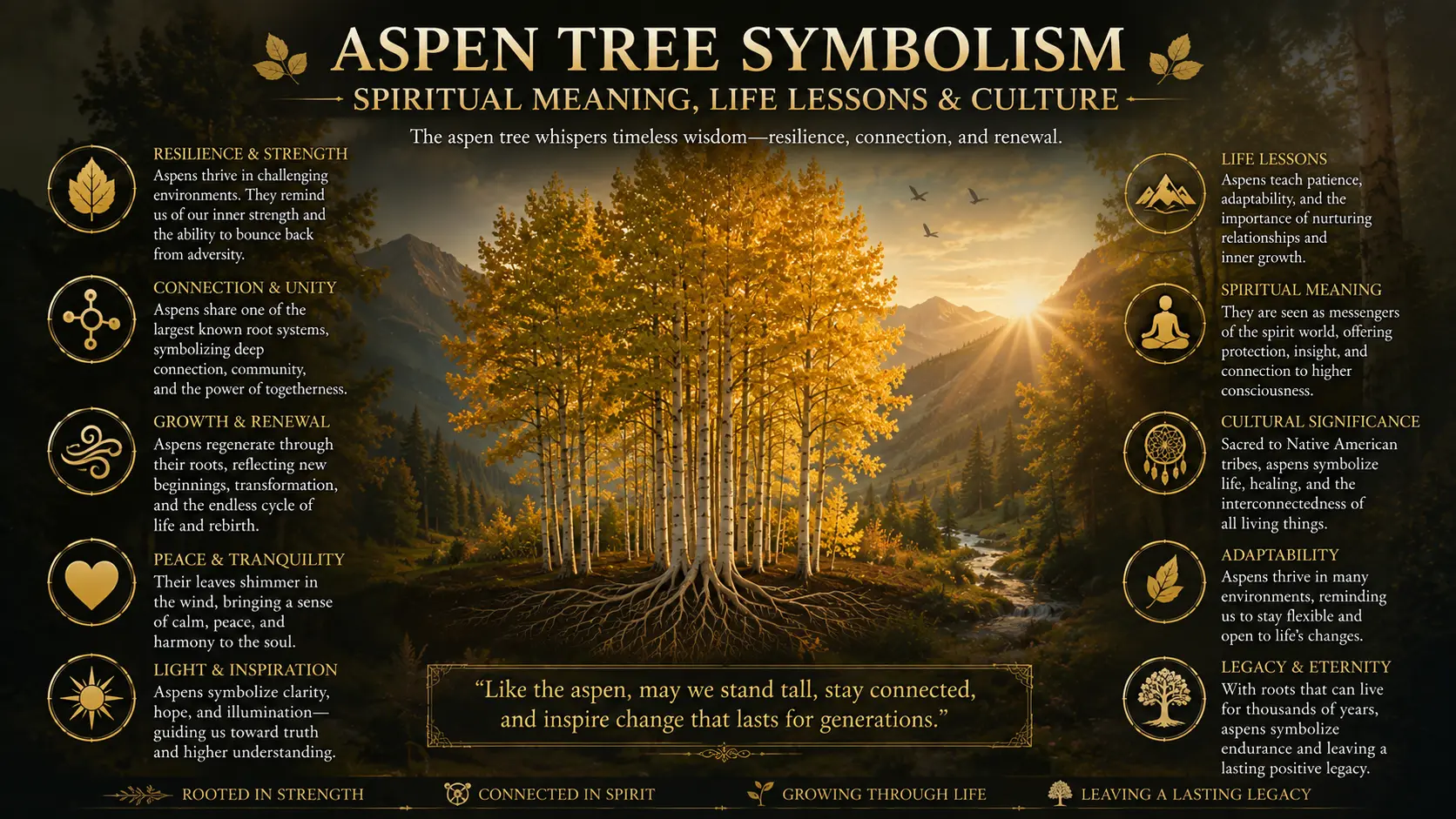
Aspen Tree Symbolism | Spiritual Meaning, Life Lessons & Culture
The aspen tree is one of nature’s most recognizable symbols of resilience, connection, transformation, and renewal. Its pale bark, shimmering leaves, and ability to grow in interconnected colonies have inspired cultural traditions, stories, artwork, and spiritual reflection for generations.
Unlike many trees that stand as individual symbols of strength, the aspen offers a different lesson: strength can come from connection. Beneath the soil, aspens can share extensive root systems, creating a living network in which individual trees are connected to a much larger organism. Above ground, their leaves tremble in even the slightest breeze, giving aspen groves an almost magical sense of movement and life.
Because of these qualities, the aspen can symbolize both individual identity and collective strength. Its changing appearance through the seasons also makes it a powerful metaphor for growth, impermanence, patience, and the natural cycles of life.
Cultural Symbolism of the Aspen Tree
Aspens have occupied an important place in the cultural landscapes of North America and Europe. Their distinctive white trunks and quaking leaves made them easy to recognize, while their ability to regenerate and spread gave them symbolic associations with endurance and renewal.
Cultural interpretations are not universal, however. Different communities have understood trees according to their own histories, environments, spiritual traditions, and stories. Aspen symbolism is therefore best viewed as a collection of meanings rather than a single fixed interpretation.
Native American Traditions
Aspen trees occur throughout many regions of North America, and different Indigenous nations have their own relationships with local trees, landscapes, and plant species. It is important not to treat all Native American traditions as one belief system.
In broader symbolic discussions, the aspen’s interconnected growth can be understood as an image of community, relationship, and continuity. Its ability to regenerate after disturbance can also inspire reflections on resilience and renewal.
The trembling leaves contribute another layer of meaning. Their constant movement can suggest attentiveness, sensitivity to the environment, and awareness of subtle changes. These interpretations should be understood as modern symbolic readings unless tied to a specific documented cultural tradition.
European Traditions
Aspens have long been part of European woodland landscapes. Their flexible leaves and characteristic movement made them memorable features of forests and countryside.
European folklore sometimes associated trembling or quivering trees with fear, mystery, or supernatural stories. Such associations vary by region and historical period, so they should not be presented as one universal European belief.
At the same time, the tree’s practical qualities—its ability to colonize disturbed land and regenerate—support symbolic themes of survival, persistence, and renewal.
Celtic Connections and Symbolism
Modern spiritual writing often connects trees with Celtic symbolism, but historical evidence for a single, standardized Celtic meaning for aspen is limited. Ancient Celtic cultures were diverse, and later traditions have sometimes blended historical material with modern interpretations.
In contemporary Celtic-inspired symbolism, aspen may represent transition, sensitivity, communication with nature, and resilience. Its movement in the wind can be viewed as a reminder that life is constantly changing.
The safest approach is to distinguish historical evidence from modern spiritual interpretation. Aspen symbolism can be meaningful without claiming that every modern association originated in ancient Celtic religion.
Aspen Symbolism Across Regional Cultures
Across different regions, the aspen’s physical characteristics naturally invite symbolic interpretations. Its white bark may suggest clarity, while its changing leaves can represent transformation.
Its grove-forming growth encourages ideas of belonging and cooperation. Rather than standing entirely alone, an aspen can be seen as part of a larger living network.
Spiritual Meaning of the Aspen Tree
Spiritually, the aspen can represent the idea that a strong life is both rooted and adaptable. Its roots remain connected beneath the ground while its branches respond to wind, weather, and seasonal change.
This combination makes the tree a useful metaphor for personal growth. You can remain connected to your values while still changing your direction, appearance, or priorities as life develops.
Connection, Community, and Unity
One of the most powerful symbolic lessons of the aspen is connection. Aspen groves can contain many visible trunks that are genetically connected through underground root systems.
Symbolically, this suggests that individuals can maintain their own identity while belonging to something larger. Family, friendship, community, and shared purpose can provide strength without requiring people to become identical.
Resilience and Inner Strength
Aspens are associated with resilience because they can regenerate and spread through their root systems. Their survival illustrates that strength does not always look dramatic.
Sometimes resilience means recovering quietly, continuing to grow, and adapting after difficult circumstances. The aspen therefore offers a gentle image of persistence rather than aggressive power.
Transformation and Renewal
The aspen changes dramatically throughout the year. Green leaves appear in warmer months before turning brilliant shades of yellow and eventually falling.
This cycle naturally symbolizes transformation. The falling leaf does not necessarily represent an ending; it can represent the necessary release that makes room for another stage of growth.
Protection and Spiritual Awareness
The trembling leaves can inspire associations with heightened awareness. When the wind moves through an aspen grove, the entire canopy can appear to respond at once.
Symbolically, this can represent listening, intuition, awareness, and sensitivity. Rather than ignoring subtle changes, the aspen encourages people to notice what is happening around and within them.
Gladiolus Flower Symbolism: Meaning, Spirituality & Strength
Aspen Tree Symbolism Through the Seasons
The changing appearance of an aspen makes seasonal symbolism especially powerful. Each stage of the year can represent a different part of the human experience.
Spring: Renewal and New Beginnings
Spring represents the return of life. Fresh leaves emerge, landscapes become greener, and the tree enters another period of active growth.
Symbolically, spring aspens can represent hope, fresh opportunities, healing, and the courage to begin again.
Summer: Growth and Vitality
During summer, aspen foliage becomes full and vibrant. The tree is at its most visibly active, creating shade and contributing to the surrounding ecosystem.
As a symbol, summer aspen represents energy, confidence, expansion, creativity, and personal development.
Autumn: Change and Letting Go
Autumn is perhaps the most iconic season for aspens. Their leaves can turn vivid yellow and gold before falling.
This makes autumn aspen symbolism strongly connected with change, maturity, release, and acceptance. The tree teaches that letting go can be a natural part of growth.
Winter: Patience and Inner Strength
In winter, the aspen loses its leaves and reveals its distinctive trunks and branches. The landscape becomes quieter, but the living system beneath the ground remains.
Winter therefore symbolizes rest, patience, hidden strength, reflection, and preparation. Not every period of life needs to be visibly productive.
Aspen Trees and Symbolism in Nature
The aspen’s natural characteristics provide the foundation for many of its symbolic meanings. Looking closely at the tree reveals lessons about relationships, adaptation, and renewal.
Quaking Leaves and Emotional Expression
Aspen leaves are famous for their movement in the breeze. Their long, flattened leaf stems allow the leaves to flutter easily.
Symbolically, this movement can represent emotional expression and responsiveness. Being sensitive does not necessarily mean being weak; it can mean being aware of changes that others overlook.
Interconnected Root Systems
Aspens can reproduce vegetatively through their root systems, producing many stems that may belong to the same clonal organism.
This natural phenomenon makes the aspen an especially compelling symbol of interdependence. What appears to be a collection of separate trees can have a much deeper connection beneath the surface.
Longevity and Regeneration
Some aspen colonies can persist for extremely long periods even though individual above-ground stems have shorter lifespans.
This creates a meaningful distinction between the lifespan of an individual and the continuity of a larger system. Symbolically, it suggests that renewal can occur without requiring everything to remain unchanged.
Aspen Tree Symbolism in Mythology and Folklore
Trees frequently appear in mythology because they connect different parts of the natural world: roots reach into the earth, trunks occupy the human landscape, and branches reach toward the sky.
Aspen folklore is particularly influenced by its unusual appearance and movement. Its trembling leaves can make a grove feel mysterious, especially in quiet forests.
Ancient Stories and Legends
Ancient and medieval stories sometimes used unusual trees as explanations for natural phenomena. The trembling of aspen leaves, for example, naturally invites questions about why the tree seems to move even when other vegetation appears still.
Such stories should be treated as folklore rather than scientific explanations. Their symbolic value lies in how people used nature to express ideas about fear, mystery, transformation, and the unknown.
European Folklore
European folklore contains many stories involving forests and trees. Aspens, because of their pale bark and quivering foliage, could become associated with mysterious woodland imagery.
In modern interpretation, these characteristics can symbolize the boundary between the familiar and unfamiliar—the feeling that nature contains meanings that are not immediately visible.
Symbolic Stories of the Quaking Aspen
The aspen’s trembling leaves have made it an especially effective storytelling symbol. The tree can appear to be whispering, reacting, or communicating with the surrounding environment.
This makes it useful as a metaphor for secrets, messages, intuition, emotional sensitivity, and awareness.
Aspen Tree Symbolism in Literature
Aspens can add emotional depth to literary landscapes. Writers may use trees not merely as scenery but as symbols that reflect a character’s internal experience.
An aspen grove can represent freedom, solitude, memory, transition, or belonging depending on the context.
Themes of Change and Identity
Because aspens change with the seasons, they naturally fit literary themes involving identity and transformation.
A character standing among autumn aspens, for example, may be surrounded by visual reminders that change is unavoidable.
Aspen Trees as Symbols of Memory
Trees often symbolize memory because they remain in a landscape while human lives change around them.
An aspen grove can therefore represent memories, family connections, childhood, ancestry, or places that remain emotionally significant over time.
Nature, Freedom, and Reflection
Aspen-covered mountains and forests are frequently associated with quietness and open landscapes.
In literature, this setting can become a space where characters think, recover, make decisions, or reconnect with themselves.
Aspen Tree Symbolism in Art and Culture
The visual qualities of aspens make them popular subjects for landscape painting, photography, illustration, decorative design, and nature-inspired artwork.
Their pale trunks create strong vertical patterns, while their leaves provide seasonal color and movement.
Aspen Trees in Landscape Art
Artists often use aspen groves to create depth and rhythm. Repeated trunks can guide the viewer’s eye through a landscape.
Symbolically, this repetition can reinforce themes of order, community, continuity, and interconnectedness.
Photography and Visual Symbolism
Aspen photography often emphasizes the contrast between white bark, colored leaves, and natural surroundings.
Golden autumn aspens are particularly associated with beauty and seasonal transition, while winter images emphasize simplicity and quiet strength.
Aspen Imagery in Popular Culture
Aspens frequently appear in visual representations of mountains, forests, outdoor recreation, wilderness, and seasonal beauty.
Because of this, the tree has developed a broad modern association with freedom, adventure, nature, renewal, and peaceful escape.
Aspen Tree Symbolism in Modern Spirituality
Modern spiritual interpretations often use the aspen as a metaphor for personal awareness and growth. These meanings are generally reflective rather than tied to one universal religious doctrine.
Mindfulness and Presence
The constant movement of aspen leaves can encourage attention to the present moment.
Watching the leaves move in the wind can become a simple reminder to slow down and observe rather than constantly react.
Personal Growth and Transformation
The aspen demonstrates that growth can involve repeated cycles. Leaves appear, mature, change color, and fall, while the larger living system continues.
This can symbolize the idea that personal transformation is not a single event but an ongoing process.
Energy, Connection, and Balance
The contrast between deep roots and flexible branches provides a useful metaphor for balance.
A person can be firmly grounded while remaining responsive to change. The aspen suggests that stability and adaptability do not have to be opposites.
Life Lessons from Aspen Tree Symbolism
Aspen symbolism becomes especially meaningful when applied to everyday life. Its natural characteristics offer several practical lessons about relationships, resilience, and personal change.
Strength Through Community
The aspen teaches that independence is not the only form of strength. Supportive relationships can make individuals more resilient.
A strong community does not erase individuality. Instead, it can provide the foundation from which people grow.
Embracing Change
Aspens do not keep the same appearance throughout the year. Their transformation is part of their natural rhythm.
The symbolic lesson is simple: change does not automatically mean failure. Sometimes changing is exactly how life continues.
Staying Grounded While Growing
The aspen combines extensive roots with flexible branches. This creates a powerful metaphor for maintaining principles while adapting to circumstances.
You can change your methods, goals, or environment without abandoning your core values.
Finding Beauty in Impermanence
Autumn leaves are beautiful partly because they do not last forever.
The aspen reminds us that temporary experiences can still have enormous value. Impermanence can make moments more meaningful rather than less meaningful.
Learning to Adapt
Aspens respond to their environment and have remarkable regenerative abilities.
As a life lesson, this encourages flexibility. When circumstances change, adaptation can be more useful than resisting every change.
Aspen Tree Symbolism in Dreams
Dream symbolism is personal rather than universal. The meaning of an aspen in a dream can depend on the dreamer’s emotions, memories, surroundings, and current life circumstances.
Still, several common symbolic interpretations can provide useful starting points.
Seeing an Aspen Tree
A healthy aspen may symbolize growth, resilience, connection, or a need to remain adaptable.
Consider how you felt when seeing the tree. Peace may suggest comfort and grounding, while fear or sadness may point toward a more personal association.
Walking Through an Aspen Grove
An aspen grove may represent community, belonging, or a journey through a period of personal transformation.
If the grove feels peaceful, the dream may reflect a desire for connection or stability. If it feels confusing, it may symbolize uncertainty about relationships or direction.
Quaking or Moving Aspen Leaves
Moving leaves can symbolize emotional sensitivity, communication, awareness, or uncertainty.
The key question is whether the movement felt calming or unsettling. Your emotional response may be more important than the tree itself.
Green Aspen Leaves
Green leaves often symbolize growth, vitality, hope, and fresh possibilities.
Dreaming of green aspens may therefore reflect a period in which you are developing a new idea, relationship, goal, or sense of identity.
Golden or Falling Aspen Leaves
Golden leaves can symbolize maturity, achievement, beauty, and transition.
Falling leaves may suggest letting go of an old chapter or accepting that something has naturally reached its next stage.
Dead or Damaged Aspen Trees
A damaged tree can symbolize exhaustion, loss, uncertainty, or concern about something that once felt stable.
However, such a dream does not predict an event. It is better understood as an opportunity to reflect on what the imagery means within your personal circumstances.
Aspen Tree Symbolism by Color and Appearance
The appearance of an aspen can change its symbolic interpretation. Colors and physical characteristics provide additional layers of meaning.
Green Leaves
Green aspen leaves symbolize growth, renewal, vitality, hope, and possibility.
They can be especially meaningful when associated with a new beginning or period of personal development.
Golden Leaves
Golden leaves represent transformation, maturity, beauty, gratitude, and transition.
Their brilliance can remind us to appreciate a stage of life even when we know it will eventually change.
White Bark
The pale bark of the aspen can symbolize clarity, simplicity, purity, and a fresh perspective.
Its striking appearance also represents individuality within a larger grove.
Quaking Leaves
Quaking leaves symbolize sensitivity, movement, communication, awareness, and responsiveness.
They offer an important reminder that visible movement is not always a sign of instability. Sometimes movement is simply a response to the environment.
Aspen Groves
An entire grove represents community, unity, cooperation, belonging, and collective resilience.
This is perhaps the strongest symbolic message of the aspen: what appears to be many individual lives may be supported by deeper connections.
Modern Applications of Aspen Tree Symbolism
Today, aspen symbolism can be incorporated into personal reflection, creative work, design, and meaningful gifts.
Personal Reflection and Meditation
An aspen can serve as a meditation image when reflecting on change or relationships.
Consider asking yourself: What needs stronger roots in my life? What needs to change? And which connections help me grow?
Home and Interior Symbolism
Aspen-inspired artwork can bring associations with nature, calmness, openness, and renewal into interior spaces.
Its light bark and seasonal colors also make it a natural theme for rustic, woodland, mountain, and nature-inspired designs.
Tattoos and Personal Art
An aspen tattoo can represent a personal connection to nature, resilience, family, transformation, or a meaningful place.
An individual tree may emphasize personal strength, while a grove can communicate connection and community.
Jewelry and Meaningful Gifts
Aspen-inspired jewelry or artwork can carry symbolic meaning when connected to a specific personal story.
It may be especially appropriate as a gift representing new beginnings, friendship, family, resilience, or a major life transition.
Environmental and Conservation Awareness
Aspen symbolism can also encourage appreciation for ecosystems and forests.
Rather than viewing the tree only as a spiritual object, recognizing its ecological importance can deepen the meaning of its symbolism: resilience is connected to healthy relationships within an ecosystem.
Common Questions About Aspen Tree Symbolism
What does an aspen tree symbolize spiritually?
The aspen commonly symbolizes resilience, connection, transformation, adaptability, renewal, and awareness. Its interconnected growth makes it particularly meaningful as a symbol of community and collective strength.
What does an aspen tree represent in life?
An aspen can represent the ability to remain grounded while adapting to change. Its seasonal cycle also reflects growth, maturity, release, rest, and renewal.
Why are aspen trees associated with transformation?
Aspens change visibly throughout the year, especially when their green leaves become brilliant yellow before falling. This natural cycle makes them powerful symbols of change and letting go.
What does an aspen grove symbolize?
An aspen grove can symbolize unity, family, community, cooperation, and interconnectedness. Many visible trees may share deeper connections beneath the ground.
What does seeing an aspen tree in a dream mean?
Dreaming of an aspen may symbolize change, resilience, connection, emotional sensitivity, or personal growth. The meaning depends heavily on the dream’s setting and your emotional reaction.
Conclusion: The Enduring Meaning of the Aspen Tree
Aspen tree symbolism brings together several powerful ideas: strength, connection, transformation, resilience, awareness, and renewal. Few trees provide such a vivid natural metaphor for the relationship between individuality and community.
The aspen’s white bark stands out against the landscape, while its leaves move constantly with the wind. Beneath the surface, its roots can connect multiple stems into a larger living network. Through the seasons, the tree changes without losing its fundamental identity.
Perhaps the most meaningful lesson of the aspen is that you can be both rooted and flexible. You can maintain your identity while growing, release what no longer serves you, accept support from others, and adapt when circumstances change.
Whether you encounter an aspen in nature, art, literature, a dream, or personal reflection, its symbolism can serve as a reminder that resilience is not always about standing alone. Sometimes the deepest strength comes from connection, renewal, and the willingness to grow with life’s changing seasons.