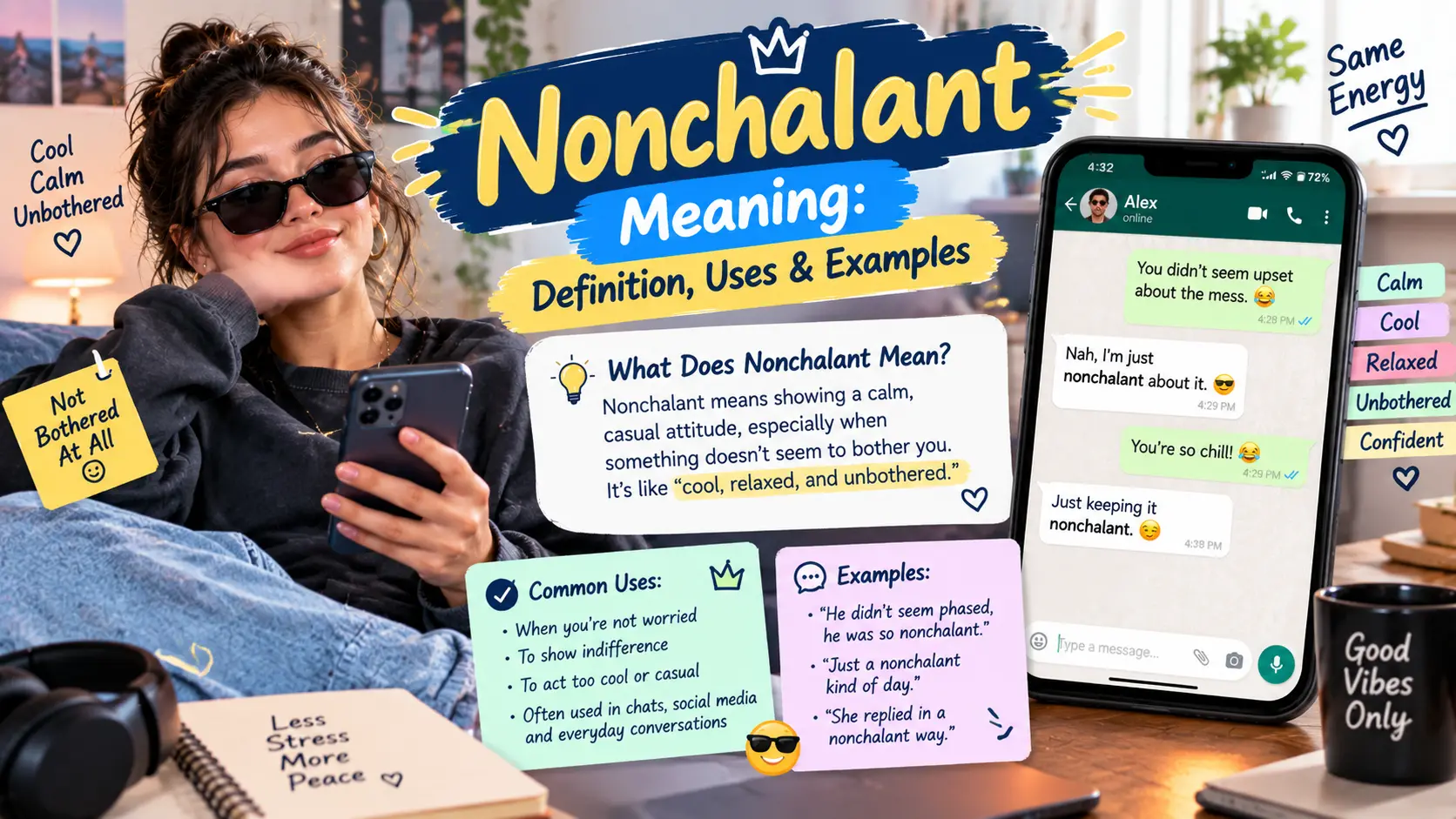
Nonchalant Meaning: Definition, Uses & Examples
Have you ever seen someone stay completely calm while everyone else is excited, worried, or stressed? They might reply with a simple “okay,” shrug their shoulders, or act as if nothing unusual happened. The word nonchalant is often used to describe exactly this kind of behavior.
The nonchalant meaning is generally connected with being calm, relaxed, and seemingly unconcerned about something. However, the word can describe more than simply being relaxed. Depending on the situation, it may suggest confidence, emotional control, indifference, or even a lack of interest.
People often search for “nonchalant meaning” because the word appears frequently in social media posts, conversations, relationship discussions, and comments. It is especially common when someone wants to describe a person who does not show much emotion.
Understanding the word properly helps you recognize an important difference: being genuinely calm is not always the same as pretending not to care.
Nonchalant Meaning: Quick Meaning
Nonchalant is an adjective that describes someone who behaves in a calm, casual, and seemingly unconcerned way.
In simple English, nonchalant can mean:
- Calm and relaxed
- Unbothered by a situation
- Not showing much concern
- Casually confident
- Emotionally reserved
- Seemingly indifferent
For example:
“She gave a nonchalant smile and walked away.”
“He was completely nonchalant about the unexpected news.”
“I tried to look nonchalant, even though I was nervous.”
The exact meaning depends heavily on context. A nonchalant person may genuinely feel calm, or they may simply appear calm on the outside.
Origin & Background of Nonchalant
The word nonchalant comes from French. It is related to the French verb nonchaloir, which historically carried the idea of not caring about or taking little concern for something.
The word eventually entered English and developed into the modern adjective nonchalant, describing a person who appears relaxed, unconcerned, or casually indifferent.
Over time, its emotional range became broader. Today, calling someone nonchalant does not necessarily mean they do not care.
For instance, someone might remain nonchalant during a stressful event because they are naturally composed. Another person might seem nonchalant because they deliberately hide their feelings.
Social media has made this distinction even more noticeable. Posts about dating, friendships, confidence, and emotional boundaries frequently use “nonchalant” to describe people who appear difficult to impress or emotionally unaffected.
This has also created a modern association between being nonchalant and appearing unbothered.
Real-Life Conversations
WhatsApp Conversation
Person A:
“Did you see what she posted?”
Person B:
“Yeah, but I’m staying nonchalant about it.”
Person A:
“You don’t seem bothered at all.”
Person B:
“I am bothered. I just don’t want to react emotionally.”
Here, nonchalant means deliberately appearing calm despite having feelings underneath.
Instagram DM
Person A:
“You really liked his picture and didn’t even message him?”
Person B:
“I’m trying to be nonchalant.”
Person A:
“So basically you care but want him to think you don’t?”
Person B:
“Exactly.”
In this situation, the word has a playful relationship-related meaning.
TikTok Comments
Person A:
“Why did he walk past her like nothing happened?”
Person B:
“That was the most nonchalant reaction ever.”
Person A:
“He definitely noticed her.”
The commenter is describing someone who appears completely unaffected.
Text Message
Person A:
“I got the job!”
Person B:
“Nice.”
Person A:
“That’s it? 😂”
Person B:
“Trying to sound nonchalant. I’m actually screaming inside.”
Here, nonchalant is used humorously to describe controlled excitement.
Emotional & Psychological Meaning
The emotional meaning of nonchalant is interesting because it focuses on outward behavior rather than necessarily revealing someone’s true feelings.
A person can look nonchalant while feeling excited, embarrassed, anxious, jealous, or deeply interested.
That is why the word is often useful when describing modern communication. Text messages contain very few emotional signals, so a short reply can easily appear nonchalant.
For example, someone replying “sure” may be relaxed, disappointed, busy, or intentionally distant. Without additional context, the emotional meaning remains uncertain.
People sometimes use nonchalant behavior as a form of emotional protection. Acting unaffected can make someone feel less vulnerable, especially in dating or emotionally complicated situations.
I have seen this pattern in everyday communication: someone may insist they “don’t care” while their choice of words, timing, and behavior suggests that the situation matters quite a lot.
That does not automatically mean they are being dishonest. Some people simply find it easier to control what they show than to openly express what they feel.
Usage in Different Contexts
Social Media
On Instagram, TikTok, Snapchat, and other platforms, nonchalant is often used to describe someone who appears effortlessly calm.
A caption might say:
“Trying to stay nonchalant.”
This can be serious, humorous, or related to dating.
Friends & Relationships
Among friends, the word can describe someone who does not react dramatically.
“He’s so nonchalant about everything.”
In romantic conversations, it may describe someone who seems emotionally distant or deliberately difficult to read.
Work & Professional Settings
Nonchalant can also describe behavior at work, but context matters.
For example:
“She remained nonchalant during the presentation.”
This may suggest impressive composure.
However:
“He was nonchalant about the missed deadline.”
This could imply that he did not take an important responsibility seriously.
Casual vs Serious Tone
In casual conversation, nonchalant can be playful.
“I acted nonchalant when my crush walked in.”
In serious situations, however, the word may carry criticism.
“His nonchalant attitude toward the problem concerned the team.”
The surrounding sentence determines whether the word sounds positive, neutral, or negative.
When NOT to Use Nonchalant
Although nonchalant is common in everyday English, it is not appropriate for every situation.
Avoid using it when you need to communicate a very precise emotional state. If someone is genuinely worried, for example, calling them nonchalant could incorrectly suggest that they do not care.
It can also create misunderstanding when discussing serious matters.
Saying:
“She was nonchalant about the accident.”
may sound as though she lacked concern, even if she was simply trying to remain composed.
Cultural sensitivity also matters. Different communities may interpret quietness, emotional restraint, and eye contact differently.
Someone who appears emotionally reserved may not necessarily be indifferent.
The safest approach is to consider behavior and context together rather than assuming what a person feels internally.
Common Misunderstandings About Nonchalant
One common misunderstanding is believing that nonchalant always means uncaring.
It does not.
Someone can be nonchalant while still caring deeply. The word primarily describes how they appear or behave.
Another misunderstanding is treating nonchalant as exactly the same as “confident.”
Confidence can contribute to a nonchalant attitude, but they are not identical.
A confident person may openly express excitement or concern. A nonchalant person tends to display less visible reaction.
People also sometimes confuse nonchalant with “lazy.” Again, these are different ideas.
A person can be relaxed and highly responsible. Likewise, someone can be unconcerned because they are careless, but that is only one possible interpretation.
Nonchalant Meaning Compared With Similar Expressions
| Expression | Meaning | Typical Tone |
|---|---|---|
| Nonchalant | Calm and seemingly unconcerned | Neutral or slightly detached |
| Unbothered | Not visibly affected by something | Casual, modern |
| Carefree | Free from worry or responsibility | Usually positive |
| Indifferent | Showing little interest or concern | Often more negative |
| Laid-back | Relaxed and easygoing | Usually positive |
| Apathetic | Lacking interest or motivation | Usually negative |
| Composed | Calm and emotionally controlled | Usually positive |
| Unconcerned | Not worried about something | Neutral |
| Chill | Relaxed and easygoing | Very casual |
| Anxious | Worried or nervous | Opposite emotional direction |
Key Insight
Nonchalant describes an outward attitude, not necessarily an inner emotional state. Someone can look completely relaxed while privately experiencing strong emotions.
Variations and Types of Nonchalant Behavior
1. Naturally Nonchalant
Meaning: Someone who naturally remains calm.
They do not have to force their relaxed behavior because it is part of their personality.
2. Socially Nonchalant
Meaning: Acting casual in social situations.
A person may avoid showing excitement or nervousness around others.
3. Romantically Nonchalant
Meaning: Acting emotionally unaffected in dating situations.
This is especially common when someone does not want to appear overly interested.
4. Professionally Nonchalant
Meaning: Remaining calm in a workplace situation.
This can communicate confidence when the situation is handled responsibly.
5. Deliberately Nonchalant
Meaning: Intentionally appearing unconcerned.
Someone may consciously control their reaction to avoid revealing emotions.
6. Playfully Nonchalant
Meaning: Pretending not to care for humorous effect.
Friends often use this style when teasing one another.
7. Emotionally Nonchalant
Meaning: Showing very little visible emotion.
This can describe someone who tends to keep personal feelings private.
8. Confidently Nonchalant
Meaning: Remaining relaxed because the person feels secure.
Their calmness may come from confidence rather than indifference.
9. Accidentally Nonchalant
Meaning: Appearing unconcerned without intending to.
A short text or quiet reaction can sometimes create this impression unintentionally.
10. Negatively Nonchalant
Meaning: Appearing careless about something important.
In this context, nonchalant can suggest that someone is not taking a serious matter seriously enough.
How to Respond When Someone Uses Nonchalant
Your response depends on the relationship and situation.
Casual Replies
“Yeah, I’m just keeping it chill.”
“That’s basically my mood today.”
“Trying not to overreact.”
Funny Replies
“Nonchalant? You replied in 0.2 seconds. 😂”
“Your nonchalant act is not convincing.”
“You care way more than you’re admitting. 😂”
Mature Replies
“I understand. Staying calm can help.”
“You don’t have to hide how you feel.”
“Sometimes being calm is better than reacting immediately.”
Respectful Replies
“I understand where you’re coming from.”
“Take your time. You don’t have to respond emotionally.”
“I respect your way of handling it.”
Regional & Cultural Usage
The basic meaning of nonchalant remains consistent across English-speaking communities, but the behavior associated with it can be interpreted differently.
Western Culture
In many Western social settings, being nonchalant can be associated with confidence and independence.
Someone who does not overreact may be described positively as calm or unbothered.
However, excessive nonchalance can sometimes be interpreted as emotional distance.
Asian Culture
In many Asian communication environments, emotional restraint can have different social meanings depending on family, workplace, and community expectations.
A calm or reserved response may be understood as politeness rather than indifference.
Therefore, labeling someone nonchalant should be done carefully when cultural communication styles differ.
Middle Eastern Culture
In Middle Eastern communities, communication styles vary considerably by country, family, age, and social setting.
Warmth and visible personal engagement can be important in many relationships. As a result, an unusually detached response may sometimes be interpreted differently from the intended meaning.
Still, there is no single Middle Eastern interpretation of the word.
Global Internet Usage
Online, nonchalant has become strongly connected with words such as “unbothered,” “chill,” and “acting like you don’t care.”
Memes and short-form videos often use the word humorously, particularly around dating and social interactions.
Gen Z vs Millennials
Younger internet users often use nonchalant in a casual, relationship-focused way.
For example, someone might joke about trying to remain nonchalant after receiving a message from their crush.
Millennials may use the word more traditionally to describe calm or unconcerned behavior.
There is plenty of overlap, though. The meaning is usually determined more by context than by age.
Is Nonchalant Safe for Kids?
Yes. Nonchalant is a normal English vocabulary word and is generally safe for children.
It can be useful when teaching children about emotions, behavior, and descriptive language.
The important lesson is that looking calm does not always mean someone feels nothing.
Children can learn that people express emotions differently and that outward behavior does not always reveal someone’s complete feelings.
FAQs About Nonchalant Meaning
What does nonchalant mean in simple words?
Nonchalant means calm, relaxed, and seemingly unconcerned about something.
Is nonchalant positive or negative?
It can be either. It may suggest confidence and composure, or it may imply that someone does not care enough about an important situation.
Does nonchalant mean you do not care?
Not necessarily. A person can care deeply while appearing nonchalant because they are controlling or hiding their emotional reaction.
What is another word for nonchalant?
Depending on the context, alternatives include unbothered, relaxed, laid-back, composed, carefree, or unconcerned.
What does nonchalant mean in texting?
In texting, nonchalant usually describes someone who responds casually or shows little visible emotion, even when the conversation may matter to them.
Is nonchalant the same as indifferent?
No. Indifferent more directly suggests a lack of interest or concern, while nonchalant focuses on a calm or unconcerned manner.
How do you use nonchalant in a sentence?
You can say, “He remained nonchalant even when everyone else became nervous.”
Conclusion
The nonchalant meaning is simple on the surface but surprisingly nuanced. It describes someone who appears calm, relaxed, and unconcerned, yet that outward behavior does not always reveal what they genuinely feel.
In everyday conversations, the word can describe confidence, emotional restraint, casual behavior, or apparent indifference. On social media, it has become especially popular for describing people who seem completely unbothered.
The most important thing to remember is context. A nonchalant person may not be careless or cold. They may simply have a quiet way of handling emotions.
Once you understand that difference, you can use nonchalant naturally and accurately in conversations, writing, texting, and social media.