ALR Meaning: What Does ALR Mean in Text?
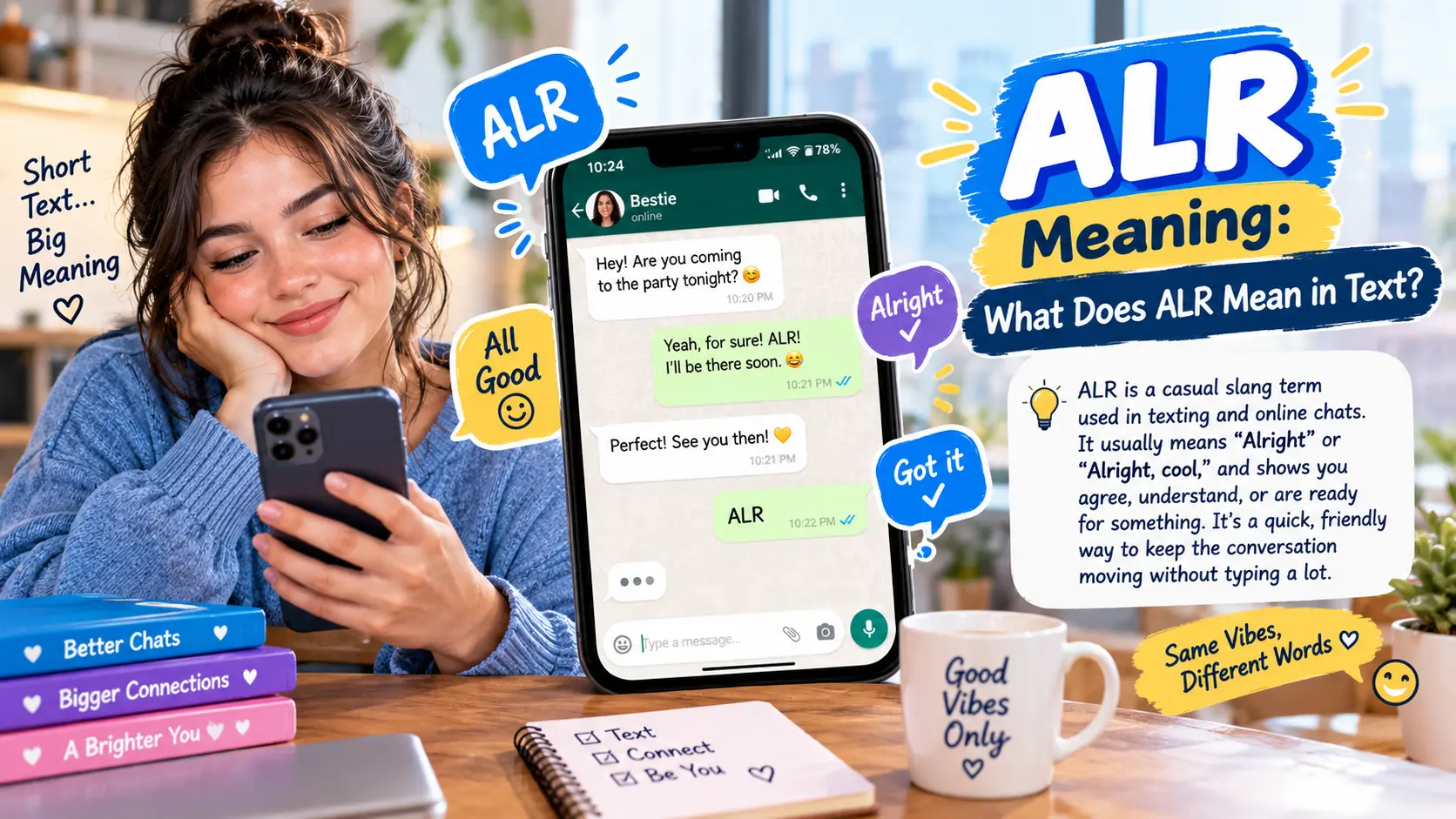
If you have seen “ALR” in a text, Instagram comment, TikTok conversation, or group chat, you may have wondered what it actually means. The good news is that ALR usually means “alright” in casual online communication.
It is a shortened form of a familiar everyday word. People use it because typing ALR is quick, relaxed, and fits the fast rhythm of texting.
Depending on the conversation, ALR can communicate agreement, acceptance, acknowledgment, or simply a casual response. For example, someone might write, “ALR, I’ll be there,” meaning “Alright, I’ll be there.”
However, the tone can change with context. “ALR” can sound friendly and casual in one conversation but slightly dismissive in another. Understanding the surrounding words, punctuation, relationship between the speakers, and situation is therefore important.
This guide explains the ALR meaning in text, where it came from, how people use it, what emotions it can express, and when it is better to use the full word instead.
ALR Meaning in Text: Quick Meaning
ALR most commonly means “alright” or “all right.”
It is informal internet and texting shorthand, especially common in quick conversations.
- ALR = alright
- Used to show agreement or acceptance
- Can also mean okay, fine, or understood
- Mostly appears in texts, DMs, comments, and casual chats
- Its exact tone depends on the conversation
Here are a few natural examples:
“ALR, I’ll call you later.”
“ALR lol, you win 😂”
“ALR, sounds good to me.”
In each example, the basic idea is similar to “alright”, but the emotional tone comes from the rest of the message.
Origin & Background of ALR
ALR developed as part of the broader culture of digital shorthand. Online communication encouraged people to shorten familiar words, especially when conversations moved quickly.
Just as people began using expressions such as “brb,” “idk,” “btw,” and “tbh,” shorter versions of everyday words became common in messaging.
ALR is particularly straightforward because it removes several letters from alright while keeping the pronunciation and meaning easy to recognize.
Its popularity has been helped by texting, social platforms, gaming chats, and comment sections. People often prefer communication that feels quick and conversational rather than formally written.
Social media has also made abbreviated language more visible. A person might see ALR in a TikTok comment or Instagram DM and then begin using it naturally in their own conversations.
Over time, digital slang has become less about saving a significant number of keystrokes and more about creating an informal conversational style.
Real-Life Conversations Using ALR
The easiest way to understand ALR meaning in text is to see how it behaves in everyday conversations.
WhatsApp Conversation
Person A: Are we still meeting at 7?
Person B: ALR, but can we meet near the café instead?
Here, ALR means “alright” and communicates agreement.
Instagram DM
Person A: I sent you the pictures. Check your requests.
Person B: ALR, checking now 😂
The abbreviation makes the reply feel quick and relaxed.
TikTok Comment
Person A: You really watched this video five times? 😭
Person B: ALR you caught me 😂
Here, ALR contributes to a playful tone. It can feel similar to saying, “Alright, you caught me.”
Text Message
Person A: Sorry, I can’t come tonight. Something came up.
Person B: ALR, no worries. We can do it another day.
In this situation, ALR expresses acceptance without making the response overly formal.
Emotional & Psychological Meaning of ALR
Words in digital communication often carry more than their dictionary definitions. ALR is a good example.
At its simplest, it can communicate acceptance. Someone says something, and the other person responds with ALR to acknowledge it.
It can also communicate agreement. In this case, it is close to saying “okay” or “sounds good.”
Sometimes it expresses mild resignation. For example:
“ALR, if that’s what you want.”
That sentence may contain a little frustration depending on the situation.
The abbreviation can also make communication feel less emotionally heavy. Compare:
“Alright. I understand.”
with:
“ALR lol, I understand.”
The second version feels more casual and conversational.
From everyday communication, one thing becomes clear: short forms allow people to control social distance. A short abbreviation can make a conversation feel spontaneous and informal.
Imagine telling a friend that your plans have changed. If they respond, “ALR, no problem,” the response may feel lighter than a carefully worded paragraph. That small choice of language can help maintain a relaxed atmosphere.
Usage in Different Contexts
Social Media
On Instagram, TikTok, Snapchat, and similar platforms, ALR can work naturally in comments, DMs, captions, and replies.
It is especially suitable when the conversation is casual.
Example:
“ALR, that transition was actually insane 😂”
Friends & Relationships
Friends frequently use abbreviations because their conversations already have an informal tone.
Example:
“ALR, text me when you get home.”
Between close friends, ALR rarely needs explanation.
In relationships, however, tone matters more. A message such as “ALR.” with a period could sound colder than “ALR 😂” or “ALR, babe.”
Work & Professional Settings
This is where caution is useful.
Although your coworkers may understand ALR, it is generally better to write “alright,” “okay,” or another clear professional expression in formal emails, applications, reports, and workplace communication.
For example:
“Alright, I’ll review the document this afternoon.”
is more appropriate than:
“ALR, I’ll review it.”
Casual vs Serious Tone
ALR naturally belongs to casual communication.
In a serious conversation, the abbreviation can sometimes make your response appear too relaxed.
If someone is discussing an important personal issue, responding only with “ALR” may sound uninterested even if you did not intend it that way.
When NOT to Use ALR
Knowing slang also means knowing when to avoid it.
Formal Communication
Avoid ALR in formal emails, academic writing, official documents, and professional applications.
The full word is clearer and more polished.
Sensitive Conversations
If someone is sharing something emotional or serious, a one-word abbreviation may unintentionally sound dismissive.
Instead of:
“ALR.”
consider:
“I understand. Take your time.”
With People Who May Not Know Internet Slang
Not everyone follows digital shorthand. Older relatives, new coworkers, teachers, or people from different communication backgrounds may not immediately recognize ALR.
When Tone Could Be Misread
Punctuation can change how short messages feel.
“ALR!” may sound enthusiastic.
“ALR lol” sounds relaxed.
“ALR.” can sometimes feel abrupt.
When the relationship is sensitive, spelling out “alright” can prevent unnecessary confusion.
Common Misunderstandings About ALR
One common misunderstanding is assuming that ALR always has exactly the same emotional meaning as “okay.”
It does not.
The basic meaning is usually “alright,” but the speaker’s intention depends on context.
Another mistake is assuming that every use of ALR represents enthusiasm. Sometimes it simply acknowledges information.
For example:
“ALR, I got it.”
usually means “Okay, I understand.”
But:
“ALR!!! Let’s go!”
has much more energy.
People also sometimes interpret a short reply as rude simply because it is short. That interpretation can be unfair without considering the relationship and previous messages.
Digital communication removes many vocal cues, such as facial expression and tone of voice. As a result, readers sometimes have to infer emotion from punctuation, emojis, wording, and context.
ALR Comparison Table
| Expression | Meaning | Typical Tone | Common Use |
|---|---|---|---|
| ALR | Alright | Casual | Texts and DMs |
| Alright | Okay / acceptable | Neutral | Everyday communication |
| Okay | Agreement or acknowledgment | Neutral | Almost any casual situation |
| K | Okay | Very brief | Quick texting |
| Sure | Agreement | Friendly or neutral | Requests and plans |
| Fine | Acceptable | Neutral or potentially annoyed | Context-dependent |
| Nope | No | Casual | Informal conversations |
| Never mind | Forget it / no longer relevant | Casual to serious | Corrections or changes |
Key Insight
ALR is not simply a replacement for “okay” in every situation. It carries the relaxed feeling of “alright,” while the surrounding words determine whether that feeling is friendly, neutral, humorous, or slightly frustrated.
Variations and Types of ALR
There are several ways people use or modify ALR in digital conversations.
1. ALR
Meaning: Alright.
The basic abbreviation is usually used for acknowledgment or agreement.
2. Alr
Meaning: Alright.
Lowercase alr is especially common in casual texting.
3. ALRR
Meaning: An extended or emphasized form of alright.
Extra letters can make the message feel playful or expressive.
4. ALRRR
Meaning: Stronger or more exaggerated alright.
The extra letters may suggest excitement, impatience, humor, or dramatic emphasis.
5. ALR LOL
Meaning: Alright, in a humorous or relaxed way.
Adding “lol” usually makes the message feel less serious.
6. ALR Bet
Meaning: Alright, agreed or understood.
“Bet” adds a stronger sense of confirmation in contemporary casual slang.
7. ALR Then
Meaning: Alright then.
It can indicate acceptance, a transition, or sometimes mild annoyance depending on context.
8. ALR Fine
Meaning: Alright, fine.
This can communicate reluctant agreement, particularly when the conversation is tense.
9. ALR Bro
Meaning: Alright, bro.
This is highly informal and usually appears between friends or people using casual internet language.
10. ALR 😂
Meaning: Alright, with humor or lightness.
The emoji changes the emotional interpretation and often prevents the reply from feeling too serious.
How to Respond When Someone Uses ALR
Your response should match the situation.
Casual Replies
- “Cool!”
- “Sounds good.”
- “Perfect.”
- “Got you.”
- “Okay 😊”
Funny Replies
- “ALR then 😂”
- “That was fast 😭”
- “Okay okay, I hear you 😂”
- “ALR, captain.”
Mature Replies
- “Sounds good, I understand.”
- “Alright, thanks for letting me know.”
- “Okay, that works for me.”
- “Understood. I’ll take care of it.”
Respectful Replies
- “Alright, thank you.”
- “Okay, I appreciate it.”
- “That works for me.”
- “Understood. Thanks for explaining.”
The best response is rarely about decoding the abbreviation alone. Look at what the person is actually trying to communicate.
Regional & Cultural Usage
Western Culture
In American and other Western online communities, ALR is generally understood as an informal shortening of alright.
Its use is especially natural among people accustomed to texting and social media slang.
Asian Culture
English-language digital communication across Asian countries frequently blends local languages with English abbreviations.
ALR may therefore appear alongside regional slang, transliterated expressions, emojis, and other English texting shortcuts.
Its basic meaning remains recognizable, but the surrounding language can influence its tone.
Middle Eastern Culture
English is widely used online alongside Arabic and other languages in many Middle Eastern digital communities.
ALR may appear in English-language messages, particularly among people who regularly communicate through social platforms or use English in everyday digital settings.
The abbreviation itself generally retains the meaning “alright.”
Global Internet Usage
Internet slang travels quickly across borders. A phrase that begins in one online community can become familiar worldwide through TikTok, Instagram, gaming, memes, and messaging platforms.
That does not mean everyone interprets it identically. Context still matters.
Gen Z vs Millennials
Both Gen Z and Millennials may recognize ALR, but individual preferences vary.
Younger users may combine it with emojis, repeated letters, lowercase typing, memes, or other current slang.
Millennial users may understand it perfectly while choosing to write “alright” or “okay” more often.
Age alone cannot determine how someone will interpret ALR. Personal texting habits matter more.
Is ALR Safe for Kids?
ALR is generally harmless slang. By itself, it does not contain sexual, violent, or offensive meaning.
The important factor is context.
Parents and educators should focus less on banning ordinary abbreviations and more on helping children understand that online language can change depending on audience and situation.
A child should know that ALR may be fine in a conversation with friends but is not necessarily appropriate in a school assignment or formal message.
Understanding when to switch between casual and formal language is an important communication skill.
FAQs About ALR Meaning
What does ALR mean in text?
ALR usually means “alright” or “all right” in text messages and online conversations. It is an informal abbreviation commonly used for acknowledgment or agreement.
Is ALR the same as okay?
Usually, yes, but not always exactly. ALR can mean “okay,” “alright,” “fine,” or “understood,” depending on the surrounding conversation.
Is ALR slang?
Yes. ALR is informal texting and internet shorthand rather than standard formal English.
What does ALR mean on TikTok?
On TikTok, ALR generally means “alright.” It can be used in comments, replies, captions, or messages to express agreement, acknowledgment, or playful acceptance.
Can ALR sound rude?
Yes, depending on context. A short message such as “ALR.” may sometimes feel abrupt, particularly during a serious conversation.
Should I use ALR at work?
It is usually better to avoid ALR in formal workplace communication. Writing “alright,” “okay,” or a more specific response creates clearer and more professional communication.
What is the difference between ALR and ALRR?
Both can represent “alright.” The additional letters in ALRR generally add emphasis or a playful tone rather than changing the basic meaning.
Conclusion
Understanding ALR meaning is really about understanding how modern digital communication works. The abbreviation usually means “alright” and is most comfortable in casual texts, DMs, comments, and conversations with friends.
Its emotional meaning can shift with punctuation, emojis, surrounding words, and the relationship between the people communicating. A simple “ALR” can express agreement, acknowledgment, humor, acceptance, or even mild reluctance.
The key is to read the whole conversation rather than judging a short abbreviation by itself. Once you understand that context, ALR becomes a simple and useful part of everyday online English.