Indingo Meaning: What Does Indingo Mean?
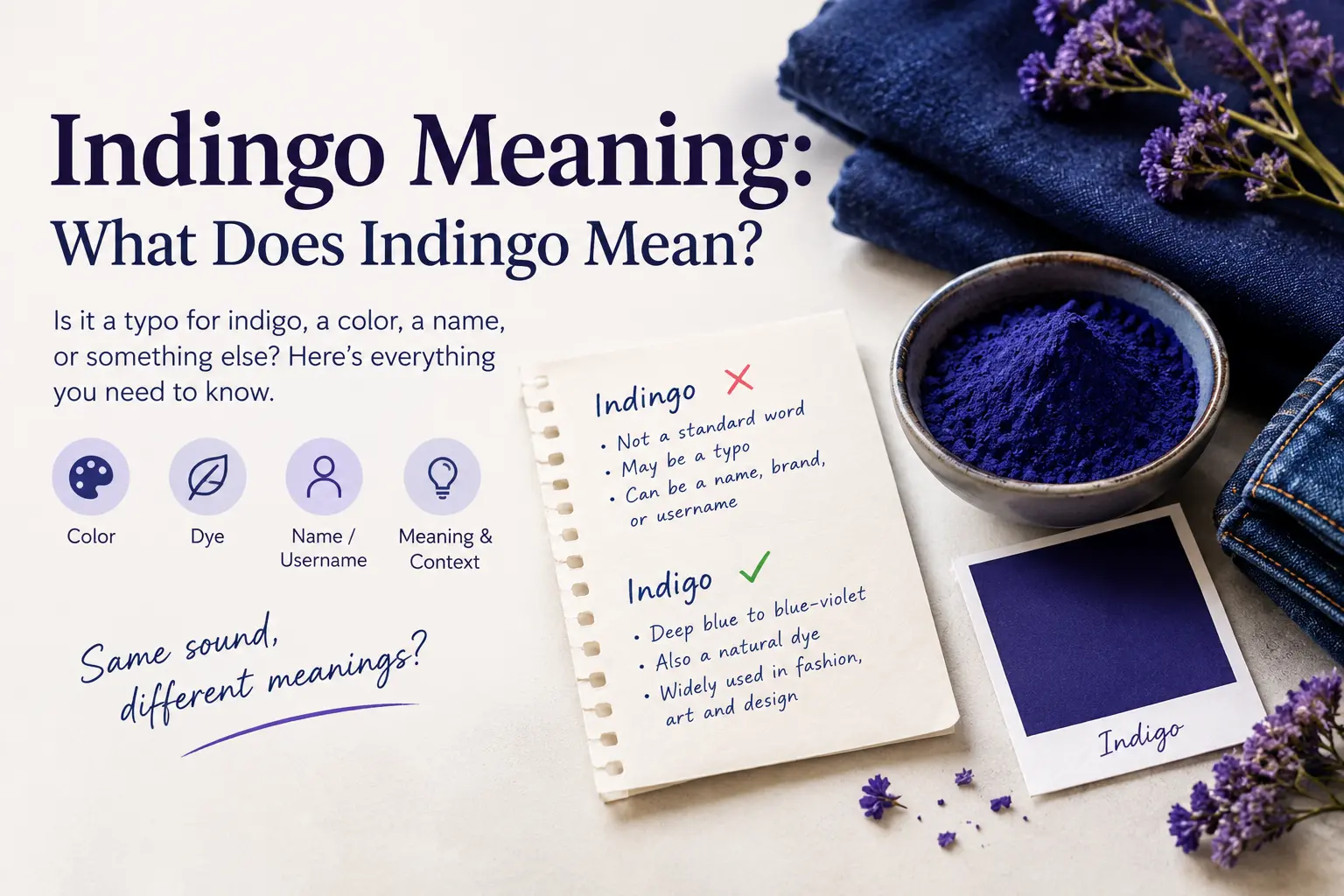
“Indingo” is not a commonly recognized standard English word with a fixed dictionary meaning. In many cases, it may be a misspelling or typing variation of “indigo,” the word used for a deep blue to blue-violet color.
The meaning of “Indingo” depends heavily on the context where you encountered it. It could potentially be a username, personal name, brand name, creative spelling, or simple typing mistake. If you saw the word while searching for a color, clothing item, paint shade, or design term, indigo is probably the intended word.
Understanding the difference between “Indingo” and “indigo” can help you identify the correct spelling and meaning.
TL;DR: What Does Indingo Mean?
Indingo does not have a widely established meaning in standard English. It is often likely to be a spelling variation or typo for indigo.
Indigo refers to a rich color commonly described as being between blue and violet. The word is also associated with a natural dye that has been used historically to create deep blue textiles.
If “Indingo” appears as a username, name, business, product, or creative term, it may have a specific meaning established by the person or organization using it.
What Is Indingo?
Basic Meaning of Indingo
The spelling “Indingo” is not commonly used as a standard English vocabulary word. Unlike familiar words such as “blue,” “purple,” or “indigo,” it does not have a broadly accepted everyday definition.
For this reason, it is important not to automatically assign a special slang or symbolic meaning to “Indingo.” The surrounding context is the best way to determine what someone intended.
In many searches, “Indingo” may simply be an accidental spelling of “indigo.” This can happen when someone types quickly or remembers the pronunciation but not the exact spelling.
Is Indingo a Correct Word?
In standard English, indigo is the established spelling for the color and the dye. “Indingo” is not generally recognized as the standard spelling of that word.
However, unusual spellings can still appear as names, usernames, business names, product names, fictional terms, or creative labels. In those situations, the spelling may be intentional rather than an error.
Therefore, whether “Indingo” is “correct” depends on how it is being used. As the name of a specific person, product, or account, it can be intentional. As the name of the familiar blue-violet color, indigo is the standard spelling.
Indingo vs. Indigo
The biggest difference is that indigo has an established meaning, while “Indingo” does not have one universally accepted definition in standard English.
Indigo commonly refers to a deep blue or blue-violet color and can also refer to a dye historically made from plants.
“Indingo,” on the other hand, may be a typo, creative spelling, name, or context-specific term.
What Does Indigo Mean?
Indigo as a Color
Indigo is a rich, dark color commonly described as a shade between blue and violet. It can appear slightly more blue or slightly more purple depending on the particular color system, lighting, and context.
Indigo is popular in fashion, artwork, interior design, textiles, branding, and digital design. It can create a deep and sophisticated visual effect without being as dark as black.
You may see indigo used to describe denim, painted walls, fabrics, flowers, illustrations, and other objects.
Indigo in the Color Spectrum
Indigo is traditionally included among the colors associated with the visible spectrum. In the familiar sequence often taught as red, orange, yellow, green, blue, indigo, and violet, indigo is positioned between blue and violet.
In everyday design, however, the exact appearance of indigo can vary. Some shades look strongly blue, while others have a noticeable violet or purple quality.
This is one reason people may describe the color differently depending on the particular shade they are viewing.
Indigo Color Examples
Indigo can appear in many everyday settings.
Clothing: Indigo is especially common in denim and other textiles.
Paint: Interior designers may use indigo for accent walls, furniture, or decorative details.
Art: Artists can use indigo to create depth, contrast, shadows, and rich blue tones.
Digital design: Indigo shades are often used in websites, illustrations, interfaces, logos, and color palettes.
The Origin of the Word Indigo
Historical Background
The word indigo has a long history connected with the trade and use of blue dye. Its name is associated with the historical connection between the dye and India.
Natural indigo became an important commodity because it could produce a strong blue color for fabrics and other materials. Its history is therefore closely connected with textile production, commerce, agriculture, and cultural traditions.
The word has continued to survive in modern English primarily as a color term.
Indigo Dye
Indigo dye is a natural dye historically obtained from plants containing compounds that can produce the characteristic blue color.
Before modern synthetic dyes became widely available, natural indigo was valuable for coloring textiles. Different cultures developed their own methods for growing dye plants, processing the material, and applying the color to fabric.
The resulting deep blue shade became strongly associated with indigo textiles.
Indigo in Different Cultures
Indigo has appeared in textile traditions around the world. It has been used in clothing, decorative fabrics, woven materials, and artistic traditions.
Its history is particularly important in regions with longstanding natural-dye and textile practices. Because these traditions differ from one culture to another, indigo does not have one universal cultural meaning.
Instead, its significance can depend on the community, historical period, and specific use.
What Does the Color Indigo Symbolize?
Indigo and Calmness
Indigo is often associated with depth, quietness, and calmness because of its dark blue appearance.
These associations are subjective rather than universal rules. In design and visual communication, darker blue shades are frequently used when a serious, peaceful, or sophisticated atmosphere is desired.
Indigo and Wisdom
Indigo is sometimes symbolically connected with wisdom, reflection, knowledge, and thoughtfulness.
These associations are common in modern color symbolism, spiritual discussions, and artistic interpretations. They should be understood as symbolic ideas rather than scientifically established properties of the color.
Indigo and Spirituality
Some spiritual and metaphysical traditions associate indigo with intuition, inner awareness, or spiritual reflection.
These interpretations vary considerably between belief systems and individuals. There is no single universal spiritual meaning of indigo.
If you encounter claims about indigo having a particular spiritual power, it is best to recognize those statements as matters of belief or symbolism rather than established scientific facts.
Is Indingo a Name?
Indingo as a Personal Name
“Indingo” could potentially be used as a personal or creative name, although it is not a common standard English vocabulary term.
People sometimes create distinctive names by changing the spelling of familiar words. A person using “Indingo” as a name may therefore have chosen the spelling for personal, artistic, cultural, or aesthetic reasons.
The intended meaning should be determined from the individual or context rather than assumed.
Indingo as a Brand or Username
An unusual spelling such as Indingo can also work as a username, brand name, project name, product name, or fictional name.
Online platforms often contain creative spellings because users want names that are distinctive or available. In such cases, “Indingo” may not refer to the color at all.
If you encounter the term on a particular website or social media account, the profile or surrounding content may provide the intended definition.
Why Do People Search for “Indingo”?
Possible Misspelling of Indigo
One of the simplest explanations is that “Indingo” is a misspelling of “indigo.”
The two words look and sound similar, making it easy for someone to insert an extra letter while typing. This is especially possible when someone knows the word from hearing it rather than seeing it written.
If the surrounding topic involves colors, clothing, dye, design, or art, “indigo” is very likely the intended term.
Search and Typing Errors
Typing mistakes are common when people search online. A person may remember the sound of a word but not its exact spelling.
“Indingo” has a structure that looks close to “indigo,” so a simple extra n can produce the alternative spelling.
Search engines may also show related results when a query appears to contain a possible spelling mistake, which can help users discover the standard term they were looking for.
Context Matters
Context is particularly important with unfamiliar words.
For example, if someone writes “indingo dress,” they may be referring to an indigo-colored dress. If “Indingo” appears as the name of an application, business, character, or account, it could have a completely different purpose.
Rather than assuming that every occurrence means the color, look at the sentence or source where the term appears.
Indingo Meaning in Text and Social Media
Does Indingo Have a Slang Meaning?
There is no widely established standard slang meaning for “Indingo” in everyday English texting.
It is important not to confuse an unusual spelling with internet slang automatically. Online communities frequently create unique words, usernames, jokes, and expressions, but a term needs recognizable usage before it can reasonably be described as common slang.
If someone uses “Indingo” in a specific online community, its meaning may be specific to that group.
Indingo as a Username or Online Name
“Indingo” can function as an online name even if it does not have a dictionary definition.
Users may choose unusual combinations of letters to create distinctive handles for social media, gaming platforms, creative projects, or online communities.
In this situation, the meaning may be personal. The username itself does not necessarily indicate that the person is referring to the color indigo.
Indingo vs. Similar Words
| Term | Possible Meaning |
|---|---|
| Indingo | Possible typo, creative spelling, name, or context-specific term |
| Indigo | A deep blue to blue-violet color |
| Indigo Dye | A dye historically used to create blue textiles |
| Indigo Blue | A description of a rich blue shade |
| Indigent | A completely different English word relating to poverty or lacking basic necessities |
Indingo vs. Indigo
The most important comparison is between Indingo and Indigo.
Indigo is the standard English spelling and has a well-established meaning. It commonly describes a deep blue or blue-violet color and can also refer to the dye associated with that color.
Indingo does not have the same established dictionary meaning. It may simply be an accidental spelling variation.
Indingo vs. Other Similar Spellings
Words that look or sound similar can easily cause confusion, especially when they are typed from memory.
For this reason, always consider the surrounding sentence. A color-related context strongly suggests indigo, while a username or brand may intentionally use a different spelling.
How to Use Indigo Correctly
Examples in Everyday English
Here are some natural examples of indigo used correctly:
- She wore an indigo dress to the event.
- The artist used indigo paint for the darker parts of the sky.
- Indigo is a rich blue-violet shade.
- The room featured indigo cushions and curtains.
- The fabric was traditionally colored with indigo dye.
These examples demonstrate the standard spelling and common uses of the word.
Common Spelling Mistakes
A common mistake is writing “indingo” when the intended word is “indigo.”
Incorrect for the color: Indingo
Standard spelling: Indigo
The extra n changes the spelling and can make the word appear unfamiliar.
If you are writing about the color, dye, clothing, or design shade, indigo is the spelling you should normally use.
What Does Indigo Look Like?
Indigo Compared With Blue
Indigo generally looks deeper and darker than many ordinary blue shades.
However, there is no single appearance that every person will identify as indigo. Different color systems, screens, fabrics, paints, and lighting conditions can produce different visual results.
In general, indigo is recognized as a rich, deep blue with a noticeable violet quality.
Indigo Compared With Purple
Indigo and purple can sometimes look similar, but indigo is generally associated more strongly with blue, while purple is more strongly associated with a combination of red and blue.
The exact boundary between these colors can be subjective. This is particularly true when comparing digital color palettes or different paint shades.
Indigo in Clothing and Design
Indigo is a popular design color because it is bold without being extremely bright.
It can work well as a main color or accent shade. In clothing, it is particularly familiar through denim. In interior design, indigo can add depth to walls, furniture, fabrics, and decorative accessories.
Its dark appearance also makes it useful when designers want a sophisticated alternative to basic navy or black.
Indigo in Fashion, Art, and Design
Indigo Clothing
Indigo is strongly associated with clothing and textiles.
Denim is one of the most familiar examples, especially when fabric has a deep blue appearance. Dresses, shirts, jackets, scarves, and other garments can also use indigo shades.
The color works well with neutral shades such as white, gray, beige, and black.
Indigo in Interior Design
Indigo can create a dramatic and sophisticated look in an interior.
It may be used on an accent wall or incorporated through pillows, curtains, rugs, furniture, artwork, and decorative objects.
Because it is relatively dark, designers often balance indigo with lighter colors when they want the room to feel open and bright.
Indigo in Digital Design
Indigo is also useful in digital design.
Websites, applications, illustrations, presentations, and branding projects can use indigo as a primary or secondary color.
Its combination of blue and violet can give a design a modern, creative, or professional appearance depending on the surrounding colors and typography.
Common Questions About Indingo
What does Indingo mean?
“Indingo” does not have a widely recognized standard English meaning. It may be a typo or alternative spelling of indigo, or it may be a name, username, brand, or other context-specific term.
Is Indingo a real English word?
“Indingo” is not generally recognized as the standard English word for the color. Indigo is the established spelling. “Indingo” may still appear as a proper name or creative term.
Is Indingo the same as Indigo?
Not necessarily. If someone is discussing the color, “Indingo” is most likely a spelling mistake for indigo. However, a person or organization could intentionally use “Indingo” as a unique name.
What color is indigo?
Indigo is generally described as a deep blue to blue-violet color. Its exact appearance can vary depending on the color system, material, lighting, and surrounding colors.
Why do people spell indigo as indingo?
The most likely reason is a simple typing or spelling error. The additional n can appear because the word is being written from memory or based on pronunciation.
Does Indingo have a slang meaning?
There is no broadly recognized slang definition of “Indingo” in standard everyday texting. A particular online community could give the term its own meaning, so context remains important.
Is Indingo a name?
It can potentially be used as a personal name, username, brand, character name, or creative label. However, its meaning in that situation depends on the person or organization using it.
How do you spell indigo correctly?
The standard spelling is I-N-D-I-G-O: indigo. If you are referring to the blue-violet color or traditional dye, “indigo” is the correct standard English spelling.
Final Takeaway: Understanding Indingo
“Indingo” does not have one universally accepted meaning in standard English. When it appears in a color-related context, it is very likely a spelling variation or typo for “indigo.”
Indigo is a well-established word referring to a deep blue to blue-violet color and is also associated with a historically important natural dye.
At the same time, “Indingo” could be intentionally used as a username, brand, personal name, product name, or creative term. In those situations, its meaning depends on the specific context.
The simplest rule is this: if you mean the color, use “indigo.” If you encountered “Indingo” as a unique name or online term, check the surrounding context before deciding what it means.