HY Meaning in Chat: Is It the Same as Hey?
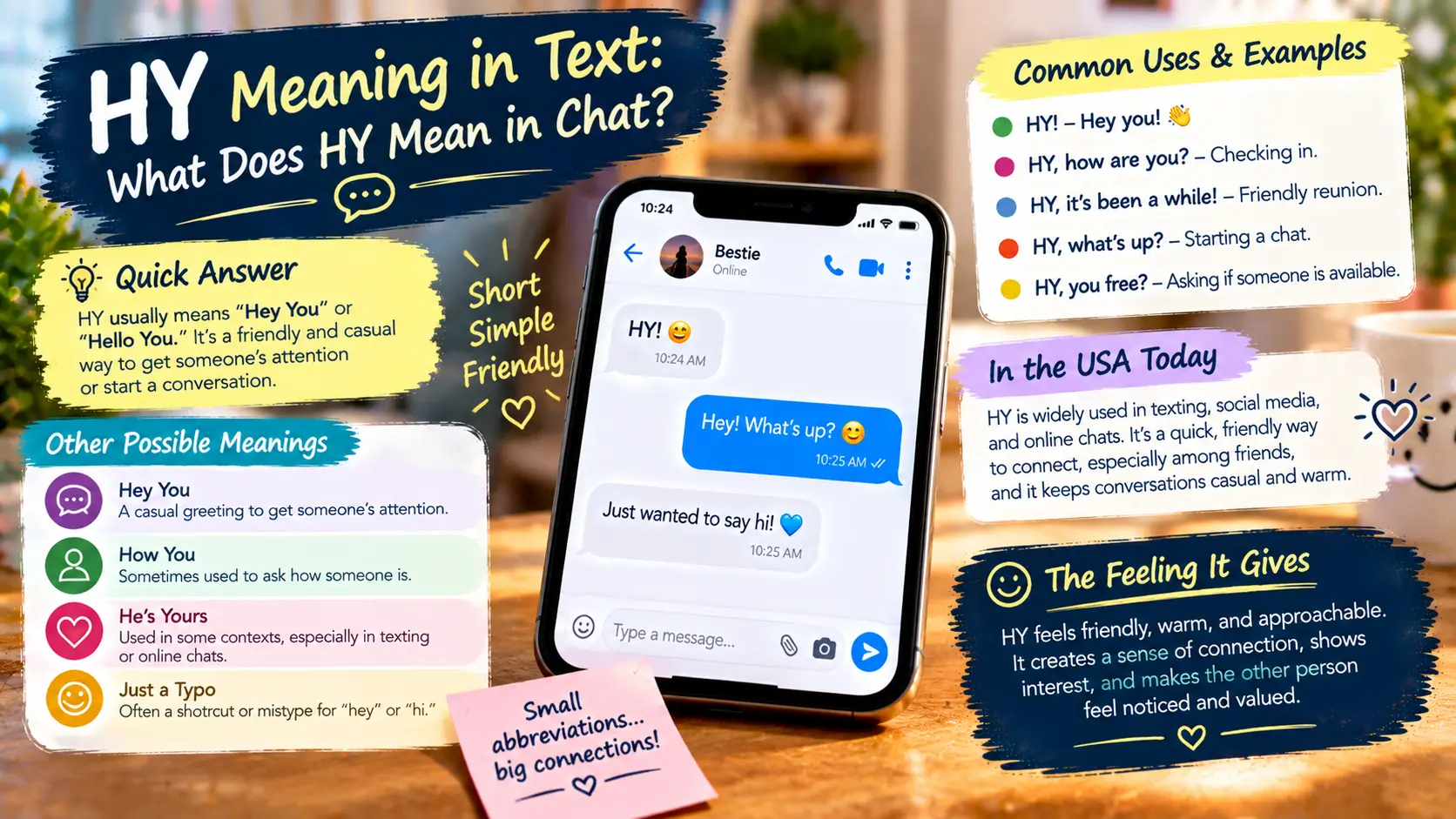
If someone sends you “HY” in a text message, chat, or social media DM, it most commonly means “Hey.” It is an informal abbreviation used to greet someone, get their attention, or start a conversation quickly.
For example, someone might text, “HY, what are you doing?” In this case, HY simply replaces “Hey” and makes the message short and casual.
The exact meaning can depend on the context. Although HY is commonly understood as a greeting in casual conversations, it may represent other terms in specialized settings. The surrounding words, emojis, and conversation history can help you understand the sender’s intention.
What Does HY Mean in Text?
In everyday texting, HY usually means “Hey.” People use it as a quick greeting when messaging friends, family members, acquaintances, or new contacts.
You might see HY used in messages such as:
- “HY!”
- “HY, how are you?”
- “HY, what’s up?”
- “HY 😊”
- “HY, are you free?”
These examples show how HY works as a simple conversation opener. Someone may use it because they prefer short messages or because abbreviated language feels natural in digital communication.
Unlike formal abbreviations used in professional writing, HY is primarily an informal texting expression.
HY Meaning in Simple Words
In simple terms:
HY = Hey = A casual greeting
For example:
- Text: “HY, how have you been?”
- Meaning: “Hey, how have you been?”
The difference is mainly the spelling and texting style, not the basic meaning.
Is HY the Same as Hey?
Yes. In most casual texting situations, HY and “Hey” serve the same purpose. HY is a shortened form, while Hey is the standard spelling.
The tone can change slightly depending on punctuation, emojis, and the rest of the message.
- “HY” — brief and casual.
- “HY!” — potentially more energetic.
- “HY 😊” — often feels warm or friendly.
- “Hey, how are you?” — a more complete greeting.
The sender’s usual texting habits also matter. Some people frequently use abbreviations, while others prefer standard spelling.
What Does HY Stand for in Texting?
When used as a greeting, HY stands for “Hey.” It reflects the informal, shortened language commonly found in text messages and online conversations.
People often shorten words to communicate quickly. Other familiar examples include “u” for “you” and “IDK” for “I don’t know.”
However, not every appearance of HY necessarily means “Hey.” In technical, professional, or specialized contexts, it may represent something else. Always consider the topic and surrounding message before deciding what an abbreviation means.
How Is HY Used in Text Messages?
HY can serve several purposes depending on the situation.
- Starting a conversation: “HY, what are you doing?”
- Reconnecting with someone: “HY! Long time no talk.”
- Asking a question: “HY, are you free today?”
- Making a friendly greeting: “HY 😊”
- Introducing a request: “HY, can I ask you something?”
In these examples, HY functions primarily as a greeting before the main message.
HY Meaning in Chat and Social Media
HY can appear in private messages, group chats, gaming conversations, and social media DMs. You may encounter it on Instagram, Snapchat, TikTok, Discord, Facebook Messenger, or WhatsApp.
For example:
“HY, I saw your post earlier.”
Here, the sender is simply opening a conversation.
The platform does not automatically give HY a different meaning. Its interpretation usually depends on how the sender uses it and what the conversation is about.
HY in a Conversation With Friends
Friends may use HY as a quick way to say hello.
Example:
Friend: “HY!”
You: “Hey! What’s up?”
There does not need to be a hidden message or deeper meaning behind the greeting.
HY From Someone You Do Not Know Well
If a new contact sends HY, they may simply be trying to start a conversation.
Example: “HY, I saw your comment earlier.”
The rest of the message helps explain why the person contacted you.
HY in Group Chats
In a group chat, HY can be used to greet several people at once.
Example: “HY everyone!”
It is a short, informal way to join a conversation or acknowledge the group.
What Does HY Mean From a Girl?
If a girl sends you HY, the most straightforward interpretation is that she is saying “Hey.”
The abbreviation alone does not tell you whether she is being friendly, romantic, curious, or simply polite. Consider the complete message instead.
For example:
- “HY, how are you?” — a straightforward greeting.
- “HY 😊 What are you doing tonight?” — a friendly opening that invites further conversation.
- “HY, I was thinking about you.” — a more personal message that may suggest interest, depending on your relationship.
HY With an Emoji
Emojis can provide additional clues about the tone of a message.
- “HY 😊” — may feel warm or friendly.
- “HY 👋” — a simple greeting.
- “HY 😂” — may suggest a playful conversation.
However, emojis do not have one universal interpretation. Their meaning depends on the people communicating.
What Does HY Mean From a Guy?
When a guy sends HY, it generally means “Hey.” He may be starting a conversation, getting your attention, or asking a question.
For example:
“HY, you still awake?”
Here, HY introduces the question rather than communicating a separate message.
If you receive HY from a guy you like, avoid assuming it automatically means romantic interest. The way he continues the conversation provides more useful clues than the abbreviation itself.
HY Meaning From Your Crush
Receiving HY from your crush may make you wonder whether the person is interested in you. However, HY alone is not proof of romantic feelings.
Compare these examples:
- “HY, how are you?” — a basic greeting.
- “HY 😊 How was your day?” — a friendly attempt to continue talking.
- “HY, I’ve been thinking about you.” — a more personal message.
The wording, conversation history, and overall behavior help you understand the situation. A single greeting is not enough to determine someone’s feelings.
Examples of HY in Texting
| Text message | Likely meaning | Tone |
|---|---|---|
| “HY” | Hey | Casual |
| “HY!” | Hey! | Energetic |
| “HY 😊” | Hey | Warm or friendly |
| “HY, how are you?” | Hey, how are you? | Conversational |
| “HY, u free?” | Hey, are you free? | Casual |
| “HY lol” | Hey | Very informal |
| “HY everyone!” | Hey, everyone! | Group greeting |
These examples demonstrate that HY usually functions as a greeting, while the rest of the message provides additional meaning.
How to Respond to HY in Text
If someone sends you HY, you can respond naturally without overthinking the abbreviation.
Casual replies:
- “Hey!”
- “Hi!”
- “Hey, what’s up?”
- “Hey, how are you?”
Friendly replies:
- “Hey! Good to hear from you.”
- “Hey! How have you been?”
- “Hi! What’s going on?”
To continue the conversation:
- “Hey! What are you up to?”
- “Hey! How’s your day going?”
If the sender is someone you like, you can respond warmly and see how the conversation develops. You do not need to match every abbreviation or use slang yourself. A natural response is usually best.
Is HY Rude or Friendly?
HY is generally casual rather than rude. Many people use short greetings simply because they are convenient.
However, a very brief message may feel abrupt to someone who prefers more complete communication.
Compare:
- “HY”
- “Hey! How are you?”
The second message feels more conversational because it includes an additional question. Still, a short greeting does not automatically mean the sender is unfriendly or uninterested.
Is HY Formal or Informal?
HY is an informal texting abbreviation best suited to casual conversations.
It may be appropriate when messaging:
- Friends and family.
- People you know well.
- Social media contacts.
- Members of casual group chats.
- Gaming friends and online communities.
For professional emails, workplace communication, or formal introductions, standard greetings such as “Hello” or “Hi” are generally more appropriate.
For example, an email to a potential employer should usually begin with “Hello [Name]” rather than “HY.”
HY vs. Hi vs. Hey vs. Hello
| Expression | Style | Common use |
|---|---|---|
| HY | Very casual | Informal texts and chats |
| Hi | Casual or neutral | Everyday communication |
| Hey | Casual and conversational | Texts and friendly conversations |
| Hello | Neutral or formal | Professional and everyday communication |
HY is the most abbreviated option, while “Hello” generally sounds more polished. “Hi” and “Hey” are flexible choices for most everyday situations.
Why Do People Use HY in Texts?
People may use HY instead of Hey for several reasons:
- Faster typing: Shortened greetings take less effort to enter.
- Casual communication: Text messages are often less formal than traditional writing.
- Personal habits: Some people naturally prefer abbreviations.
- Conversation starters: A short greeting makes it easy to begin talking.
- Online culture: Informal language is common in social media, gaming, and messaging communities.
Not everyone uses HY, and its popularity may vary between individuals and social groups.
Does HY Have Different Meanings?
Yes. Like many abbreviations, HY can represent different words or phrases in specialized settings.
However, when someone starts an ordinary personal message with HY, “Hey” is the most likely interpretation.
For example, “HY, what’s going on?” clearly functions as a greeting. In a technical document or industry-specific conversation, the same letters may have another meaning.
If the intended meaning is unclear, read the full message or ask the sender what they mean.
HY Meaning in American Texting Culture
In American texting culture, communication is often brief, conversational, and informal. Greetings such as “Hey,” “Hi,” and “What’s up?” are common in personal messages.
HY fits into this broader pattern of abbreviated digital language. However, not every American texter uses HY, and texting habits vary by age, personality, social group, and platform.
In professional settings, clearer and more conventional language is usually preferred. Understanding the relationship and situation helps you choose the right communication style.
Common Misunderstandings About HY
- HY always means something romantic: No. It is usually just a greeting.
- HY is always rude: No. It is generally casual, although it may feel abrupt to some people.
- HY has only one possible meaning: No. Specialized contexts may use it differently.
- HY is appropriate in every situation: No. Formal communication generally calls for standard greetings.
- HY reveals someone’s feelings: No. Two letters are not enough to determine someone’s intentions.
The best way to interpret HY is to consider the complete message rather than making assumptions based on the abbreviation alone.
Frequently Asked Questions About HY Meaning in Text
What does HY mean in text?
HY commonly means “Hey” in casual texting. It is used as a quick greeting or conversation starter.
What does HY mean from a girl?
It usually means “Hey.” The abbreviation alone does not prove romantic interest.
What does HY mean from a guy?
It generally means “Hey” and may simply be a casual way to begin a conversation.
Is HY slang?
HY is best described as an informal texting abbreviation. It is not normally used in formal English writing.
Is HY the same as Hey?
Yes, in most casual texting situations. HY is commonly used as a shortened version of “Hey.”
How should I respond to HY?
You can reply with “Hey!”, “Hi!”, or “Hey, what’s up?” Choose a response that feels natural for your relationship.
Is HY rude?
Usually not. It is generally casual and brief, although its tone depends on the sender and conversation.
Can HY mean something else?
Yes. HY can have other meanings in specialized contexts, but “Hey” is the likely interpretation when it appears as a greeting in a personal text.
Final Takeaway: HY Meaning in Text
HY usually means “Hey” in text messages, online chats, and social media conversations. It is an informal greeting used to start a conversation, get someone’s attention, or say hello quickly.
The abbreviation does not automatically indicate flirting, romantic interest, rudeness, or any particular emotion. Context is the key to understanding its tone and purpose.
If someone texts you HY, replying with “Hey!” or “Hi!” is usually enough. For professional or formal communication, stick with standard greetings such as “Hello” or “Hi.”