What Is Symbolism in Poetry? Examples and Meanings
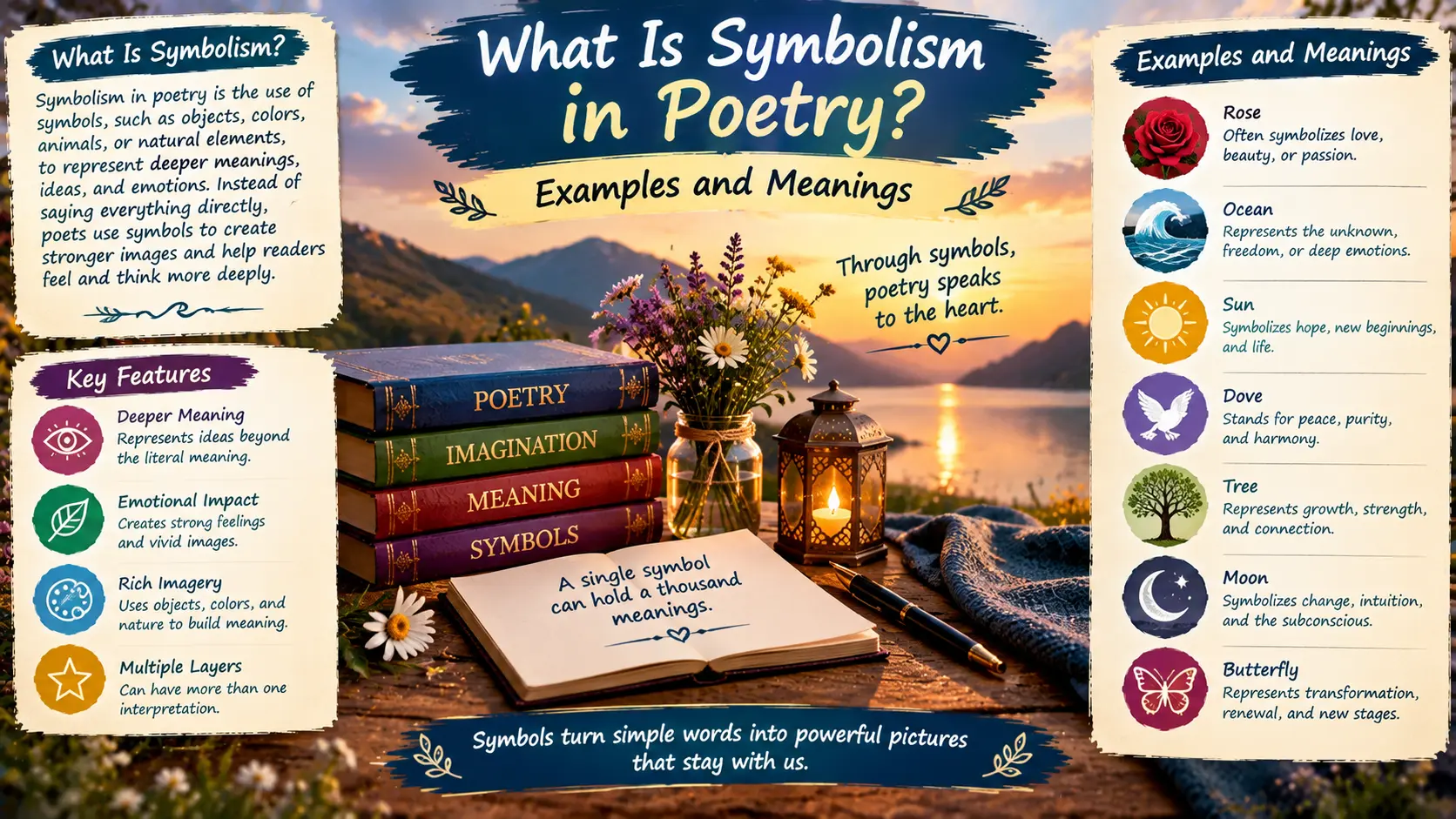
Symbolism in poetry is a literary technique that uses objects, colors, animals, and natural elements to express deeper ideas and emotions. Instead of explaining everything directly, poets use meaningful images to communicate messages about love, hope, freedom, loss, and personal growth. For example, a rose may symbolize love, while a dove often represents peace.
Symbolism makes poetry more emotional, imaginative, and meaningful. A shining star might represent hope, while a falling leaf could suggest change or the passage of time. These images encourage readers to look beyond the literal words and discover the ideas hidden within a poem.
Understanding symbolism helps readers appreciate a poet’s creativity and recognize how ordinary images can express complex human experiences.
What Is Symbolism in Poetry?
Symbolism in poetry occurs when an object, image, color, place, or action represents an idea beyond its literal meaning. Poets use symbols to communicate feelings, develop themes, and give their writing greater depth.
For example, a sunrise may symbolize a fresh start, a winding road may represent life’s journey, and darkness may suggest fear or uncertainty. The meaning of a symbol depends on the poem’s context, including its tone, imagery, and central message.
By recognizing these deeper meanings, readers can understand a poem more fully and connect with the emotions behind its words.
Why Do Poets Use Symbolism?
Poets use symbolism to express complex ideas in a creative and memorable way. A single image can communicate emotions that might otherwise require several sentences to explain.
Symbolism also encourages readers to think independently. Rather than presenting every message directly, poets allow readers to explore different interpretations based on the poem’s language and their own experiences.
The main purposes of symbolism include:
- Expressing emotions: Communicating love, grief, happiness, or fear.
- Developing themes: Strengthening ideas about life, freedom, nature, or change.
- Creating vivid imagery: Helping readers imagine scenes and feelings.
- Encouraging interpretation: Allowing readers to discover deeper meanings.
- Making poetry memorable: Connecting powerful images with lasting ideas.
Common Symbols in Poetry and Their Meanings
Poets frequently use familiar objects and natural elements to represent universal experiences. However, these meanings are not fixed, and a symbol can represent something different depending on the poem.
| Symbol | Common Symbolic Meaning |
|---|---|
| Rose | Love, beauty, and affection |
| Dove | Peace, hope, and harmony |
| Sunrise | New beginnings and renewal |
| Sunset | Endings, reflection, and transition |
| Ocean | Deep emotions, mystery, and freedom |
| Butterfly | Transformation and personal growth |
| Stars | Dreams, guidance, and possibility |
| Winter | Hardship, stillness, or loneliness |
| Spring | Renewal, hope, and fresh starts |
| Light | Truth, knowledge, and understanding |
| Darkness | Fear, uncertainty, or the unknown |
| Road | Life’s journey, choices, and opportunities |
Always consider the surrounding lines before deciding what a symbol means. A rose, for instance, may represent romantic love in one poem but heartbreak or lost beauty in another.
Examples of Symbolism in Famous Poems
Symbolism plays an important role in many well-known poems. Poets use familiar images to explore complex questions about life, identity, nature, and human experience.
In Robert Frost’s The Road Not Taken, the two roads represent different paths and choices in life. The speaker’s decision encourages readers to reflect on the opportunities they pursue and the alternatives they leave behind.
In William Blake’s The Tyger, the tiger becomes a powerful image associated with strength, beauty, fear, and questions about creation. The poem uses this striking animal to explore the mystery of existence.
Emily Dickinson also uses natural imagery to communicate deeper ideas. In “Hope” is the thing with feathers, the bird symbolizes hope as a persistent presence that continues even during difficult times.
These examples show how symbolism transforms ordinary images into powerful expressions of human thought and emotion.
How Symbolism Adds Meaning to Poetry
Symbolism strengthens poetry by allowing a single image to communicate several ideas at once.
- Expresses complex emotions: Symbols help communicate feelings such as grief, joy, love, and longing.
- Creates vivid imagery: Readers can picture meaningful objects, places, and scenes.
- Adds deeper meaning: Everyday images can represent important life experiences.
- Strengthens themes: Repeated symbols reinforce ideas about change, freedom, or hope.
- Builds emotional connections: Readers may connect symbols with their own memories.
- Encourages reflection: Hidden meanings invite readers to think beyond the literal words.
- Makes language memorable: Powerful images help readers remember a poem’s message.
- Creates mystery: Symbolism can introduce uncertainty and invite multiple interpretations.
Through these techniques, poets make their writing more engaging while giving readers opportunities to discover new meanings.
Types of Symbolism in Poetry
Symbolism can take different forms depending on the images a poet chooses and the ideas being explored.
1. Conventional Symbolism
Conventional symbols have widely recognized meanings. For example, a dove often represents peace, while a heart commonly symbolizes love.
Poets use these familiar associations to communicate ideas quickly. However, the surrounding context can change or complicate their meanings.
2. Personal Symbolism
Personal symbols carry a particular meaning within a poem or an individual’s experience. An old photograph might represent cherished memories, while a broken watch could symbolize lost time.
Personal symbols often become meaningful through the poem’s details rather than through universally accepted definitions.
3. Nature Symbolism
Natural elements such as trees, rivers, mountains, and flowers frequently represent human experiences. A growing tree may suggest resilience, while a flowing river can symbolize change or the passage of time.
4. Color Symbolism
Colors can communicate emotions and ideas. Red may suggest passion or danger, blue may evoke calmness or sadness, and green may represent nature or renewal.
These associations vary across cultures and literary contexts, so readers should avoid assuming that every color has one universal meaning.
5. Religious and Cultural Symbolism
Religious and cultural symbols can express faith, sacrifice, spiritual hope, or belonging. Their meanings depend on the traditions and communities in which they appear.
When interpreting these symbols, it is important to consider the poem’s historical and cultural background.
Symbolism in Nature and Everyday Life
Nature offers poets a rich collection of images for expressing human emotions and experiences. Flowers may represent affection, mountains can suggest strength, and rivers may symbolize the movement of life.
The seasons also carry symbolic possibilities. Spring often suggests renewal, summer may represent vitality, autumn can evoke transition, and winter may reflect hardship or stillness. These interpretations depend on how the poet uses each season.
Everyday objects can become meaningful symbols as well. A key might represent freedom or opportunity, a mirror may suggest self-reflection, and a clock can remind readers of time’s passing.
By transforming familiar things into meaningful images, poets connect abstract ideas with experiences readers can visualize and understand.
How to Identify Symbolism in a Poem
Recognizing symbolism becomes easier when you pay attention to the poet’s imagery, word choices, and central themes.
Follow these practical steps:
- Look for significant images: Notice objects, colors, animals, or places that receive special attention.
- Identify repetition: An image that appears several times may reinforce an important theme.
- Consider the context: Examine the words surrounding the image to understand its possible meaning.
- Study the mood: Determine whether the poem feels hopeful, sorrowful, mysterious, or peaceful.
- Connect the image to the theme: Ask how the symbol relates to the poem’s central idea.
- Support your interpretation: Use specific words or lines from the poem as evidence.
For example, a poem describing a locked door might use it to suggest a barrier, a secret, or an opportunity that remains out of reach. The correct interpretation depends on the details of the poem.
Remember that not every object is a symbol. A strong interpretation should be supported by the text rather than based on guesswork alone.
Symbolism vs. Metaphor: What Is the Difference?
Symbolism and metaphor are related literary devices, but they serve different purposes.
Symbolism occurs when an object, image, or action represents a broader idea. For example, a candle may symbolize hope because its light continues to shine in darkness.
A metaphor directly describes one thing as another to create a comparison. For example, the statement “Hope is a candle” compares hope to a candle to emphasize its comforting or guiding qualities.
The key difference is that symbolism gives an image a broader meaning, while a metaphor creates a direct comparison. A symbol may develop throughout an entire poem, whereas a metaphor may appear in a single line.
Poets can also combine these techniques to make their writing more expressive and meaningful.
Tips for Using Symbolism in Your Own Poetry
You do not need complicated language to use symbolism effectively. Start with a meaningful idea and choose images that help readers experience it.
- Begin with a central theme: Decide whether your poem explores love, loss, hope, freedom, or change.
- Choose meaningful images: Select objects or natural elements that connect with your theme.
- Use familiar symbols creatively: Give traditional images fresh meaning through your descriptions.
- Develop personal symbols: Let ordinary objects represent specific memories or experiences.
- Show rather than explain: Allow images to communicate emotions without describing everything directly.
- Use repetition carefully: Bring back important symbols when doing so strengthens the poem.
- Consider cultural context: Remember that readers may interpret symbols differently.
- Avoid overcrowding your poem: Focus on a few meaningful images instead of using too many unrelated symbols.
- Leave room for discovery: Let readers interpret the imagery without explaining every detail.
Effective symbolism feels natural to the poem. Each symbol should contribute to the mood, theme, or emotional experience rather than appear simply to make the writing sound complex.
Final Thoughts on Symbolism in Poetry
Symbolism in poetry transforms ordinary images into expressions of deeper meaning. From roses representing love to roads suggesting life’s choices, symbols help poets communicate emotions, develop themes, and create lasting impressions.
Understanding symbolism allows readers to appreciate the layers of meaning within poetic language. It also helps aspiring writers express complex feelings through simple, vivid images.
When reading a poem, pay attention to repeated images, meaningful objects, and the relationship between symbols and the central theme. The more carefully you examine these details, the more you can discover about the poet’s message and creative vision.
Frequently Asked Questions About Symbolism in Poetry
1. What is symbolism in poetry?
Symbolism is a literary technique in which an object, image, color, or action represents a deeper idea. It helps poets communicate emotions and themes creatively.
2. What is an example of symbolism in a poem?
A rose may symbolize love, while a sunrise may represent hope or a new beginning. The specific meaning depends on the poem’s context.
3. Why is symbolism important in poetry?
Symbolism adds emotional depth, strengthens themes, and encourages readers to explore meanings beyond the literal words. It also makes poetic images more memorable.
4. What are the most common symbols in poetry?
Common symbols include roses, doves, stars, roads, light, darkness, and butterflies. They may represent love, peace, hope, choices, and transformation.
5. How can I identify symbolism in a poem?
Look for significant or repeated images and consider how they connect with the poem’s mood and central theme. Support your interpretation with evidence from the text.
6. What is the difference between symbolism and metaphor?
Symbolism uses an image or object to represent a broader idea, while a metaphor directly compares one thing to another. Both techniques can appear in the same poem.
7. Can colors be symbols in poetry?
Yes. Red may represent passion or danger, while green can suggest nature or renewal. Color meanings vary according to context and culture.
8. What does nature symbolize in poetry?
Nature can represent growth, freedom, change, resilience, and the passage of time. Its meaning depends on how the poet describes and uses natural imagery.
9. Can one symbol have different meanings?
Yes. The same symbol can represent different ideas across poems, cultures, and situations. Readers should consider the surrounding language rather than rely on one fixed definition.
10. How can I use symbolism in my own poetry?
Choose an image that connects with your main idea or emotion. Describe it meaningfully and allow readers to discover its deeper significance through the poem.