Arrogant Definition & Meaning in Text Explained (2026)
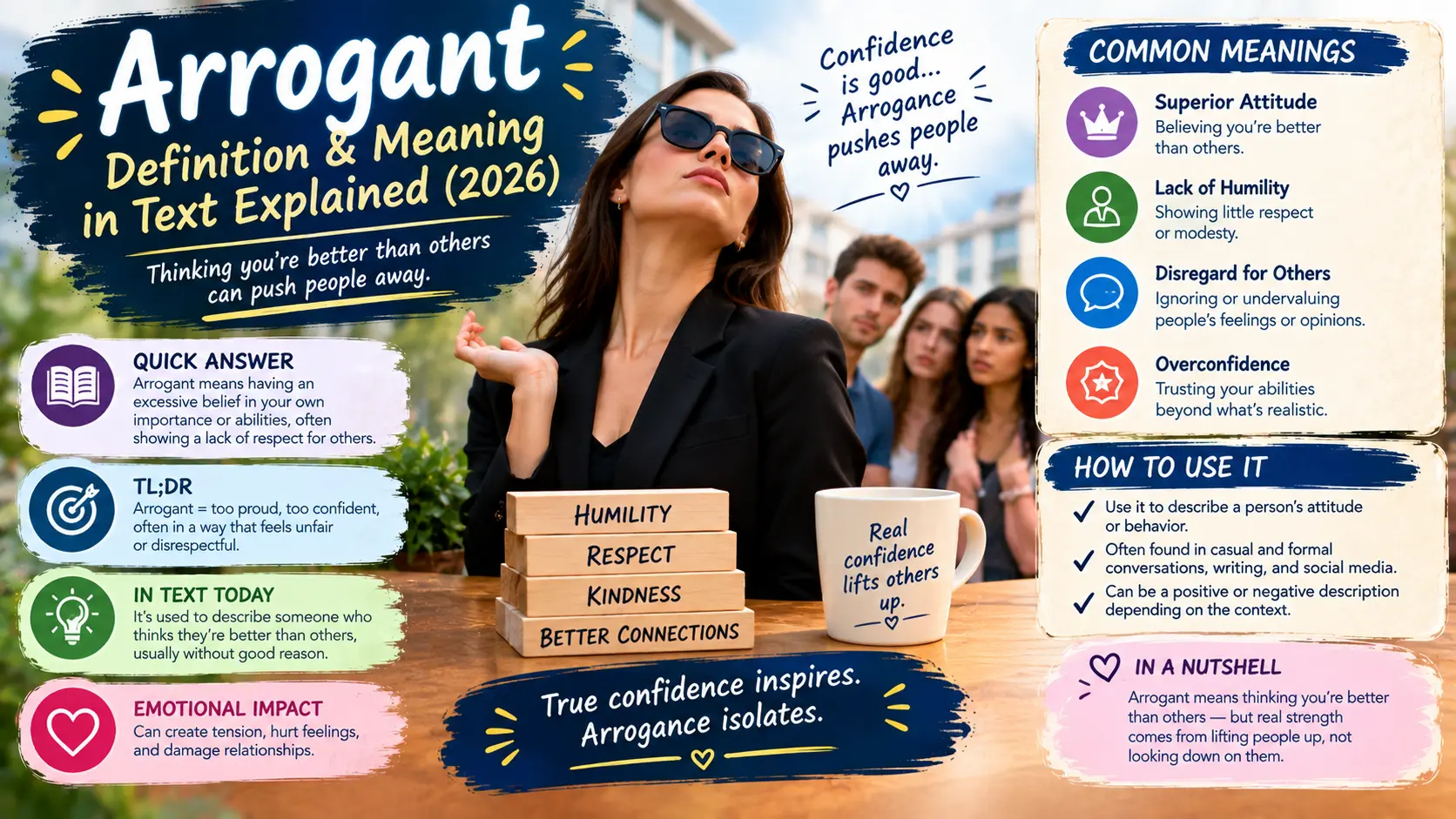
Arrogant describes someone who has an exaggerated sense of their own importance, abilities, intelligence, or status and behaves as though they are better than other people. In text messages, calling someone “arrogant” usually means the person’s words or attitude seem overly proud, superior, dismissive, or self-important.
For example, if someone repeatedly says they are smarter than everyone else and refuses to consider another person’s opinion, they may be described as arrogant.
TL;DR
Arrogant means overly proud or self-important, especially when someone treats other people as inferior. In texting, “you’re arrogant” is generally a criticism of someone’s attitude, although tone and context can affect how the word should be interpreted.
What Does “Arrogant” Mean?
Simple Definition of Arrogant
The adjective arrogant describes a person who believes they are more important, talented, intelligent, or deserving than other people. The word generally carries a negative meaning because it suggests that excessive self-confidence has crossed into superiority.
An arrogant person may talk about their achievements constantly, dismiss criticism, interrupt others, or behave as though their opinions automatically matter more. The key idea is not simply feeling good about yourself; it is elevating yourself above others.
Arrogant Meaning in Text Messages
In texting, arrogant usually means that someone’s messages come across as superior, boastful, dismissive, or overly self-confident.
For example, if someone writes, “Obviously, I know more about this than you do,” the recipient might describe that message as arrogant. However, text communication does not include facial expressions, gestures, or vocal tone, so a confident statement can sometimes be interpreted as arrogance.
Arrogant Meaning in Everyday English
In everyday English, arrogant is commonly used to criticize an attitude or behavior. Someone might say, “He is arrogant,” when they believe that person’s behavior shows excessive pride or a sense of superiority.
The word can describe a person’s general character, but it can also describe a particular action, comment, response, or attitude.
What Someone Means When They Call You Arrogant
When someone calls you arrogant, they usually believe that you are presenting yourself as superior to others.
That does not necessarily mean they are objectively correct. The label can be influenced by personality, cultural expectations, context, and misunderstanding. Sometimes a person may intend to sound confident while another person interprets the same words as boastful.
Arrogant Meaning in Text and Online Conversations
How “Arrogant” Is Used in Texting
People commonly use arrogant in texting when they want to describe an attitude they perceive as unnecessarily superior.
It may appear during disagreements, conversations about achievements, dating conversations, workplace discussions, or arguments between friends. The exact meaning depends heavily on the surrounding messages.
What “You’re Arrogant” Usually Implies
The statement “You’re arrogant” usually communicates more than simple disagreement. It suggests that the speaker thinks the other person’s attitude is excessively proud or disrespectful.
The speaker may be reacting to bragging, dismissive language, constant self-praise, or an unwillingness to recognize other viewpoints.
Examples of Arrogant Text Messages
Some examples include:
- “Nobody here understands this as well as I do.”
- “You should listen to me because I’m obviously the smartest person here.”
- “I don’t need advice from people who aren’t successful.”
- “I already know I’m going to win.”
These statements can sound arrogant because they place the speaker above other people.
Arrogant as an Insult or Criticism
Arrogant can function as a direct criticism. Unlike a neutral description such as “confident,” it generally communicates disapproval.
However, calling someone arrogant does not automatically prove that the person is arrogant. It is a judgment about behavior or attitude and should be considered in context.
Where Does the Word “Arrogant” Come From?
Latin Origins of Arrogant
The English word arrogant ultimately comes from Latin roots associated with claiming or assuming something for oneself. The historical development of the word is connected with the idea of claiming more than is properly one’s due.
Over time, this developed into the modern sense of excessive self-importance and superiority.
How the Meaning Developed
The word gradually became associated with behavior that goes beyond healthy self-confidence. Instead of simply believing in one’s abilities, an arrogant person is understood as overestimating their importance or treating others as lesser.
This distinction remains important in modern English.
Early Moral Associations With Arrogance
Historically, excessive pride was frequently treated as a moral problem. Many philosophical and religious traditions emphasized humility and warned against allowing personal status, power, or achievement to become an excuse for looking down on others.
This history helps explain why arrogance still has a strongly negative emotional meaning today.
Arrogant vs Confident: What Is the Difference?
What Confidence Looks Like
Confidence generally means having a realistic belief in your abilities or value. A confident person can recognize their strengths while still respecting other people’s abilities.
For example, saying, “I think I can handle this project,” can demonstrate confidence without suggesting that everyone else is incapable.
What Arrogance Looks Like
Arrogance adds a sense of superiority. An arrogant person may communicate, directly or indirectly, that other people are less intelligent, talented, successful, or important.
The difference is often summarized as confidence in yourself versus superiority over others.
Confidence Without Putting Others Down
A person can be highly confident without being arrogant. Someone might celebrate an achievement, speak firmly, or acknowledge their expertise while still listening to other people.
Healthy confidence does not require another person to feel inferior.
When Confidence Can Be Mistaken for Arrogance
Confidence can sometimes look like arrogance when someone communicates very directly, talks about achievements frequently, or appears unusually self-assured.
This is especially common in text because written messages remove many social cues. A statement intended as confidence may therefore be interpreted differently by the reader.
Arrogant vs Proud vs Conceited
Arrogant Meaning Compared With Proud
Proud can be positive or negative depending on context. You can be proud of your work, family, achievement, or personal growth.
Arrogant is more strongly negative because it usually suggests that pride has become excessive and involves a sense of superiority.
Arrogant Meaning Compared With Conceited
Conceited generally describes someone who has an excessively high opinion of themselves, particularly their appearance, abilities, or qualities.
Arrogant overlaps with conceited but often emphasizes how a person’s inflated self-view affects their treatment of others.
Arrogant Meaning Compared With Self-Important
Self-important describes someone who behaves as though they are especially important or deserving of attention.
It is closely related to arrogant, although arrogant can place stronger emphasis on superiority and disrespect toward others.
Which Word Is Stronger?
There is no universal scale, but arrogant is usually a strong negative judgment. The perceived strength depends on the speaker, situation, and relationship between the people involved.
Common Signs of Arrogant Behavior
Acting Superior to Others
An arrogant person may frequently behave as though they are better, smarter, or more capable than everyone around them.
This can appear through speech, body language, online comments, or repeated comparisons.
Refusing to Admit Mistakes
Another possible sign is an unwillingness to acknowledge mistakes. Someone who always blames other people and never accepts responsibility may be perceived as arrogant.
Still, one mistake or defensive reaction is not enough to establish someone’s personality.
Constantly Seeking Recognition
Repeatedly emphasizing achievements, status, wealth, intelligence, appearance, or connections can sometimes appear arrogant when recognition becomes the main focus of conversation.
The behavior becomes particularly noticeable when achievements are used to diminish other people.
Dismissing Other People’s Opinions
Arrogance can also appear when someone automatically rejects another person’s ideas simply because they believe their own opinion is superior.
Listening and disagreement are not signs of arrogance by themselves. The issue is often how someone treats alternative viewpoints.
Why Does Arrogance Feel Stronger in Text Messages?
Text Removes Facial Expressions and Tone
Text communication lacks many signals people normally use to interpret meaning. A speaker’s facial expression, voice, timing, and gestures can soften or clarify a statement.
Without these signals, a short or direct message can seem colder or more superior than intended.
Short Replies Can Sound Arrogant
Replies such as “Obviously,” “I already know,” or “Whatever” can appear dismissive depending on the conversation.
The same words might have a completely different effect when used jokingly between close friends.
Confidence Can Be Misread Through Text
Someone might write, “I’m very good at this,” intending to communicate confidence. Another person may read it as bragging.
This is why judging someone’s personality from one isolated text message can be unreliable.
Context Changes the Meaning
The relationship between the speakers, previous messages, topic, and emotional situation all influence interpretation.
A phrase that seems arrogant during an argument might sound completely normal in a professional conversation about someone’s qualifications.
See Also: Fairy Rings in Grass: Spiritual Meaning & Symbolism
Modern Digital Use of “Arrogant”
Arrogant on Social Media
On social media, arrogant is often used to describe people who appear excessively boastful, superior, or obsessed with status.
However, social media provides a limited view of someone’s life. A curated post does not necessarily reveal someone’s complete personality.
Arrogant in Comments and DMs
The word can appear in comments, direct messages, group chats, and online arguments. It is particularly common when people disagree about expertise, opinions, achievements, or social status.
Arrogant in Online Arguments
During heated discussions, people may use arrogant as a character criticism rather than addressing the original issue.
For example, instead of saying, “I disagree with your reasoning,” someone might say, “You’re arrogant.” The second statement focuses more on perceived attitude than the actual argument.
How Younger Users May Interpret the Word
Modern internet communication has made words such as arrogant, entitled, narcissistic, toxic, and conceited increasingly common in informal discussions.
These terms are sometimes used loosely, so their everyday online meaning may be broader than their precise dictionary definitions.
Arrogance in American Culture
How Americans Commonly View Arrogance
In the United States, arrogance is generally viewed negatively, particularly when someone appears to believe they are superior to others.
At the same time, American culture can place considerable value on confidence, ambition, achievement, and self-expression. This creates an important distinction between being proud of your accomplishments and looking down on other people.
Confidence, Individualism, and Social Status
American communication often rewards people for demonstrating competence and confidence. However, excessive self-promotion can produce a negative reaction when it appears to lack humility.
The social line between confidence and arrogance is therefore influenced by both the content of what someone says and the way they treat others.
Why Arrogant Behavior Often Gets Negative Reactions
People may react strongly to arrogance because it can communicate disrespect, exclusion, or a lack of equality.
Nobody necessarily objects to another person’s success. The problem usually arises when success is used to establish superiority.
Common American Expressions About Arrogance
English contains many expressions connected with excessive pride, including ideas such as “too full of yourself,” “big-headed,” “stuck-up,” and “thinks highly of themselves.”
These expressions overlap with arrogance but can vary in strength and context.
Cultural and Historical Views of Arrogance
Ancient Greek Ideas of Hubris
Ancient Greek thought included the concept of hubris, often associated with excessive pride, overconfidence, or behavior that violated accepted limits.
Although hubris and modern arrogance are not identical concepts, they share an important theme: excessive pride can lead to harmful consequences.
Arrogance in Religious and Moral Traditions
Many moral traditions have emphasized humility and warned against excessive pride. The exact interpretation differs between traditions, but the recurring idea is that personal power or success should not automatically justify superiority over others.
Shared Cultural Ideas About Humility
Across many societies, humility has traditionally been valued because it can encourage cooperation, respect, and awareness of personal limitations.
This helps explain why arrogance tends to have a negative reputation across cultures.
How Views Differ Across Cultures
Different cultures have different expectations regarding self-promotion, authority, directness, and modesty.
A communication style considered confidently assertive in one environment may be viewed as boastful or arrogant in another.
Symbolic Meaning of Arrogance
Arrogance as a Symbol of Excessive Pride
Symbolically, arrogance often represents pride that has gone too far.
It can suggest that someone has become so focused on their own importance that they no longer recognize the value of others.
Power and Social Status
Arrogance can also symbolize an unhealthy relationship with power or status. A person who believes their position makes them inherently better than others may represent the darker side of authority.
Ego and Self-Importance
Another symbolic association is ego. Arrogance can represent excessive attachment to one’s achievements, identity, intelligence, appearance, or social position.
The Contrast Between Pride and Humility
Arrogance is frequently contrasted with humility. Pride can acknowledge achievement, while humility recognizes that achievement does not make someone inherently superior to everyone else.
Common Misunderstandings About “Arrogant”
Mistaking Quietness for Arrogance
Being quiet, reserved, or less socially expressive does not automatically mean someone is arrogant.
Some people simply communicate differently or prefer to observe rather than participate constantly.
Mistaking Confidence for Arrogance
A confident person may speak clearly about their abilities without intending to insult anyone.
To determine whether behavior is arrogant, look beyond confidence itself and consider whether the person is dismissing or devaluing others.
Assuming Someone Is Arrogant From One Message
One message rarely provides enough information to accurately judge someone’s personality.
A poorly worded text, rushed response, joke, or misunderstood tone can create an impression that does not reflect the person’s broader behavior.
Why Context Matters
Meaning depends on circumstances. Who said the statement, what happened before it, and how the recipient interpreted it can all influence whether something seems arrogant.
How the Meaning of “Arrogant” Has Changed Over Time
Historical Meaning
Historically, arrogance was closely connected with excessive self-importance, improper pride, and claiming more than one was entitled to.
The moral criticism surrounding the word has remained relatively strong.
Modern Everyday Meaning
Today, arrogant commonly describes someone who acts as though they are superior, more knowledgeable, more talented, or more important than other people.
It is used in ordinary conversations, workplaces, entertainment, education, and personal relationships.
Meaning in Digital Communication
Digital communication has expanded how the word is used. People now describe posts, comments, captions, usernames, messages, and online personalities as arrogant.
The basic concept remains the same, but the word can now be applied to much more visible and immediate forms of communication.
What Has Stayed the Same
Despite changes in communication, the central meaning has remained stable: arrogance involves an excessive sense of superiority or self-importance.
Arrogant Characters in American Media and Storytelling
The Arrogant Leader
Stories often portray arrogant leaders as people who believe their authority makes them superior.
This personality type can create conflict because the character ignores warnings or undervalues others.
The Arrogant Rival
An arrogant rival may constantly boast about their abilities while underestimating the main character.
This creates a familiar contrast between confidence and humility.
The Arrogant Expert
Another common character is the expert who believes their knowledge makes them incapable of being wrong.
Such characters can be used to demonstrate how excessive certainty can become a weakness.
Why Arrogant Characters Are Often Used as Foils
Arrogant characters frequently serve as foils for humble or cooperative characters. Their behavior highlights the difference between superiority and respect.
Arrogant Meaning Across Different Contexts
Arrogant in a Relationship
In relationships, arrogant behavior may involve dismissing a partner’s feelings, refusing to listen, or repeatedly presenting oneself as superior.
Healthy relationships generally require mutual respect rather than a hierarchy of personal worth.
Arrogant at Work
At work, someone may be described as arrogant if they constantly dismiss colleagues, refuse feedback, or act as though their expertise makes them immune to mistakes.
Being knowledgeable or experienced does not automatically make someone arrogant.
Arrogant Among Friends
Among friends, arrogance may appear as constant bragging, one-upmanship, or making other people feel inferior.
However, playful teasing between close friends should not automatically be classified as arrogance.
Arrogant in School
A student might be perceived as arrogant if they repeatedly boast about grades, intelligence, or abilities while mocking classmates.
Confidence in academic ability is different from treating classmates as inferior.
Arrogant on Social Media
Online arrogance may be associated with excessive self-promotion, dismissive comments, or repeatedly presenting oneself as better than other people.
Again, context matters because social media content can be selective and performative.
Arrogant in Texting
In texting, arrogance is often communicated through dismissive wording, excessive bragging, superiority claims, or refusal to acknowledge another person’s perspective.
Because text lacks vocal tone and facial expression, misunderstandings are especially possible.
Arrogant Meaning Examples
Example of an Arrogant Person
Example: Someone says, “There’s no point asking anyone else. I’m always the smartest person in the room.”
This can sound arrogant because the speaker is not merely expressing confidence; they are placing themselves above everyone else.
Example of an Arrogant Text
Example: “You clearly don’t understand this. Just do what I told you.”
Depending on the context, this could be perceived as arrogant because it dismisses the other person’s understanding.
Example of an Arrogant Comment
Example: “People like you could never reach my level.”
The phrase communicates superiority and deliberately places another person beneath the speaker.
Example of Confidence Instead of Arrogance
Example: “I’ve worked on projects like this before, so I’m confident I can help.”
This communicates experience without suggesting that other people are inferior.
Arrogant Meaning: Quick Reference Table
| Term | Basic Meaning | Usually Positive or Negative? |
|---|---|---|
| Arrogant | Acting superior or excessively self-important | Negative |
| Confident | Having reasonable belief in your abilities | Usually positive |
| Proud | Feeling satisfaction about an achievement or quality | Positive or negative |
| Conceited | Having an excessively favorable opinion of yourself | Negative |
| Self-important | Acting as though you are especially important | Usually negative |
| Humble | Not exaggerating your importance or achievements | Usually positive |
| Narcissistic | Relating to excessive self-focus and a need for admiration; also a clinical term in specific contexts | Context-dependent |
FAQs About “Arrogant” Meaning
What does arrogant mean in simple words?
Arrogant means acting as if you are better, smarter, or more important than other people. It usually describes excessive pride combined with a sense of superiority.
What does arrogant mean in text?
In text messages, arrogant usually means that someone’s words sound overly proud, dismissive, boastful, or superior. Because texting lacks vocal tone and facial expressions, misunderstandings are possible.
Is arrogant a bad word?
Arrogant is generally a negative word. It is commonly used to criticize someone’s attitude or behavior, although the seriousness depends on the context and relationship between the speakers.
Is being confident the same as being arrogant?
No. Confidence is belief in your abilities, while arrogance usually involves superiority over others. A confident person can recognize their strengths while respecting other people’s abilities.
Can someone be arrogant without realizing it?
Yes. A person may unintentionally sound arrogant because of their communication style, lack of awareness, or habit of emphasizing their achievements.
Why do people call someone arrogant?
People often use the word when they feel someone is boasting, dismissing others, refusing criticism, or acting superior.
What is the opposite of arrogant?
Common opposites include humble, modest, respectful, grounded, and unassuming.
What is the difference between arrogant and narcissistic?
Arrogant describes behavior or attitude involving superiority and excessive self-importance. Narcissistic can be used casually to describe extreme self-focus, but it also has a specific psychological meaning when referring to narcissistic personality disorder. The terms should not automatically be treated as synonyms.
Conclusion: Understanding the Meaning of “Arrogant”
The word arrogant generally describes someone who has an exaggerated sense of their own importance and behaves as though they are superior to others. In texting and online communication, it is often used when a person’s words appear boastful, dismissive, or overly self-confident.
The most important distinction is between confidence and superiority. Confidence allows someone to recognize their strengths, while arrogance tends to place those strengths above the value or abilities of other people. Because tone is easily misunderstood in digital communication, it is wise to consider the complete context before labeling someone arrogant.