Meaning of the Color Pink: Spiritual & Symbolic Guide
Quick Answer
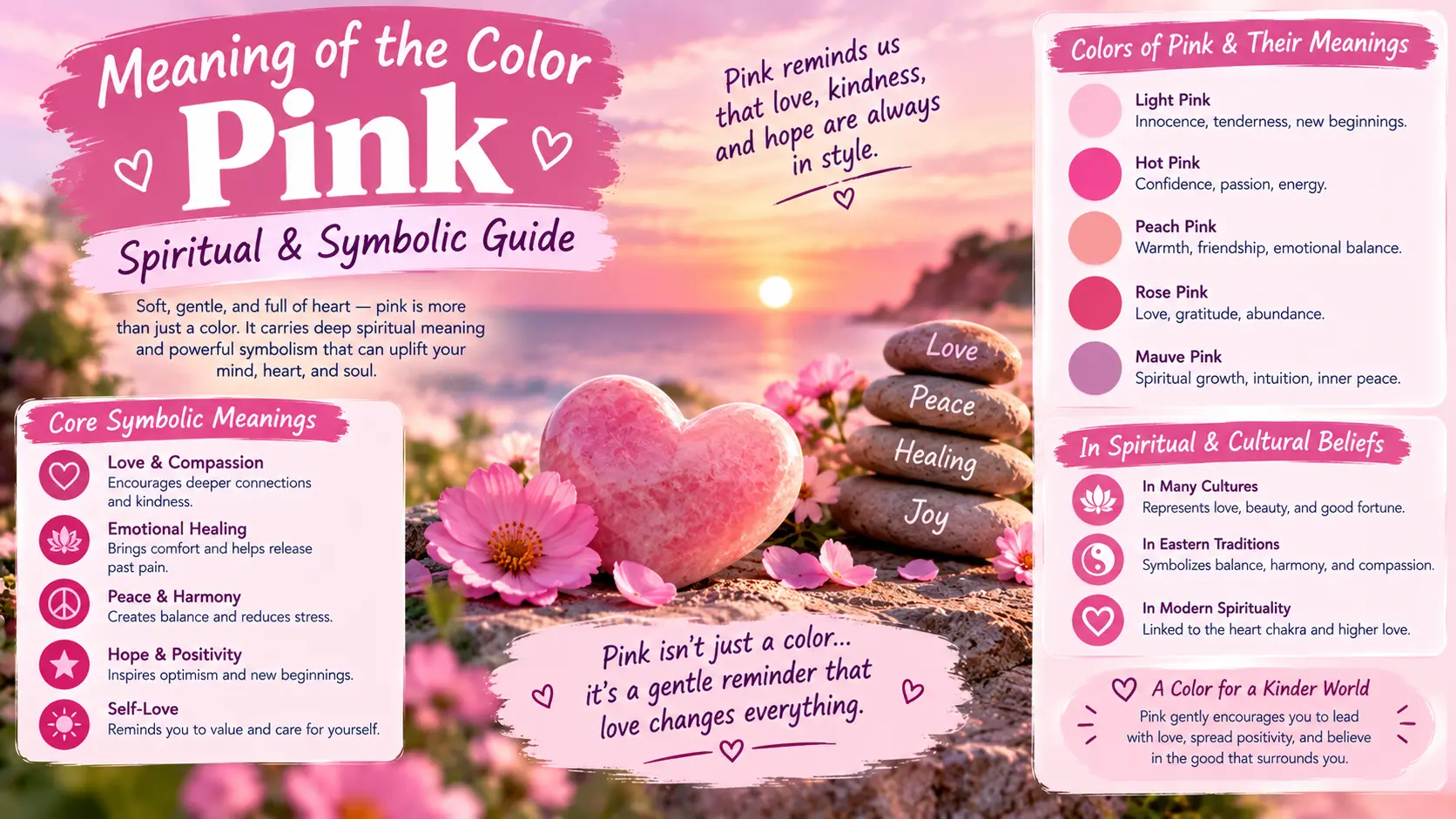
The meaning of the color pink is commonly connected with love, compassion, tenderness, emotional warmth, peace, kindness, innocence, and healing. Spiritually, pink is often viewed as a gentle color associated with the heart, emotional balance, forgiveness, and unconditional love. However, its meaning can change depending on the shade, culture, historical period, and personal context.
TL;DR
Pink symbolizes love, compassion, gentleness, hope, affection, and emotional sensitivity. Light pink can suggest innocence and calmness, while brighter shades such as hot pink can represent confidence, energy, creativity, and individuality. Although pink is strongly associated with femininity in modern Western culture, that association is relatively recent and has changed considerably throughout history.
What Does the Color Pink Mean?
Pink is a color created by combining the visual qualities of red and white. Because red is frequently associated with passion, energy, and love while white can represent purity and simplicity, pink is often interpreted as a softer expression of those qualities.
The meaning of pink is not fixed. A pale pink flower may communicate tenderness, while a vivid pink outfit may express confidence and individuality. In spiritual contexts, pink may be interpreted as a symbol of compassion or emotional healing, whereas in advertising it can communicate playfulness, youthfulness, or warmth.
Simple Meaning of Pink
At its simplest, pink represents gentle love and emotional warmth. It can suggest affection without the intensity traditionally associated with deep red.
Pink is also frequently connected with kindness, friendship, nurturing energy, sensitivity, and peaceful emotions. These associations make it a popular color when people want to create a feeling of comfort or emotional connection.
Why Pink Has Different Meanings
Colors acquire meanings through culture, history, psychology, personal experience, and context. Pink does not have one universal interpretation that applies everywhere.
For example, a person may associate pink with childhood because of clothing or toys, while another person may associate it with breast cancer awareness, romance, flowers, or spiritual healing. The same shade can therefore produce different emotional responses in different situations.
What Does Pink Symbolize?
Pink has developed several powerful symbolic associations. Its most common themes revolve around relationships, emotions, compassion, and gentleness.
Love, Compassion, and Affection
Pink is strongly associated with love and affection, particularly softer forms of love such as friendship, tenderness, caring, and emotional closeness.
Unlike intense red, which can symbolize passion and desire, pink often represents love expressed through kindness and compassion. It can therefore symbolize a caring relationship, emotional support, appreciation, and warmth.
Peace, Gentleness, and Emotional Warmth
Pink can create an impression of softness and tranquility. Pale shades are often used to produce environments that feel welcoming, gentle, and emotionally comfortable.
Symbolically, pink may represent the desire to approach situations with patience rather than aggression. It can serve as a visual reminder of tenderness, empathy, and peaceful communication.
Hope, Innocence, and Renewal
Certain shades of pink are associated with innocence, youth, optimism, and new beginnings. This is particularly noticeable in spring flowers, where pink blossoms can represent renewal after winter.
Spiritually, this symbolism can be interpreted as encouragement to remain hopeful during periods of emotional change. Pink can represent the possibility of healing and starting again without carrying unnecessary bitterness from the past.
Spiritual Meaning of the Color Pink
The spiritual meaning of pink is commonly connected with love, compassion, forgiveness, emotional healing, and harmony.
In many modern spiritual interpretations, pink is associated with the emotional side of human experience. It can symbolize opening yourself to kindness, accepting affection, releasing resentment, and developing greater compassion toward yourself and others.
Pink as a Symbol of Love and Healing
Pink is often viewed as a gentle representation of love. In spiritual symbolism, it may suggest a period when emotional wounds are being acknowledged and gradually healed.
Seeing pink during a reflective or emotionally significant moment may encourage someone to consider whether they need more self-compassion. Rather than interpreting the color as a guaranteed supernatural message, it can be used as a personal symbol for emotional restoration and care.
Pink and Emotional Balance
Pink can symbolize balance between strong emotions and peaceful responses. Because it visually sits between the intensity of red and the softness of white, it is sometimes interpreted as a color of moderation.
Spiritually, this can represent learning how to experience powerful emotions without allowing them to control every decision. Pink may therefore symbolize emotional maturity, patience, forgiveness, and inner harmony.
Pink as a Sign of Compassion
Compassion is one of the strongest spiritual themes associated with pink. The color can represent caring for others while also remembering to care for yourself.
When pink repeatedly catches someone’s attention, they may personally interpret it as an invitation to become more patient, understanding, or emotionally open. This is a symbolic interpretation rather than a scientifically established spiritual rule.
Pink in Spiritual and Energy Traditions
Some modern spiritual traditions associate pink with the heart and emotional energy. It is sometimes discussed alongside themes such as unconditional love, empathy, forgiveness, and emotional openness.
These interpretations vary considerably between traditions and should not be treated as universal facts. Spiritual color symbolism is best understood as a cultural or personal framework for reflection rather than a scientifically proven system.
See Also: Whiskey Neat Meaning: What It Means and How It’s Served
Psychological and Emotional Meaning of Pink
Pink can influence emotional impressions because colors affect how people perceive environments, objects, and visual messages. However, individual responses vary, and color psychology should not be treated as a universal formula.
How Pink Can Affect Mood
Soft pink environments can appear gentle, welcoming, or comforting. Brighter pinks may feel energetic, playful, expressive, or attention-grabbing.
The emotional effect depends on factors such as saturation, lighting, surrounding colors, personal experience, and cultural expectations. A dusty pink wall, for example, creates a very different visual impression from an intensely bright neon pink sign.
Pink and Feelings of Calm
Pale pink can be associated with softness and tranquility. This is one reason similar shades appear in bedrooms, nurseries, wellness environments, packaging, and relaxing visual designs.
The calming interpretation of pink is especially strong when it is combined with neutral colors and soft lighting. However, not everyone experiences pink as calming.
Pink and Emotional Sensitivity
Pink can also symbolize sensitivity and emotional awareness. It is often visually associated with qualities such as tenderness, empathy, affection, and vulnerability.
This does not mean that people who prefer pink are necessarily more sensitive. Rather, sensitivity is one of the cultural qualities that societies have attached to the color.
Historical Origins of Pink Symbolism
The symbolic history of pink is more complicated than its modern reputation might suggest. Pink has not always had the same gender associations it has today.
Early Uses and Symbolic Associations
People have produced pinkish pigments and used pink or reddish tones in art, decoration, textiles, and natural materials for centuries. However, the modern concept of pink as a distinct cultural category developed gradually.
Before modern industrial dyes made bright colors widely accessible, many pink shades were created from natural pigments and dyes. Their meanings depended heavily on local traditions and the materials available.
Pink in Ancient and Pre-Modern Culture
Pinkish colors could appear in flowers, skin tones, fabrics, paintings, and decorative objects. In some artistic contexts, pink was connected with beauty, delicacy, youth, or romantic imagery.
It is important not to project modern assumptions backward. Historical societies did not necessarily interpret pink through today’s categories of gender, childhood, or fashion.
Pink in European History
European history demonstrates how dramatically the meaning of pink can change.
How Pink Became Associated With Gender
The idea that pink is naturally or universally a “girl’s color” is not an ancient rule. Gender-color conventions developed through changing fashion practices, commercial marketing, social expectations, and popular culture.
During different historical periods, children of both genders wore various colors, and the rules were not consistent. Modern Western associations between pink and femininity became particularly influential during the twentieth century.
Changing Cultural Ideas About Pink
Pink gradually became strongly connected with femininity in many Western societies. Fashion, children’s products, advertising, magazines, entertainment, and retail merchandising helped reinforce this association.
Yet the association continues to evolve. Contemporary fashion frequently uses pink across gender categories, and many people now view pink as an expressive color rather than a strictly feminine one.
Pink Symbolism in the United States
In the United States, pink has accumulated numerous cultural meanings.
Common American Associations
Common associations include romance, femininity, childhood, sweetness, beauty, compassion, breast cancer awareness, and playful energy.
The exact interpretation depends on context. A pink rose may communicate affection, while a hot-pink graphic may communicate confidence or boldness.
Pink in Fashion, Media, and Advertising
Pink has played a major role in American fashion and commercial culture. Brands have used different shades of pink to communicate youthfulness, femininity, playfulness, luxury, energy, or emotional warmth.
Bright pink can attract attention, while pastel pink often creates a softer appearance. Marketing professionals therefore select shades according to the emotional impression they want a product to create.
Pink and Cultural Identity
For some people, pink represents femininity and traditional beauty. For others, it represents rebellion, self-expression, confidence, nostalgia, or cultural identity.
The meaning of pink has therefore expanded beyond a single stereotype. Modern interpretations can be highly personal.
Pink and Social Movements
Pink has become an important visual symbol in several forms of public awareness and social advocacy.
Pink and Breast Cancer Awareness
The pink ribbon became widely recognized as a symbol of breast cancer awareness. Pink is now strongly associated with campaigns designed to raise awareness, encourage support, and honor people affected by breast cancer.
This association demonstrates how colors can develop meanings through collective cultural use. Pink’s symbolism in this context is connected with awareness and solidarity rather than simply femininity.
Pink in Women’s Rights and Advocacy
Pink has sometimes been incorporated into women’s advocacy and social movements because of its historical association with femininity.
However, activists have also deliberately used pink in ways that challenge stereotypes. A color traditionally associated with femininity can become a symbol of strength, political visibility, solidarity, or resistance.
Pink as a Symbol of Solidarity
Pink can communicate support for a cause or community when people intentionally adopt it through clothing, ribbons, artwork, campaigns, or public events.
Its meaning in these situations comes from shared cultural understanding rather than from the color itself.
Different Shades of Pink and Their Meanings
Not every pink communicates the same message. Shade, brightness, saturation, and surrounding colors can significantly change its impression.
Light Pink Meaning
Light pink is commonly associated with tenderness, innocence, softness, peace, and affection.
It often creates a delicate and gentle visual impression and can symbolize emotional comfort or quiet love.
Baby Pink Meaning
Baby pink is strongly connected with infancy, childhood, sweetness, innocence, and softness in many contemporary Western contexts.
Because of its association with children’s products and clothing, it can also evoke nostalgia and memories of early life.
Hot Pink Meaning
Hot pink is much more energetic than pastel pink. It can represent confidence, boldness, excitement, creativity, and individuality.
In modern fashion and design, hot pink can challenge the idea that pink must be quiet or delicate.
Bright Pink Meaning
Bright pink can symbolize enthusiasm, playfulness, attention, and expressive energy.
It is particularly effective when someone wants pink to feel lively rather than subtle.
Dusty Pink Meaning
Dusty pink has a muted and sophisticated appearance. It is often associated with maturity, elegance, nostalgia, softness, and understated beauty.
This shade is popular in interior design, fashion, weddings, and branding because it can feel less youthful than brighter pinks.
Rose Pink Meaning
Rose pink combines the symbolism of pink with associations traditionally connected to roses. It can represent romantic affection, appreciation, beauty, gratitude, and emotional warmth.
Its exact meaning depends on the cultural and personal context in which it appears.
Magenta and Deep Pink Meaning
Deep pink and magenta tend to feel more intense and expressive. They may symbolize creativity, confidence, individuality, passion, and transformation.
Although they belong to the broader family of pink-related colors, their stronger saturation gives them a different psychological impression from pale pink.
Pink in Everyday Life
Pink appears throughout modern life, from clothing and interiors to flowers, technology, packaging, and branding.
Pink in Clothing and Fashion
Pink clothing can communicate many different identities. Pastel pink may appear soft and traditional, while bright pink can look confident and contemporary.
Today, pink is increasingly treated as a flexible fashion color rather than one restricted to a particular gender.
Pink in Home Decor
Pink can make interiors feel warm, welcoming, romantic, playful, or sophisticated.
Pale pink works well with neutral shades for a subtle atmosphere, while stronger pinks can become focal points in a room.
Pink in Branding and Marketing
Brands may use pink to communicate warmth, youthfulness, creativity, beauty, compassion, or playfulness.
However, successful branding depends on the entire visual system. Typography, imagery, product category, shade, and cultural context all influence how the audience interprets pink.
Pink in Flowers and Nature
Pink occurs naturally in flowers such as roses, cherry blossoms, lilies, carnations, and numerous wildflowers.
Because flowering plants are associated with spring and renewal, natural pink can evoke ideas of beauty, growth, affection, and new beginnings.
Is Pink Always Considered a Feminine Color?
No. Pink is not inherently feminine.
How Gender Associations Developed
Pink’s strong feminine association in contemporary Western culture developed through relatively recent social and commercial changes. Fashion and marketing helped establish pink as a common symbol of femininity.
This history shows that color meanings are culturally constructed and can change over time.
Modern Views of Pink and Gender
Today, people increasingly use pink according to personal taste rather than strict gender expectations.
Men, women, and people of all genders may wear pink or use it in their homes, art, accessories, and personal branding. Bright pink, in particular, has become a popular symbol of confidence and individuality.
Positive and Negative Meanings of Pink
Pink is predominantly associated with positive ideas, but it can also have less favorable interpretations.
Positive Symbolism of Pink
Common positive meanings include:
- Love
- Compassion
- Kindness
- Affection
- Peace
- Hope
- Healing
- Innocence
- Beauty
- Emotional warmth
- Friendship
- Renewal
These meanings make pink especially useful for communicating care and emotional connection.
Possible Negative Associations
Depending on context, pink can sometimes be interpreted as overly delicate, immature, artificial, sentimental, or stereotypically feminine.
These interpretations are not inherent properties of pink. They arise from cultural expectations and individual experiences.
Why Context Changes Pink’s Meaning
A single color can communicate entirely different messages depending on where and how it appears.
A pale pink flower may suggest romance. A bright pink sports shoe may suggest energy. A pink awareness ribbon may communicate solidarity. A dark pink wall may appear sophisticated.
Context is therefore essential when interpreting color symbolism.
How the Meaning of Pink Has Changed Over Time
The history of pink demonstrates that color symbolism is constantly evolving.
From Historical Symbolism to Modern Culture
Pink moved through multiple cultural meanings before becoming strongly associated with femininity in modern Western society.
Its current symbolism reflects centuries of artistic traditions combined with twentieth- and twenty-first-century fashion, advertising, entertainment, social movements, and consumer culture.
The Changing Meaning of Pink Today
Today, pink can represent far more than softness or femininity. It can communicate strength, confidence, activism, creativity, individuality, romance, compassion, and nostalgia.
The rise of different pink shades has also expanded the color’s expressive range. Pale pink and neon pink can communicate almost opposite moods while still belonging to the same broad color family.
What Does Seeing Pink Symbolize Spiritually?
Some people attach special spiritual meaning to repeatedly noticing a particular color. Pink is often interpreted in these situations as a symbol of emotional openness, compassion, affection, or healing.
There is no scientifically established rule that seeing pink repeatedly carries one universal supernatural message. Its value may instead come from the personal meaning someone gives the experience.
Seeing Pink in Dreams
A pink object or environment in a dream may personally symbolize affection, vulnerability, tenderness, relationships, or emotional healing.
Dream interpretation is subjective. The meaning can depend on what happened in the dream and how the dreamer felt when seeing the color.
Noticing Pink Repeatedly
Repeatedly noticing pink may encourage personal reflection about relationships, emotional needs, kindness, or self-care.
Rather than assuming the color predicts an event, it can be more useful to ask what pink represents to you and why it is attracting your attention at that particular moment.
Pink Objects and Spiritual Reflection
Flowers, clothing, gemstones, artwork, sunsets, or other pink objects can become personal reminders of love and compassion.
If pink repeatedly appears during a meaningful period, someone may choose to use it as a symbolic reminder to practice patience, forgiveness, gratitude, or emotional openness.
FAQs About the Meaning of Pink
What does the color pink symbolize spiritually?
Spiritually, pink is commonly associated with love, compassion, emotional healing, forgiveness, kindness, and inner harmony. These meanings vary between spiritual traditions and personal beliefs.
What does pink mean emotionally?
Emotionally, pink can represent affection, tenderness, calmness, compassion, sensitivity, and warmth. Brighter pinks may feel more energetic and expressive, while pale pinks tend to appear softer.
Is pink always considered a feminine color?
No. Although pink became strongly associated with femininity in modern Western culture, that association is historically and culturally variable. Today, pink is widely used by people of all genders.
What does light pink symbolize?
Light pink commonly symbolizes innocence, tenderness, peace, affection, gentleness, and emotional warmth. It can also evoke youthfulness and softness.
What does hot pink symbolize?
Hot pink is often associated with confidence, boldness, creativity, energy, individuality, and expressive self-confidence. It has a much stronger visual impact than pale pink.
Why is pink associated with breast cancer awareness?
Pink became widely recognized as a color of breast cancer awareness through the use of the pink ribbon and related awareness campaigns. The color now represents awareness, support, and solidarity in this context.
Can pink have a negative meaning?
Yes. Depending on context, pink can sometimes be interpreted as overly sentimental, immature, artificial, or stereotypically feminine. These meanings are culturally influenced rather than universal.
What does seeing the color pink mean spiritually?
Some spiritual interpretations connect repeatedly seeing pink with love, compassion, emotional healing, forgiveness, and openness. However, there is no universal scientific rule establishing a supernatural meaning for repeatedly seeing a color.
Conclusion
The meaning of the color pink reaches far beyond a simple association with femininity. Pink can symbolize love, compassion, tenderness, peace, hope, emotional healing, beauty, creativity, and confidence.
Its interpretation changes according to shade and context. Light pink may suggest innocence and gentleness, while hot pink can communicate boldness and individuality. Historically, pink’s gender associations have also changed, showing that color symbolism is shaped by culture rather than being permanently fixed.
From spiritual reflection and emotional symbolism to fashion, social movements, nature, and everyday design, pink remains one of the most versatile colors in modern culture. Ultimately, its deepest meaning may come from the feelings, memories, relationships, and experiences that the color evokes for you.