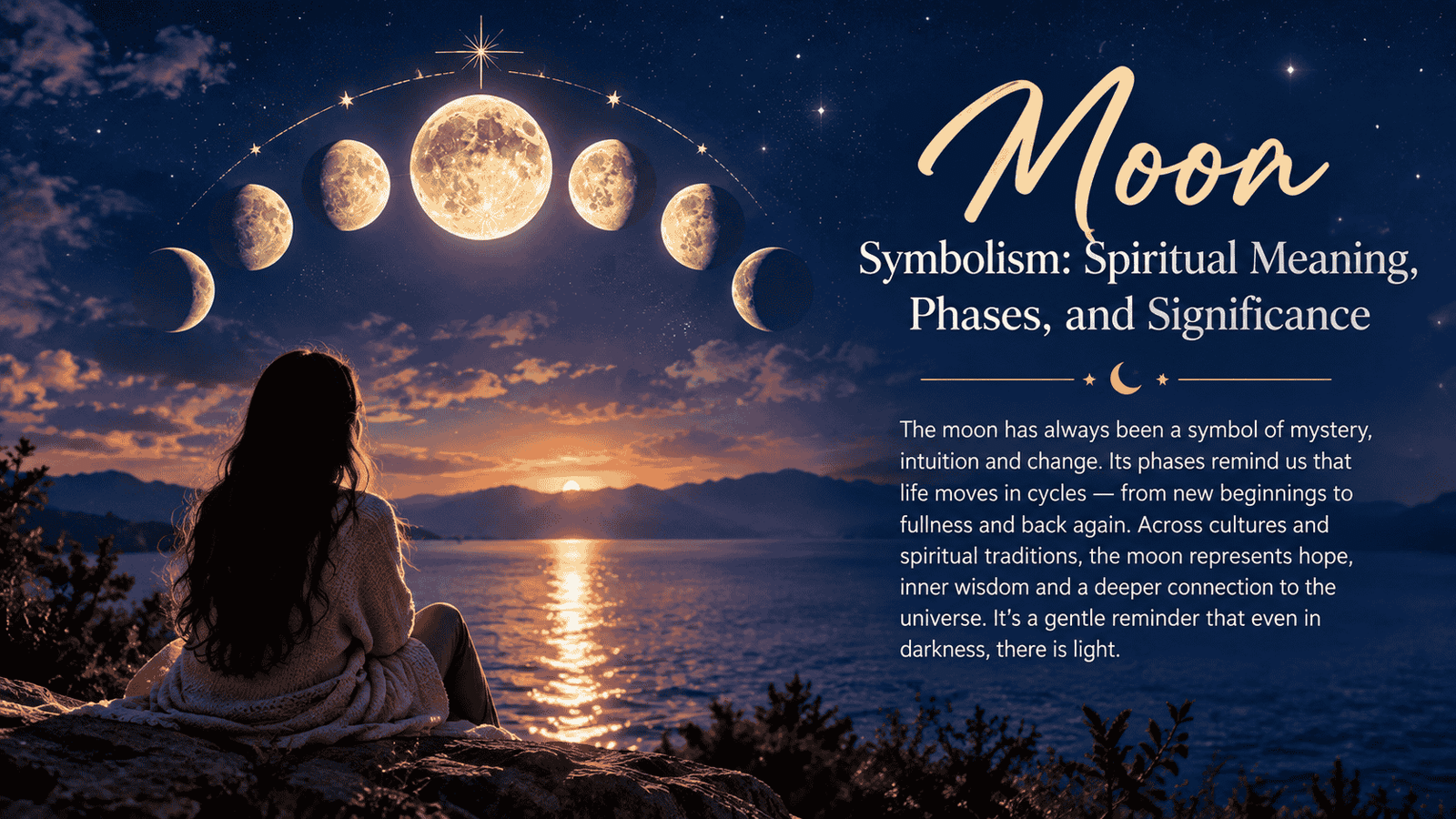
Moon Symbolism: Spiritual Meaning, Phases, and Significance
Quick Answer
Moon symbolism commonly represents change, cycles, intuition, mystery, reflection, renewal, and emotional awareness. Because the Moon appears to change throughout its cycle, it has long been associated with transformation and the natural rhythm of life.
The Moon can also carry different meanings depending on its phase, color, cultural setting, and personal context. A full Moon may represent completion and illumination, while a crescent Moon can suggest growth and possibility. A new Moon is often connected with beginnings, and a Blood Moon may symbolize transformation or powerful change in spiritual and cultural interpretations.
TL;DR: What Does the Moon Symbolize?
The Moon is one of the most recognizable symbols in human culture. Its changing appearance has inspired meanings connected with time, transformation, emotion, mystery, intuition, and renewal.
Common Moon symbolism includes:
- Change: The Moon continually moves through visible phases.
- Cycles: Its monthly pattern can represent repeating stages of life.
- Intuition: Nighttime and the Moon are often associated with inner awareness.
- Mystery: Its presence in the night sky gives it an association with the unknown.
- Renewal: The Moon disappears from view and returns again.
- Love: Moon imagery frequently represents romance, emotional connection, and longing.
- Reflection: The quiet nighttime setting can symbolize self-examination.
- Balance: The Moon’s changing relationship between light and darkness can represent opposing forces.
The exact meaning is not universal. Moon symbolism changes across religions, cultures, historical periods, and individual experiences.
Moon Symbolism
The Moon is commonly viewed as a symbol of change and transformation because it never appears exactly the same throughout its lunar cycle. It grows from a thin crescent to a full circle, then gradually fades from view. This natural pattern can represent the idea that life also moves through stages of beginning, development, completion, decline, and renewal.
The Moon is also strongly associated with mystery and the unknown. It illuminates the night without completely removing the darkness. Because of this, Moon imagery can symbolize the parts of life that cannot be immediately understood. It may represent intuition, imagination, hidden emotions, dreams, and the search for meaning.
In symbolic traditions, the Moon is sometimes connected with feminine qualities, particularly because of historical associations with fertility, menstruation, motherhood, and lunar cycles. However, these interpretations are culturally specific rather than universal.
Another important meaning is reflection. The Moon does not produce its own visible light; it reflects sunlight toward Earth. Symbolically, this has inspired associations with reflection, perception, and seeing something indirectly. A Moon can therefore represent looking inward and understanding experiences from a different perspective.
Moon Symbolism in Love
The Moon has a strong place in romantic symbolism. Its appearance in the nighttime sky has inspired poetry, music, artwork, photography, jewelry, and expressions of affection for centuries. In modern symbolism, looking at the same Moon can represent connection between people who are physically apart.
Moon symbolism in love can also represent emotional depth. Unlike symbols that communicate straightforward passion, the Moon often suggests quieter emotions such as longing, intimacy, tenderness, remembrance, and emotional closeness.
The changing Moon can represent the changing nature of relationships. A crescent may suggest the beginning of love, while a full Moon can symbolize emotional fullness or a mature relationship. A waning Moon may represent reflection, acceptance, or the closing of a chapter.
Moon imagery can also be used after heartbreak. In this context, it may represent healing and the understanding that emotions, like lunar phases, change over time. The darkness of one phase does not mean the Moon has disappeared permanently.
Moon Symbolism Phases
The Moon’s phases provide some of the clearest symbolic meanings associated with lunar imagery.
New Moon
The new Moon occurs when the Moon is positioned so that the illuminated side facing Earth is largely invisible. Symbolically, it can represent beginnings, quietness, potential, and a period of preparation.
Crescent Moon
The crescent Moon is often associated with growth, hope, possibility, and gradual progress. Its small amount of visible light can symbolize the early stages of a new goal or personal transformation.
Half Moon
A half Moon can represent balance, choice, transition, and opposing forces. The visible division between light and darkness makes it an especially useful symbol for duality.
Gibbous Moon
The gibbous phase can symbolize development and anticipation because the Moon is moving toward fullness. In personal symbolism, it may represent preparation, progress, and something approaching completion.
Full Moon
The full Moon is commonly associated with completion, illumination, fulfillment, and heightened awareness. Its bright circular appearance makes it one of the strongest lunar symbols.
Waning Moon
A waning Moon can represent release, reflection, rest, and closure. Symbolically, it may encourage letting go of something that has reached the end of its natural cycle.
Blood Moon Symbolism
A Blood Moon is a common popular term for a total lunar eclipse, during which the Moon can appear reddish because of sunlight passing through Earth’s atmosphere.
Historically and culturally, unusual celestial events have often inspired stories, predictions, rituals, and symbolic interpretations. A reddish Moon may therefore be associated with dramatic transformation, mystery, endings, beginnings, or powerful emotions.
In modern spiritual symbolism, a Blood Moon is sometimes interpreted as a moment of transition. It may represent the closing of one chapter and the beginning of another.
However, there is an important distinction between astronomy and symbolism. The reddish appearance has a natural scientific explanation and is not evidence that a particular event will occur in someone’s personal life.
Full Moon Symbolism
The full Moon is one of the most powerful visual symbols associated with lunar imagery. Because the Moon appears completely illuminated from Earth’s perspective, it commonly represents completion and visibility.
Symbolically, a full Moon can represent reaching a goal, recognizing the results of previous efforts, or bringing something hidden into awareness. It can also represent emotional clarity because the nighttime landscape becomes more visible under its light.
In different traditions, the full Moon has been associated with celebrations, agricultural cycles, religious observances, and seasonal events. Its symbolic meaning therefore depends heavily on the cultural context.
Modern spiritual interpretations often connect the full Moon with reflection, gratitude, release, and personal awareness. These are spiritual or cultural interpretations rather than scientific effects of the full Moon on individual behavior.
Crescent Moon Symbolism
The crescent Moon is one of the most recognizable lunar symbols. Its thin curved shape often communicates the idea of something beginning to emerge.
For this reason, crescent Moon symbolism commonly includes hope, growth, possibility, renewal, and transformation. It can represent a small beginning that has the potential to become something much larger.
The crescent also has major cultural and religious significance in various parts of the world. Its meaning cannot be reduced to a single interpretation because its historical uses differ between societies.
In modern jewelry and tattoo designs, a crescent Moon may be chosen simply for its elegant shape or as a personal symbol of growth and change.
New Moon Symbolism
The new Moon is commonly associated with beginnings because it marks the start of a new lunar cycle. Although the Moon itself has not disappeared, its illuminated side is facing away from Earth, making it difficult to see.
Symbolically, this hidden phase can represent quiet beginnings, potential, intention, reflection, and preparation. It is sometimes viewed as a time to step away from external distractions and consider what comes next.
The new Moon can also symbolize starting over. Someone going through a major life transition may use the new Moon as a metaphor for leaving an old chapter behind and preparing for a new one.
In contemporary spiritual practices, new Moon rituals sometimes involve journaling, goal setting, meditation, or personal reflection. These are modern practices and should not be confused with established scientific effects.
Blue Moon Symbolism
The phrase Blue Moon has an important cultural meaning because a Blue Moon refers to a relatively uncommon occurrence under certain calendar or seasonal definitions.
The expression “once in a blue moon” has helped give the term a symbolic connection with rarity, unusual opportunities, and something that does not happen often.
A Blue Moon does not normally mean that the Moon literally becomes blue. Under unusual atmospheric conditions, the Moon can appear bluish, but that is a separate phenomenon.
Symbolically, the Blue Moon can therefore represent appreciating rare moments. It may be used as an image of patience, opportunity, uniqueness, or an experience that feels special because it is uncommon.
Red Moon Symbolism
A red Moon can have several meanings depending on what causes its appearance. During a total lunar eclipse, the Moon can appear reddish and is commonly called a Blood Moon.
Red is often associated symbolically with passion, intensity, energy, courage, transformation, and strong emotion. When combined with the Moon, these themes can create a powerful symbol of emotional or personal change.
In mythology and popular culture, red celestial objects have sometimes been interpreted as warnings or omens. Such interpretations belong to cultural storytelling and belief systems rather than astronomy.
Today, red Moon imagery is frequently used in art, tattoos, photography, fantasy themes, and spiritual content because of its dramatic appearance.
Half Moon Symbolism
The half Moon is a natural symbol of balance and duality because one portion appears illuminated while the other remains dark.
This visual contrast can represent opposing concepts such as light and darkness, beginning and ending, knowledge and mystery, or action and rest.
A half Moon can also symbolize decision-making. When someone is standing between two possibilities, the divided appearance of the Moon can serve as a metaphor for weighing different directions.
The exact phase matters as well. A first-quarter Moon is waxing, while a last-quarter Moon is waning, so their symbolic interpretations can differ when someone intentionally uses lunar phases in artwork or personal symbolism.
Moon Symbolism in Different Cultures
Moon symbolism appears in cultures around the world, but there is no single universal lunar meaning.
In ancient Mesopotamia, lunar observations were closely connected with calendars, religious traditions, and celestial interpretation. The Moon played an important role in understanding time and organizing social and religious life.
In ancient Egypt, several deities were associated with lunar concepts. The Moon could be connected with timekeeping, knowledge, healing, and religious symbolism.
Greek and Roman traditions included lunar deities and figures such as Selene, Artemis, Luna, and Diana, although their identities and associations changed across different periods and traditions.
Across East Asian cultures, Moon imagery appears in mythology, poetry, festivals, and stories. The Moon is often connected with family, reunion, beauty, seasonal cycles, and storytelling.
Indigenous cultures of North America also have diverse lunar traditions. It is important not to describe Indigenous peoples as having one universal Moon belief. Different nations and communities have their own languages, calendars, stories, ceremonies, and relationships with the natural world.
In Islamic history and culture, lunar observation has particular importance for determining months in the Islamic calendar. This illustrates how the Moon can have both practical calendrical importance and cultural significance.
Moon Symbolism in Mythology
Moon mythology appears throughout human history because people have always observed the Moon’s changing appearance.
Greek mythology includes Selene, a personification of the Moon, while Artemis became strongly associated with the Moon in later traditions. Roman mythology similarly included Luna and associations involving Diana.
Egyptian traditions included lunar deities such as Khonsu, who was connected with the Moon and the passage of time.
East Asian mythology contains famous Moon stories as well. One widely known example is the story of Chang’e, a lunar figure in Chinese mythology, and the Moon rabbit, which appears in traditions across several Asian cultures.
These stories demonstrate why the Moon has become connected with themes such as time, immortality, love, separation, fertility, nature, and transformation.
Spiritual Meaning of the Moon
The spiritual meaning of the Moon is often connected with inner awareness and personal transformation. Because the Moon lights the darkness without eliminating it, it can serve as a metaphor for finding guidance while moving through uncertainty.
The Moon’s repeating cycle also makes it a natural symbol for personal growth. People experience periods of activity, rest, change, uncertainty, completion, and renewal. Lunar imagery can provide a visual reminder that these stages are normal parts of life.
Another common association is intuition. The Moon is visible at night, a period traditionally associated with dreams and inward reflection. For this reason, spiritual traditions and modern symbolic practices sometimes connect it with listening to one’s inner thoughts and emotions.
These meanings are matters of belief and symbolism rather than scientific measurements of spiritual influence.
Moon Symbolism in Christianity and the Bible
The Moon appears in biblical passages as part of the created order and as an element used in descriptions of time, signs, seasons, and prophetic imagery.
In Genesis, the heavenly lights are described as serving purposes related to signs, seasons, days, and years. The Moon therefore has a clear place within biblical descriptions of creation and time.
Other biblical passages use the Moon in prophetic and poetic imagery. References to the Moon can occur alongside the sun and stars when describing cosmic signs or dramatic changes.
Christian interpretations vary depending on the biblical passage and theological tradition. Modern spiritual meanings assigned to lunar phases should not automatically be presented as biblical teachings.
For Christians, Moon symbolism may therefore be considered through themes such as creation, God’s order, time, light, and biblical prophecy, while specific interpretations require attention to the context of each passage.
Moon Symbolism in Dreams
The Moon can appear in dreams in many different forms, and its meaning depends heavily on the dreamer’s circumstances and emotions.
A full Moon may personally represent clarity, completion, or emotional awareness. A crescent Moon might suggest a beginning or developing possibility.
A red or Blood Moon could symbolize intense emotions or a dramatic personal transition within the dream’s narrative. A disappearing Moon might represent uncertainty, loss of direction, or the end of something.
Dream interpretation should not be treated as a fixed system in which every Moon image has one guaranteed meaning. The dreamer’s feelings, experiences, cultural background, and surrounding dream details matter.
Moon Symbolism in Tattoos
Moon tattoos are popular because the Moon can represent many different ideas without requiring a single interpretation.
A crescent Moon tattoo may represent growth, hope, mystery, or a new beginning. A full Moon can symbolize completion, confidence, illumination, or personal achievement.
Moon-phase tattoos can represent the idea that life is constantly changing. Some people use a complete lunar cycle as a visual reminder that difficult periods can eventually lead to renewal.
Sun-and-Moon tattoos commonly represent duality and balance. Moon-and-star designs may communicate mystery, dreams, guidance, or a personal connection with the night sky.
Ultimately, a Moon tattoo can be meaningful because of its personal story rather than because of a universal symbolic definition.
Moon Symbolism in Art, Jewelry, and Social Media
Moon imagery has become especially popular in visual design. Moon necklaces, earrings, rings, illustrations, paintings, photography, and digital artwork frequently use lunar shapes to communicate elegance and mystery.
In jewelry, a crescent Moon can have a delicate and understated appearance. A full Moon may create a stronger visual statement, while Moon-and-star combinations often emphasize nighttime beauty.
On social media, Moon imagery can communicate calmness, mystery, romance, individuality, dreams, and introspection. Moon emojis and photographs are frequently used to express a mood rather than a precise symbolic belief.
Artists also use the Moon to contrast darkness and light. A bright Moon against a dark sky can create an image of hope, while an obscured Moon can suggest mystery or uncertainty.
Moon Symbolism and Emotional Meaning
The Moon is often associated with emotions because its appearance changes while remaining part of the same larger cycle. This makes it a useful metaphor for the way feelings can shift over time.
A dark lunar phase may symbolize solitude or uncertainty, while a bright full Moon may suggest clarity or emotional openness.
Moon symbolism can also represent nostalgia. Looking at the night sky may remind people of important places, relationships, memories, or periods of their lives.
The most useful emotional interpretation is often personal. The meaning someone attaches to the Moon may come from their own memories and experiences rather than from a universal symbolic rule.
Moon Symbolism for Personal Growth
The Moon’s cycle provides a simple metaphor for personal growth. Not every stage of life is about visible progress. Some periods involve rest, reflection, preparation, or recovery.
The waxing phases can symbolize development, while the full Moon can represent recognizing what has been accomplished. The waning phases may represent releasing outdated habits, expectations, or goals.
The new Moon can then represent the possibility of beginning again.
This makes lunar symbolism particularly useful for people who want a visual reminder that growth is not always linear. Progress can include moving forward, pausing, changing direction, and starting over.
Moon Symbolism by Phase and Color
| Moon Phase or Type | Common Symbolic Associations |
|---|---|
| New Moon | Beginnings, potential, reflection |
| Crescent Moon | Growth, hope, possibility |
| Half Moon | Balance, choice, transition |
| Gibbous Moon | Development, preparation, anticipation |
| Full Moon | Completion, illumination, awareness |
| Waning Moon | Release, closure, reflection |
| Blood Moon | Transformation, mystery, intense change |
| Red Moon | Passion, intensity, transition |
| Blue Moon | Rarity, uniqueness, unusual opportunity |
These meanings are symbolic associations rather than fixed universal definitions. Their significance can change depending on culture, religion, artistic context, and personal belief.
Common Misunderstandings About Moon Symbolism
One common misunderstanding is treating symbolism as scientific fact. The Moon has measurable astronomical effects, but symbolic meanings such as intuition, transformation, or emotional energy belong to cultural, spiritual, artistic, or personal interpretation.
Another misconception is that every Blood Moon represents a warning or supernatural event. A Blood Moon is a natural astronomical phenomenon caused by the way sunlight interacts with Earth’s atmosphere during a total lunar eclipse.
The phrase Blue Moon can also cause confusion. A Blue Moon does not usually mean the Moon visibly turns blue. The common term refers to a particular occurrence involving the timing of full Moons.
Moon symbolism is also not identical across cultures. A meaning that is important in one tradition may not exist in another. Understanding the historical and cultural context makes lunar symbolism more accurate and respectful.
Frequently Asked Questions About Moon Symbolism
What does the Moon symbolize?
The Moon commonly symbolizes change, cycles, intuition, mystery, reflection, renewal, and emotional awareness. Its changing phases make it a natural metaphor for transformation and the different stages of life.
What does the Moon symbolize in love?
In love, the Moon can symbolize emotional connection, intimacy, longing, romance, loyalty, and relationships that develop through different stages. Its nighttime presence also makes it a popular symbol of affection between people who are apart.
What does a full Moon symbolize?
A full Moon commonly symbolizes completion, illumination, fulfillment, clarity, and awareness. In personal symbolism, it can represent reaching an important stage or recognizing something that was previously unclear.
What does a crescent Moon symbolize?
A crescent Moon commonly represents growth, hope, new possibilities, and gradual transformation. Its small amount of visible light can symbolize the beginning of something that has not yet reached its full potential.
What does a new Moon symbolize?
A new Moon can symbolize new beginnings, potential, reflection, preparation, and renewal. Its hidden appearance makes it a useful metaphor for quiet periods before a new stage becomes visible.
What does a Blood Moon symbolize spiritually?
Spiritually, a Blood Moon is sometimes interpreted as a symbol of transformation, endings, rebirth, mystery, or intense emotional change. These are cultural and spiritual interpretations rather than scientific predictions.
What does a Blue Moon symbolize?
A Blue Moon can symbolize rarity, uniqueness, patience, and unusual opportunities. The expression “once in a blue moon” contributes strongly to these modern symbolic associations.
What does a half Moon symbolize?
A half Moon can represent balance, duality, transition, and decision-making. Its division between illuminated and dark areas makes it a natural visual metaphor for opposing or complementary forces.
What does the Moon symbolize spiritually?
Spiritually, the Moon is often associated with intuition, inner reflection, emotional awareness, cycles, transformation, and renewal. The specific interpretation depends on the spiritual or cultural tradition involved.
What does the Moon symbolize in dreams?
The Moon in a dream can symbolize different things depending on the context. A full Moon may suggest clarity or completion, while a crescent may suggest growth or a new beginning. Personal emotions and experiences are important when interpreting dream imagery.
What does a Moon tattoo symbolize?
A Moon tattoo can symbolize transformation, mystery, growth, love, personal cycles, renewal, or inner reflection. The meaning often depends on the Moon’s phase and the other elements included in the design.
Conclusion: The Lasting Meaning of Moon Symbolism
Moon symbolism is ultimately about cycles, change, mystery, reflection, and renewal. The Moon moves through recognizable phases, disappears from view, returns to the sky, and continually changes its appearance. This natural pattern has made it a powerful symbol across art, mythology, religion, culture, and personal expression.
Different Moon forms can communicate different ideas. A crescent may suggest possibility, a full Moon can represent completion, a new Moon can symbolize beginnings, and a Blood Moon may evoke transformation and mystery. Blue and red Moon imagery can add ideas of rarity or intensity.
The most important point is that Moon symbolism does not have one universal meaning. Historical traditions, religious beliefs, cultural practices, artistic choices, and personal experiences all shape interpretation.
Whether used in a tattoo, dream, piece of jewelry, artwork, spiritual practice, or simple appreciation of the night sky, the Moon remains a powerful reminder that change is a natural part of life—and that darkness can exist alongside the possibility of new light.