PTSO Meaning & Hiatus Meaning Explained (2026 Guide)
Quick Answer
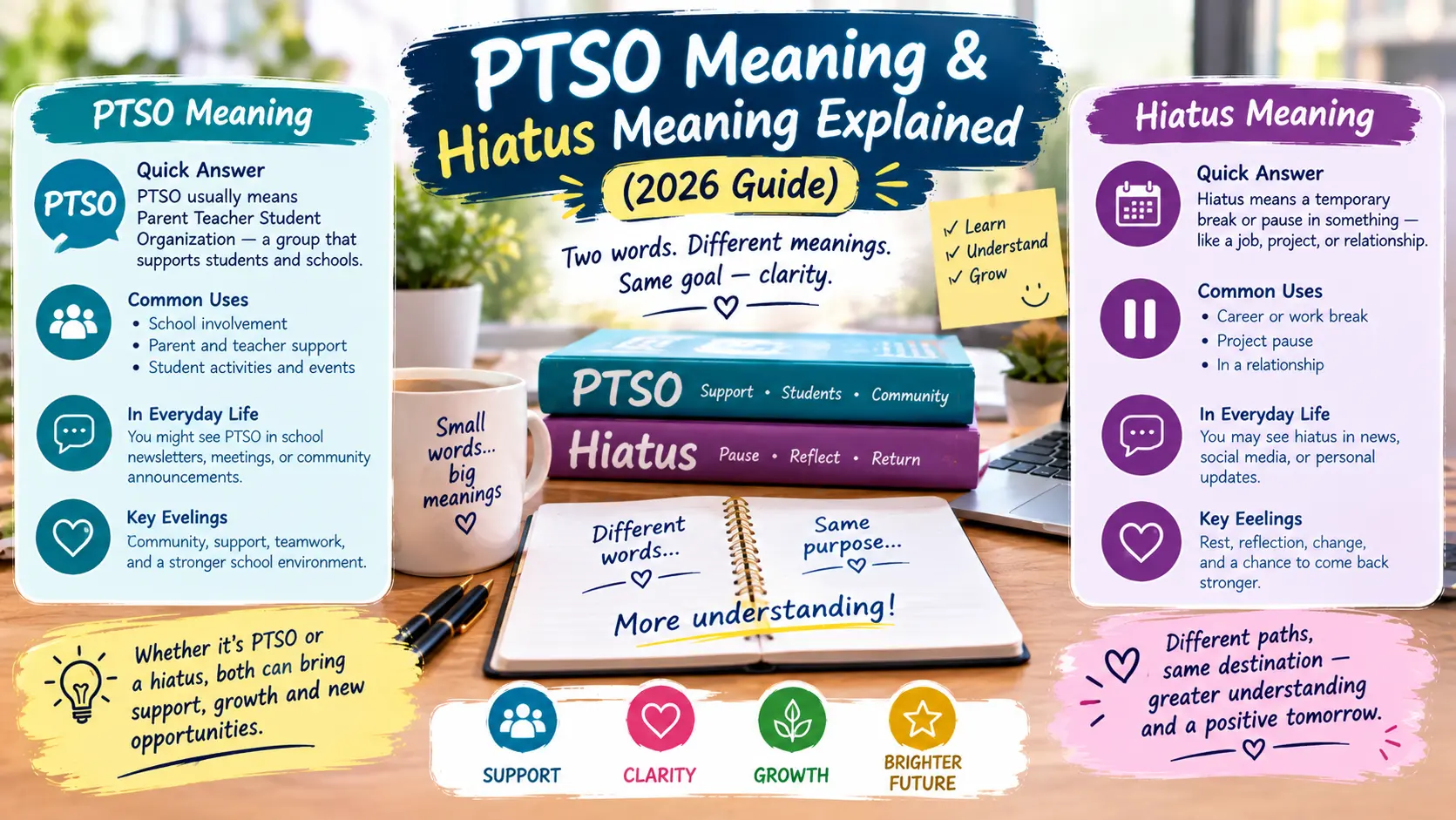
PTSO can have different meanings depending on the context. In modern online slang, PTSO is commonly used to mean “Put That Shit On,” an informal compliment about someone’s outfit, fashion, or appearance. In school settings, PTSO can also refer to a Parent-Teacher-Student Organization.
Hiatus is a standard English word meaning a temporary break, pause, or interruption. It is often used when someone temporarily stops working, posting content, producing a show, studying, or pursuing a project.
PTSO and hiatus are not interchangeable. PTSO is an abbreviation with context-dependent meanings, while hiatus describes a period of interruption.
TL;DR
- PTSO can mean “Put That Sh*t On” in online slang.
- PTSO can also mean Parent-Teacher-Student Organization in educational settings.
- Hiatus means a temporary break or interruption.
- PTSO is generally informal, while hiatus is a standard English term.
- Context is essential when understanding PTSO.
- A hiatus usually suggests a pause rather than an immediate permanent ending.
- The word hiatus can be used for work, school, entertainment, creative projects, and social media.
What Does PTSO Mean in 2026?
The Most Common Meaning of PTSO
In contemporary internet slang, PTSO is commonly understood as “Put That Sh*t On.” It is usually used as a compliment when someone looks particularly stylish or has put together an impressive outfit.
For example, a person might upload a photograph wearing a fashionable outfit and receive the comment “PTSO 🔥.” In this situation, PTSO expresses strong approval of the person’s appearance or fashion choices.
The expression is informal and belongs primarily to casual digital communication. It may appear in comments, text messages, captions, group chats, and social-media conversations.
PTSO can also have a completely different meaning in education. Some schools use PTSO as an abbreviation for Parent-Teacher-Student Organization, a group designed to encourage cooperation between families, educators, and students.
How PTSO Is Used in Texts and Online Conversations
The slang form of PTSO is most likely to appear when people are discussing fashion, clothing, shoes, styling, selfies, or appearance.
Examples include:
- “PTSO 🔥”
- “You really PTSO with that outfit.”
- “That fit is crazy. PTSO!”
- “She knows how to PTSO.”
- “PTSO with those new shoes.”
The expression normally has a positive and enthusiastic tone.
However, PTSO should not automatically be interpreted as internet slang. If the conversation involves a school, teachers, parents, students, meetings, or fundraising, the educational meaning is much more likely.
Examples of PTSO in Modern American English
The context can completely change the meaning.
Social media:
“PTSO 🔥” — an enthusiastic compliment about someone’s appearance.
Group chat:
“PTSO with that fit!” — praise for someone’s outfit.
School announcement:
“The PTSO meeting begins at 6 p.m.” — likely referring to a Parent-Teacher-Student Organization.
School event:
“PTSO volunteers are needed for Saturday’s event.” — referring to the school organization.
This is why context matters when interpreting abbreviations.
What Does “Hiatus” Mean?
Simple Definition of Hiatus
Hiatus means a break, pause, or interruption in something that has been ongoing.
For example:
- “The television show is on hiatus.”
- “She took a career hiatus.”
- “The podcast is currently on hiatus.”
- “The project went on hiatus.”
- “He took a short hiatus from social media.”
The word often suggests that the activity has temporarily stopped rather than definitively ended.
What a Hiatus Usually Implies
A hiatus generally communicates that something is paused for a period of time.
A person might take a hiatus from work to focus on another goal. A musician might take a hiatus from performing. A content creator might temporarily stop posting.
Importantly, hiatus does not guarantee a return. Something can remain on hiatus for an unknown period, or it can eventually end altogether.
Therefore, hiatus should be understood as describing a pause or interruption, not necessarily a promise of a comeback.
Examples of Hiatus in Everyday Language
The word can appear in many situations.
Entertainment:
“The series is on hiatus until the next season.”
Career:
“She took a career hiatus to pursue further education.”
Education:
“He took a semester hiatus from his studies.”
Creative work:
“The author placed the project on hiatus.”
Social media:
“The creator announced a short hiatus from posting.”
Business:
“The development of the product went on hiatus.”
In all of these examples, hiatus describes an interruption in an activity that had previously been happening.
Where Did the Word “Hiatus” Come From?
Latin Origins and Original Meaning
The word hiatus comes from Latin and originally carried the idea of an opening, gap, or separation.
This basic concept eventually developed into the modern idea of a gap or interruption in something continuous.
The historical background also helps explain why hiatus can sound more formal than ordinary words such as break or pause.
How Hiatus Entered English
English adopted hiatus as a learned word, and its meaning developed around the concept of a gap or interruption.
Over time, it became useful not only for describing physical or linguistic gaps but also for describing periods when an activity temporarily stops.
Today, the word is familiar in entertainment, education, professional communication, literature, and online culture.
The Development of Its Modern Meaning
Modern English uses hiatus primarily in a figurative sense when discussing an interruption.
People may talk about:
- a career hiatus,
- a television hiatus,
- a writing hiatus,
- a social-media hiatus,
- a study hiatus,
- a podcast hiatus,
- a project hiatus.
Although the contexts vary, the central meaning remains the same: a period of interruption or pause.
See Also: Arrogant Definition & Meaning in Text Explained (2026)
Where Did PTSO Come From?
Abbreviations and Internet Language
The slang use of PTSO reflects the broader development of internet abbreviations and initialisms.
Online communication encourages people to shorten longer expressions. Text messages, comments, captions, and group conversations often favor compact language.
PTSO represents this tendency by reducing a longer phrase into four letters.
At the same time, the acronym can exist independently in educational settings, where it represents a school organization.
Why Acronyms Become Popular Online
Acronyms can make communication:
- faster,
- shorter,
- more casual,
- easier to repeat,
- more recognizable within a specific community.
Internet language changes quickly because expressions can spread through social platforms, messaging apps, videos, memes, and online communities.
Some abbreviations become widely recognized, while others remain limited to particular groups.
How Context Determines the Meaning of PTSO
The best way to determine what PTSO means is to examine the surrounding conversation.
If PTSO appears underneath an outfit photograph, the slang meaning is likely.
If PTSO appears in a school newsletter, meeting announcement, or parent communication, it probably refers to a Parent-Teacher-Student Organization.
The same four letters can therefore communicate completely different ideas.
PTSO vs. Hiatus: What Is the Difference?
Meaning and Purpose Compared
PTSO and hiatus are fundamentally different terms.
| Term | Meaning | Typical Context |
|---|---|---|
| PTSO | “Put That Sh*t On” | Internet slang and fashion |
| PTSO | Parent-Teacher-Student Organization | Schools |
| Hiatus | Temporary break or interruption | Work, entertainment, school, projects |
PTSO is an abbreviation, while hiatus is a standard English noun.
There is no direct synonym relationship between them.
Formal vs. Informal Usage
The slang form of PTSO is strongly informal. It is most appropriate in casual conversations where the audience understands the expression.
Hiatus is much more flexible. It can appear in casual conversation but also works in professional, academic, entertainment, and public announcements.
Compare:
Casual:
“I’m taking a break from posting.”
More formal:
“I’m taking a hiatus from posting.”
Both communicate a pause, but the second sounds more deliberate and formal.
When One Term Works Better Than the Other
Use PTSO when the context clearly calls for the abbreviation.
Use hiatus when describing a temporary interruption.
For example, saying “the podcast is on hiatus” makes sense because a podcast can temporarily stop publishing episodes.
Saying “the podcast is PTSO” would not communicate the same meaning.
Emotional Meaning and Tone
The Tone Behind PTSO
The slang meaning of PTSO generally has a positive, enthusiastic, and approving tone.
When used to compliment someone’s clothing or appearance, it can express admiration and excitement.
Because its common expansion contains profanity, it remains more suitable for casual environments than formal communication.
The Tone Behind Hiatus
Hiatus has a more neutral, thoughtful, or formal tone.
Depending on the situation, it may suggest:
- rest,
- transition,
- reflection,
- uncertainty,
- recovery,
- personal priorities,
- creative renewal.
The emotional meaning depends on why the person or organization has paused.
How These Terms Can Affect Interpretation
Word choice influences how a message feels.
PTSO slang can sound energetic and conversational.
Hiatus can sound intentional, structured, and formal.
Choosing between casual and formal language can therefore change how the audience interprets the message.
PTSO and Hiatus in Social Media and Pop Culture
Acronyms in Online Communication
Social media has helped create an environment where abbreviations can spread extremely quickly.
Users often prefer short expressions that are easy to type and understand within a particular community.
PTSO fits this pattern because its slang meaning can communicate strong approval in only a few characters.
Creators and Influencers Announcing a Hiatus
The word hiatus is especially common among content creators, musicians, writers, podcasters, streamers, and online personalities.
A creator may announce a hiatus because they want to:
- take a break,
- focus on another project,
- reduce their online workload,
- spend time away from social media,
- reconsider their content strategy,
- prepare for a future return.
Using the word hiatus gives an audience a clear explanation for a temporary reduction in activity.
How Digital Culture Changes Language
Digital culture has influenced both vocabulary and communication style.
Traditional words such as hiatus have gained new visibility through online creator culture, while informal abbreviations such as PTSO have developed within internet communities.
This demonstrates how modern language combines established vocabulary with rapidly changing digital expressions.
Hiatus in Work, School, and Everyday Life
Taking a Break From Work
A person may take a career hiatus for many different reasons.
They might want to travel, study, work on a personal project, care for family members, or reconsider their career direction.
The phrase itself does not indicate whether the break is positive or negative.
For example:
“After several years in the industry, she took a career hiatus.”
The sentence simply describes a period away from her career.
Academic or Career Hiatus
Students may use hiatus to describe a temporary interruption in their education.
Similarly, professionals may describe an extended period away from their careers as a hiatus.
The word emphasizes the gap between periods of participation.
Personal Projects and Online Activity
Hiatus can also describe hobbies and personal projects.
Examples include:
- “My blog is on hiatus.”
- “The podcast is taking a short hiatus.”
- “The art project has gone on hiatus.”
- “The account is on hiatus until next month.”
These uses are particularly useful online because audiences often want to understand why regular activity has stopped.
PTSO and Hiatus in Modern American English
How Americans Use Informal Abbreviations
American English contains many abbreviations, and digital communication has increased their visibility.
Text messages, comments, captions, and group chats frequently use shortened expressions.
PTSO demonstrates why context is important because an acronym may have different meanings in different communities.
Why “Hiatus” Sounds More Formal
Hiatus generally sounds more polished than everyday alternatives.
Compare:
- “I’m taking a break.”
- “I’m taking a hiatus.”
The first is natural and conversational. The second sounds more deliberate and formal.
Both can be correct depending on the situation.
Context, Audience, and Word Choice
Language should match the audience.
Using internet slang in a casual conversation can create a friendly and modern tone. Using standard vocabulary may be more appropriate for professional or educational communication.
When PTSO appears without explanation, context becomes especially important.
Common Misunderstandings and Misuse
When PTSO Is Unclear
The primary issue with PTSO is that different groups may understand the acronym differently.
Someone unfamiliar with online slang may not recognize “Put That Sh*t On.”
Likewise, someone familiar with internet slang may not immediately realize that PTSO refers to a school organization.
Looking at the topic of the conversation usually resolves the confusion.
When Hiatus Is Used Incorrectly
A common misunderstanding is believing that hiatus always means something will definitely return.
It does not.
A hiatus describes a pause, but it does not establish a guaranteed return date.
Another mistake is using hiatus for every short pause. In ordinary conversation, break or pause may sound more natural.
How to Understand the Intended Meaning From Context
When encountering an unfamiliar expression, consider:
- The platform where it appears
- The people involved in the conversation
- The subject being discussed
- The surrounding words
- Any images, emojis, or additional information
This is especially important with abbreviations such as PTSO.
How Language Around Breaks Has Changed Since 2020
The Rise of Flexible Work and Online Presence
Since 2020, conversations about flexible work, remote activity, career changes, personal boundaries, and digital lifestyles have become increasingly common.
People now frequently discuss taking breaks from work, stepping away from social media, changing careers, or temporarily reducing their online activity.
This has increased the usefulness of words that describe temporary interruptions.
Digital Breaks and Creator Hiatuses
Online creators often have audiences that expect frequent content.
When a creator needs time away, announcing a hiatus provides a simple way to explain the absence.
It also allows the creator to establish expectations without claiming that the account or project has permanently ended.
Why Temporary-Pause Language Is More Common
Modern communication often emphasizes transparency.
Instead of simply disappearing, people may explain that they are taking:
- a break,
- a pause,
- time off,
- leave,
- or a hiatus.
These expressions help communicate that a change in activity is intentional.
Related Words and Alternatives
Break, Pause, and Time Off
Break is the most natural choice for casual conversation.
Pause emphasizes temporarily stopping something.
Time off usually describes time away from work or regular responsibilities.
For everyday communication, these words may be easier to understand than hiatus.
Leave, Absence, and Intermission
Leave is frequently associated with employment or education.
Absence focuses on someone or something not being present.
Intermission commonly refers to a scheduled break during a performance or event.
Hiatus emphasizes an interruption in an ongoing activity.
When to Use Each Expression
Choose the word that fits the context:
- Break: casual conversation
- Pause: temporary stopping
- Time off: personal or professional rest
- Leave: work or education
- Intermission: performance or event
- Hiatus: formal or extended interruption
PTSO should be treated differently because it is an abbreviation whose meaning depends on context.
FAQs
What does PTSO mean?
In modern online slang, PTSO commonly means “Put That Sh*t On.” It is generally used as an enthusiastic compliment about someone’s outfit, fashion, or appearance. In school settings, PTSO can mean Parent-Teacher-Student Organization.
Is PTSO an official English word?
No. PTSO is an abbreviation or initialism, not a conventional English word. Its meaning depends on the context in which it is used.
What does hiatus mean in simple terms?
Hiatus means a temporary break or pause. It can describe a break from work, school, entertainment, social media, creative projects, or other ongoing activities.
Is a hiatus always temporary?
A hiatus generally suggests a temporary interruption, but it does not guarantee a return. Something can remain on hiatus indefinitely or eventually end.
Are PTSO and hiatus interchangeable?
No. PTSO and hiatus have completely different meanings. PTSO is a context-dependent abbreviation, while hiatus refers to a pause or interruption.
Why do creators announce a hiatus?
Creators announce a hiatus to explain that they are temporarily stepping away from their normal activities. It can help audiences understand why new content is not currently being released.
Can hiatus describe a break from work or school?
Yes. Hiatus can describe a temporary interruption in employment, education, creative work, personal projects, or other ongoing activities.
Does hiatus have a negative meaning?
No. Hiatus is generally neutral. The reason for the break determines whether the situation sounds positive, negative, or simply practical.
Conclusion
PTSO and hiatus represent two very different concepts in modern language. PTSO is an abbreviation that can have different meanings depending on context. In internet slang, it commonly expresses enthusiastic approval of someone’s style or appearance, while in education it can refer to a Parent-Teacher-Student Organization.
Hiatus means a break, pause, or interruption and is widely used when discussing entertainment, careers, education, creative projects, social media, and everyday activities.
The easiest distinction is to remember that PTSO is a context-dependent abbreviation, while hiatus describes a period of interruption. Understanding the surrounding conversation is the most reliable way to interpret both terms correctly.