Lotus Symbolism: Meaning, Spirituality & Cultural Roots
Quick Answer: What Does the Lotus Symbolize?
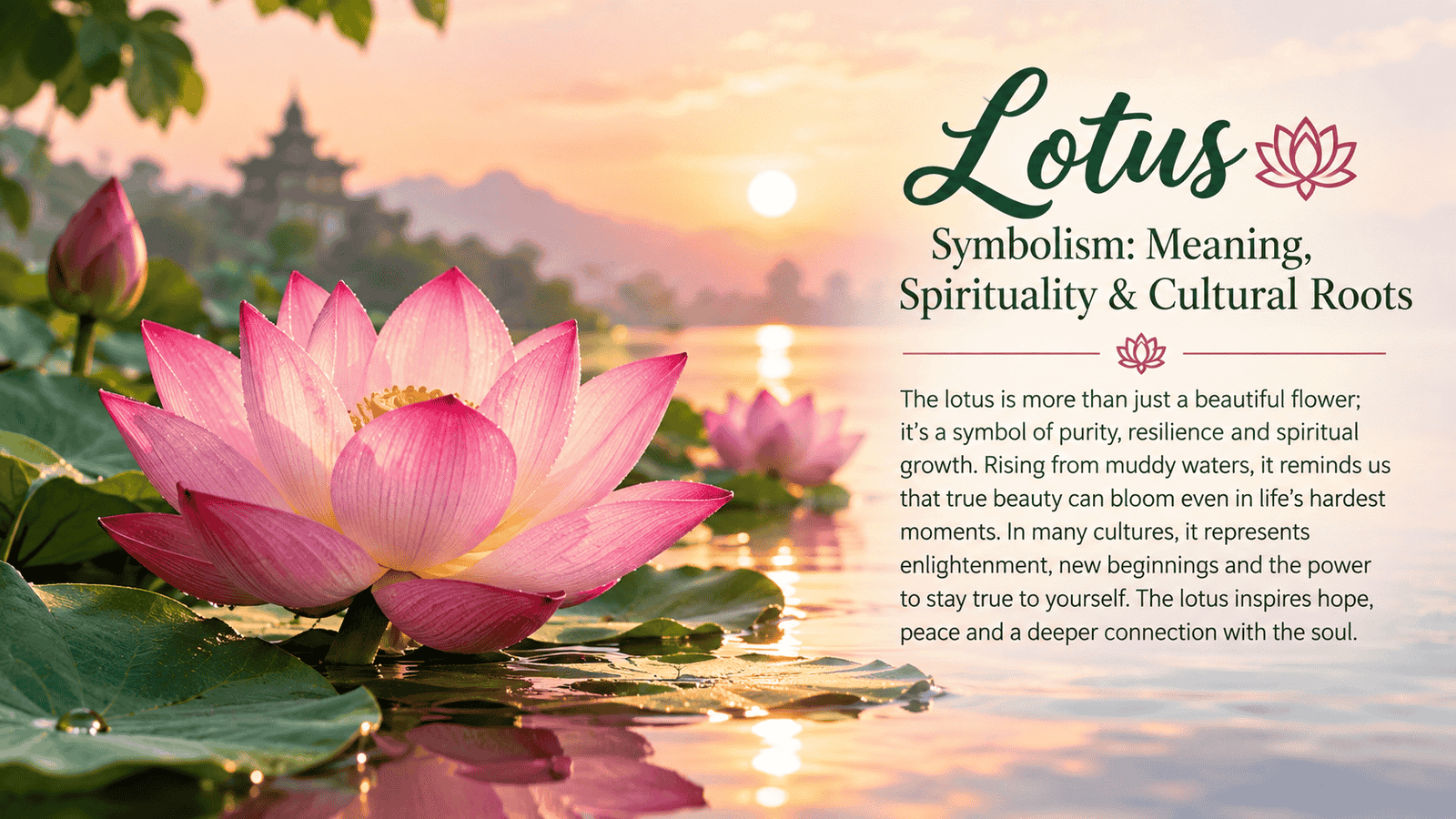
Lotus symbolism is commonly associated with purity, spiritual awakening, resilience, transformation, renewal, and inner growth. The flower is especially meaningful because it grows in muddy water while producing an elegant bloom above the surface. This natural contrast has inspired religious, philosophical, artistic, and cultural interpretations for centuries.
In Buddhism, the lotus is strongly connected with enlightenment and the journey toward awakening. In Hinduism, it is associated with purity, divinity, creation, prosperity, and spiritual consciousness. Chinese and Japanese traditions also give the flower important symbolic roles, although specific meanings can differ by context.
At a personal level, a lotus can represent rising above difficult circumstances, beginning again, protecting inner peace, or developing into a stronger version of yourself.
TL;DR: Lotus Symbolism at a Glance
- Purity: Remaining symbolically clean despite growing from muddy surroundings.
- Spiritual awakening: Moving from darkness or ignorance toward greater awareness.
- Resilience: Growing through challenging conditions.
- Transformation: Representing personal, emotional, and spiritual development.
- Renewal: Symbolizing fresh beginnings and another stage of life.
- Love: Often connected with devotion, beauty, affection, and emotional growth.
- Buddhism: Associated with enlightenment, awakening, and spiritual development.
- Hinduism: Connected with divinity, creation, prosperity, and purity.
- China: Often associated with purity, virtue, beauty, and harmony.
- Japan: Closely connected with Buddhist imagery, contemplation, and purity.
- India: Deeply rooted in religious imagery, literature, art, and cultural traditions.
Lotus Symbolism Meaning
The lotus is one of the world’s most recognizable symbolic flowers because its physical characteristics naturally invite metaphor. Its roots remain in muddy water while its stem rises upward and its flower opens above the surface. For many traditions, this creates an image of growth without being defined by one’s difficult surroundings.
The flower can therefore represent a person who experiences challenges but continues developing. The lotus does not symbolize only struggle; its open bloom also suggests what can emerge after that struggle: clarity, beauty, wisdom, peace, and transformation.
Purity and Spiritual Cleansing
Purity is one of the most enduring meanings associated with the lotus. Although the plant grows in muddy environments, the visible flower appears clean and beautiful. This contrast has made it a powerful metaphor for maintaining one’s inner values despite external difficulties.
Spiritually, lotus imagery can suggest cleansing the mind of confusion, resentment, fear, or harmful attachments. It does not necessarily mean avoiding life’s problems. Instead, it can represent moving through them without allowing them to completely determine one’s character.
Spiritual Awakening and Enlightenment
The lotus is frequently used to represent spiritual awakening. Its upward growth can be interpreted as movement from darkness toward light and from limited awareness toward deeper understanding.
In Buddhist and Hindu contexts, this symbolism can become particularly significant. The opening flower may represent consciousness unfolding, while its petals can suggest different stages or dimensions of spiritual development.
Rebirth and Renewal
A lotus can symbolize rebirth, renewal, and a fresh beginning. Its emergence and blooming make it a natural image for change after a difficult period.
For someone beginning a new chapter, lotus symbolism can serve as a reminder that an ending does not necessarily represent permanent loss. It can instead become part of a larger process of growth and renewal.
Resilience and Inner Strength
The lotus also represents resilience. Its environment is not ideal, yet the plant continues to grow toward the surface.
This makes the flower meaningful to people who have experienced obstacles, disappointment, major life changes, or periods of uncertainty. A lotus image can become a visual reminder that difficult circumstances do not automatically prevent growth.
Beauty Rising From Darkness
One of the strongest ideas behind lotus symbolism is beauty emerging from darkness. The muddy water represents difficult or uncertain conditions, while the flower represents what becomes visible after growth.
This does not mean hardship is inherently good. Rather, the lotus offers a symbolic way of thinking about how people can develop wisdom, strength, compassion, or renewed purpose after challenging experiences.
Lotus Symbolism in Buddhism
The lotus holds a major place in Buddhist symbolism. It is commonly connected with purity, spiritual development, awakening, and enlightenment.
The central metaphor is especially powerful: the lotus grows from mud but rises above the water and opens toward the light. This can represent the human spiritual journey—moving through suffering, confusion, and attachment toward greater awareness.
The Lotus and Enlightenment
In Buddhist thought and imagery, the lotus can represent enlightenment because the flower’s development provides a visual metaphor for spiritual awakening.
A closed bud may suggest potential, while an opening or fully opened flower can represent the unfolding of understanding. The symbolism emphasizes development rather than instant transformation.
Mud, Water, and the Spiritual Journey
The lotus’s journey from mud to water to open air is frequently interpreted symbolically.
The mud can represent difficult worldly conditions. The water can suggest the process of development and experience. The flower above the water can represent awakening without being completely separated from the world.
This makes the lotus a particularly effective image for the idea that spiritual growth can happen while a person is still living an ordinary human life.
Lotus Petals and Stages of Awakening
Lotus petals frequently appear in Buddhist art and religious imagery. Their layered structure naturally lends itself to ideas about gradual spiritual unfolding.
The exact interpretation varies across Buddhist traditions and artistic contexts, so lotus petals should not automatically be assigned one fixed meaning. Nevertheless, the opening flower commonly provides imagery for growth, awareness, and awakening.
Lotus Symbolism in Buddhist Art
Lotus flowers appear extensively in Buddhist visual traditions. They can be seen in representations of Buddhas and bodhisattvas, temple decoration, paintings, sculpture, and sacred designs.
A lotus pedestal, for example, can elevate a sacred figure symbolically above ordinary ground. The flower therefore becomes part of a broader visual language of purity and transcendence.
Different Lotus Colors in Buddhism
Different lotus colors can carry different associations depending on Buddhist tradition and artistic context.
- White lotus: Purity, clarity, and spiritual development.
- Pink lotus: Often associated with sacredness and the Buddha in some Buddhist traditions.
- Red lotus: Love, compassion, and the heart.
- Blue lotus: Wisdom and knowledge.
- Purple lotus: Spiritual or mystical dimensions in some symbolic systems.
These meanings should be understood as traditional associations rather than universal rules.
Lotus Symbolism in Hinduism
Lotus symbolism is deeply embedded in Hindu religious imagery. The flower appears in associations with divinity, purity, creation, beauty, prosperity, and spiritual consciousness.
Its importance comes partly from the flower’s natural characteristics. The lotus rises above muddy water while retaining its beauty, making it an effective representation of spiritual purity within the material world.
Lotus as a Symbol of Purity
In Hindu traditions, the lotus can represent purity and spiritual elevation. Its physical separation from the mud once it blooms creates a powerful visual distinction between worldly conditions and spiritual ideals.
The flower therefore appears frequently in religious imagery where purity, beauty, and sacred presence are emphasized.
Lakshmi and the Lotus
The lotus is strongly associated with Lakshmi, a major Hindu goddess connected with prosperity, abundance, beauty, and auspiciousness.
Lakshmi is often depicted standing or seated on a lotus. Lotus flowers can also appear in her hands or around her imagery. In this context, the flower contributes to themes of beauty, abundance, purity, and divine grace.
Brahma and the Lotus
The lotus also appears in creation symbolism connected with Brahma. Hindu traditions contain imagery in which Brahma is associated with a lotus emerging from Vishnu.
This gives the lotus an important connection with creation and cosmic order. Its unfolding form can also evoke the emergence of existence from a deeper spiritual source.
Vishnu and Lotus Imagery
Vishnu is frequently represented with lotus imagery, including the lotus as one of his traditional attributes.
Within this religious context, the lotus can contribute to themes of divine order, beauty, preservation, and sacred consciousness. Its presence demonstrates how one flower can carry multiple related meanings within the same religious tradition.
Lotus and the Chakras
Lotus imagery is also prominent in representations of the chakras. Chakras are frequently depicted using lotus-like forms with different numbers of petals.
The petals provide a visual language for spiritual centers and stages of consciousness. Interpretations differ among Hindu and yogic traditions, so chakra lotus imagery is best understood within the specific system in which it appears.
Lotus Symbolism Japan
In Japan, the lotus is strongly connected with Buddhist traditions, purity, contemplation, and spiritual awakening. Lotus flowers are especially recognizable in temple landscapes, religious artwork, and summer ponds.
Japanese lotus symbolism reflects both the flower’s beauty and its religious associations. Its ability to rise from muddy water makes it an enduring image of purity emerging from ordinary worldly conditions.
Buddhist Roots of Lotus Symbolism in Japan
Buddhism played a major role in establishing the lotus as an important religious symbol in Japan.
The flower appears in Buddhist statues, paintings, temple decoration, and other forms of religious art. Its association with enlightenment makes it particularly suitable for sacred visual environments.
Lotus Flowers in Japanese Temples
Lotus ponds can be found around some Japanese temples and gardens, particularly where Buddhist traditions and seasonal appreciation of nature intersect.
The flowering season can turn the lotus into both a spiritual and aesthetic experience. Visitors may appreciate the flower’s beauty while also recognizing its religious symbolism.
Lotus Symbolism and Purity
The lotus’s ability to grow from mud while producing a clean flower gives it a natural connection with purity.
In Japanese Buddhist imagery, this symbolism can suggest remaining spiritually centered even while living within the complexities of ordinary life.
Lotus in Japanese Art and Literature
Lotus imagery has appeared in Japanese visual and literary traditions, particularly through Buddhist influence and the broader appreciation of seasonal nature.
The flower can be presented as elegant, fleeting, contemplative, or spiritually meaningful. Its symbolism can therefore combine natural beauty with philosophical reflection.
Lotus Symbolism in Modern Japan
Today, lotus imagery can appear beyond strictly religious contexts. It may be used in gardens, decorative art, photography, tattoos, fashion, and contemporary design.
Modern interpretations can be personal rather than explicitly religious, with people using the lotus to communicate ideas such as peace, renewal, resilience, and beauty.
Lotus Symbolism in China
The lotus has a long and important history in Chinese culture. It is commonly associated with purity, virtue, beauty, harmony, and moral character.
Its symbolic power partly comes from its natural form: the flower emerges from muddy water but remains visually elegant. This has encouraged interpretations involving integrity and maintaining one’s character despite difficult surroundings.
Lotus as a Symbol of Purity
The lotus can symbolize a person who maintains moral or spiritual purity despite being surrounded by challenging circumstances.
This interpretation has been especially influential in Chinese art and literature, where the flower can become a metaphor for honorable character.
Lotus Symbolism and Harmony
The lotus may also be associated with harmony, balance, and peacefulness.
Its graceful appearance and connection with water make it a natural decorative and poetic image for calmness and balanced living. However, specific symbolic meanings depend on the historical or cultural context.
Lotus in Chinese Art
Lotus imagery appears in Chinese painting, ceramics, textiles, gardens, decorative objects, and other artistic forms.
Artists can use the flower to express beauty and natural elegance while also incorporating deeper themes of virtue, spirituality, or harmony.
Lotus and Buddhist Influence
Buddhism had an important influence on lotus symbolism in China. Buddhist imagery frequently uses the lotus to represent purity and enlightenment.
Over time, Buddhist meanings interacted with Chinese literary, artistic, and philosophical traditions, producing a rich symbolic vocabulary around the flower.
Lotus Symbolism Chinese
When searching specifically for lotus symbolism Chinese, it is useful to recognize that the subject covers both religious symbolism and broader Chinese cultural traditions.
The lotus can represent purity, virtue, beauty, harmony, and refinement, while Buddhist contexts may emphasize enlightenment and spiritual development.
The Meaning of the Lotus in Chinese Tradition
The lotus is often admired for growing from mud while producing a beautiful flower. This physical characteristic supports interpretations involving purity in an imperfect world.
The flower can therefore represent someone who maintains dignity and integrity despite challenging surroundings.
Lotus and Moral Character
One particularly important symbolic idea is the relationship between the lotus and moral character.
The flower’s separation from the muddy environment has made it a useful metaphor for maintaining one’s values without allowing external circumstances to completely change one’s character.
Lotus in Chinese Poetry
The lotus has been an important image in Chinese poetry and literary expression.
Writers can use the flower to discuss beauty, virtue, solitude, integrity, nature, and spiritual ideals. Its symbolism is especially effective because the flower can be appreciated both literally and metaphorically.
Lotus Symbolism in Chinese Names and Expressions
Lotus imagery also appears in Chinese names, expressions, artwork, and decorative symbolism.
However, meanings should not be treated as identical in every name or expression. Language, historical period, literary context, and personal intention can all affect interpretation.
Lotus Symbolism in Chinese Culture
Lotus symbolism in Chinese culture extends beyond religion. The flower appears in artistic, literary, decorative, and everyday cultural contexts.
It can communicate ideas of beauty, purity, virtue, harmony, and refinement, making it one of the most recognizable flowers in traditional Chinese visual culture.
Lotus and Purity
The lotus is frequently admired as an image of purity because it grows from muddy water without appearing contaminated by it.
This creates an enduring metaphor for maintaining integrity and inner cleanliness while participating in ordinary society.
Lotus and Beauty
The lotus is also a symbol of natural beauty.
Its symmetrical petals, large leaves, and association with ponds have made it an important subject for artists and designers. Its beauty can carry both aesthetic and moral symbolism.
Lotus and Family or Social Harmony
In certain Chinese symbolic contexts, lotus imagery can be connected with harmony and positive relationships.
The exact meaning depends on accompanying imagery, words, colors, and cultural setting, so it is better to view harmony as one established association rather than the flower’s only meaning.
Lotus in Festivals and Decorations
Lotus imagery appears in decorative objects, paintings, gardens, textiles, ceramics, and seasonal cultural displays.
The flower can be selected because of its beauty as well as its traditional associations with purity and virtue.
Lotus in Traditional Chinese Medicine and Food Culture
The lotus plant has practical importance as well as symbolic significance. Different parts of the plant, including lotus root and lotus seeds, have culinary and traditional medicinal uses.
These practical uses should be distinguished from symbolism. A lotus appearing in food or medicine does not automatically carry the same religious or cultural meaning as a lotus used in sacred artwork.
Lotus Symbolism in Love
The lotus can have a beautiful meaning in relationships because its growth provides a metaphor for love that develops, survives challenges, and becomes deeper over time.
Its association with purity and beauty can also make it suitable for expressing sincere affection, devotion, and emotional renewal.
Lotus as a Symbol of Pure Love
A lotus can represent pure and sincere love.
Its clean bloom emerging from muddy surroundings provides a metaphor for affection that remains meaningful even when relationships encounter difficulties.
Lotus and Devotion
The flower can also represent devotion and dedication.
Because lotus symbolism is strongly connected with religious traditions, it can communicate a form of love that goes beyond attraction and includes respect, commitment, patience, and spiritual connection.
Lotus and Relationship Growth
A relationship can be compared symbolically to a lotus because both can develop gradually.
The lotus begins below the surface before becoming visible as a flower. Similarly, meaningful relationships can grow through trust, shared experiences, patience, and mutual understanding.
Lotus After Heartbreak
For someone recovering from heartbreak, the lotus can symbolize healing and a new beginning.
Rather than representing the pain itself, the flower can serve as a reminder that emotional difficulty does not have to prevent future growth.
Lotus Colors and Love
Color can add another layer of meaning:
- Red lotus: Often associated with love, passion, and compassion.
- Pink lotus: Can suggest affection, tenderness, and sacred beauty.
- White lotus: Often associated with purity and sincere intentions.
- Blue lotus: Can suggest wisdom, understanding, and emotional depth.
These interpretations vary among cultures and symbolic systems.
Lotus Symbolism India
India has one of the richest cultural contexts for lotus symbolism. The flower appears throughout religious art, mythology, architecture, literature, philosophy, and traditional design.
The lotus is particularly prominent in Hindu imagery, where it can represent purity, divinity, creation, prosperity, and spiritual consciousness.
Ancient Indian Roots of Lotus Symbolism
Lotus imagery has deep historical roots in the Indian subcontinent.
Its presence in religious and artistic traditions demonstrates how natural elements can become vehicles for philosophical and spiritual ideas. The lotus’s connection with water and its distinctive blooming pattern make it especially suitable for symbolic interpretation.
Lotus in Hindu Religious Imagery
Hindu religious imagery frequently uses the lotus in representations of deities and sacred concepts.
It can symbolize purity, divine beauty, prosperity, creation, and transcendence. The flower can also represent the unfolding of spiritual consciousness.
Lotus in Indian Art and Architecture
Lotus motifs appear in Indian sculpture, temple architecture, paintings, textiles, jewelry, and decorative arts.
Architectural lotus forms can be used to represent beauty and sacredness. The motif remains recognizable in both traditional and modern Indian design.
Lotus in Indian Literature and Poetry
Indian literature and poetry have frequently drawn upon lotus imagery to express beauty, spiritual development, divine qualities, and emotional refinement.
The flower can be used as a comparison for eyes, faces, divine forms, or states of consciousness, depending on the literary context.
Lotus as a Modern Indian Symbol
The lotus continues to have cultural visibility in contemporary India.
It appears in religious ceremonies, artwork, fashion, architecture, decorative design, and popular imagery. Its modern meanings can combine traditional religious symbolism with broader ideas of beauty, renewal, identity, and resilience.
Lotus Symbolism Across Cultures
Although the lotus appears in many cultures, its meaning is not identical everywhere.
Buddhism
Enlightenment, purity, awakening, spiritual development, and transcendence are among its most important associations.
Hinduism
The lotus is connected with divinity, purity, creation, prosperity, beauty, and spiritual consciousness.
China
Chinese traditions commonly associate lotus imagery with purity, virtue, beauty, harmony, and moral integrity, with Buddhist symbolism adding further meanings.
Japan
The lotus is strongly connected with Buddhism, purity, contemplation, spiritual awakening, and sacred beauty.
India
In the Indian context, the lotus is deeply associated with Hindu religious imagery, divinity, creation, prosperity, purity, and spiritual growth.
Lotus Symbolism by Color
Color can change how lotus imagery is interpreted, although meanings are not universal.
White Lotus Symbolism
The white lotus commonly represents purity, peace, clarity, innocence, and spiritual development.
Its clean appearance makes it especially suitable for symbolic themes involving purification and peaceful awareness.
Pink Lotus Symbolism
The pink lotus can carry strong sacred associations in Buddhist and Hindu contexts.
It may symbolize spiritual beauty, devotion, compassion, and sacredness. In some Buddhist traditions, the pink lotus has a particularly important relationship with the Buddha.
Red Lotus Symbolism
The red lotus is commonly associated with love, compassion, passion, and the heart.
In personal symbolism, it can represent strong affection or emotional openness. Its meaning may change according to the religious or artistic context.
Blue Lotus Symbolism
The blue lotus can represent wisdom, knowledge, understanding, and self-mastery.
Its symbolism often emphasizes the mind and spiritual insight rather than romantic love.
Purple Lotus Symbolism
The purple lotus is sometimes connected with mystery, spirituality, transformation, and higher consciousness.
Its interpretation varies considerably across traditions, making the surrounding imagery important when determining its intended meaning.
Lotus Symbolism in Spirituality
The lotus has become a popular spiritual symbol because its natural growth provides a simple visual representation of transformation.
Rather than suggesting that a person must escape difficult circumstances, lotus symbolism can communicate the idea of growing through life while developing greater inner awareness.
Lotus as a Sign of Transformation
The lotus can represent a major transformation from one stage of life to another.
A closed bud becoming an open flower provides a natural image of potential becoming visible, making it especially meaningful for people experiencing personal development.
Lotus and Inner Peace
Lotus imagery is often used to communicate calmness and inner peace.
Its connection with still water, meditation, and spiritual traditions makes it a popular visual reminder to slow down, reflect, and maintain balance.
Lotus and Overcoming Challenges
The flower’s growth through muddy water makes it an enduring symbol of overcoming difficult conditions.
Its message can be summarized simply: your surroundings may influence your journey, but they do not necessarily determine what you can become.
Lotus and Personal Growth
A lotus can serve as a personal symbol for learning, healing, emotional maturity, and spiritual development.
For some people, it represents a particular transformation; for others, it simply serves as a reminder to keep growing even when progress is difficult to see.
Lotus Symbolism in Dreams
Dream symbolism is highly personal. A lotus appearing in a dream can have different meanings depending on the dreamer’s emotions, memories, cultural background, and circumstances.
Seeing a Lotus in a Dream
Seeing a lotus may suggest themes of growth, peace, renewal, beauty, or spiritual reflection.
If the dream feels peaceful, the flower may function as an image of emotional calm. If the dream involves difficult water or damaged flowers, the surrounding details may be more important than the lotus itself.
White Lotus Dream Meaning
A white lotus in a dream may symbolize peace, clarity, purity, or emotional cleansing.
For someone entering a new stage of life, it could personally represent the desire for a clean beginning or greater inner calm.
Pink or Red Lotus Dream Meaning
A pink or red lotus may bring themes of love, affection, compassion, passion, or emotional connection into the dream.
The meaning depends heavily on the people, setting, and feelings present in the dream.
Lotus Blooming in a Dream
A blooming lotus can symbolize development and a new stage of personal growth.
It may be especially meaningful when someone has recently completed a difficult period or is beginning to recognize changes within themselves.
Lotus in Muddy Water
A lotus surrounded by muddy water can create one of the strongest symbolic images.
It may represent resilience, hope, and growth during challenging circumstances. The dream may also simply reflect memories or associations the dreamer already has with lotus imagery.
Lotus Symbolism in Tattoos
Lotus tattoos are popular because the flower combines an attractive visual form with several layers of symbolism.
A lotus tattoo can represent transformation, resilience, spiritual growth, healing, love, or renewal.
Lotus Tattoo Meaning
For many people, a lotus tattoo marks a significant period of change.
It may commemorate overcoming a challenge, starting over, developing greater self-awareness, or choosing to continue growing despite difficult experiences.
Lotus and Mandala Tattoos
Lotus flowers and mandala-inspired patterns complement one another visually because both use symmetrical, radial forms.
Together, they can communicate themes of balance, meditation, spirituality, and inner harmony.
Lotus With a Quote
Adding words can make a lotus tattoo more personal.
A short phrase may identify the particular lesson, person, experience, or belief represented by the flower.
Lotus and Water Tattoos
Combining a lotus with water can emphasize the flower’s natural environment.
The water may represent emotion, change, movement, or life experience, while the flower represents growth and renewal.
Lotus Tattoo Colors
Color can personalize the symbolism:
- White: Purity and peace
- Pink: Devotion and spiritual beauty
- Red: Love and passion
- Blue: Wisdom and understanding
- Purple: Spirituality and mystery
These are symbolic associations rather than fixed definitions.
Lotus Symbolism in Art and Literature
The lotus has remained powerful in art and literature because it can communicate several ideas simultaneously.
It can be a literal flower, a symbol of spiritual development, a metaphor for beauty, or an image of a person maintaining integrity in difficult circumstances.
Lotus as a Literary Metaphor
Writers can use the lotus to represent transformation, purity, resilience, beauty, or awakening.
The contrast between muddy roots and an elegant flower gives writers a particularly strong metaphor for human development.
Lotus in Religious Art
Buddhist and Hindu art use lotus imagery extensively.
The flower can support religious themes involving sacredness, purity, enlightenment, divine beauty, and spiritual consciousness.
Lotus in Poetry
Poetry often benefits from the lotus’s combination of visual beauty and symbolic depth.
A poet can describe the flower literally while simultaneously exploring human resilience, emotional transformation, love, solitude, or spiritual growth.
Lotus in Contemporary Art
Modern artists continue to reinterpret the lotus through painting, photography, illustration, fashion, jewelry, tattoos, and digital design.
Contemporary uses may preserve traditional symbolism or create entirely personal meanings around healing, identity, growth, and renewal.
Why Is the Lotus Such a Powerful Symbol?
The lotus has survived across different cultural traditions because its physical characteristics provide an unusually effective metaphor.
It combines mud and beauty, darkness and light, roots and elevation, struggle and blooming in one natural image.
It Grows Through Difficult Conditions
The lotus’s environment makes it an especially powerful symbol of resilience.
Its story is not about pretending that difficult conditions do not exist. Instead, it represents the possibility of continuing to develop despite those conditions.
It Represents a Journey
A lotus can symbolize a process rather than a destination.
From its hidden roots to its emergence through water and eventual bloom, the plant provides a visual metaphor for gradual growth and transformation.
It Connects Nature With Spirituality
Many religious and philosophical traditions use nature to express ideas that can be difficult to describe directly.
The lotus provides a tangible image for abstract concepts such as enlightenment, purity, consciousness, renewal, and transcendence.
Its Meaning Can Be Personal
The lotus does not have to represent the same thing to everyone.
One person may associate it with faith, another with healing, another with love, and another with simply having the strength to begin again. Personal experience can become an important part of symbolic meaning.
Frequently Asked Questions About Lotus Symbolism
What is the main symbolism of a lotus?
The lotus commonly symbolizes purity, resilience, spiritual awakening, transformation, and renewal. Its growth from muddy water makes it a powerful metaphor for developing beauty and strength despite difficult circumstances.
What does the lotus symbolize in Buddhism?
In Buddhism, the lotus is strongly associated with enlightenment, purity, awakening, and spiritual development. Its journey from mud to an open flower can represent the movement from suffering and ignorance toward greater awareness.
What does the lotus symbolize in Hinduism?
The lotus is associated with purity, divinity, creation, prosperity, beauty, and spiritual consciousness. It appears prominently in Hindu imagery involving deities such as Lakshmi and Brahma.
What does a lotus symbolize in Chinese culture?
The lotus commonly represents purity, virtue, beauty, harmony, and moral integrity in Chinese cultural traditions. Buddhist symbolism also contributes important associations with spiritual purity and enlightenment.
What does the lotus symbolize in Japan?
In Japan, the lotus is particularly connected with Buddhism, purity, contemplation, spiritual awakening, and sacred beauty. It appears in religious art, temples, gardens, and other cultural settings.
What does a lotus symbolize in love?
A lotus can symbolize pure love, devotion, emotional growth, healing, and renewal. Its ability to bloom after growing through muddy water makes it a meaningful metaphor for relationships that develop through challenges.
What does a white lotus symbolize?
A white lotus commonly represents purity, peace, clarity, innocence, and spiritual growth. Its color can make it especially suitable for themes involving cleansing, calmness, and renewal.
What does a red lotus symbolize?
A red lotus is commonly associated with love, passion, compassion, and emotional intensity. In romantic contexts, it can represent strong affection and heartfelt connection.
What does a lotus tattoo symbolize?
A lotus tattoo commonly represents transformation, resilience, spiritual growth, healing, and renewal. Many people choose the design to mark a significant personal change or a difficult experience they have moved through.
Is the lotus a symbol of rebirth?
Yes. Rebirth and renewal are common lotus interpretations, particularly because the flower’s growth and blooming provide a natural metaphor for beginning again and moving into a new stage of life.
Why is the lotus associated with enlightenment?
The lotus is associated with enlightenment because its growth from muddy water to an open flower creates a metaphor for moving from darkness, confusion, or ignorance toward awareness and spiritual understanding.
Final Thoughts on Lotus Symbolism
Lotus symbolism brings together purity, resilience, transformation, love, renewal, and spiritual awakening in one powerful natural image. Its meaning has developed across religious and cultural traditions, with especially important roles in Buddhism, Hinduism, China, Japan, and India.
The flower’s most memorable symbolic lesson comes from its natural growth: the lotus rises from muddy surroundings without allowing those surroundings to define its final form. That image can represent spiritual awakening, emotional healing, personal development, or simply the courage to begin again.
Whether it appears in religious art, a dream, a tattoo, poetry, a garden, or personal decoration, the lotus can serve as a reminder that growth may begin in difficult places, while the direction of that growth can still lead toward beauty, wisdom, and renewal.