Goat With Horns: Meaning, Facts, and Symbolism
Quick Answer
A goat with horns is a normal example of natural goat anatomy. Many goat breeds develop horns in both males and females, although horn size, shape, and direction vary according to genetics, breed, age, and sex. Goat horns are permanent structures that can help with defense, competition, social communication, and establishing boundaries.
Beyond biology, horned goats have acquired symbolic meanings in different cultures. They may represent strength, independence, resilience, protection, determination, and natural instinct. However, these meanings are not universal. A goat with horns can have very different significance depending on whether it appears in mythology, religion, art, dreams, farming traditions, or modern culture.
TL;DR
- Goats with horns are completely natural and occur in many breeds.
- Both male and female goats can grow horns.
- Horns are useful for defense, competition, communication, and social behavior.
- Some goats are naturally polled, meaning they are born without horns.
- Other goats may have their horn buds removed when young through disbudding.
- Horn shape and size differ considerably between breeds.
- In symbolism, goat horns are commonly associated with strength, protection, courage, independence, and determination.
- Biblical and mythological interpretations of goats vary considerably by tradition.
- Dreaming about a horned goat can be interpreted symbolically, but dream meanings are personal rather than scientifically established.
What Is a Goat With Horns?
A goat with horns is simply a goat that has naturally developed its horn structures. Horned goats can be found in numerous domestic breeds and in wild relatives. The presence of horns is primarily determined by genetics, although the final appearance of the horns is influenced by breed, age, sex, nutrition, and overall development.
Goat horns are not temporary structures. Unlike antlers, which are shed and regrown by many deer species, goat horns generally remain throughout the animal’s life. They consist of a bony core covered by a keratin sheath, creating the characteristic hard outer surface.
The appearance of horns can be dramatically different from one goat to another. Some goats have short, thick horns, while others develop long, curved, twisted, or backward-pointing horns. This variation is one reason horn shape can be useful when identifying particular breeds.
How Goat Horns Develop
Goat horn development begins when a kid is very young. Horn tissue develops from specialized areas of the skull called horn buds. In goats that are genetically horned, these buds develop into permanent horns as the animal grows.
The horns become larger and more defined as the goat matures. Their shape is strongly influenced by genetics, which means goats of the same breed often have recognizable horn characteristics.
Young horned goats should be handled carefully because their horn buds and developing horns can be sensitive. Proper livestock management is especially important when goats are kept around people or other animals.
What Goat Horns Are Made Of
A goat horn has a bony internal core connected to the skull and an outer layer made primarily of keratin. Keratin is the same general type of structural protein found in human fingernails and hair, although a goat horn is much more substantial.
The outer sheath protects the underlying structure and continues to grow throughout the goat’s life. This growth contributes to the distinctive curves and ridges visible on mature horns.
Why Some Goats Have Larger Horns Than Others
Horn size is influenced by several factors. Genetics and breed are among the most important, which is why a mature goat of one breed may have dramatically different horns from another.
Sex can also influence horn development in some breeds. Nutrition, age, and general health can affect overall growth as well. Therefore, horn size should not be used by itself to determine a goat’s age, temperament, or dominance.
Why Do Goats Have Horns?
Goat horns serve several practical purposes. They can provide physical protection, assist in competition with other goats, and play a role in communication.
Goats are social animals, and their interactions often involve body positioning, movement, vocalizations, scent, and physical displays. Horns can become part of these interactions, particularly when animals establish social relationships or compete over resources.
Protection From Predators
For wild goats and their relatives, horns can provide an important form of defense. A goat may use its horns when confronted by a predator or when attempting to protect itself.
Domestic goats generally face different conditions from wild animals, but the physical structure remains. A goat may use its horns defensively if it feels threatened, cornered, or handled improperly.
Competition Between Goats
Horns can also be involved in competition between goats. Animals may push, lock, or strike with their horns during disputes.
This behavior can occur when goats establish social hierarchy or compete for food, space, mates, or other resources. The intensity of such interactions varies between individuals and circumstances.
Establishing Social Hierarchy
Goats live within social groups where relationships develop over time. Physical characteristics, age, personality, and previous interactions can influence how individual goats relate to one another.
Horns may be part of the visual and physical signals used during these interactions. A goat can display its horns through posture or movement without necessarily attacking another animal.
Communication and Body Language
Horns can contribute to a goat’s overall body language. Head position, posture, distance, movement, and horn display can communicate confidence, caution, threat, or submission.
Importantly, horns themselves do not automatically indicate aggression. A horned goat can be calm, friendly, curious, or cautious depending on its individual temperament and environment.
Do All Goats Have Horns?
No. Not every goat develops horns. Whether a goat grows horns depends largely on genetics and breed.
Some goats are naturally horned, while others inherit genes associated with being polled, meaning they naturally lack horns. A third group consists of goats that were born with the genetic potential to develop horns but underwent disbudding when young.
Horned Goat Breeds
Many well-known goat breeds can naturally develop horns. Examples include Spanish goats, Angora goats, Nubian goats, Alpine goats, Boer goats, and Pygmy goats, although horn characteristics can vary within breeds.
Breed standards and individual genetics matter, so not every goat within a particular breed will necessarily have identical horn characteristics.
Naturally Polled Goats
A naturally polled goat is born without the horn development that would normally produce horns. This is different from a goat whose horns were removed.
Polled genetics occur naturally in goat populations. Breeders may consider horn status when selecting animals for particular breeding programs.
Goats That Have Been Disbudded
Some domestic goats undergo disbudding, a management procedure performed when they are very young to prevent horn development. This is different from removing mature horns.
Disbudding is generally performed early because the horn buds are small and developing. The procedure should be carried out by appropriately trained professionals and according to applicable animal-welfare standards.
Male Goat vs Female Goat Horns
Both male and female goats can have horns. The idea that only male goats grow horns is incorrect.
However, differences in horn size or shape can sometimes occur between males and females, depending on the breed and individual genetics.
Do Male Goats Have Bigger Horns?
In some goat breeds, mature males may develop larger or more substantial horns than females. This is not an absolute rule for every breed.
Male goats can also have other physical characteristics that distinguish them from females, including body size and certain secondary sexual traits.
Can Female Goats Have Horns?
Yes. Female goats can naturally have horns. Many horned goat breeds include horned females as well as horned males.
The presence of horns therefore cannot be used by itself to determine whether a goat is male or female.
How Horn Size Varies by Breed
Breed genetics can have a major influence on horn size. Some goats develop relatively short horns, while others can produce impressive curved or twisted structures.
Age also matters because horns continue to grow. A young goat’s horns will generally look very different from those of a mature adult.
Common Goat Breeds With Horns
Many domestic goat breeds can develop horns naturally. Their appearance can help make each breed visually distinctive.
Alpine Goats
Alpine goats are known primarily as dairy goats. Horn status can vary, particularly because many domestic Alpine goats are managed through disbudding.
When horns are present, their size and shape can vary with genetics.
Nubian Goats
Nubian goats are recognizable for their long, pendulous ears and distinctive facial profile. Horned individuals can develop horns that curve backward from the head.
Their horn appearance varies among individual animals.
Boer Goats
Boer goats are widely recognized as meat goats. Naturally horned Boer goats commonly develop substantial horns that extend backward from the head.
Their strong physical build and prominent horns contribute to their distinctive appearance.
Angora Goats
Angora goats are primarily associated with mohair production. Both males and females can develop horns, although the horn characteristics differ between individuals.
Their long, curly fiber gives them a distinctive appearance alongside their horns.
Nigerian Dwarf Goats
Nigerian Dwarf goats are small goats known for their compact size and dairy characteristics. They can naturally develop horns unless they are polled or disbudded.
Their smaller body size does not mean that horn development follows exactly the same proportions as larger breeds.
Spanish Goats
Spanish goats are traditionally associated with hardy, adaptable livestock. Many Spanish goats naturally retain their horns.
Horn shape can vary significantly, making individual animals visually distinctive.
Pygmy Goats
Pygmy goats are small, compact goats that can naturally grow horns. Their horns may remain relatively short compared with those of some larger breeds, although variation is common.
Different Shapes of Goat Horns
Goat horns can take many forms. Shape is strongly influenced by genetics and breed.
Curved Horns
Curved horns sweep away from the head and may bend backward or outward. This is one of the most recognizable horn patterns in domestic goats.
The degree of curvature can increase as the goat matures.
Spiral Horns
Some goats develop horns with noticeable twists or spiral patterns. These forms can create a dramatic appearance.
Spiral growth is particularly striking in certain breeds and wild goat relatives.
Backward-Pointing Horns
Many goats have horns that extend upward and then curve backward. This arrangement allows the horns to grow away from the face while maintaining a strong structural form.
Short and Thick Horns
Some goats develop relatively short but thick horns. These horns can still be strong and functional despite lacking the dramatic length associated with some breeds.
Goat With Horns Symbolism and Spiritual Meaning
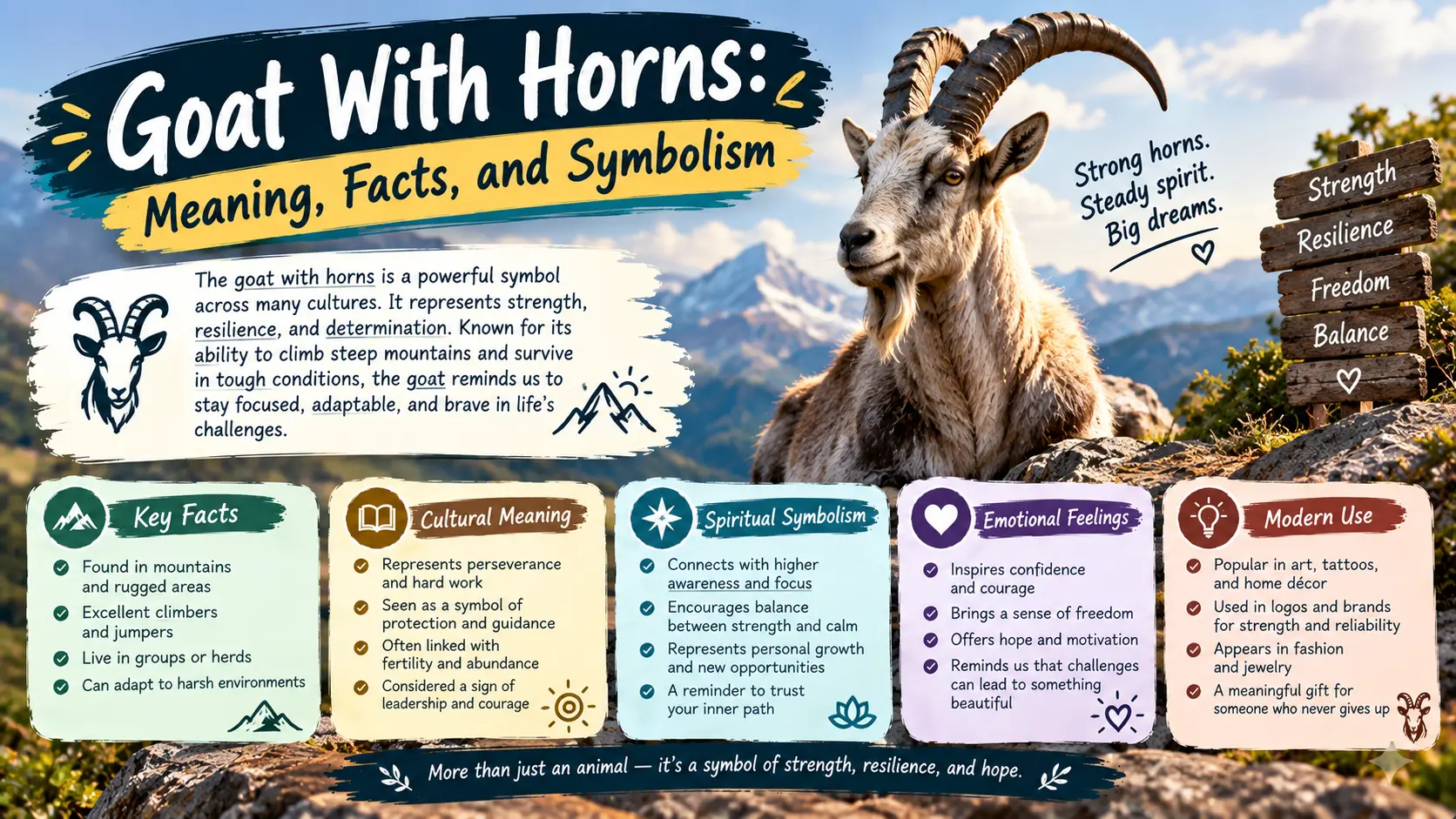
A goat with horns is commonly associated with strength, independence, resilience, protection, determination, and instinct. These meanings often arise from the animal’s physical characteristics and its reputation for climbing difficult terrain and surviving in challenging environments.
However, symbolism is not a universal code. A horned goat can represent different things in different cultures, religions, stories, or personal experiences.
Strength and Determination
Goats are often associated with determination because they can navigate steep, rocky, and difficult landscapes. Their ability to maintain balance and continue climbing has made them useful symbols of persistence.
The horns reinforce this symbolism because they are hard, permanent structures that can serve defensive purposes.
Independence and Resilience
The goat is frequently portrayed as an independent and adaptable animal. Its ability to forage across varied landscapes contributes to associations with self-reliance and resilience.
A horned goat may therefore symbolize someone who remains steady when facing obstacles.
Protection and Defense
Because horns can be used defensively, they are naturally connected with ideas of protection and boundaries.
Symbolically, a horned goat may represent the willingness to protect personal space, defend important values, or stand firm when challenged.
Confidence and Assertiveness
A goat standing with its head raised and horns visible can create an image of confidence. This has contributed to interpretations involving courage and assertiveness.
In symbolic contexts, however, confidence should not automatically be interpreted as aggression.
Nature and Instinct
Goats are closely connected with farming, mountains, grazing landscapes, and natural environments. Their horns can reinforce associations with instinct, earthiness, survival, and connection to nature.
Goat With Horns in Ancient Cultures
Goats have appeared in art, religion, mythology, agriculture, and folklore for thousands of years. Their meanings have never been identical across all societies.
In some contexts, goats were connected with fertility, abundance, wilderness, sacrifice, or agricultural life. In other traditions, goat imagery became associated with divine figures or mythological beings.
Goats in Ancient Mediterranean Traditions
Goats were important agricultural animals in the ancient Mediterranean world. They provided milk, meat, hides, and other resources.
Because of their economic importance, goats naturally appeared in religious and artistic imagery.
Goat Imagery in Greek Mythology
Greek mythology contains several important goat-related figures and stories. Pan, for example, is traditionally depicted with goat-like features and is associated with wild nature, shepherds, music, and rustic landscapes.
This imagery demonstrates how goat characteristics could be connected with wilderness and natural forces rather than having a single fixed meaning.
Horned Goats in Ancient Near Eastern Symbolism
Goat imagery also appeared in ancient Near Eastern art and religious contexts. Horns could emphasize an animal’s strength, vitality, or importance.
The meaning depended heavily on the specific culture, object, period, and artistic setting.
How Historical Meanings Differ Across Cultures
There is no single ancient meaning for a goat with horns. Historical interpretation must consider the specific culture and time period rather than combining unrelated traditions into one definition.
This is especially important when discussing spiritual symbolism because modern interpretations can differ substantially from ancient beliefs.
Goat With Horns in Christianity and the Bible
Goats appear in biblical texts in several different contexts. Their symbolism can involve livestock, sacrifice, separation, judgment, sin, or ordinary agricultural life depending on the passage.
The Bible should therefore not be reduced to the idea that goats always represent something negative.
Goats in Biblical Imagery
Goats were familiar livestock in the ancient biblical world. They were valuable animals and appear in practical as well as symbolic contexts.
Their meaning changes according to the specific passage and surrounding imagery.
The Difference Between Goats and Sheep in Scripture
One well-known biblical image appears in Matthew 25, where sheep and goats are used in a teaching about judgment and the separation of groups.
The symbolism in that passage should be understood within its theological context rather than treated as a universal statement about actual goats.
Why Horns Have Symbolic Meaning in the Bible
Horns frequently appear in biblical symbolism and can represent strength, power, authority, or victory. This association is connected to the physical strength and prominence of horns in ancient animal imagery.
A horned goat therefore combines two separate symbolic elements: the meaning associated with goats and the broader symbolism associated with horns.
Avoiding Misinterpretations of Biblical Goat Imagery
Not every biblical reference to a goat is symbolic, and not every horned animal represents evil or danger.
Understanding the surrounding passage, historical setting, and literary purpose is essential before assigning a spiritual interpretation.
Goat With Horns in Mythology and Folklore
Horned goats have played a prominent role in folklore because their physical appearance is visually distinctive. Their horns, hooves, climbing ability, and association with mountains have all influenced storytelling.
Different traditions have connected goat imagery with nature, fertility, wilderness, sexuality, mischief, strength, and supernatural beings.
Pan and Goat Imagery
Pan is one of the most recognizable examples of goat imagery in classical mythology. His goat-like legs, horns, and connection to wilderness helped establish an enduring artistic association between goats and untamed nature.
The Satyr and Horned Goat Connection
Satyrs are another important part of Greek and later artistic traditions. Their depiction developed over time, and their relationship to goat-like physical characteristics became especially influential in European art.
Folklore About Mountain Goats
Mountain goats and related wild caprines are often associated with endurance, balance, elevation, and survival because of their ability to navigate steep terrain.
These characteristics have encouraged symbolic interpretations centered on overcoming difficult obstacles.
Why Horned Animals Appear in Mythology
Horns are visually powerful features. They can make an animal appear larger, more imposing, or more mysterious.
For this reason, horns frequently appear in mythology and religious art as visual signs of power, vitality, status, or supernatural identity.
What Does Seeing a Goat With Horns Mean?
Seeing a horned goat does not have one objectively established spiritual meaning. The interpretation depends on the circumstances and the person’s cultural or personal framework.
From a symbolic perspective, the animal may invite reflection on strength, boundaries, independence, resilience, or determination.
Seeing a Goat in Everyday Life
If you encounter a goat naturally, the simplest explanation is usually the practical one: you have encountered an animal.
A personal symbolic meaning can still exist if the encounter feels significant to you, but that meaning comes from your own interpretation rather than a universal rule.
Seeing a Horned Goat in a Dream
A horned goat in a dream may be interpreted symbolically as a representation of strength, independence, challenge, or personal boundaries.
Dream interpretation is subjective, so the goat’s behavior and your emotions during the dream can be more meaningful than the animal alone.
Seeing a Goat Repeatedly
Repeatedly noticing goat imagery may simply reflect increased attention to that symbol. Once something becomes meaningful to you, your mind may notice it more often.
From a spiritual perspective, some people interpret repetition as meaningful, but there is no scientifically established rule that repeated goat sightings constitute a supernatural message.
Personal Meaning vs Traditional Symbolism
Traditional symbolism can provide ideas, but personal context matters. A farmer, artist, religious reader, animal lover, and dreamer may all interpret the same horned goat differently.
Goat With Horns Dream Meaning
Dreams involving horned goats can be interpreted through several symbolic themes. The most useful approach is to consider what the goat was doing and how you felt.
Dreaming of a Calm Horned Goat
A calm goat may symbolize stability, confidence, independence, or grounded energy.
If the dream felt peaceful, the horned goat could represent a sense of strength that does not need to become aggressive.
Dreaming of an Aggressive Goat
An aggressive goat may represent conflict, confrontation, boundaries, or a situation that feels threatening.
The dream may also reflect an interaction in waking life where you feel challenged or pressured.
Dreaming of a Goat Chasing You
A goat chasing you could symbolize something you are avoiding or a challenge that continues to demand attention.
The interpretation becomes more personal when you consider what you were afraid of in the dream and whether the goat represented a person, situation, responsibility, or internal concern.
Dreaming of Goat Horns
Seeing horns without focusing on the entire animal can emphasize themes of strength, defense, boundaries, or confrontation.
The horns may represent your desire to protect yourself or your awareness that another person has strong boundaries.
Dreaming of a White, Black, or Brown Goat
Color can influence personal dream symbolism. White may be associated with peace or clarity, black with mystery or uncertainty, and brown with earthiness or stability.
These associations are interpretive rather than universal dream rules.
Goat Horns as a Symbol of Strength and Protection
Goat horns naturally lend themselves to symbolism because they are visible defensive structures. They communicate physical power without requiring the animal to attack.
This makes the horned goat a useful symbolic image for people exploring themes of courage, boundaries, resilience, and protection.
Why Horns Represent Power
Across many cultures, horns have been associated with strength because they are hard, prominent, and capable of being used in combat.
Their physical characteristics made them natural symbols for power in art and storytelling.
Horns as a Natural Defense
A goat can use its horns defensively when threatened. This practical function contributes directly to the symbolic association between horns and protection.
The Connection Between Horns and Confidence
A horned animal often appears visually imposing. As a result, horns can symbolize confidence and the willingness to stand one’s ground.
Modern Uses of Horned Goat Imagery
Today, horned goat imagery can appear in artwork, tattoos, logos, clothing, home decor, jewelry, and fantasy-inspired designs.
Modern creators may use the image to communicate strength, ruggedness, independence, wilderness, or personal identity.
Goat With Horns in Modern Culture
The horned goat remains a recognizable visual symbol in modern culture. Its distinctive silhouette makes it easy to identify and adapt for artistic purposes.
The interpretation can range from agricultural and natural imagery to mythology, fantasy, spirituality, and personal symbolism.
Goat Images in Art and Design
Artists may emphasize horns to create an image that feels powerful, rustic, natural, or mysterious.
The direction and size of the horns can significantly influence the visual impression.
Goat Horns in Tattoos
A horned goat tattoo can represent different ideas depending on the wearer. Common interpretations include strength, independence, resilience, determination, and connection to nature.
Some people may choose goat imagery because of mythology, family traditions, zodiac associations, farming backgrounds, or personal experiences.
Goat Symbolism on Jewelry and Decor
Horned goat imagery can appear on pendants, wall art, sculptures, ornaments, and decorative objects.
In these contexts, the symbol may be selected for its visual character rather than a specific religious or spiritual meaning.
Goat Imagery in Social Media
Goat images are frequently used online for humor, farming content, animal appreciation, nature photography, and symbolic posts.
The meaning depends strongly on the caption and surrounding context.
Goat With Horns vs Other Horned Animals
Goats are sometimes confused with other horned animals because many species have similar-looking head structures.
Understanding the differences helps explain why goat horns have their own biological and symbolic associations.
Goat vs Sheep
Goats and sheep are closely related livestock species, but their horns, body structures, behavior, and physical characteristics differ.
Sheep may have horns depending on breed and sex, while goat horns commonly have a different growth pattern and texture.
Goat vs Ram
A ram is an adult male sheep. Rams of horned breeds often develop large, curved horns that can curl around the sides of the head.
Goat horns generally have a different shape and growth direction.
Goat vs Antelope
Antelopes include many species with permanent horns, but their horns differ substantially in shape and anatomy.
Some antelope species have long, spiral, or highly specialized horns.
Goat vs Ibex
Ibex are wild goats rather than domestic goats. They are especially famous for large, backward-curving horns and their ability to navigate mountainous terrain.
Their appearance has strongly influenced symbolism involving mountains, endurance, balance, and survival.
Are Goat Horns Dangerous?
Goat horns can cause injuries if an animal strikes, pushes, or hooks a person or another animal. However, the presence of horns does not mean a goat is naturally dangerous.
Safe handling depends on understanding goat behavior and avoiding situations that encourage defensive or aggressive responses.
When Goats May Use Their Horns
A goat may use its horns when defending itself, competing with another goat, protecting resources, or responding to perceived threats.
Young goats may also experiment with head-butting as part of play.
Safe Ways to Approach a Horned Goat
Approach calmly and avoid sudden movements. Do not corner a goat or deliberately place your face or body close to its horns.
Children should be supervised around horned livestock.
Why Horns Should Not Be Grabbed
Grabbing a goat by the horns can frighten or provoke the animal. It can also create an unsafe situation for both the person and goat.
Proper livestock-handling techniques are preferable to controlling an animal by its horns.
Managing Horned Goats Responsibly
Owners should provide adequate space, secure fencing, appropriate shelter, and safe social conditions.
Horned goats should also be monitored for injuries or situations where horns become trapped in fencing or equipment.
How to Care for a Goat With Horns
Caring for a horned goat involves many of the same basic requirements as caring for other goats, but housing and handling need additional consideration.
Providing Enough Space
Adequate space reduces unnecessary competition and gives goats room to move away from one another.
Crowded environments can increase conflict and make horn-related injuries more likely.
Safe Fencing and Housing
Fencing should be designed with goat behavior in mind. Openings should not be large enough for horns to become trapped.
Regular inspection can help identify damaged or unsafe areas.
Preventing Horn Injuries
Owners should watch for broken horns, bleeding, unusual swelling, or horns becoming caught in objects.
Horn injuries can be serious, so veterinary attention may be appropriate when an injury is significant.
When Veterinary Care May Be Needed
A veterinarian should be contacted for substantial horn injuries, persistent bleeding, infection, severe pain, or other unusual symptoms.
Professional advice is especially important when the injury involves the skull or another major structure.
Common Misconceptions About Goats With Horns
Horned goats are sometimes surrounded by myths and assumptions that do not accurately describe their biology or behavior.
Not Every Goat Is Naturally Horned
Some goats are naturally polled, while others have been disbudded. Therefore, the absence of horns does not necessarily indicate a particular breed or sex.
Horns Do Not Automatically Mean Aggression
A horned goat can be calm and gentle. Horn presence is not the same thing as temperament.
Individual behavior depends on genetics, handling, environment, social conditions, age, and previous experiences.
Horn Size Does Not Always Indicate Age or Dominance
Older goats often have larger horns because horns grow throughout life, but horn size varies significantly between breeds and individuals.
Horn size should therefore not be treated as a precise measurement of age or social status.
Horns Are Not the Same as Antlers
This is an important biological distinction. Goat horns are permanent structures, while antlers in species such as deer are typically shed and regrown.
The two structures differ in anatomy, growth, and biological function.
Frequently Asked Questions About Goats With Horns
Do all goats have horns?
No. Many goats naturally grow horns, but some are genetically polled and are born without them. Others may have been disbudded when young.
Why do goats have horns?
Goat horns can help with defense, competition, social interactions, and communication. They are also an important physical characteristic of many breeds.
Can female goats have horns?
Yes. Female goats can naturally grow horns. Horn development depends primarily on genetics and breed rather than being limited to males.
What does a goat with horns symbolize?
A horned goat is commonly associated with strength, independence, protection, determination, resilience, and instinct. Symbolic meanings vary according to culture and personal interpretation.
Are goats with horns aggressive?
Not necessarily. Horned goats can have calm or friendly temperaments. Their behavior depends on the individual animal, environment, handling, age, and social circumstances.
What does it mean to dream about a goat with horns?
A horned goat in a dream may symbolically relate to strength, boundaries, independence, conflict, or determination. Dream interpretation is personal, so the goat’s behavior and your emotions in the dream are important.
Why are some goats born without horns?
Some goats inherit genes for being naturally polled. This means they do not develop horns naturally.
Do goat horns keep growing?
Yes. Goat horns continue growing throughout the animal’s life. Their appearance changes with age and can be influenced strongly by breed and genetics.
What is the difference between goat horns and sheep horns?
Goat and sheep horns are both permanent structures, but their shapes and growth patterns differ. Goat horns often curve backward or outward, while some horned sheep, particularly rams, develop large horns that curl around the sides of the head.
What does seeing a horned goat mean spiritually?
In spiritual and symbolic traditions, a horned goat may represent strength, resilience, protection, courage, independence, or groundedness. There is no single universal spiritual meaning.
Final Thoughts on Goat With Horns
A goat with horns is both a fascinating animal and a powerful symbolic image. Biologically, horns provide important functions related to defense, competition, communication, and social behavior. Their size and shape are influenced largely by genetics and breed, and both male and female goats can naturally develop them.
Symbolically, the horned goat can represent strength, determination, independence, protection, resilience, and connection with nature. Ancient mythology, biblical imagery, folklore, dreams, tattoos, and modern art may all interpret the animal differently.
The most accurate way to understand a horned goat is to separate biology from symbolism. Its horns have real physical functions, while their deeper meanings depend on culture, context, and personal interpretation.