Hourglass Symbol Meaning: Time, Life & Change
Quick Answer
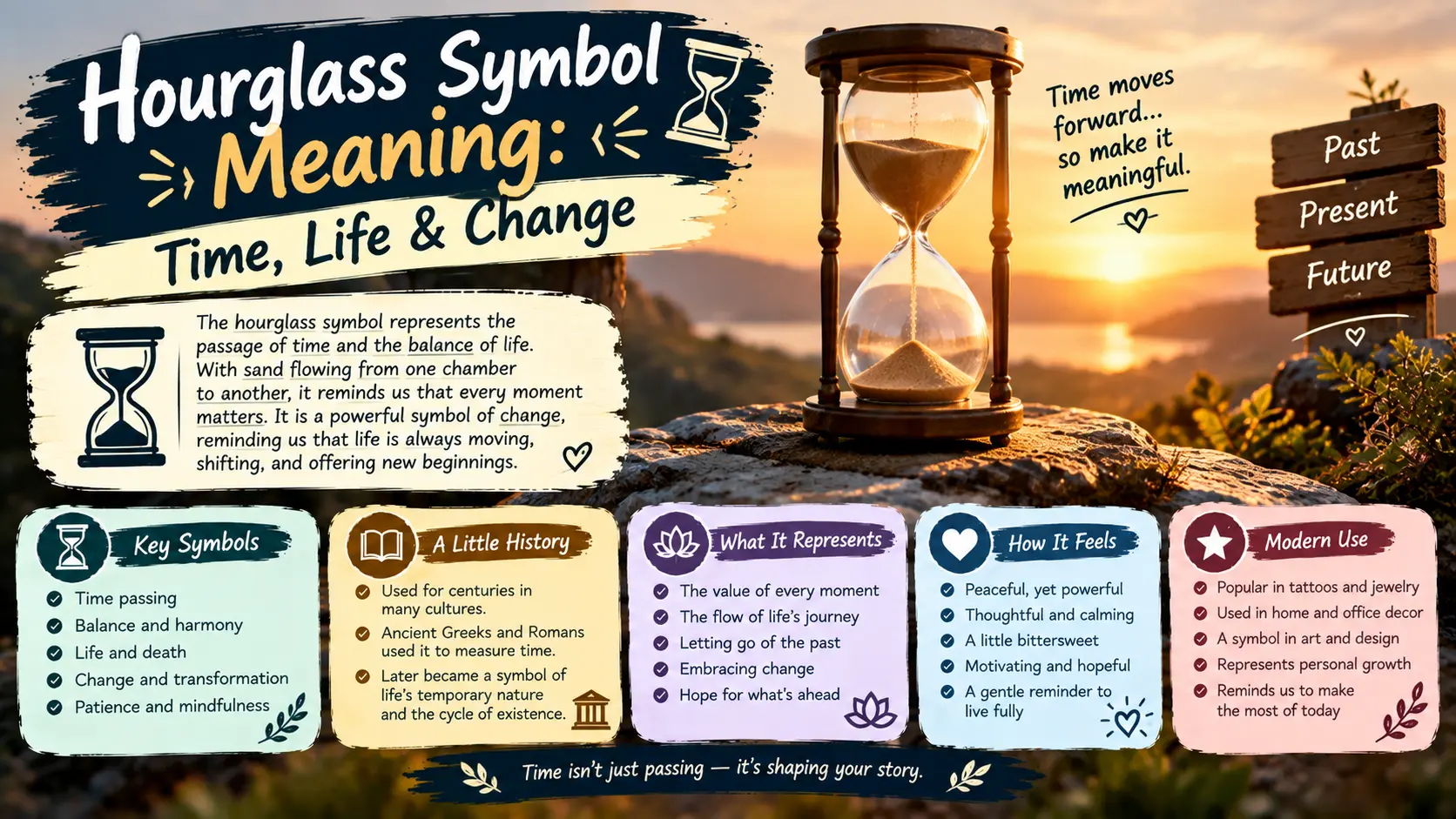
The hourglass symbol meaning is most commonly connected with time, the passage of life, mortality, patience, change, balance, and the value of the present moment. Its simple design—sand steadily moving from one chamber to another—creates a powerful visual reminder that time continues to pass.
An hourglass can have a serious meaning because it reminds people that life is temporary. At the same time, it can have a positive meaning, representing patience, personal growth, transformation, and the importance of making meaningful use of the time available.
The exact interpretation depends on context. An hourglass in religious art may represent mortality, while an hourglass tattoo may represent memories, change, or a personal commitment to appreciate life.
TL;DR
- Time: The hourglass is one of the clearest symbols of passing time.
- Mortality: It can remind us that human life is temporary.
- Patience: Waiting for the sand to move can represent patience and endurance.
- Change: Sand constantly moves from one chamber to another, symbolizing transition.
- Balance: The two chambers can represent opposing but connected stages of life.
- Transformation: The movement through the narrow center can symbolize moving from one phase into another.
- Spiritual awareness: It can encourage mindfulness and appreciation of the present.
- Modern meaning: Today, hourglass imagery appears in tattoos, jewelry, art, decor, logos, and digital symbols.
What Does the Hourglass Symbol Mean?
The hourglass is fundamentally a symbol of passing time. Sand placed in the upper chamber gradually falls through a narrow opening into the lower chamber. Because the movement cannot be stopped once the hourglass is turned, the object naturally represents the continuous progression of time.
This simple mechanism has encouraged many symbolic interpretations. The upper chamber can be viewed as the past or time that remains, while the lower chamber can represent time that has already passed. The narrow opening between them can symbolize the present—the brief point where one moment becomes another.
An hourglass can therefore represent both the temporary nature of life and the importance of living in the present. Its meaning does not have to be gloomy. For many people, it serves as a reminder to appreciate experiences, relationships, opportunities, and personal growth before time moves forward.
The Main Symbolic Meanings of an Hourglass
Time and the Passage of Life
The strongest association of an hourglass is the passage of time. Unlike a clock that displays a specific hour, the hourglass visually demonstrates time disappearing as sand falls.
This makes the symbol especially powerful when discussing aging, memories, deadlines, important life stages, or moments that cannot be recovered. The falling sand provides an immediate visual metaphor for the fact that every moment eventually becomes part of the past.
Mortality and the Temporary Nature of Life
The hourglass has also become associated with mortality. Once the sand has moved completely from one chamber to the other, the measured period has ended.
Symbolically, this can represent the limited nature of human life. The hourglass does not necessarily represent death itself; rather, it can represent awareness that life has boundaries and that time is not unlimited.
Patience and Waiting
An hourglass can symbolize patience because its sand moves at a steady pace that cannot be rushed.
This interpretation is especially relevant when someone is waiting for a change, decision, opportunity, or new stage of life. The symbol suggests that some processes require time and that meaningful outcomes cannot always be forced.
Change and Transformation
The movement of sand from one chamber to another represents change and transition. The sand never remains permanently in the same position.
For this reason, an hourglass can symbolize moving from one chapter of life into another. It may represent leaving behind an old identity, beginning a new stage, accepting circumstances, or growing through experience.
Balance and Duality
The hourglass has two chambers connected by a narrow center. This structure naturally creates associations with balance and duality.
The upper and lower sections can represent past and future, beginning and ending, youth and age, or holding on and letting go. Neither chamber exists independently of the other; together, they create the complete symbol.
Cycles and Renewal
Although an hourglass measures a limited period, it can also represent renewal because it can be turned over after the sand reaches the bottom.
This creates a symbolic contrast between endings and beginnings. One period finishes, and another can begin. In this sense, an hourglass may represent repeated opportunities to start again.
Urgency and Making Time Count
An hourglass can also communicate a sense of urgency. Watching the sand disappear naturally encourages awareness that an opportunity may not remain available forever.
This interpretation is common in modern motivational contexts. Rather than focusing only on mortality, the hourglass can encourage people to use their time intentionally and give attention to what matters most.
Why the Hourglass Became a Symbol of Mortality
The connection between hourglasses and mortality developed because time measurement naturally relates to the limited duration of human life. When an hourglass measures a fixed period, its completion provides a visible representation of an ending.
In historical art, objects associated with passing time were sometimes used to remind viewers of human mortality. This broader tradition is often connected with the idea of memento mori, a Latin expression associated with remembering mortality.
The hourglass can therefore carry a serious message without necessarily being a symbol of death. Its deeper idea is that time is limited and life changes continuously.
Historical Origins of the Hourglass
Early Development of Sand-Based Timekeeping
The exact origin of the hourglass is not completely established. Historians generally associate its development with medieval Europe, although earlier cultures used various other methods of measuring time.
Water clocks, sundials, candles, and other devices existed long before the familiar sand-filled hourglass became common. The hourglass offered a portable method for measuring a predetermined period.
Hourglasses in Medieval Europe
By the medieval period, hourglasses were being used in Europe for practical and symbolic purposes. Their portability made them useful when people needed to measure a particular duration without relying on a fixed clock.
The object gradually became recognizable beyond its practical function. Its distinctive shape and moving sand made it visually suitable for artwork and symbolic representations.
Use in Navigation, Religion, and Daily Life
Hourglasses were useful in activities where measuring a set period mattered. They could be used in navigation, religious settings, cooking, work, and other activities requiring approximate intervals.
Their usefulness helped establish the hourglass as a familiar cultural object. Once people understood that the sand represented a limited period, the object naturally gained metaphorical meanings.
The Hourglass in Historical Art
Artists used the hourglass as a visual shorthand for time and mortality. A viewer could recognize the falling sand and understand the message without needing lengthy explanation.
It often appeared alongside other symbols connected with temporary life, aging, death, knowledge, and worldly possessions. Over time, these artistic associations helped strengthen the hourglass as a symbolic image.
Hourglass Symbolism in Christianity and Religious Art
In Christian and European religious art, the hourglass has sometimes been used to represent human mortality and the temporary nature of earthly existence.
The falling sand can encourage reflection on how quickly earthly life passes. This idea fits with broader religious themes concerning repentance, spiritual preparation, judgment, and the difference between temporary earthly life and eternal spiritual existence.
However, an hourglass is not a universal Christian symbol with only one fixed interpretation. Its meaning depends on the artwork, historical period, surrounding imagery, and intended message.
In religious art, an hourglass may therefore encourage reflection rather than simply represent death. It can remind viewers that life is temporary and that time can be used for spiritual growth, compassion, and meaningful action.
Hourglass Symbolism Across Different Cultures
European Symbolism
European traditions have strongly associated the hourglass with time, mortality, aging, and the temporary nature of worldly life.
This association is especially visible in historical art and memento mori imagery. The hourglass served as an easily understood reminder that time continues to move regardless of wealth, status, or personal circumstances.
Ancient and Medieval Ideas About Time
Different civilizations developed different ways of understanding and measuring time. Although the modern hourglass is strongly associated with medieval Europe, the broader symbolic idea of time passing is much older.
Across human cultures, natural cycles such as sunrise, sunset, seasons, aging, and the movement of celestial bodies have encouraged reflection on time. The hourglass became one later visual representation of this universal human experience.
Eastern Perspectives on Time and Impermanence
In several Eastern philosophical and religious traditions, impermanence is an important concept. However, it is important not to claim that the hourglass itself has one universal traditional meaning across Asian cultures.
Modern interpretations may connect the hourglass with ideas of change, impermanence, mindfulness, and letting go. These interpretations are often contemporary symbolic associations rather than evidence of a single ancient tradition.
Modern Global Interpretations
Today, the hourglass is widely recognizable across cultures. Its meaning is often understood through the visual relationship between sand and time.
Modern interpretations commonly include time, patience, mortality, transformation, memories, urgency, and personal growth.
Spiritual Meaning of an Hourglass
Spiritually, an hourglass can serve as a reminder that life is temporary and each moment has value.
The movement of sand can encourage mindfulness. Instead of focusing entirely on what has already happened or what may happen in the future, the image can remind a person to recognize the present moment.
An hourglass can also symbolize patience. The sand moves according to its natural process, suggesting that some forms of growth cannot be rushed.
For someone going through a major transition, the hourglass may represent the idea that one stage of life is ending while another is beginning.
Psychological Meaning of the Hourglass Symbol
Psychologically, hourglass imagery can evoke strong awareness of time. Seeing sand gradually disappear can make people think about deadlines, aging, missed opportunities, memories, or future goals.
For some people, the symbol may create a sense of urgency. It can encourage action when someone feels that an important opportunity should not be postponed indefinitely.
For others, it may communicate patience and calm. The predictable movement of the sand demonstrates that time continues regardless of immediate emotions.
Personal experiences matter greatly. Someone approaching a major life milestone may interpret an hourglass differently from someone beginning a new chapter after a difficult experience.
Hourglass Symbolism in Dreams
Seeing an Hourglass in a Dream
An hourglass appearing in a dream may symbolize awareness of time, waiting, transition, or an important period of change.
The meaning depends heavily on the dreamer’s circumstances. An hourglass may reflect a current deadline, anticipation, or concern about an upcoming life event.
An Hourglass Running Out of Sand
An hourglass running out of sand can represent a feeling that time is limited.
It may be connected with a deadline, a decision, an opportunity, or a personal concern about something changing. It does not automatically predict a negative event.
Turning an Hourglass Over
Turning an hourglass over can symbolize a fresh beginning or another opportunity.
The image is particularly relevant when someone is starting again after completing an important phase of life. It can represent renewal and the willingness to move forward.
A Broken Hourglass
A broken hourglass can represent disrupted expectations, interrupted plans, or a major transition.
Some people may interpret it as a desire to escape pressure associated with time. Others may see it as a reminder that life does not always follow a predictable schedule.
A Full or Empty Hourglass
A full hourglass may symbolize time available, potential, or a new beginning, while an empty upper chamber may represent time that has already passed.
These interpretations are not universal dream rules. The emotional feeling of the dream and the individual’s circumstances are usually more meaningful than a fixed symbolic dictionary.
Hourglass Symbol Meaning in Love and Relationships
In relationships, the hourglass can represent timing, patience, memories, commitment, and change.
Two people may use the symbol to express the idea that meaningful relationships develop over time. It can also represent shared memories and the recognition that important moments cannot be repeated exactly.
An hourglass may be particularly meaningful during periods of waiting or transition. It can represent giving a relationship time to develop while recognizing that circumstances and people naturally change.
In this context, the symbol does not automatically indicate whether a relationship will continue or end. Its meaning is more often connected with the experience of time itself.
Hourglass Symbolism in Tattoos
Hourglass and Rose Tattoo
An hourglass combined with a rose can create a contrast between beauty and the passage of time.
The rose may represent love, beauty, growth, or temporary beauty, while the hourglass emphasizes the limited nature of time.
Hourglass and Skull Tattoo
An hourglass and skull are frequently associated with mortality. Together, they create a direct reminder that life is temporary.
This design is often chosen as a strong representation of memento mori, remembrance, mortality, and appreciation of life.
Hourglass With Flowers
Flowers can soften the serious aspects of hourglass symbolism. Together, they may represent growth, beauty, change, and the temporary nature of life.
Different flowers can introduce additional meanings based on their cultural and personal associations.
Broken Hourglass Tattoo
A broken hourglass can symbolize a significant life change, disrupted expectations, freedom from the pressure of time, or an experience that permanently changed someone’s perspective.
Its meaning is highly personal and can represent both difficulty and transformation.
Hourglass With Wings
Wings can add ideas of freedom, spiritual movement, transcendence, or the passage of the soul.
Combined with an hourglass, they can create a symbolic theme of time moving forward and life transforming beyond a particular stage.
Minimalist Hourglass Tattoo
A simple hourglass tattoo can communicate the idea of time without requiring additional imagery.
Minimalist designs are often chosen because the basic shape is immediately recognizable and can represent personal reminders about patience, priorities, memories, or living intentionally.
Hourglass Symbolism in Jewelry and Fashion
Hourglass necklaces, pendants, rings, bracelets, and charms can function as subtle reminders of time and meaningful experiences.
A person might choose an hourglass pendant to commemorate a particular period of life or to express appreciation for the present.
In fashion and accessories, the symbol can also represent elegance, nostalgia, transformation, or historical aesthetics. Its distinctive shape makes it recognizable even when presented in a very small design.
Hourglass Symbol Meaning in Art and Literature
Artists and writers often use the hourglass to communicate ideas that are difficult to express directly.
It can symbolize aging, mortality, waiting, memory, lost opportunities, transformation, or the unstoppable movement of time.
In literature, an hourglass can function as a recurring image that reminds characters or readers that circumstances are changing. A character may be unable to stop time, even when they wish to preserve a particular moment.
In visual art, the hourglass can communicate a similar idea immediately. The viewer sees the sand moving and understands that the represented period is temporary.
The Meaning of the Sand in an Hourglass
Falling Sand
Falling sand represents time in motion. Each grain can be viewed metaphorically as a passing moment.
Because the sand moves continuously, it emphasizes that time does not remain still.
Sand Running Out
Sand running out can symbolize an approaching ending, deadline, or completion.
It can also represent the final stage of a particular chapter, encouraging reflection on what happened during that period.
Sand at the Bottom
The sand accumulated in the lower chamber can symbolize the past—experiences that have already happened and cannot be returned to exactly as they were.
This does not necessarily make the image negative. The past can represent memories, lessons, achievements, and personal growth.
Sand Moving Between Chambers
The movement between the two chambers represents transition.
It illustrates the relationship between what has happened and what is still unfolding. The sand’s journey can therefore symbolize personal development and the constant movement from one stage of life into another.
What the Two Chambers of an Hourglass Symbolize
The two chambers provide one of the hourglass’s most interesting symbolic features.
The upper chamber can represent what remains, while the lower chamber can represent what has already passed. The interpretation can also be reversed depending on the symbolic context.
The narrow center is particularly meaningful because it is the point where the sand passes from one side to the other. It can represent the present moment, a transition, or the boundary between two stages.
Together, the chambers create a visual representation of balance and change. Neither side is permanent.
Hourglass Symbolism and the Concept of Time
The hourglass can represent both linear time and recurring cycles.
From one perspective, the sand moves in a single direction until the measured period ends. This resembles the human experience of moving from childhood through adulthood and into later stages of life.
From another perspective, the hourglass can be turned over and used again. This introduces the idea of renewal and repetition.
The contrast makes the hourglass especially powerful. It can represent an ending and a beginning at the same time.
Hourglass Symbol Meaning in Modern Culture
Social Media and Digital Communication
Hourglass imagery is often used online to communicate waiting, patience, limited time, or anticipation.
Someone may use an hourglass image when waiting for an event, announcement, decision, or important moment.
Emojis and Digital Symbols
The hourglass has become recognizable in digital communication because it communicates the concept of time quickly.
Depending on context, it can suggest waiting, time running out, patience, or an approaching moment.
Home Decor
Hourglass decorations are commonly used in homes and offices as both functional objects and decorative pieces.
Their presence can create a reflective atmosphere, reminding viewers of time while also providing a visually balanced design.
Logos and Graphic Design
The hourglass works well in graphic design because its shape is simple and immediately recognizable.
Organizations, products, educational materials, and creative projects may use hourglass imagery when they want to communicate concepts related to time, scheduling, patience, or transformation.
Tattoos and Personal Expression
Modern tattoos have expanded hourglass symbolism beyond traditional mortality themes.
People may combine the hourglass with flowers, animals, celestial imagery, names, dates, or other personal symbols to represent a specific memory or life experience.
Is an Hourglass Symbol Positive or Negative?
An hourglass is not inherently positive or negative.
Its interpretation depends on the surrounding context. A person focused on mortality may see it as a reminder of life’s limited duration. Someone beginning a new chapter may see the same image as a symbol of transformation and renewal.
Positive interpretations include:
- Appreciating the present
- Practicing patience
- Accepting change
- Learning from the past
- Using time intentionally
- Recognizing personal growth
More serious interpretations include:
- Mortality
- Aging
- Lost time
- Deadlines
- Endings
- The temporary nature of life
The same hourglass can therefore represent both the seriousness of limited time and the opportunity created by having time at all.
Hourglass Symbol Meaning by Context
| Context | Common Meaning |
|---|---|
| Spirituality | Impermanence and awareness |
| Love | Timing and patience |
| Tattoo | Mortality, memories, or meaningful time |
| Dreams | Awareness of change or deadlines |
| Jewelry | Remembrance and appreciation |
| Art | Mortality and the passage of time |
| Home Decor | Patience, balance, and time |
| Social Media | Waiting, time, or nostalgia |
These meanings are general associations rather than universal rules. The surrounding imagery and personal circumstances can significantly change the interpretation.
Why the Hourglass Remains a Powerful Symbol Today
The hourglass remains powerful because its message is immediately understandable. People do not need specialized knowledge to understand that the falling sand represents time moving forward.
Its symbolism is also flexible. The same object can represent mortality in historical art, patience in personal development, waiting in digital communication, or remembrance in a tattoo.
The hourglass also reflects modern concerns about time. People regularly think about deadlines, productivity, aging, memories, relationships, and future goals. The image gives all of these ideas a simple visual form.
Most importantly, the hourglass can encourage awareness rather than fear. It reminds us that time moves continuously, making each moment meaningful.
Common Misunderstandings About Hourglass Symbolism
Does an Hourglass Always Represent Death?
No. Death and mortality are important historical associations, but the hourglass can also represent time, patience, balance, transformation, memories, and new beginnings.
Does an Hourglass Always Mean Bad Luck?
No. There is no universal rule that an hourglass represents bad luck.
In many contexts, it simply symbolizes the passage of time or serves as a reminder to appreciate the present.
Does Seeing an Hourglass Have One Spiritual Meaning?
No. Spiritual interpretations vary.
One person may see it as a reminder to be patient, while another may interpret it as a reminder to value life or accept change.
Is the Hourglass Only a Symbol of the Past?
No. The hourglass connects past, present, and future.
The lower chamber can represent what has passed, the upper chamber what remains, and the narrow center can be interpreted as the present transition between them.
How to Interpret an Hourglass Symbol Personally
When an hourglass feels personally meaningful, consider the context rather than relying on a single symbolic definition.
- Consider where you encountered it. A tattoo, dream, painting, necklace, and digital icon may carry different meanings.
- Look at surrounding symbols. A skull may emphasize mortality, while flowers may emphasize growth and temporary beauty.
- Think about your current relationship with time. You may be waiting for something, starting something new, or reflecting on the past.
- Consider your emotional response. If the image creates calm, it may represent patience. If it creates urgency, it may represent limited time or a deadline.
- Think about personal memories. An hourglass may commemorate a particular period or person.
- Avoid assuming one interpretation applies to everyone. Symbolism is influenced by culture, history, personal experience, and context.
Frequently Asked Questions About Hourglass Symbol Meaning
What does an hourglass symbolize?
An hourglass commonly symbolizes time, the passage of life, mortality, patience, balance, change, and transformation. Its falling sand visually represents moments moving from the future into the past.
What does an hourglass symbolize spiritually?
Spiritually, an hourglass can represent impermanence, mindfulness, patience, and awareness of life’s limited nature. It may encourage a person to appreciate the present rather than focusing entirely on the past or future.
Is an hourglass a symbol of death?
An hourglass has historically been associated with mortality and the temporary nature of life, particularly in European art. However, it does not exclusively symbolize death and can also represent patience, change, renewal, and meaningful use of time.
What does an hourglass mean in love?
In love and relationships, an hourglass can symbolize timing, patience, shared memories, commitment, and change. It may represent the idea that meaningful relationships develop over time and that important moments become lasting memories.
What does an hourglass tattoo symbolize?
An hourglass tattoo can symbolize making time count, remembering the past, accepting change, mortality, personal transformation, or appreciating life. Additional elements such as flowers, skulls, wings, or dates can make the intended meaning more specific.
What does a broken hourglass symbolize?
A broken hourglass may represent disrupted plans, lost time, major life changes, or freedom from previous expectations. Its meaning depends on why the person chose the broken design and what other symbols appear with it.
What does an hourglass mean in a dream?
An hourglass in a dream may reflect awareness of time, waiting, deadlines, transition, or concerns about change. Dream symbolism is personal, so the dreamer’s circumstances and emotions are important when interpreting the image.
What does an hourglass symbolize in Christianity?
In historical Christian and European art, the hourglass can symbolize mortality, repentance, judgment, and the temporary nature of earthly life. It may encourage reflection on how a person uses the limited time of life.
What does the sand in an hourglass symbolize?
The sand commonly symbolizes passing moments and the continuous movement of time. As it falls, it can represent experiences moving from the future into the past.
Is the hourglass a symbol of balance?
Yes. The two chambers can represent balance, duality, and the relationship between different stages of time. The central opening can also symbolize transition between one state and another.
Final Thoughts on Hourglass Symbol Meaning
The hourglass symbol meaning centers on one simple but powerful idea: time is always moving. From its historical role as a timekeeping device to its appearance in art, spirituality, tattoos, dreams, jewelry, and modern design, the hourglass has remained a recognizable symbol for centuries.
Its most familiar meanings include time, mortality, patience, change, balance, transformation, and appreciation of the present. While its historical imagery can be serious, the symbol does not have to represent something negative.
An hourglass can also communicate hope and renewal. Every completed cycle can be followed by another beginning when the hourglass is turned over. In this way, it can remind us not only that time passes, but also that each new moment provides another opportunity to live, learn, change, and grow.