Eclipse Symbolism: Spiritual Meaning & Significance
Quick Answer
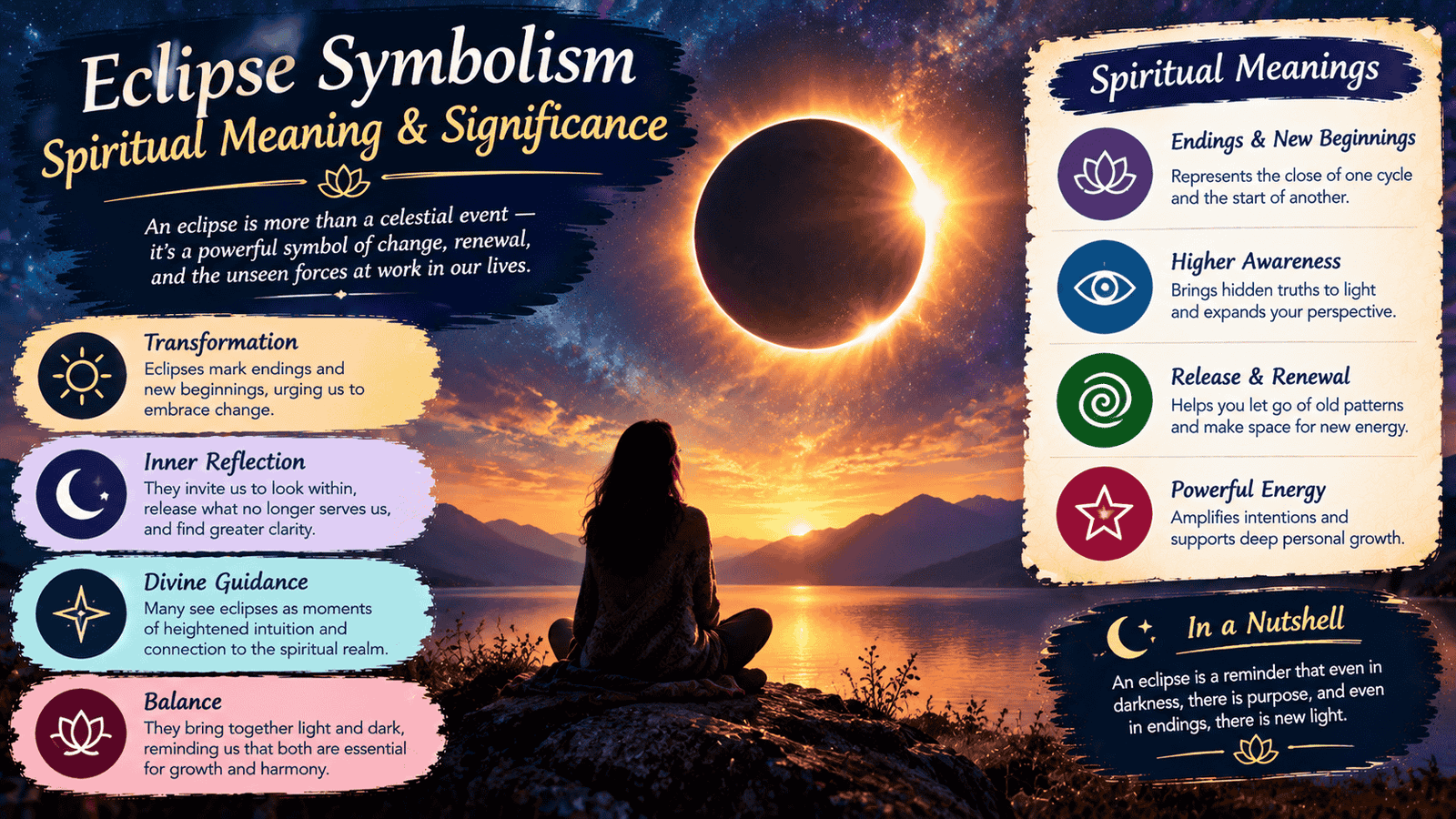
Eclipse symbolism commonly represents transformation, mystery, temporary darkness, revelation, renewal, and the meeting of opposing forces. Because an eclipse briefly changes the familiar relationship between light and darkness, many cultures and spiritual traditions have interpreted it as a meaningful transition or unusual celestial event.
A solar eclipse is often associated symbolically with hidden truth, transformation, interruption, and new beginnings. A lunar eclipse is more frequently connected with emotions, reflection, endings, and inner change. A blood moon can carry additional associations with intensity, mystery, passion, and major transitions.
These meanings are symbolic rather than scientific predictions. Astronomically, an eclipse is a natural alignment involving the Sun, Earth, and Moon. Its personal or spiritual meaning depends on the cultural, religious, or individual framework through which someone interprets it.
TL;DR
- Eclipse symbolism often centers on transformation, mystery, change, and revelation.
- Solar eclipse symbolism can represent hidden light, new beginnings, and temporary uncertainty.
- Lunar eclipse symbolism is commonly associated with emotions, reflection, release, and endings.
- Blood moon symbolism often emphasizes intensity, mystery, and transition.
- In mythology, eclipses have appeared in stories involving celestial beings, cosmic conflict, renewal, or disruption.
- Different cultures have developed very different interpretations of eclipses.
- Spiritually, an eclipse may be viewed as a reminder to pause, reflect, release old patterns, or embrace change.
- Eclipse symbolism does not have one universal meaning.
Eclipse symbolism
An eclipse is one of the most visually striking events in the sky. For a short period, the ordinary pattern of sunlight or moonlight changes, creating an experience that can feel unusual and significant. This dramatic contrast between light and darkness is one reason eclipse symbolism has developed across many societies.
At a symbolic level, an eclipse can represent the temporary interruption of something familiar. The Sun does not permanently disappear during a solar eclipse, and the Moon does not cease to exist during a lunar eclipse. Instead, their appearance changes because of celestial alignment. This makes the eclipse a useful metaphor for temporary uncertainty followed by restoration.
Another important theme is transformation. An eclipse changes what people can see without changing the underlying celestial bodies themselves. Symbolically, this can represent periods in life when circumstances appear different, perspectives shift, or something previously unnoticed becomes visible.
The eclipse can therefore symbolize both darkness and illumination. Darkness may represent the unknown, while the return of light can represent understanding, hope, or renewed direction.
Solar eclipse symbolism
A solar eclipse occurs when the Moon passes between Earth and the Sun and temporarily blocks some or all of the Sun’s visible disk. Symbolically, this unusual interruption of sunlight has often been connected with mystery and transformation.
One common symbolic interpretation is hidden light. The Sun remains present even when its light is temporarily obscured. In a metaphorical sense, this can represent inner strength, truth, identity, or hope that remains present during difficult circumstances.
Solar eclipses can also symbolize new beginnings. The sequence of increasing darkness followed by returning sunlight creates a natural metaphor for moving through uncertainty toward clarity.
Another interpretation involves revelation. An eclipse changes ordinary visibility, encouraging people to pay attention to what they normally overlook. In modern spiritual language, this may be interpreted as a period for examining beliefs, habits, relationships, or personal goals.
The meaning does not have to be negative. Although darkness can traditionally represent uncertainty, the temporary nature of a solar eclipse can emphasize change rather than permanent loss.
Lunar eclipse symbolism
A lunar eclipse happens when Earth moves between the Sun and Moon and Earth’s shadow falls across the Moon. Because the Moon is traditionally associated with nighttime, reflection, cycles, and emotions in many symbolic systems, lunar eclipses often receive interpretations centered on the inner world.
Lunar eclipse symbolism can represent emotional awareness and reflection. The changing appearance of the Moon may encourage people to consider feelings, memories, or situations that have been developing beneath the surface.
Another recurring theme is release. Since lunar cycles are already associated with change and repetition, a lunar eclipse can be used symbolically to represent letting go of outdated habits or emotional patterns.
A lunar eclipse may also symbolize endings and transitions. This does not necessarily mean that something bad is going to happen. Rather, it can serve as a metaphor for recognizing that one phase of life is changing and another is beginning.
For people who use spiritual symbolism personally, a lunar eclipse can become a reminder to slow down and observe rather than immediately react.
Blood moon symbolism
A blood moon is a common name for a total lunar eclipse when the Moon can appear reddish or copper-colored. The color results from sunlight passing through Earth’s atmosphere and reaching the lunar surface indirectly.
The dramatic appearance of a blood moon has contributed to strong symbolic associations throughout history. Blood moon symbolism may include mystery, intensity, transformation, passion, and major change.
The red appearance can be interpreted symbolically in different ways. Red may represent vitality, strength, emotional intensity, love, danger, or sacrifice depending on the cultural context.
In modern spiritual interpretations, a blood moon is sometimes treated as a powerful symbol of transition. Its unusual appearance can represent a moment when ordinary patterns are temporarily disrupted.
However, the scientific explanation remains important. The Moon appears red because of atmospheric effects during a total lunar eclipse, not because the event itself predicts a particular personal or world event.
Eclipse symbolism in mythology
Eclipses have appeared in mythology because ancient observers could see the Sun or Moon dramatically change without having modern astronomical explanations. A sudden darkening of the sky could naturally inspire stories about celestial beings, supernatural forces, conflict, or cosmic imbalance.
In some traditions, eclipses were explained through stories involving a creature or supernatural figure consuming, attacking, or covering the Sun or Moon. In other traditions, an eclipse could be interpreted as a warning, a disruption in cosmic order, or a moment requiring ritual attention.
These stories should be understood within their own historical and cultural contexts. Ancient societies did not share one universal explanation for eclipses.
Mythological eclipse symbolism therefore includes several recurring themes: cosmic conflict, temporary disorder, supernatural intervention, transformation, and restoration. The eventual return of the Sun or Moon could also reinforce ideas of renewal and the restoration of balance.
Eclipse symbolism in different cultures
Eclipse symbolism varies considerably between cultures. The same celestial event could be regarded as frightening, sacred, mysterious, protective, or simply extraordinary depending on the society observing it.
In some historical traditions, an eclipse was interpreted as a warning connected to rulers or political events. In others, people developed stories explaining the temporary disappearance or changing appearance of the Sun and Moon.
Some Indigenous traditions have their own teachings and stories concerning celestial events. These should not be reduced to a single generalized “Native American” meaning because Indigenous nations have distinct histories, languages, spiritual traditions, and interpretations.
In China, historical eclipse observations were connected with astronomy, calendrical systems, and traditional beliefs about celestial order. In ancient Mesopotamia, eclipses were carefully observed and could be incorporated into systems of celestial omens.
The broader pattern is that eclipses often became symbols of disruption in the ordinary order of the heavens. Yet the specific meaning depended on the culture and period.
Eclipse spiritual meaning
The eclipse spiritual meaning often focuses on transformation, reflection, release, and the relationship between darkness and light.
For some people, an eclipse symbolizes a temporary period when familiar circumstances become unclear. This can encourage introspection and patience rather than immediate conclusions.
Another spiritual interpretation is that an eclipse represents the hidden becoming visible. Something may be temporarily obscured while another aspect of life receives greater attention.
Eclipses can also symbolize surrender to natural cycles. They demonstrate that periods of brightness and darkness can occur without either state lasting forever. In this sense, an eclipse can become a metaphor for accepting change while remaining aware that circumstances continue to evolve.
It is useful to distinguish personal spirituality from factual prediction. An eclipse can be meaningful to an individual without being evidence that a specific future event will occur.
What does an eclipse symbolize?
An eclipse can symbolize change, transformation, mystery, temporary darkness, revelation, renewal, and the balance between opposing forces.
Its meaning often depends on the type of eclipse and the symbolic tradition being used. A solar eclipse may emphasize hidden light and new beginnings, while a lunar eclipse may emphasize emotions, reflection, and release.
The eclipse can also symbolize the idea that appearances can change without reality disappearing. The Sun remains behind the Moon during a solar eclipse, and the Moon remains present during a lunar eclipse.
This makes the eclipse a powerful metaphor for difficult periods. Something may seem absent, uncertain, or hidden without being permanently lost.
Eclipse Symbolism and Transformation
Transformation is one of the strongest modern interpretations of eclipse symbolism. An eclipse visibly changes the appearance of the sky, making it a natural metaphor for moments when life enters a new phase.
The event also demonstrates that transformation can be temporary and cyclical. Darkness gradually develops, reaches a peak, and then passes. Symbolically, this can represent moving through uncertainty without assuming that uncertainty will last forever.
For personal reflection, eclipse symbolism can encourage people to consider what they are changing, what they are leaving behind, and what they want to develop next.
Eclipse Symbolism and New Beginnings
An eclipse can represent a transition between one stage and another. The return of light after a period of darkness creates a strong metaphor for renewal and fresh direction.
A new beginning does not necessarily mean starting life completely over. It may involve changing a habit, adopting a different perspective, repairing a relationship, or beginning a new personal goal.
The eclipse can therefore symbolize the moment between an ending and a beginning—the period when the old pattern is changing but the new one has not fully emerged.
Eclipse Symbolism and Hidden Truths
Because an eclipse temporarily blocks or changes visibility, it can symbolize information that has been hidden or overlooked.
This interpretation is particularly relevant to the solar eclipse, when the Moon passes across the Sun from Earth’s perspective. Symbolically, something bright and familiar becomes partially obscured.
The idea can be applied to personal reflection. An eclipse may represent the need to look beyond appearances and consider what lies underneath a situation.
Importantly, symbolic “hidden truth” does not mean an eclipse provides supernatural information. It is a metaphor for examining what may not be immediately obvious.
Eclipse Symbolism in Dreams
Dreams involving eclipses can be interpreted in many ways because dream symbolism is highly personal. An eclipse may reflect feelings about uncertainty, transition, emotional change, or something that currently feels difficult to understand.
The details of the dream matter more than a universal dream dictionary definition.
Dreaming About a Solar Eclipse
A solar eclipse in a dream may symbolize a temporary interruption in clarity, confidence, direction, or awareness. It can reflect a situation where something important feels partially hidden.
If the Sun becomes visible again, the dream may be associated with resolution or renewed clarity.
Dreaming About a Lunar Eclipse
A lunar eclipse may be connected symbolically with emotional changes, personal reflection, or the release of something from the past.
Because the Moon is often associated with nighttime and inner experience, the dream may encourage attention to feelings that have not been fully acknowledged.
Watching an Eclipse in a Dream
Simply watching an eclipse may represent observation rather than direct participation. You may be symbolically noticing a major change without knowing exactly what it means yet.
The emotional tone of the dream—peaceful, frightening, exciting, or confusing—can provide additional context.
An Eclipse Suddenly Becoming Dark
An unusually dark eclipse in a dream can symbolize uncertainty or a temporary loss of clarity. It may reflect a situation where familiar expectations no longer seem reliable.
The dream does not necessarily predict an event. It can simply mirror concerns, transitions, or emotions already present in waking life.
Eclipse Symbolism in Christianity and the Bible
Eclipses can be discussed in relation to biblical imagery involving the Sun, Moon, darkness, and signs in the heavens. Biblical passages sometimes use celestial darkness as imagery associated with significant spiritual or prophetic events.
However, the Bible does not provide a single general definition stating that every eclipse has one fixed spiritual meaning.
Christian interpretations vary. Some readers understand celestial darkness symbolically as an image of judgment, mourning, divine action, or major transition. Others focus on the broader theological message rather than connecting particular modern eclipses with specific biblical prophecies.
A responsible interpretation therefore distinguishes biblical symbolism from later speculation. A natural eclipse can be scientifically explained while still serving as a personal occasion for reflection within a person’s faith.
Eclipse Symbolism in Ancient Religions and Traditions
Ancient religious traditions frequently connected the sky with divine order, seasonal cycles, rulers, and sacred narratives. Because eclipses were unusual and visually dramatic, they naturally attracted religious and symbolic attention.
In ancient Mesopotamia, celestial observations could be incorporated into omen traditions. Historical Chinese records also demonstrate careful attention to eclipses and celestial events.
Other civilizations developed their own explanations through mythology and religion. These interpretations sometimes presented an eclipse as a disturbance in cosmic order or as an event involving supernatural beings.
Rather than treating these beliefs as one unified ancient meaning, it is more accurate to recognize the diversity of historical eclipse traditions.
Eclipse Symbolism in Native and Indigenous Traditions
Indigenous traditions concerning eclipses are diverse and should be discussed with cultural care. Different Indigenous nations have distinct stories, teachings, ceremonial practices, and relationships with celestial events.
Some traditions have understood eclipses through narratives involving relationships between celestial bodies, while others may emphasize respect, observation, community practices, or spiritual reflection.
There is no single meaning of an eclipse shared by all Indigenous peoples of North America. Modern summaries should avoid combining separate nations into one generalized tradition.
The broader lesson is that celestial events can carry meaning within a community’s relationship with nature, time, ancestry, and the wider universe.
Eclipse Symbolism in Modern Spirituality
Modern spirituality often uses the eclipse as a metaphor for personal transformation and energetic transition. People may use eclipse periods as opportunities for journaling, meditation, reflection, or setting personal intentions.
Some spiritual communities associate eclipses with releasing old patterns or beginning a new chapter. Others connect them with heightened awareness or emotional reflection.
These interpretations are matters of spiritual belief rather than established scientific effects. A person can find personal meaning in an eclipse without assuming that the astronomical event has a predetermined influence on individual circumstances.
Eclipse Symbolism in Astrology
In astrology, eclipses are traditionally given special significance because they occur around the lunar nodes and are associated with themes of change and turning points.
Astrological interpretations may connect solar eclipses with new developments and lunar eclipses with culmination, emotional awareness, or endings.
These are astrological interpretations rather than scientific findings. Astronomy explains eclipses through the positions and movements of the Sun, Earth, and Moon, while astrology gives them symbolic meaning within an interpretive system.
Understanding this distinction helps readers explore eclipse symbolism without confusing symbolic traditions with astronomical evidence.
Eclipse Symbolism in Love and Relationships
In relationship symbolism, an eclipse can represent change, emotional revelation, transition, and shifting perspectives.
A solar eclipse may metaphorically represent something that has been hidden within a relationship becoming noticeable. A lunar eclipse may be associated symbolically with emotional honesty or the release of unresolved feelings.
An eclipse can also represent the changing nature of relationships. Some connections enter new stages, while others end or transform.
There is no universal rule that an eclipse predicts a breakup, reunion, marriage, or other relationship event. Its value can instead be found as a metaphor for examining how a relationship is changing.
Eclipse Symbolism for Personal Growth
Eclipse symbolism can be useful for personal growth because it naturally encourages reflection on change.
Questions such as “What am I ready to release?” or “What has become clearer to me?” can turn the eclipse into a personal reflection exercise. The goal is not to predict the future but to examine the present.
The return of light can also symbolize resilience. Temporary darkness does not eliminate the source of light; it changes what can be seen for a limited period.
In this way, the eclipse can represent patience, adaptability, self-awareness, and renewal.
Eclipse Symbolism in Tattoos, Jewelry, and Art
Eclipse imagery is popular in tattoos, jewelry, paintings, graphic designs, and other forms of visual art because it combines recognizable celestial shapes with strong symbolic contrast.
A solar eclipse tattoo may represent transformation, mystery, hidden strength, or a major life transition. A lunar eclipse design may emphasize emotional depth, cycles, or introspection.
Some designs combine an eclipse with flowers, mountains, stars, animals, eyes, or human figures. These additional elements can personalize the symbolism.
The meaning of an eclipse tattoo is therefore determined not only by the eclipse itself but also by design choices and the personal story of the person wearing it.
Eclipse Symbolism in the United States Today
In the United States, eclipses are commonly approached through both scientific observation and popular cultural interest. Major eclipse events can attract large crowds, educational programs, photography projects, and public viewing activities.
At the same time, eclipses continue to inspire spiritual, artistic, and personal interpretations. Social media has expanded the way people share eclipse photography, symbolism, rituals, artwork, and personal reflections.
Modern American eclipse symbolism therefore exists across several contexts. For some people, it is an astronomical event; for others, it is an artistic image or spiritual metaphor.
These perspectives can coexist as long as symbolic interpretations are not presented as scientific facts.
Common Eclipse Symbol Meanings at a Glance
| Eclipse Symbolism | Common Meaning |
|---|---|
| Solar eclipse | Transformation, hidden light, revelation |
| Lunar eclipse | Emotional reflection, release, transition |
| Blood moon | Intensity, mystery, transformation |
| Total eclipse | Major transition or completion |
| Partial eclipse | Gradual change or incomplete transformation |
| Darkness | Mystery, uncertainty, introspection |
| Returning light | Hope, clarity, renewal |
| Celestial alignment | Balance, timing, interconnectedness |
| Eclipse cycle | Change, repetition, and natural rhythms |
Is Eclipse Symbolism Always Spiritual?
No. An eclipse can have scientific, cultural, historical, artistic, religious, psychological, or spiritual significance depending on the context.
Astronomically, an eclipse is an understandable celestial event caused by the relative positions of the Sun, Earth, and Moon.
Symbolically, people may assign additional meaning based on their beliefs or cultural traditions. A person can appreciate the spiritual or artistic symbolism without treating it as a scientific prediction.
This distinction is especially important when discussing claims about eclipses causing specific events or directly determining personal outcomes.
How Eclipse Symbolism Is Interpreted Responsibly
Responsible interpretation begins by separating documented history, religious tradition, cultural belief, and personal symbolism.
There is no single universal meaning of an eclipse. A meaning found in one culture should not automatically be applied to another.
It is also useful to distinguish astronomical facts from spiritual interpretations. The scientific explanation describes what causes an eclipse, while symbolism explores what the event may represent to people.
A thoughtful approach allows an eclipse to remain both a remarkable natural phenomenon and a meaningful personal or cultural symbol.
Frequently Asked Questions About Eclipse Symbolism
What does an eclipse symbolize spiritually?
An eclipse can symbolize transformation, reflection, temporary darkness, renewal, and the transition between different stages of life. Spiritual interpretations vary by tradition and personal belief.
What is the symbolism of a solar eclipse?
A solar eclipse commonly symbolizes hidden light, transformation, mystery, and new beginnings. The temporary covering of the Sun can serve as a metaphor for uncertainty followed by renewed clarity.
What does a lunar eclipse symbolize?
A lunar eclipse is often associated symbolically with emotions, reflection, release, endings, and personal transformation. These meanings are cultural or spiritual interpretations rather than scientific effects.
What does a blood moon symbolize?
A blood moon may symbolize intensity, mystery, passion, transformation, and major transitions. Its reddish appearance has inspired different interpretations throughout history.
What does an eclipse symbolize in mythology?
In mythology, eclipses have been interpreted in many ways, including cosmic conflict, supernatural intervention, disruption, warnings, and restoration of order. The exact meaning differs among cultures.
Is seeing an eclipse considered a spiritual sign?
Some spiritual traditions may treat an eclipse as meaningful, but there is no universal spiritual interpretation. Whether someone views it as a personal sign depends on their beliefs and cultural framework.
What does an eclipse symbolize in dreams?
An eclipse in a dream may symbolically reflect uncertainty, change, hidden emotions, transformation, or a temporary lack of clarity. Dream meanings are highly personal and should be interpreted in context.
Does an eclipse symbolize change or transformation?
Yes, change and transformation are among the most common modern symbolic interpretations of eclipses. The temporary alteration of light and visibility provides a natural metaphor for transitions in life.
What does an eclipse symbolize in love?
In relationship symbolism, an eclipse may represent emotional revelation, changing circumstances, transition, or a shift in perspective. It does not reliably predict a particular relationship outcome.
What does an eclipse symbolize in different cultures?
Eclipse symbolism differs widely. Historical traditions have associated eclipses with celestial beings, cosmic order, warnings, spiritual events, or natural cycles, while modern cultures may emphasize astronomy, art, spirituality, or personal reflection.
Final Thoughts on Eclipse Symbolism
Eclipse symbolism brings together ideas of darkness and light, endings and beginnings, mystery and revelation, and change and renewal. Its power comes partly from the dramatic way an ordinary celestial pattern temporarily changes.
A solar eclipse may symbolize hidden light and transformation, while a lunar eclipse can represent reflection and emotional transition. A blood moon adds another layer of visual intensity and mystery.
Across history, different cultures have created their own explanations and meanings for eclipses. Today, people continue to interpret these events through science, spirituality, religion, art, astrology, and personal experience.
Ultimately, an eclipse does not have one fixed meaning. Its symbolism depends on the culture, tradition, belief system, and personal perspective through which it is understood.