Betrayal Tattoo Symbolism: Meaning & Ideas
Quick Answer
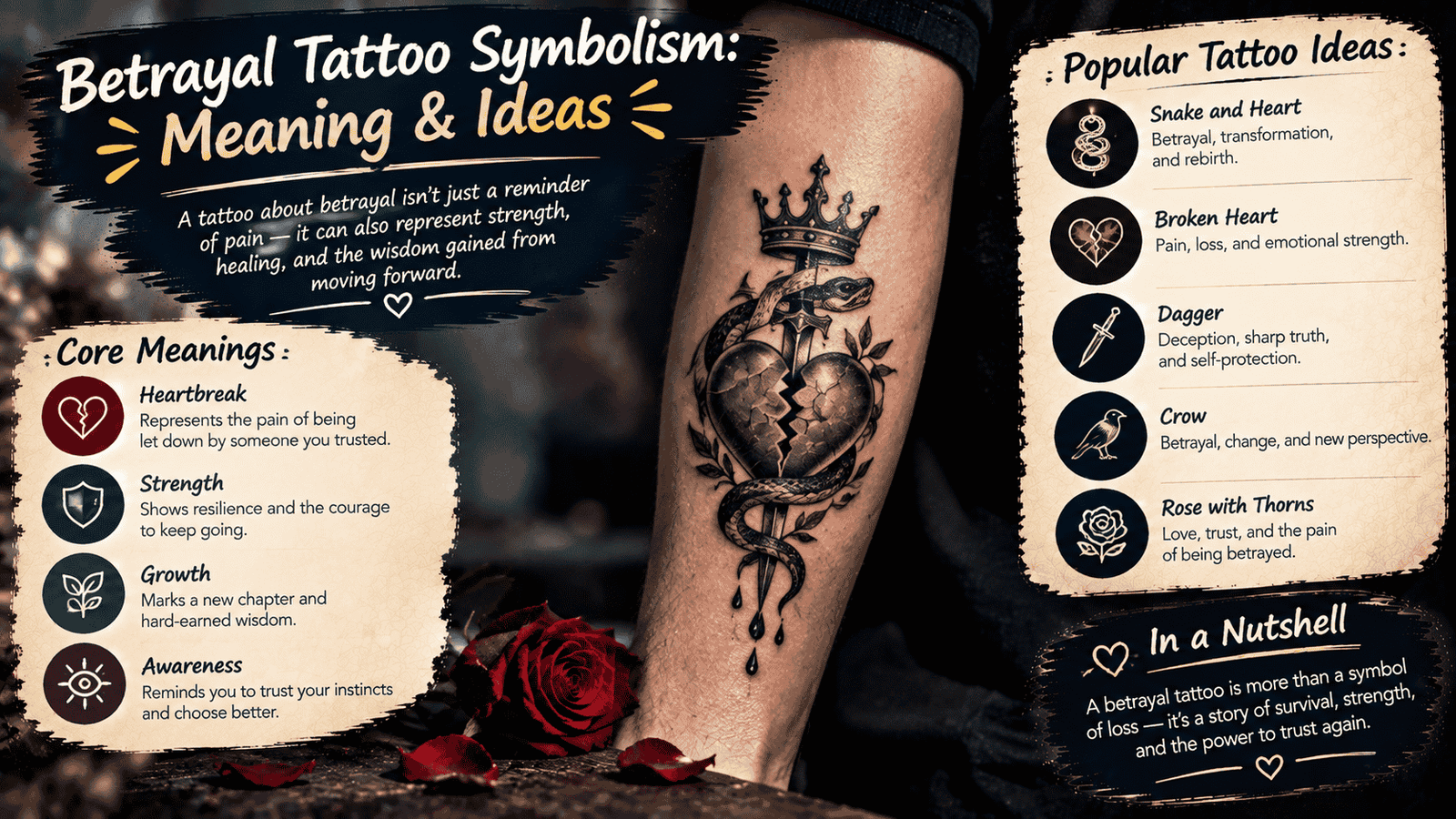
A betrayal tattoo commonly symbolizes broken trust, deception, emotional pain, disappointment, or the end of a relationship. People may use imagery such as daggers, broken hearts, snakes, masks, black roses, thorns, cracked mirrors, or broken chains to represent an experience of being betrayed.
The meaning is highly personal. One person may choose a betrayal tattoo to remember a painful experience, while another may use the same imagery to represent healing, independence, boundaries, or moving forward.
In modern tattoo culture, betrayal imagery does not necessarily communicate anger or revenge. Its meaning often depends on the design, accompanying words, placement, and the story behind it.
TL;DR
- Betrayal tattoos represent experiences involving broken trust, deception, or emotional disappointment.
- A dagger through a heart can symbolize emotional wounds caused by betrayal.
- Snakes are often associated with deception, secrecy, and hidden danger.
- Masks can represent false appearances or people who were not what they seemed.
- Broken hearts and black roses can symbolize loss, grief, and difficult relationships.
- Thorns may represent pain, protection, and lessons learned.
- A broken chain can symbolize freedom from a harmful relationship or situation.
- The meaning can shift from pain toward healing and personal strength.
- Placement can add another layer of private or public meaning.
- A betrayal tattoo does not automatically mean revenge, hatred, or hostility.
What Is a Betrayal Tattoo and What Does It Look Like?
A betrayal tattoo is a tattoo design chosen to represent an experience of broken trust, deception, disloyalty, or emotional loss. There is no single official symbol for betrayal. Instead, tattoo art draws from familiar images whose meanings have developed through mythology, literature, religion, art, and popular culture.
Common designs include a heart pierced by a dagger, a broken rose, a snake wrapped around a heart, a theatrical mask, a cracked mirror, or a chain breaking apart. Some people prefer realistic artwork, while others choose minimalist symbols, dates, initials, or short phrases.
The visual style can change the emotional impression. A dark, heavily shaded design may emphasize grief or pain, while a simple broken chain or emerging flower can focus more strongly on freedom and recovery.
The Core Symbolism Behind Betrayal Tattoos
Broken Trust and Emotional Pain
At the center of many betrayal tattoos is the idea of trust that has been damaged or destroyed. A heart, for example, is widely recognized as a symbol of emotional attachment, making a damaged or pierced heart an intuitive representation of emotional hurt.
For some people, putting this experience into permanent artwork creates a personal reminder of something significant. The tattoo may represent what happened without needing to communicate the entire story to other people.
Deception and Hidden Truths
Betrayal frequently involves discovering that someone or something was different from what was believed. Symbols such as masks, snakes, shadows, and cracked mirrors can therefore represent deception or hidden realities.
A mask can suggest a false identity or concealed intentions, while a cracked mirror can represent the realization that one’s previous understanding of a person or relationship has changed.
Loss, Separation, and Disappointment
Betrayal can also symbolize the loss of a relationship, friendship, expectation, or sense of security. Designs featuring fallen flowers, broken objects, fading imagery, or solitary figures can communicate this dimension.
In this context, the tattoo is less about the person who caused the pain and more about acknowledging an important chapter in the tattoo owner’s life.
Strength, Healing, and Moving Forward
Betrayal symbolism does not have to remain negative. A design can show what happened while emphasizing survival, independence, and personal growth.
For example, a broken chain may represent freedom, while a flower growing through cracks can suggest recovery after hardship. Adding new growth to darker imagery can visually transform the tattoo from a symbol of injury into one of resilience.
What Betrayal Tattoos Commonly Mean in the United States
In contemporary American tattoo culture, meanings are often individualized rather than fixed. A betrayal tattoo may relate to a romantic relationship, friendship, family conflict, professional disappointment, or another experience involving broken confidence.
Some people choose direct symbolism, such as the words “trust no one” or a dagger and heart. Others use indirect imagery that only they understand.
The tattoo may also function as a personal milestone. Instead of commemorating the betrayer, the design can commemorate the moment when the wearer recognized their own boundaries, independence, or ability to rebuild.
Why People Turn Betrayal Into Tattoo Symbolism
Tattoos are permanent visual records, so people sometimes use them to mark experiences that significantly changed their perspective.
A betrayal can affect how someone understands trust, relationships, communication, and personal boundaries. Turning that experience into symbolic artwork can provide a way to represent the transition from what happened to what was learned.
Another reason is that symbolism allows privacy. A small snake, broken heart, or black rose may carry an extensive personal story without explicitly identifying another person.
Historical Roots of Betrayal Imagery
Betrayal imagery has existed in art and storytelling for centuries. Weapons, serpents, broken objects, disguises, and wounded hearts have repeatedly been used to communicate danger, deception, disloyalty, or emotional injury.
The dagger became particularly powerful because it represents an attack that can be sudden and intimate. When combined with a heart, it connects physical imagery with emotional suffering.
The snake has another long symbolic history. Depending on the culture and context, serpents can represent wisdom, renewal, danger, temptation, transformation, or deception. Therefore, a snake tattoo should not automatically be interpreted as betrayal.
Betrayal Symbolism in Literature, Religion, Movies, and Popular Culture
Stories have helped establish many of the symbols now used in betrayal-themed tattoos. Literary and religious narratives frequently explore themes of loyalty, deception, broken promises, and consequences.
Characters such as Judas Iscariot and Brutus have become widely recognized cultural examples of betrayal. Their stories have influenced how Western audiences understand the idea of someone close turning against another person.
Modern movies, television, music, and visual art continue to use masks, knives, broken hearts, snakes, and roses to communicate similar themes. Tattoo artists and clients often adapt these familiar symbols into more personal designs.
Dagger and Pierced Heart Symbolism
The dagger and heart is one of the clearest visual combinations for emotional betrayal. The heart generally represents love, affection, trust, or emotional connection, while the dagger introduces the idea of injury.
A dagger passing directly through a heart can therefore suggest deep emotional pain caused by someone trusted.
Additional elements can alter the meaning. Blood may emphasize injury, roses may connect the design to romantic love, and wings or flowers may shift the focus toward healing and recovery.
Snake Symbolism: Deception, Betrayal, and Hidden Danger
A snake can represent deception because serpents have appeared in many stories involving temptation, secrecy, danger, or transformation.
However, snake symbolism is not universally negative. In different cultural and religious traditions, snakes can also represent renewal, healing, wisdom, fertility, protection, or transformation.
For a betrayal tattoo, the snake’s meaning usually comes from the surrounding design. A snake wrapped around a broken heart may communicate deception in a relationship, while a shedding snake may emphasize transformation after a painful experience.
Masks and False-Friendship Symbolism
A mask can represent the difference between appearance and reality. In betrayal-themed artwork, it may suggest that someone presented one personality while concealing another.
Two contrasting masks can symbolize changing behavior or hidden identities. A cracked mask may represent discovering what was behind someone’s public appearance.
This imagery can be particularly appropriate for friendship betrayal because it does not require a romantic interpretation.
Broken Hearts, Black Roses, and Thorns
A broken heart is one of the most recognizable symbols of emotional loss. When used in a betrayal tattoo, it can specifically represent trust that has been damaged.
A black rose can communicate grief, loss, endings, mystery, or remembrance. Its interpretation is not limited to betrayal, so additional imagery may clarify the intended meaning.
Thorns add another layer. They can represent the pain associated with love and relationships while also suggesting protection and boundaries. A rose surrounded by thorns can therefore symbolize both vulnerability and self-protection.
Judas, Brutus, and Famous Stories of Betrayal
Judas Iscariot is traditionally associated with the betrayal of Jesus in the New Testament narrative. His story has made his name an enduring reference point for betrayal in Western culture.
Marcus Junius Brutus is similarly associated with the assassination of Julius Caesar and the famous literary tradition surrounding Caesar’s reaction to the conspirators. His story has contributed to the cultural association between political loyalty, friendship, and betrayal.
Tattoo designs inspired by these figures may use names, historical references, daggers, Roman imagery, or symbolic quotations. The meaning depends on whether the wearer is focusing on betrayal itself, historical storytelling, or another personal interpretation.
Common Betrayal Tattoo Symbols and Their Meanings
Broken Chain
A broken chain commonly represents freedom, separation, and release. In a betrayal context, it may symbolize breaking away from a relationship or situation that damaged one’s trust.
Dagger or Knife
A dagger can represent a sudden emotional wound, particularly when paired with a heart or other relationship imagery.
Snake
A snake may symbolize deception, secrecy, hidden danger, or transformation. Its meaning should be interpreted from the complete design.
Mask
A mask often represents false appearances, hidden intentions, or discovering someone’s true nature.
Broken Heart
A broken heart directly communicates emotional loss, heartbreak, or damaged affection.
Black Rose
A black rose can symbolize grief, endings, remembrance, mystery, or loss. In a betrayal tattoo, it may represent mourning the end of a relationship.
Thorns
Thorns can symbolize pain, protection, boundaries, and the difficult experiences associated with love.
Cracked Mirror
A cracked mirror can represent changed perception, shattered expectations, or seeing a relationship differently after betrayal.
Fallen Crown
A fallen crown can represent damaged pride, lost status, disappointment, or the end of an idealized view of someone.
Emotional and Psychological Meaning
A betrayal tattoo can represent a range of emotions, including sadness, anger, disappointment, grief, confusion, and acceptance. Not everyone experiences betrayal in the same way, so the symbolism is highly individual.
For some people, the most important meaning develops after the initial emotional response. The tattoo may eventually represent boundaries, self-respect, independence, or personal growth rather than the original pain.
The design can also serve as a reminder that an experience occurred without allowing that experience to define an entire identity.
Betrayal Tattoos in Modern American Tattoo Culture
Modern tattoo culture places considerable emphasis on personal storytelling. People frequently combine established symbols with individual details such as dates, handwriting, flowers, animals, coordinates, initials, or meaningful objects.
Because of this, a betrayal tattoo does not have one universally understood interpretation. Two people can have nearly identical designs while attaching completely different stories to them.
Minimalist tattoos are also useful for private symbolism. A tiny broken heart, single thorn, cracked line, or small snake can carry personal meaning without looking like an explicitly themed tattoo.
Tattoo Placement and What It Can Symbolize
Placement can influence how public or private a betrayal tattoo feels.
Forearm: A visible location that can make the symbolism part of everyday self-expression.
Chest: Often chosen for emotionally personal imagery because of its association with the heart and inner life.
Upper arm: Provides enough space for detailed symbolic artwork while allowing the tattoo to remain covered when desired.
Back: Offers a larger canvas for complex scenes involving multiple symbols.
Wrist: Works well for small reminders, words, or minimalist symbols.
Ribs: Often selected for designs intended to remain more private.
The placement does not have a universal meaning. The wearer’s personal reason for choosing the location is usually more important than traditional tattoo interpretations.
Popular Small Betrayal Tattoo Ideas
Small designs can communicate betrayal without requiring a large composition. Some possibilities include:
- A tiny broken heart for damaged trust.
- A small dagger for emotional injury.
- A single black rose for loss or an ending.
- A minimal snake for deception or transformation.
- A cracked mirror symbol for changed perception.
- A broken chain for freedom and separation.
- A single thorn for pain and protection.
- A small mask for hidden identity.
- A fallen leaf for an ending or transition.
- A flower growing through a crack for healing after hardship.
Positive and Negative Interpretations of Betrayal Tattoos
Betrayal tattoos can carry both difficult and constructive meanings. The negative side may focus on hurt, distrust, grief, anger, or deception.
The positive interpretation can emphasize survival, learning, boundaries, independence, and emotional recovery. A design that begins with imagery of a wound can be expanded with flowers, light, wings, or new growth to communicate a movement toward healing.
Because tattoos are interpreted differently by different viewers, the same design may appear sad to one person and empowering to another.
Betrayal Tattoo vs. Revenge Tattoo: Key Differences
A betrayal tattoo generally focuses on the experience of broken trust and its emotional consequences. A revenge tattoo, by contrast, may be designed around retaliation, confrontation, or a desire to communicate anger toward another person.
The two themes can overlap, but they are not identical. A dagger through a heart may simply represent emotional pain, while a design explicitly centered on retaliation would communicate a different message.
Design choices can make the distinction clearer. Imagery involving broken chains, flowers, or rising figures tends to emphasize separation and recovery, while aggressive imagery can create a more confrontational interpretation.
Cross-Cultural and Religious Interpretations
Betrayal symbolism varies considerably between cultures and traditions. Snakes, for example, have both positive and negative meanings across different religious and cultural systems. A serpent may represent danger in one context and healing or renewal in another.
Religious traditions also contain stories about loyalty, temptation, forgiveness, sacrifice, and betrayal. Christian interpretations may connect betrayal imagery with Judas, while other traditions have their own stories and symbols involving broken loyalty.
Because symbols are culturally specific, it is useful to consider the original context before assigning a universal spiritual meaning to a tattoo.
How Betrayal Tattoo Meaning Changes With Design and Context
Small design changes can significantly alter interpretation. A snake surrounding a heart may emphasize deception, while a snake shedding its skin can focus on renewal and transformation.
Similarly, a broken heart alone may communicate sadness, but a broken heart surrounded by flowers can suggest recovery. A dagger can represent betrayal when placed through a heart, but it can have very different meanings in historical, military, or decorative designs.
Words and dates can provide additional context. A personal phrase can make the tattoo’s intended meaning clear even when the imagery is abstract.
Common Misunderstandings About Betrayal Tattoos
One common misunderstanding is that every dark tattoo represents anger or negativity. Dark imagery can also represent remembrance, transformation, protection, or artistic preference.
Another misconception is that snakes always mean betrayal. Snake symbolism is much broader and includes healing, wisdom, renewal, fertility, and transformation in different traditions.
It is also incorrect to assume that a betrayal tattoo is necessarily about romantic infidelity. Betrayal can involve friendships, family relationships, professional situations, or broken promises.
How Betrayal Symbolism Has Changed Over Time
Older betrayal imagery often came from religious narratives, mythology, historical events, and literature. Weapons, serpents, disguises, and political or religious stories provided recognizable symbols.
Modern tattoo culture has expanded these meanings by emphasizing individual experience. A person may combine traditional imagery with contemporary concepts such as emotional boundaries, self-discovery, independence, or healing.
As a result, betrayal symbolism has moved beyond simply identifying a betrayer. For many modern designs, the central message is what the wearer learned or became after the experience.
Choosing a Betrayal Tattoo With Personal Meaning
A meaningful betrayal tattoo should reflect the specific message the wearer wants to preserve. Before choosing a design, it can help to decide whether the central theme is loss, broken trust, deception, freedom, healing, or personal growth.
It is also worth considering whether the tattoo should directly reference another person. Names, initials, portraits, or relationship dates can create a very specific connection, while abstract symbolism can remain meaningful even as circumstances change.
The strongest personal symbolism does not necessarily require the darkest design. A tattoo can acknowledge betrayal while placing greater emphasis on recovery, boundaries, and a new chapter.
FAQs About Betrayal Tattoo Symbolism
What does a betrayal tattoo symbolize?
A betrayal tattoo can symbolize broken trust, deception, emotional pain, loss, or disappointment. Depending on the design, it can also represent healing, freedom, and personal growth after a difficult experience.
What tattoo represents being betrayed?
Common choices include a dagger through a heart, broken heart, black rose, snake, mask, cracked mirror, or broken chain. The surrounding imagery determines whether the emphasis is on pain, deception, separation, or recovery.
What flower symbolizes betrayal?
There is no single flower that universally means betrayal. Black roses are sometimes used in betrayal-related tattoo designs because they can represent loss, grief, endings, or remembrance.
What animal represents deception or betrayal?
The snake is one of the animals frequently associated with deception in Western symbolism. However, snakes have many other meanings across cultures, including transformation, healing, wisdom, and renewal.
What is a good small tattoo for overcoming betrayal?
A broken chain, flower growing through a crack, small rising bird, single thorn, or minimalist broken heart can represent moving beyond betrayal. Designs emphasizing growth and freedom can shift the focus from the painful event toward recovery.