Symbols of Growth and Progress: Meaning, Culture & Spirituality
Growth and progress are universal ideas that appear in nature, spirituality, art, culture, and everyday life. From a tiny seed becoming a strong tree to a person climbing a staircase toward a goal, humans have long used visual symbols to express development, transformation, achievement, renewal, and forward movement.
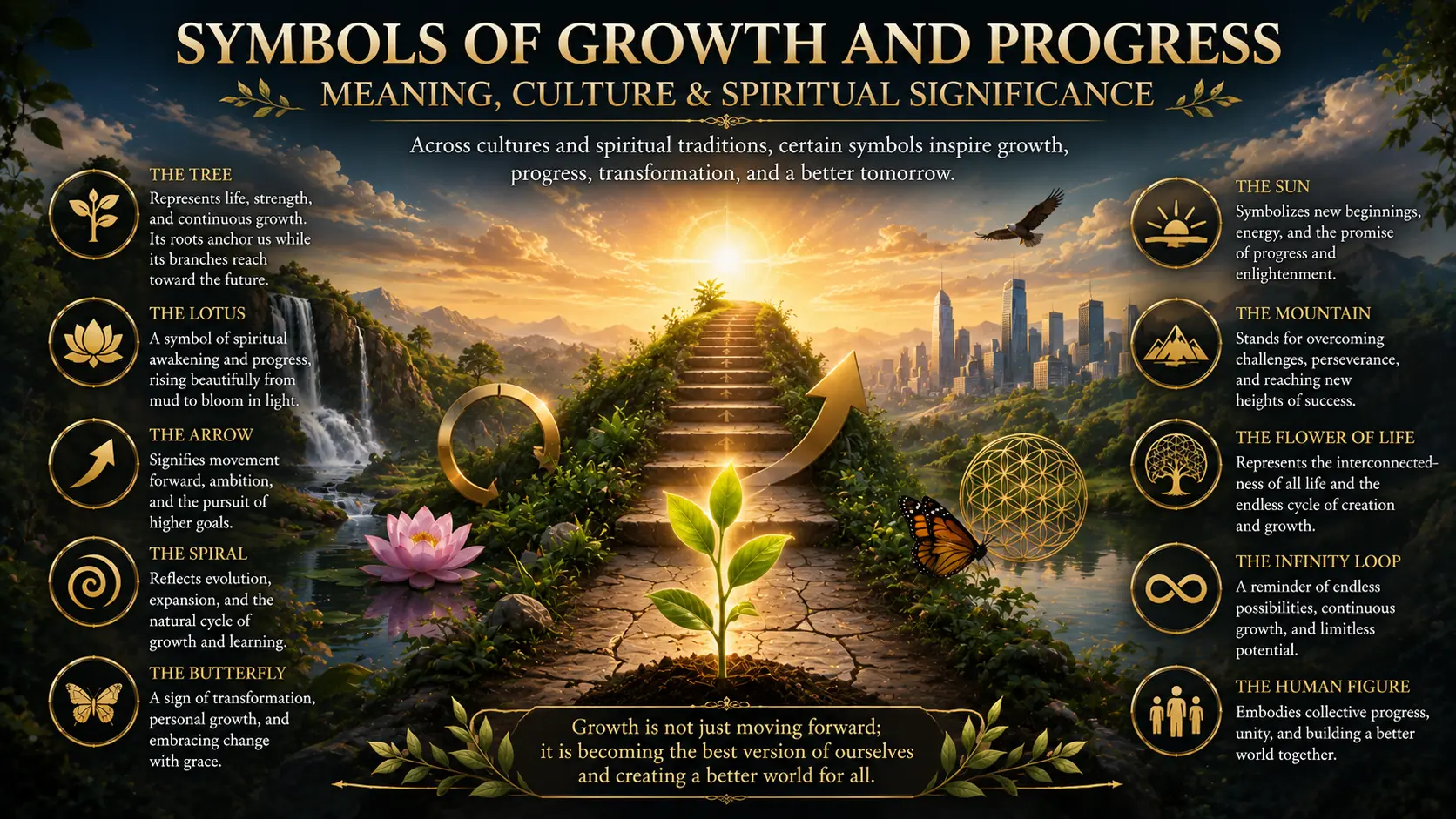
Symbols of growth and progress can be simple or complex. A tree may represent stability and long-term development, while a spiral can suggest continuous transformation. A rising sun may symbolize a fresh beginning, and a ladder may represent ambition or movement toward a higher state of awareness.
Although many of these symbols share common themes, their meanings are not identical everywhere. Cultural traditions, personal experiences, spiritual beliefs, and historical circumstances can influence how a symbol is understood.
Quick Answer
Symbols of growth and progress are images, objects, patterns, or natural forms that represent development, improvement, transformation, advancement, renewal, and movement toward a goal. Common examples include trees, seeds, flowers, spirals, ladders, stairs, mountains, rising suns, and upward arrows.
The tree is one of the strongest universal growth symbols because it develops from a small seed while remaining connected to its roots. Spirals often represent continuous development, while stairs and ladders commonly suggest gradual advancement.
TL;DR
Trees symbolize long-term growth, stability, wisdom, and connection.
Seeds represent potential, beginnings, patience, and hidden possibilities.
Flowers often symbolize transformation, beauty, renewal, and personal unfolding.
Spirals can represent cycles, evolution, expansion, and continuous change.
Ladders and stairs commonly represent ambition, achievement, progress, and movement toward higher goals.
Mountains can symbolize challenges, perseverance, accomplishment, and reaching new heights.
Rising suns often represent hope, renewal, opportunity, and a new chapter.
These meanings are widely recognized, but the interpretation of any symbol can change according to culture and personal context.
What Are Symbols of Growth and Progress?
Symbols of growth and progress are visual representations used to communicate the idea that something is developing, improving, expanding, changing, or moving forward. They may come from nature, architecture, mathematics, religious traditions, mythology, art, or modern design.
Many growth symbols are based on processes humans can easily observe. A seed becomes a plant, a bud becomes a flower, a child becomes an adult, and a small tree can eventually become a towering organism. These natural processes provide powerful metaphors for personal and collective development.
Common Visual Traits
Growth symbols frequently contain visual qualities associated with upward movement, expansion, transformation, repetition, or emergence. Vertical forms are especially common because they visually suggest movement from a lower position toward a higher one.
Trees, mountains, towers, ladders, arrows, and rising lines all create a sense of direction. Spirals and expanding circles communicate another kind of progress: development that occurs through cycles rather than through a perfectly straight path.
Why Humans Use Growth Symbols
People often use symbols because abstract ideas can be difficult to communicate directly. Growth is not something that can always be seen at one moment, but a tree, staircase, or blooming flower can make the concept immediately understandable.
A growth symbol can also provide emotional encouragement. Someone going through a difficult period may view a seed, mountain, or rising sun as a reminder that development takes time and difficult stages can be part of a larger journey.
Core Meanings of Growth and Progress
Growth and progress can involve far more than financial or professional achievement. They can describe emotional maturity, spiritual development, education, relationships, creativity, physical development, and social change.
For this reason, growth symbols often carry several meanings at once.
Growth and Personal Development
Personal growth involves becoming more aware, capable, confident, resilient, or emotionally mature. A tree with deep roots can represent the development of a strong inner foundation, while new branches can symbolize expanding experiences and opportunities.
The important idea is that growth does not always mean becoming bigger. Sometimes it means becoming wiser, stronger, more balanced, or more self-aware.
Progress and Achievement
Progress focuses on movement toward a desired outcome. Stairs, ladders, arrows, roads, and mountains are particularly effective symbols because they imply movement from one stage to another.
These images are often used in educational, professional, and motivational settings to communicate goals, improvement, advancement, and accomplishment.
Renewal and Transformation
Growth frequently requires transformation. A seed changes into a plant, a caterpillar transforms into a butterfly, and a flower emerges from a closed bud.
Such symbols remind us that meaningful development can involve leaving an earlier identity behind. Transformation is often represented as a natural part of growth rather than as a complete rejection of the past.
Ancient Origins of Growth Symbols
Long before modern branding and motivational imagery, ancient societies used natural objects and geometric forms to express ideas about life, fertility, renewal, death, rebirth, and spiritual development.
Many early symbols were connected to seasonal cycles. Humans observed that plants disappeared and returned, rivers continued flowing, animals reproduced, and the sun appeared to rise and set in predictable patterns.
Nature-Based Symbolism
Nature provided some of humanity’s earliest growth metaphors. Seeds, plants, trees, flowers, water, sunlight, and mountains were easy to observe and connect with life.
A seed could represent potential, even though its future form was hidden. A tree could represent endurance because it grows gradually over many years. Flowers could represent temporary beauty and renewal because they emerge, bloom, and eventually fade.
Early Civilizations and Sacred Traditions
Ancient cultures often connected fertility, vegetation, agriculture, and renewal with spiritual beliefs. Plants and trees could become associated with divine life, sacred spaces, ancestors, abundance, or cosmic order.
These traditions helped establish symbolic patterns that continue to appear today. However, the exact meaning of a symbol was never identical across all civilizations. Context remains essential when interpreting historical symbolism.
Trees as Powerful Symbols of Growth
The tree is perhaps one of the clearest symbols of growth because its entire structure visually communicates development.
A tree begins as a seed, develops roots, produces a trunk, and extends branches toward the sky. This creates a natural symbolic relationship between foundation, growth, expansion, and aspiration.
Why Trees Represent Growth
Trees grow slowly but continuously, making them powerful symbols of patience and long-term development. Their roots suggest grounding, while their branches suggest exploration and expansion.
A mature tree can also symbolize resilience. It may survive storms, droughts, changing seasons, and environmental challenges while continuing to develop.
Tree of Life Symbolism
The Tree of Life is an important symbolic concept found in different cultural and spiritual traditions. Although its meaning varies, it often connects themes such as life, interconnectedness, ancestry, balance, growth, and continuity.
Its roots can represent origins and ancestors, the trunk can represent the present foundation, and the branches can symbolize future possibilities.
Roots, Branches, and Personal Development
The parts of a tree provide a useful metaphor for human development. Roots can represent values, family, education, and experiences that provide stability.
Branches can symbolize relationships, interests, opportunities, and different directions a person may take. In this interpretation, healthy growth involves both strong foundations and continued expansion.
Spirals, Circles, and Cycles of Progress
Not all growth moves upward in a straight line. Spirals and circles represent a different understanding of progress: development through repetition, cycles, and transformation.
A person may return to familiar challenges while approaching them with greater knowledge and maturity. In this sense, progress can look circular while still moving forward.
Meaning of Spirals
Spirals are often associated with expansion, movement, evolution, and transformation. Their continuous form creates a sense that development has no simple endpoint.
The spiral can therefore represent the idea that growth is an ongoing process. You may revisit the same themes in life while experiencing them from a different level of understanding.
Circles and Continuous Growth
Circles commonly represent wholeness, continuity, cycles, and completion. When connected with growth, they can suggest that development is part of a larger recurring process.
The changing seasons are a useful example. Spring leads to summer, summer to autumn, and autumn to winter before another cycle begins. The cycle changes, but life continues.
Ancient and Modern Interpretations
Circular and spiral imagery appears in many historical and artistic traditions, although individual meanings differ. Today, these forms are also common in logos, tattoos, jewelry, architecture, and decorative design.
Modern interpretations frequently connect spirals with personal evolution, mindfulness, energy, creativity, and continuous self-development.
Ladders, Stairs, and Upward Movement
Ladders and stairs are among the most direct symbols of progress because they divide advancement into visible stages.
Instead of suggesting instant transformation, steps communicate gradual movement. Each step can represent a lesson, achievement, challenge, or milestone.
Climbing as a Symbol of Progress
Climbing generally requires effort. This makes ladders and mountains useful metaphors for ambition and perseverance.
The higher a person climbs, the farther they may see, creating another symbolic connection between progress and expanded perspective.
Steps and Personal Achievement
Stairs can represent the idea that major goals are reached through smaller actions. Each individual step may seem insignificant, but together they create meaningful advancement.
This makes stairs particularly relevant to education, career development, fitness, personal goals, and other areas where progress happens incrementally.
Cultural and Spiritual Interpretations
In spiritual contexts, upward movement may represent movement toward wisdom, enlightenment, divine awareness, or a higher state of consciousness.
However, upward symbolism should not automatically be interpreted as spiritually superior. Different cultures can understand vertical movement in very different ways.
Plants, Seeds, and New Beginnings
Seeds and plants are especially powerful symbols because they show how something small can contain the potential for significant development.
The process is also a reminder that growth often happens before it becomes visible. A seed may spend time underground before producing a visible shoot.
Seed Symbolism
A seed commonly represents potential, possibility, patience, preparation, and new beginnings.
As a metaphor for human life, it can suggest that a person’s abilities or dreams may exist before others can recognize them.
Flowers and Blossoms
Flowers often symbolize the visible stage of development. A closed bud can represent potential, while a fully opened flower can represent confidence, expression, beauty, or fulfillment.
Because flowers bloom and eventually fade, they can also symbolize the temporary nature of particular life stages.
Roots and Grounding
Roots symbolize the hidden foundation that supports visible growth. They can represent family, identity, education, experience, values, and emotional stability.
This creates an important lesson: healthy progress does not always look dramatic from the outside because much of development happens beneath the surface.
Symbols of Growth and Progress in American Culture
Growth and progress have a particularly strong presence in American cultural narratives. Ideas of opportunity, ambition, innovation, independence, and self-improvement frequently appear in national stories and popular culture.
National and Social Context
American imagery often uses roads, horizons, stars, buildings, cities, and rising forms to communicate movement and possibility.
The idea of moving toward a better future is frequently expressed through images of expansion and advancement.
The American Dream and Progress
The American Dream has historically been associated with opportunity, achievement, and the possibility of improving one’s circumstances.
Because of this cultural framework, symbols such as upward arrows, ladders, homes, open roads, and rising skylines can acquire meanings connected with ambition, opportunity, and social mobility.
Personal Success and Achievement
Modern American culture also commonly connects growth with education, entrepreneurship, career development, financial independence, and personal achievement.
This interpretation can be motivating, but growth can also be understood more broadly. Emotional well-being, relationships, creativity, community involvement, and personal wisdom are equally meaningful forms of progress.
Spiritual Meaning of Growth Symbols
Spiritual growth symbols often focus on inner transformation rather than external achievement. They can represent awakening, healing, renewal, wisdom, faith, or movement toward a deeper understanding of life.
Transformation and Inner Growth
A butterfly, seed, tree, or rising sun can symbolize an internal transformation. The central idea is that the individual is changing in ways that may not be immediately visible.
Spiritual growth is often described as a gradual process involving greater awareness, compassion, acceptance, and understanding.
Faith, Hope, and Renewal
Symbols of light, sunrise, flowers, and new leaves can represent hope after a difficult period.
Their message is not necessarily that challenges disappear. Instead, they may suggest that new possibilities can emerge even after periods of uncertainty or loss.
Awakening and Higher Awareness
Upward movement can sometimes symbolize spiritual awakening or expanded consciousness. A mountain peak, rising light, or ascending staircase can visually communicate movement toward a new perspective.
These meanings are personal and should be understood within the belief system of the person using the symbol.
Growth Symbolism Across Different Cultures
Growth symbols appear across the world, but their interpretations depend heavily on cultural traditions and historical context.
A tree may represent life in one tradition, ancestry in another, and sacred knowledge somewhere else.
Eastern Perspectives
Many Asian philosophical and spiritual traditions emphasize cycles, balance, transformation, discipline, and harmony. Growth may therefore be understood not simply as constant upward movement but as a process of developing balance and awareness.
Natural imagery such as flowers, mountains, water, bamboo, and trees can carry layered meanings.
European Traditions
European symbolism includes numerous historical associations involving trees, flowers, agricultural cycles, stars, mountains, and architectural forms.
Christian, classical, Celtic, Germanic, and later European traditions have each contributed different interpretations of renewal, life, virtue, and transformation.
Indigenous Perspectives
Indigenous cultures around the world have diverse symbolic systems, so there is no single universal Indigenous interpretation of growth.
In many traditions, relationships with land, plants, animals, ancestors, community, and seasonal cycles can provide important frameworks for understanding life and renewal. Specific meanings should always be considered within the individual culture rather than generalized.
African and Middle Eastern Traditions
African and Middle Eastern cultures contain rich symbolic traditions involving trees, water, fertility, agriculture, light, gardens, and renewal.
The meanings vary considerably between communities and historical periods, but natural processes often provide powerful ways to express life, continuity, abundance, and transformation.
Psychological Meaning of Growth and Progress Symbols
Growth symbols work psychologically because humans naturally respond to patterns of movement, development, and transformation.
Images can influence emotions even when people do not consciously analyze their symbolic meaning.
Why Upward Images Feel Positive
Humans often associate upward movement with achievement, elevation, visibility, and reaching a goal. This helps explain why arrows, rising graphs, stairs, mountains, and upward-facing forms are common in motivational communication.
However, the association is not absolute. Cultural experience and personal circumstances can change how a person responds to an image.
Emotional Associations
Growth symbols can evoke feelings such as hope, confidence, patience, courage, optimism, curiosity, and determination.
A symbol may become especially meaningful when it is connected to a personal experience. For example, someone who has overcome a major challenge may associate a mountain with perseverance rather than simply difficulty.
Motivation and Personal Identity
People sometimes use growth symbols as reminders of who they want to become. A tattoo, necklace, artwork, journal image, or personal logo can function as a visual statement of a long-term goal.
In this way, symbolism becomes more than decoration. It can become a personal reminder of values and intentions.
Modern Uses of Growth Symbols
Growth symbols are widely used in contemporary design because their meanings are relatively easy to understand visually.
Businesses, artists, writers, educators, and individuals use them to communicate development, hope, transformation, and progress.
Tattoos and Personal Expression
Growth-themed tattoos often include trees, flowers, butterflies, mountains, arrows, phases of the moon, and spirals.
People may choose these images to represent personal transformation, recovery from difficult experiences, new beginnings, family connections, or an ongoing life journey.
Art, Media, and Literature
Artists and writers frequently use growth imagery to communicate character development and transformation.
A growing plant can represent a character’s emotional journey, while a long road or mountain climb can represent challenges and eventual achievement.
Logos, Branding, and Design
Businesses often use leaves, upward arrows, trees, rising lines, and circular forms to suggest development and positive change.
These visual choices are especially common in industries associated with education, finance, technology, sustainability, health, and personal development.
Jewelry and Everyday Objects
Growth symbols also appear on necklaces, rings, bracelets, home décor, stationery, and gifts.
A tree pendant, for example, can represent family and continuity, while a flower may symbolize a new chapter or personal transformation.
Growth Symbols in Dreams and Personal Experiences
When growth symbols appear in dreams or meaningful personal experiences, their interpretation is highly individual.
A tree in a dream does not automatically have one fixed meaning. Its condition, location, emotional atmosphere, and relationship to the dreamer may be more important than the symbol alone.
Seeing Trees and Plants
A healthy growing tree may suggest stability, development, connection, or long-term potential.
A damaged or dying tree may evoke different themes, such as change, loss, vulnerability, or the need to restore one’s foundation.
Seeing Stairs or Ladders
Stairs can represent progress toward a goal, while a difficult climb may reflect feelings about effort or obstacles.
A person who feels excited while climbing may interpret the same image very differently from someone who feels trapped or exhausted.
Seeing Spirals and Circles
Spirals may suggest cycles, transformation, or recurring experiences. Circles may evoke completion, continuity, or a return to something important.
Dream symbolism should be treated as reflective rather than predictive. Personal associations are usually more meaningful than a universal dream dictionary.
Common Misunderstandings About Growth Symbols
Growth symbolism is powerful, but it can easily be oversimplified.
Symbols Do Not Have One Universal Meaning
There is rarely one meaning that applies everywhere. A symbol can represent life, death, wisdom, fertility, ambition, spirituality, or something entirely personal depending on context.
Cultural Context Matters
A symbol taken from another culture should not automatically be assigned a meaning based on modern internet interpretations.
Historical symbols deserve respectful treatment, particularly when they are connected to religious, Indigenous, or sacred traditions.
Positive Symbols Can Have Complex Meanings
Growth is not always comfortable. Development can involve endings, uncertainty, sacrifice, failure, and difficult choices.
Therefore, a growth symbol does not necessarily promise happiness or success. It may instead represent the process of becoming stronger through change.
How Growth and Progress Symbols Have Changed Over Time
The concept of progress has evolved as societies have changed.
Earlier symbolism often emphasized natural cycles, fertility, survival, harvests, and renewal. Modern symbolism frequently focuses on innovation, achievement, productivity, technology, and personal development.
From Natural Cycles to Human Achievement
Traditional growth imagery often showed humans as part of nature. Contemporary culture sometimes presents growth as something individuals actively control.
This difference reflects a broader shift from seeing life primarily as a cycle to emphasizing individual goals, measurable progress, and achievement.
Traditional Meanings in Modern Culture
Older symbols have not disappeared. Instead, their meanings have expanded.
A tree can still represent life and continuity while also representing environmental awareness, family identity, personal development, or sustainability.
Digital Age Interpretations
Digital culture has introduced new visual symbols of progress, including loading bars, rising graphs, achievement badges, levels, arrows, and progress indicators.
These modern forms translate an ancient human idea into a technological environment: something is moving from one stage toward another.
Comparing Growth Symbols by Meaning and Context
Different symbols emphasize different aspects of development.
| Symbol | Common Meaning | Main Theme |
|---|---|---|
| Tree | Stability, growth, wisdom | Long-term development |
| Seed | Potential, beginnings | Possibility |
| Flower | Transformation, renewal | Visible development |
| Spiral | Evolution, cycles | Continuous change |
| Ladder | Achievement, advancement | Step-by-step progress |
| Mountain | Challenge, perseverance | Overcoming obstacles |
| Sunrise | Hope, renewal | New beginnings |
| Arrow | Direction, movement | Forward progress |
| Butterfly | Transformation | Personal change |
| Circle | Continuity, wholeness | Cycles and completion |
Personal Growth vs. Material Progress
Personal growth focuses on qualities such as wisdom, emotional maturity, confidence, resilience, and self-awareness.
Material progress is more often represented by wealth, career advancement, technology, infrastructure, or measurable achievement. A symbol can communicate either form depending on its context.
Spiritual Growth vs. Social Progress
Spiritual growth generally emphasizes inner transformation, awareness, faith, compassion, or connection.
Social progress concerns communities and societies, including education, equality, innovation, cooperation, and improved living conditions.
Individual vs. Collective Growth
Some symbols focus on an individual journey, while others communicate collective development.
A personal tree tattoo might represent an individual’s roots and growth, while a growing forest may symbolize community, cooperation, or generations developing together.
FAQs About Symbols of Growth and Progress
What do symbols of growth usually represent?
They commonly represent development, transformation, renewal, potential, achievement, resilience, and positive change. Their exact meaning depends on the symbol and context.
What is the most common symbol of growth?
The tree is one of the most widely recognized symbols of growth because it naturally demonstrates development from seed to maturity while representing roots, stability, and expansion.
Are growth symbols the same across cultures?
No. Some symbols have broadly shared meanings, but cultural traditions can give them unique interpretations. Context is important when understanding historical or spiritual symbolism.
Why are upward symbols associated with progress?
Upward movement visually suggests advancement, elevation, achievement, and reaching a higher point. This is why stairs, ladders, mountains, arrows, and rising lines are frequently used to communicate progress.
Do growth symbols have spiritual meanings?
Yes, many growth symbols can have spiritual meanings related to awakening, renewal, transformation, faith, wisdom, and inner development. These interpretations vary according to belief and culture.
What symbols represent new beginnings and transformation?
Seeds, flowers, butterflies, sunrise imagery, new leaves, spirals, and emerging plants are common symbols of new beginnings and transformation.
Are growth symbols always positive?
Not necessarily. Growth can involve difficulty, uncertainty, loss, and major change. A symbol of growth may therefore represent the entire process of transformation rather than guaranteed success.
Conclusion
Symbols of growth and progress give visual form to one of the most universal human experiences: change over time. Trees, seeds, flowers, spirals, ladders, mountains, arrows, and rising suns all communicate different aspects of development.
The deepest meaning of these symbols is often found in the journey rather than the destination. A tree teaches patience, a seed suggests hidden potential, a staircase emphasizes gradual progress, and a spiral reminds us that growth can happen through cycles.
Ultimately, symbols of growth and progress encourage us to recognize that development is rarely instant or perfectly linear. Real growth can be slow, complicated, and deeply personal—but every stage can contribute to becoming something stronger, wiser, or more complete.