Namakubi Tattoo: Meaning, History & Symbolism
Quick Answer
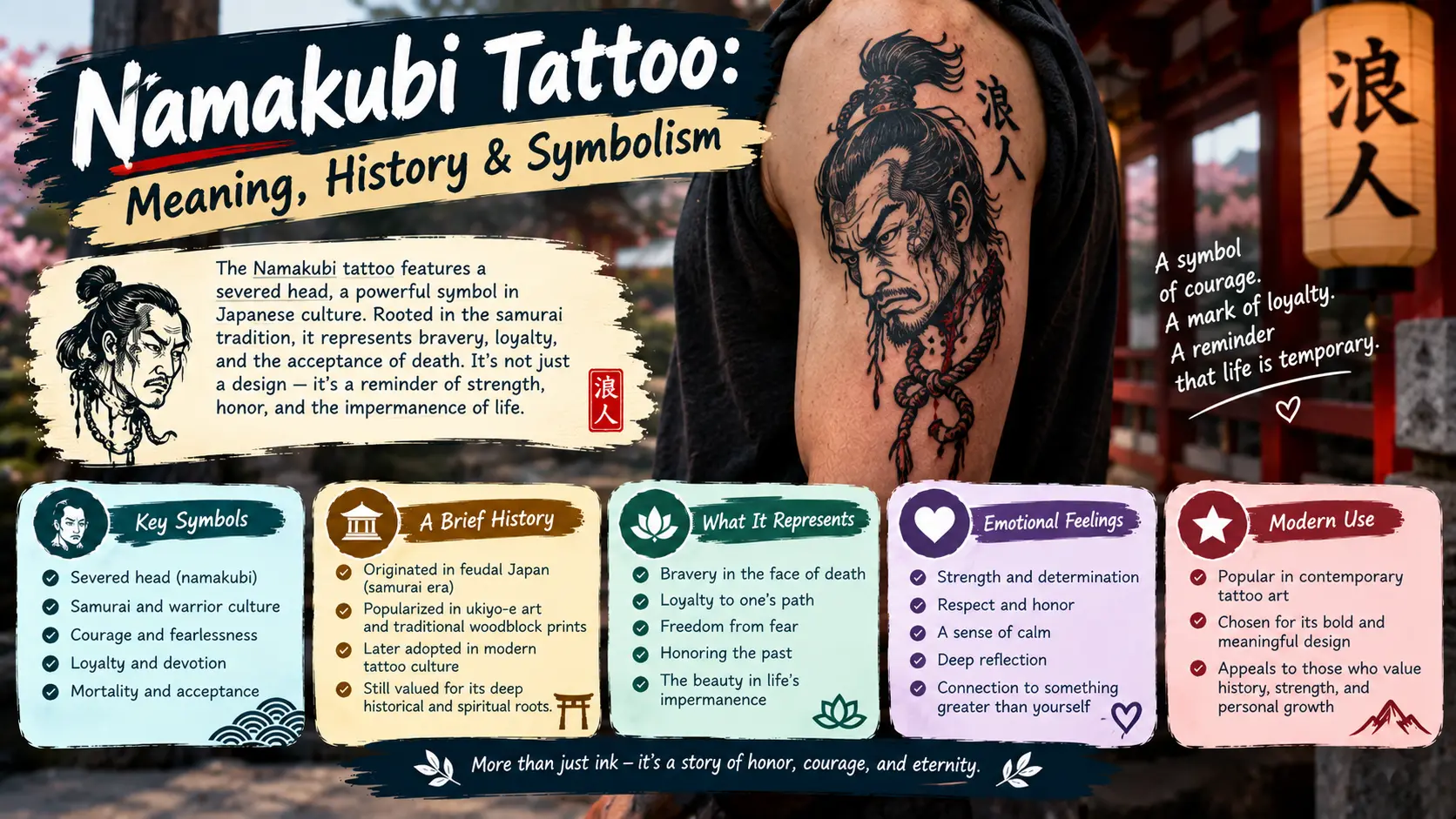
A namakubi tattoo is a Japanese-inspired tattoo featuring a severed human head. The Japanese term namakubi (生首) literally refers to a severed head, and the imagery has historical connections with warfare, samurai culture, traditional Japanese art, and tattooing.
In modern tattoo culture, a namakubi tattoo can represent mortality, courage, impermanence, strength, conflict, survival, and fearlessness. Its meaning can change significantly depending on facial expression, surrounding flowers, weapons, animals, colors, and other Japanese tattoo elements.
Although the image is associated with death, it does not necessarily represent a desire for violence. For some people, it is a visual reminder that life is temporary and that difficult experiences can be faced with courage.
TL;DR
- Namakubi is a Japanese term referring literally to a severed human head.
- A namakubi tattoo is strongly connected with traditional Japanese imagery and tattoo aesthetics.
- Common symbolic themes include mortality, impermanence, courage, conflict, strength, and transformation.
- Samurai and battlefield imagery influenced the historical development of severed-head representations.
- Flowers, snakes, oni, weapons, waves, and clouds can change the visual and symbolic message.
- Modern wearers may choose the design to represent survival, personal transformation, fearlessness, or acceptance of mortality.
- Because the imagery has a specific cultural and historical background, understanding its context is important before getting one.
What Does Namakubi Mean?
The Japanese word namakubi (生首) is generally translated as a severed or freshly severed human head. The word itself describes the subject rather than providing a single symbolic interpretation.
In tattoo culture, however, the term commonly refers to a particular visual motif associated with Japanese-style tattooing. The image may show a human head with flowing hair, dramatic facial expression, blood, wounds, flowers, weapons, or other decorative elements.
The Literal Meaning of Namakubi
The literal meaning is important because it separates the word from interpretations that have developed around it.
A namakubi represents a human head that has been separated from the body. In historical contexts, severed heads could have specific military, social, or ritual significance. In art and tattooing, the image became a dramatic way of representing subjects connected with death, conflict, impermanence, and the consequences of violence.
The literal image is therefore much more specific than simply calling it a “death tattoo.”
Namakubi in Japanese Tattoo Terminology
Within discussions of Japanese tattoo imagery, namakubi refers to a recognizable motif rather than a general category covering every image associated with death.
Traditional Japanese tattoo compositions often combine a central figure with background patterns, flowers, animals, mythical creatures, or other established motifs. A namakubi can therefore be designed as a standalone image or incorporated into a much larger composition.
What Is a Namakubi Tattoo?
A namakubi tattoo depicts a severed human head, usually rendered with considerable attention to facial expression, hair, shading, and surrounding decorative details.
The design can range from highly traditional Japanese compositions to modern interpretations influenced by realism, black-and-grey tattooing, or contemporary illustrative styles.
The Traditional Namakubi Image
Traditional-style namakubi imagery often emphasizes a dramatic head positioned within a strong composition. The face may appear angry, defiant, peaceful, frightened, or expressionless.
Long or flowing hair is another recognizable visual feature. Artists may also incorporate blood, wounds, decorative flowers, blades, or other motifs.
The surrounding composition is often just as important as the head itself. Japanese-style backgrounds such as waves, clouds, wind bars, smoke, and flowing lines can give the tattoo movement and depth.
Why the Image Is So Visually Powerful
The namakubi image creates a strong contrast between human beauty and mortality. Facial details make the subject recognizable as a person, while the severed form immediately communicates death and impermanence.
This contrast allows the tattoo to carry a range of meanings. Someone may view it primarily as historical imagery, while another person may connect it with surviving a difficult period or accepting the temporary nature of life.
Namakubi Tattoo Meaning and Symbolism
There is no single universal interpretation for every namakubi tattoo. Meaning depends on historical context, artistic choices, and the person wearing the tattoo.
Several themes, however, appear repeatedly.
Mortality and Impermanence
The most direct symbolism is mortality. A severed head is an unmistakable reminder that human life has an endpoint.
This can make the tattoo a representation of impermanence. Rather than necessarily celebrating death, it can acknowledge that life changes and eventually ends.
For some people, this interpretation becomes a reminder to value the present and recognize that circumstances are temporary.
Fearlessness and Courage
Because the image confronts death directly, it can also symbolize fearlessness.
A person may choose the design as a visual statement about facing difficult circumstances rather than allowing fear to control their decisions. The symbolism can be especially meaningful when the tattoo marks a period of personal hardship.
Victory and Defeat
Historical representations of severed heads can be connected with warfare and victory over an opponent.
In a tattoo, this symbolism may appear through combinations with warriors, weapons, armor, or other battlefield imagery. However, the historical meaning should not automatically be assumed to be the personal meaning of every modern wearer.
Strength and Warrior Spirit
Namakubi imagery can also evoke ideas of strength, endurance, discipline, and warrior identity.
When paired with samurai-inspired imagery, the tattoo may emphasize themes of confronting danger and remaining composed under difficult circumstances.
Modern interpretations can move beyond literal warfare and apply the idea of a “warrior spirit” to personal resilience.
Transformation and Rebirth
Although death is central to the image, modern symbolic interpretation can extend toward transformation.
The end of one stage of life can become the beginning of another. Someone might use a namakubi tattoo to mark the closing of a difficult chapter, a major personal change, or the decision to move forward.
This interpretation is more personal and modern than a literal historical definition of namakubi.
See Also: Kaizen Tattoo Meaning: Symbolism, History, and Modern Use
Historical Origins of Namakubi Imagery
The imagery has to be understood within the broader history of Japanese warfare and visual culture.
Severed-Head Imagery in Japanese History
Severed heads appeared in historical Japanese military contexts and artistic representations. In periods of warfare, identifying defeated opponents could have political and military significance.
Over time, these subjects became part of Japanese visual storytelling. Artists represented battles, warriors, legendary figures, and dramatic historical events through prints and illustrated works.
The imagery therefore developed within a broader cultural environment rather than originating as a modern tattoo trend.
Samurai and Battlefield Traditions
Japanese warfare included historical practices involving the collection and presentation of enemy heads. These practices were connected with military status, identification, and recognition of achievements.
It is important to distinguish these historical practices from modern tattoo symbolism. A contemporary namakubi tattoo does not automatically communicate the same social or military meaning.
Instead, modern tattooing often transforms historical imagery into a personal symbol of courage, mortality, history, or resilience.
Namakubi in Japanese Art
Traditional Japanese visual arts frequently explored dramatic subjects involving warriors, ghosts, supernatural beings, battles, and death.
Woodblock prints and other forms of popular art helped establish visual conventions for depicting dramatic human figures. These artistic traditions later became important references for Japanese tattoo imagery.
The namakubi motif fits naturally within this larger tradition of visually powerful storytelling.
Namakubi and Traditional Japanese Tattooing
Namakubi became especially recognizable within the broader world of Japanese tattoo aesthetics.
Irezumi and Japanese Tattoo Culture
Irezumi is commonly used as a term for Japanese tattooing, although Japanese tattoo terminology and practices are more complex than a single word suggests.
Traditional Japanese tattoo aesthetics often emphasize bold outlines, strong colors, detailed figures, and carefully planned compositions.
A namakubi tattoo can use these characteristics to create a highly dramatic image.
Horimono and Full-Body Composition
Traditional Japanese tattooing can involve large compositions that extend across substantial portions of the body.
Rather than treating each image as an isolated sticker-like design, the composition may connect figures, flowers, animals, and background patterns.
A namakubi can serve as a central focal point while waves, clouds, wind, flowers, and other elements create a visual framework around it.
The Role of Storytelling
One of the most important characteristics of traditional Japanese tattoo composition is visual storytelling.
A namakubi may communicate one part of a larger story. A warrior, flower, snake, blade, or mythical creature can add additional layers of interpretation.
This is why simply identifying the head itself does not always explain the entire tattoo.
Common Namakubi Tattoo Designs
The basic concept can be interpreted in many artistic styles.
Realistic Namakubi Tattoo
A realistic design emphasizes facial anatomy, skin texture, hair, shadows, and expression.
This approach can make the tattoo visually intense because the viewer sees the human characteristics of the subject in considerable detail.
Black-and-grey realism is particularly suited to designs where the artist wants to emphasize texture and shading rather than bright colors.
Traditional Japanese Namakubi Tattoo
A traditional Japanese version usually emphasizes strong outlines, controlled color, decorative backgrounds, and recognizable Japanese composition.
The head may be surrounded by waves, flowers, clouds, wind, or other motifs.
This approach places the namakubi within a larger artistic tradition rather than presenting it as an isolated realistic image.
Samurai Namakubi Tattoo
A samurai-inspired design can combine the namakubi with armor, helmets, swords, or other warrior imagery.
This combination emphasizes themes of warrior culture, courage, conflict, honor, and mortality.
Historical accuracy can vary considerably in modern tattoos, so anyone seeking a historically informed design should discuss references with an artist familiar with Japanese history.
Namakubi With Flowers
Flowers provide an important contrast to the imagery of death.
Cherry blossoms can emphasize the temporary nature of life, while peonies can add associations with beauty, richness, and traditional Japanese decorative aesthetics. Chrysanthemums can introduce additional cultural and symbolic associations.
The combination of flowers and namakubi can therefore create a visual relationship between beauty and mortality.
Namakubi With Snakes
Snakes can introduce ideas such as danger, transformation, mystery, and renewal.
When combined with a namakubi, the snake can make the overall design more complex. The final interpretation depends on the specific snake imagery and the broader composition.
Namakubi With Oni or Demons
Adding an oni or other supernatural figure creates a distinctly different atmosphere.
Instead of focusing primarily on human mortality and historical warfare, the design may emphasize fear, supernatural power, protection, conflict, or the boundary between life and death.
Namakubi Tattoo Symbolism by Design Elements
Small design decisions can significantly change the impression of the tattoo.
Blood
Blood makes the connection with violence and mortality more explicit.
Some designs use highly visible blood for dramatic effect, while others minimize it and rely on facial expression and composition. The choice can shift the tattoo from graphic imagery toward a more symbolic interpretation.
Facial Expression
The facial expression is one of the most important parts of a namakubi tattoo.
An angry expression may emphasize conflict. A calm expression can suggest acceptance. A fearful expression can focus attention on vulnerability and mortality.
The same basic motif can therefore communicate very different emotions.
Hair
Flowing hair is visually important in many traditional-style representations.
It creates movement and can make the composition feel dramatic even when the central figure is stationary. Hair can also provide opportunities for the artist to integrate flowers, wind, or other background elements.
Flowers
Flowers create contrast with the severed head and introduce ideas related to beauty, life, seasons, impermanence, and renewal.
Their significance depends on the particular flower and the cultural context in which it is used.
Background Elements
Waves, clouds, wind bars, smoke, and other background patterns help establish the environment around the main subject.
They can also connect separate elements into one cohesive tattoo instead of making the composition appear like several unrelated images.
Namakubi Tattoo Meaning in Japanese Culture
Understanding the cultural background is important because namakubi is not simply a generic Western-style symbol of death.
Why Cultural Context Matters
Japanese tattoo imagery developed through specific artistic, historical, and cultural traditions.
Using a traditional Japanese motif without understanding its background can lead to an oversimplified interpretation. Learning about the imagery can help a person make more informed decisions about design and symbolism.
Historical Meaning vs. Modern Interpretation
A distinction should be made between historical meaning and personal symbolism.
Historical representations of severed heads existed within particular military and artistic contexts. A modern person may instead choose a namakubi because it represents survival, mortality, courage, or transformation.
Both the historical background and the wearer’s personal intention can be relevant.
Namakubi Tattoo Meaning in the United States Today
Japanese-inspired tattoos have become widely recognized within American tattoo culture.
Popularity in Modern Tattoo Culture
Japanese tattoo aesthetics have influenced many tattoo styles in the United States.
Modern artists may combine traditional Japanese composition with realism, black-and-grey techniques, fine detail, or contemporary illustrative approaches.
As a result, not every namakubi tattoo looks traditionally Japanese.
Personal Meanings People May Attach to Namakubi
A modern wearer might associate the tattoo with:
- Accepting mortality
- Overcoming fear
- Surviving hardship
- Closing an old chapter
- Personal transformation
- Strength and resilience
- Remembering a difficult period
- Interest in Japanese history or art
These are personal interpretations rather than universal definitions.
Namakubi Tattoo Placement Ideas
The size and detail of the tattoo should influence placement.
Arm and Forearm
The arm and forearm can accommodate medium-sized namakubi designs.
A vertical composition can work particularly well because the shape of the head and surrounding elements can follow the natural length of the limb.
Leg and Calf
The calf offers enough space for a vertically oriented composition.
Waves, flowers, clouds, or other background elements can be incorporated around the main image.
Chest and Back
The chest and back provide considerably more space for elaborate designs.
These areas can accommodate a central namakubi surrounded by extensive traditional Japanese backgrounds.
Shoulder and Upper Arm
The shoulder and upper arm work well for compositions that curve naturally around the body’s shape.
A skilled artist can use the body’s contours to make the design appear integrated rather than simply placed on the skin.
Namakubi Tattoo Color Choices
Color can dramatically affect the final appearance.
Black and Grey Namakubi
Black-and-grey designs emphasize shading, texture, facial expression, and contrast.
This style can produce a darker, more restrained appearance and is particularly effective for realistic interpretations.
Traditional Japanese Color
Traditional Japanese-inspired designs often use strong, clearly defined colors.
Color can help separate the central figure from flowers, waves, clouds, and other elements while maintaining a cohesive composition.
Red and Black Designs
Red and black create a particularly dramatic combination.
Red can emphasize blood, flowers, or selected decorative details, while black establishes the primary outlines and shadows.
Using a limited palette can make specific elements stand out without overwhelming the central image.
Namakubi Tattoo Ideas for Men and Women
There is no requirement that namakubi imagery belong to one gender or body type.
Bold Traditional Designs
Large traditional compositions can emphasize the historical and artistic qualities of the motif.
These designs often use strong outlines, substantial backgrounds, and several interconnected elements.
Smaller Namakubi Designs
A smaller version can simplify the facial details and surrounding decoration.
However, extremely small designs may lose some of the visual characteristics that make namakubi recognizable, particularly intricate hair and facial features.
Feminine-Inspired Namakubi Designs
Some contemporary designs combine namakubi imagery with flowers, ornamental elements, elegant linework, or softer compositions.
The central symbolism remains connected with mortality and dramatic Japanese imagery, while the surrounding aesthetic can make the tattoo feel more personal.
Is a Namakubi Tattoo Offensive?
Whether a tattoo is perceived as offensive can depend on its context, execution, and the viewer’s cultural perspective.
Cultural Appropriation and Japanese Imagery
Using imagery from another culture does not automatically have one universal interpretation.
However, people can approach Japanese-inspired tattooing more respectfully by learning the meaning and history of the motifs they choose.
Understanding the difference between traditional imagery and modern adaptations is particularly useful.
Violent Imagery and Personal Interpretation
Because namakubi depicts a severed head, some people will naturally interpret it as violent or disturbing.
Others may see it primarily as historical artwork or a symbolic representation of mortality.
Neither response should automatically be assumed to represent the tattoo wearer’s personal intention.
How to Approach the Design Respectfully
A thoughtful approach includes researching the term, understanding the historical background, and discussing the design with an experienced tattoo artist.
It is also useful to decide what the tattoo means personally before selecting decorative elements simply because they look attractive.
Namakubi Tattoo vs. Other Death-Themed Tattoos
Namakubi shares themes with several other death-related tattoo motifs but is not identical to them.
Namakubi vs. Skull Tattoo
A skull is a generalized representation of death and mortality found across many cultures.
Namakubi is more specifically connected with Japanese imagery and the representation of a severed human head.
Namakubi vs. Hannya Tattoo
A Hannya is a Japanese Noh mask representing a specific supernatural female figure transformed by intense jealousy and emotion.
A namakubi, by contrast, depicts a severed human head.
Although both can appear in Japanese-style tattooing, their histories and meanings are different.
Namakubi vs. Grim Reaper Tattoo
The Grim Reaper is a Western personification of death, typically represented as a skeletal or cloaked figure carrying a scythe.
Namakubi communicates death through a different visual and cultural tradition.
Namakubi Tattoo in Dreams and Symbolic Interpretation
Dreams involving severed heads or namakubi-like imagery do not have one scientifically established universal meaning.
For some people, such imagery may be connected with fear, endings, conflict, major changes, or feelings about mortality. Personal experiences and emotional associations can strongly influence dream content.
A dream should therefore be treated as an individual experience rather than as a fixed spiritual prediction.
How to Choose a Namakubi Tattoo Design
Choosing a namakubi tattoo requires more than selecting an image from a collection of designs.
Decide What the Tattoo Represents
First identify the central personal meaning.
You may want the tattoo to represent mortality, resilience, courage, transformation, historical interest, or another personal idea.
Having a clear intention makes it easier to select the right expression, colors, background, and placement.
Choose the Right Supporting Elements
Supporting imagery can include:
- Peonies
- Cherry blossoms
- Chrysanthemums
- Snakes
- Samurai
- Oni
- Swords
- Waves
- Clouds
- Wind patterns
Each element contributes to the overall visual story.
Consider Size and Placement
Highly detailed namakubi designs generally need enough space for facial features, hair, shading, and background elements.
Before choosing a placement, consider how much detail you want and whether the tattoo needs to remain visible or can be covered.
Choose an Experienced Tattoo Artist
Look for an artist whose portfolio demonstrates experience with Japanese-inspired composition.
Pay particular attention to healed tattoos, not only freshly completed work. A healed portfolio can provide a better indication of how lines, shading, and colors remain over time.
Common Misunderstandings About Namakubi Tattoos
“Namakubi Only Means Violence”
Violence is part of the historical context of severed-head imagery, but it is not the only possible modern interpretation.
A contemporary tattoo can also represent mortality, courage, resilience, transformation, or historical interest.
“Every Namakubi Tattoo Has the Same Meaning”
The basic image remains recognizable, but surrounding elements and personal context can change its interpretation.
A namakubi surrounded by flowers communicates a different visual message from one combined with weapons and battlefield imagery.
“Namakubi Is the Same as Every Japanese Death Symbol”
Japanese tattoo culture contains many different motifs associated with death, spirits, danger, transformation, and the supernatural.
Namakubi specifically refers to the severed-head motif and should not automatically be treated as interchangeable with skulls, Hannya, oni, or other imagery.
Frequently Asked Questions About Namakubi Tattoos
What does a namakubi tattoo mean?
A namakubi tattoo commonly represents mortality, impermanence, courage, conflict, strength, and fearlessness. Its specific meaning depends on the design and the person wearing it.
What does namakubi mean in Japanese?
Namakubi (生首) literally refers to a severed human head. In tattoo discussions, the word commonly identifies the distinctive severed-head motif found in Japanese-inspired tattoo art.
Is namakubi tattoo Japanese?
Yes. Namakubi imagery has roots in Japanese historical and artistic traditions and became associated with Japanese tattoo aesthetics. Modern tattoo artists may interpret the motif in traditional or contemporary styles.
Is namakubi tattoo offensive?
A namakubi tattoo can be perceived differently depending on cultural context and individual interpretation. Understanding its Japanese historical background and working with an artist familiar with the imagery can help avoid superficial or inaccurate use of the motif.
What does a namakubi tattoo symbolize?
Common interpretations include mortality, impermanence, courage, warrior spirit, conflict, resilience, and transformation. There is no single meaning that applies to every tattoo.
What is the difference between namakubi and hannya?
Namakubi depicts a severed human head, while Hannya imagery represents a specific Japanese Noh mask associated with a woman transformed into a supernatural figure through intense emotion.
What flowers go with a namakubi tattoo?
Common Japanese-inspired floral choices include cherry blossoms, peonies, and chrysanthemums. Flowers can introduce themes of beauty, seasonal change, life, impermanence, and traditional Japanese aesthetics.
Where should I put a namakubi tattoo?
Possible placements include the back, chest, upper arm, forearm, thigh, and calf. Larger areas generally provide more room for detailed facial features and traditional Japanese backgrounds.
Does a namakubi tattoo mean death?
Death is a central element of the imagery, but the tattoo does not necessarily mean only death. It can also represent acceptance of mortality, courage, survival, transformation, or remembrance.
Can a namakubi tattoo have a positive meaning?
Yes. Some modern interpretations use the imagery as a reminder of resilience, fearlessness, personal growth, or appreciation for life. These positive interpretations are personal rather than fixed historical definitions.
Final Thoughts on Namakubi Tattoo Meaning
A namakubi tattoo is one of the most visually recognizable death-related motifs associated with Japanese tattoo imagery. Its literal subject is a severed human head, but its symbolic possibilities extend beyond a simple representation of violence.
Historically, severed-head imagery was connected with warfare and Japanese visual culture. Within tattooing, the motif became part of a broader artistic language involving warriors, flowers, supernatural figures, animals, weapons, and dynamic backgrounds.
Today, a namakubi tattoo may represent mortality, courage, impermanence, resilience, strength, transformation, or personal history. The expression, color palette, supporting imagery, and placement all influence how the finished design is understood.
Because the motif has a specific cultural and historical background, thoughtful research is valuable. A well-designed namakubi tattoo can combine powerful visual storytelling with a personal meaning while remaining informed by the tradition from which the imagery developed.