Spiritual Meaning and Symbolism of the Star: Deeper Meanings
Quick Answer
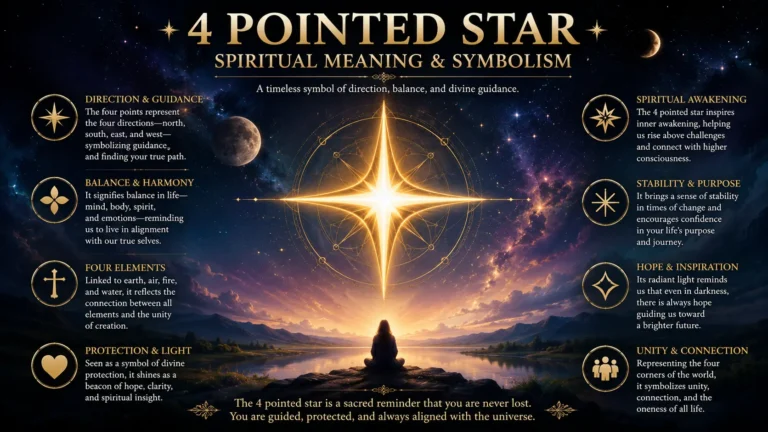
The star spiritually symbolizes hope, guidance, divine presence, transformation, ambition, protection, and connection to something greater than ourselves. Because stars shine in the darkness and appear constant across generations, people have long associated them with direction, eternity, wisdom, and spiritual illumination.
The meaning of a star can change depending on its shape, number, color, cultural setting, personal experience, and surrounding symbols. A star in a religious setting may represent divine guidance, while a star tattoo may express individuality, dreams, remembrance, or personal growth.
TL;DR
- Hope: A star can represent light during difficult times.
- Guidance: Stars have historically helped travelers find direction.
- Spirituality: They may symbolize divine presence or higher awareness.
- Transformation: A star can represent becoming something brighter or stronger.
- Ambition: “Reaching for the stars” connects stars with goals and achievement.
- Protection: Some traditions associate stars with guardianship and safety.
- Eternity: Their appearance in the night sky can evoke ideas of timelessness.
- Personal meaning: A star can represent a person, memory, dream, milestone, or life purpose.
What Is the Star as a Symbol?
A star is one of humanity’s oldest and most recognizable symbols. At its simplest, it is an image representing a luminous object in the night sky. Symbolically, however, the star can mean far more than astronomy.
Stars appear distant, mysterious, and enduring. They remain visible above human life regardless of changing generations, cultures, and circumstances. This has encouraged people to connect them with eternity, destiny, guidance, mystery, and the divine.
The star also has an important psychological quality: it is a point of brightness surrounded by darkness. This visual contrast naturally supports interpretations involving hope, clarity, resilience, and spiritual awakening.
How Stars Appear Visually
In nature, stars appear as tiny points of light scattered across the night sky. Although astronomical stars are enormous celestial bodies, their immense distance makes them look small from Earth.
Symbolic stars are often represented using five-pointed, six-pointed, eight-pointed, or other geometric forms. These shapes do not automatically carry the same meaning. Their interpretation depends heavily on the culture and context in which they appear.
Core Meaning at a Glance
| Symbolic Theme | Common Interpretation |
|---|---|
| Hope | Light during darkness |
| Guidance | Finding direction |
| Wisdom | Illumination and understanding |
| Spirituality | Connection with the divine |
| Protection | Watchfulness and guardianship |
| Ambition | Reaching toward goals |
| Eternity | Timelessness and continuity |
| Transformation | Becoming something greater |
| Destiny | A meaningful life path |
| Remembrance | Honoring someone or something |
Ancient Origins of Star Symbolism
Long before modern astronomy explained stars as distant suns, people looked toward the heavens and searched for meaning. The predictable appearance of stars made the night sky an important source of orientation, storytelling, calendars, and spiritual reflection.
Ancient communities did not necessarily separate astronomy, mythology, religion, and everyday life in the same way modern societies often do. Celestial objects could simultaneously serve practical, cultural, and spiritual purposes.
Prehistoric and Ancient Roots
Evidence from ancient societies shows that celestial observation was important for tracking seasons and organizing time. Stars could help communities understand when certain seasonal changes were approaching and could provide orientation during travel.
Over time, the practical importance of the stars became intertwined with symbolic ideas. Because stars appeared above humanity yet seemed unaffected by ordinary earthly events, they could become representations of permanence, cosmic order, and mystery.
The star therefore developed a powerful symbolic contrast: humans experience change and mortality, while the heavens appear enduring.
Mythology and Early Spiritual Thought
Ancient mythology frequently connected celestial objects with gods, heroes, ancestors, or supernatural events. Constellations transformed groups of stars into stories that could be remembered and passed between generations.
This helped establish one of the most enduring meanings of stars: they can turn something distant and mysterious into a story about human experience.
Stars could represent heroes placed in the heavens, divine beings, destiny, or signs associated with important events. These traditions contributed to the modern idea that looking at a star can inspire reflection on one’s own journey.
Religious and Spiritual Interpretations
Stars have appeared in many religious and spiritual traditions, although their meanings are not universal. A star should not automatically be interpreted as representing one specific religion.
Instead, different traditions have assigned particular meanings to particular star shapes, arrangements, stories, and celestial events.
Judeo-Christian Traditions
Stars have an important presence in Jewish and Christian religious imagery and scripture. In Christianity, the Star of Bethlehem is traditionally associated with the birth of Jesus and the guidance of the Magi.
Because of this tradition, a star can symbolize guidance, revelation, divine direction, and hope in Christian contexts.
Judaism also has an important association with the Star of David, a six-pointed geometric symbol that became strongly connected with Jewish identity. Its historical development is complex, and its meaning should not be reduced to a single universal spiritual interpretation.
Other Spiritual Systems
Outside Judeo-Christian traditions, stars have been interpreted in numerous ways. Some cultures connected celestial bodies with gods, ancestors, destiny, or cosmic forces.
Astrological traditions also gave stars and other heavenly bodies symbolic significance in relation to personality, timing, and human experience.
In contemporary spirituality, stars are frequently used more broadly. Someone may interpret seeing a particularly bright star as a reminder to stay hopeful, follow a personal calling, trust their direction, or remain connected to a larger perspective.
These interpretations are personal or spiritual beliefs rather than scientific conclusions.
Symbolism of the Star in the United States
In the United States, stars have an especially rich symbolic history. They appear in national imagery, state flags, military insignia, entertainment, sports, decorations, and everyday expressions.
The American meaning of a star is therefore often a combination of freedom, aspiration, identity, achievement, and cultural symbolism.
National Identity and Ideals
The most recognizable example is the United States flag, which contains 50 white stars representing the 50 states. In this context, stars are directly connected to the structure and identity of the nation.
Stars also appear extensively in state flags and government-related imagery. Their use can communicate ideas such as unity, belonging, independence, or civic identity.
American culture also uses the word “star” metaphorically to describe exceptional achievement. A person who becomes highly successful may be called a “star,” reinforcing associations between stars and excellence, recognition, and accomplishment.
Popular Culture and Media
Hollywood has made the star one of the most recognizable symbols of fame. The phrase “movie star” connects the celestial image with celebrity and public recognition.
Awards, entertainment logos, sports imagery, and celebrity culture frequently use stars to communicate excellence or status. A star can therefore mean not only spiritual illumination but also success and social visibility.
This cultural meaning sometimes overlaps with the older spiritual association of stars as things that stand out against darkness.
Star Symbolism in American Holidays and Traditions
Stars are frequently used in American seasonal, religious, and civic traditions.
They may appear in Christmas decorations, winter displays, patriotic decorations, crafts, ornaments, school artwork, and community celebrations.
Seasonal and Civic Use
During Christmas, stars commonly evoke the Star of Bethlehem, making them symbols of guidance, faith, hope, and the sacred story surrounding the holiday.
During patriotic celebrations, stars can instead emphasize national identity and civic pride. Decorations using stars may appear around Independence Day and other national occasions.
The same basic shape can therefore carry completely different meanings depending on the setting. A star on a Christmas ornament is not necessarily communicating the same idea as a star on a flag.
Cross-Cultural Meanings of the Star
Star symbolism is remarkably widespread, but it should not be treated as one universal language. Similar meanings often emerge independently because humans everywhere can observe the night sky.
At the same time, individual cultures may attach unique religious, historical, or political meanings to particular star symbols.
Shared Themes Across Cultures
Several themes repeatedly appear across cultures:
Guidance is one of the strongest. Stars have historically helped people navigate landscapes and oceans.
Hope is another common theme because stars provide visible points of light during darkness.
Eternity emerges from their apparent persistence across generations.
Divinity and transcendence can arise because stars seem to occupy a realm beyond ordinary human experience.
Destiny is also frequently associated with celestial imagery, especially in cultures where heavenly movements have been connected with human lives.
These similarities reveal something important: star symbolism is partly cultural and partly rooted in the human experience of looking upward.
Emotional and Psychological Associations
Stars often create a strong emotional response because they combine beauty, distance, darkness, and mystery.
For many people, looking at a star-filled sky encourages quietness and reflection. The experience can make everyday problems feel smaller while creating a sense of connection with something much larger.
Common Feelings Linked to Stars
Stars can evoke:
- Wonder — because of their enormous distance and mystery.
- Hope — because light remains visible in darkness.
- Peace — because observing the night sky can feel calming.
- Nostalgia — because people often associate stars with childhood memories.
- Longing — because stars can symbolize distant dreams.
- Inspiration — because they encourage people to think beyond present limitations.
- Connection — because the same sky has been observed by countless generations.
The emotional meaning of a star is therefore often highly personal. One person may see a star as a spiritual sign, while another sees it simply as a reminder of a loved one or an important memory.
Modern Uses of Star Symbolism
Today, stars appear everywhere from jewelry and tattoos to interior design and digital communication. Their flexibility makes them one of the easiest symbols to personalize.
A modern star can communicate spirituality, beauty, ambition, identity, nostalgia, fandom, or simply visual style.
Tattoos, Fashion, and Decor
Star tattoos can represent dreams, freedom, direction, achievement, remembrance, or personal transformation.
Some people choose a single star because they want a minimalist symbol of individuality. Others use multiple stars to represent family members, important milestones, or a personal journey.
In fashion and home decor, stars are often decorative rather than explicitly spiritual. Their presence may create associations with nighttime, imagination, elegance, or aspiration without communicating a particular belief.
Digital and Social Media Meaning
In digital communication, star symbols and star emojis can be used to express excitement, admiration, celebration, emphasis, or affection.
A star can function almost like visual punctuation. Someone might use it to highlight an achievement or make a message feel more positive.
Because digital symbols are highly context-dependent, a star emoji does not necessarily have a deep spiritual meaning. Sometimes it simply means “special,” “excellent,” or “beautiful.”
Contextual Meanings of the Star in the USA
The meaning of a star in the United States depends strongly on where and how it appears.
| Context | Possible Meaning |
|---|---|
| American flag | States, national identity, unity |
| Christmas decoration | Faith, guidance, Bethlehem |
| Military insignia | Rank, authority, achievement |
| Hollywood imagery | Fame and celebrity |
| Sports | Excellence or championship |
| Tattoo | Personal meaning, dreams, remembrance |
| Jewelry | Beauty, aspiration, spirituality |
| School awards | Achievement and recognition |
| Western décor | Heritage or decoration |
| Social media | Celebration or emphasis |
This context-based approach is important because the same star shape can have completely different meanings.
For example, a five-pointed star on a patriotic object may represent American identity, while the same basic geometric shape in another setting may have religious, historical, or purely decorative significance.
Misunderstandings and Controversies
Because stars are used across religions, governments, organizations, entertainment, and political movements, misunderstandings can occur.
A star symbol should therefore be interpreted by considering its specific design, context, accompanying symbols, historical background, and intended use.
Neutral and Harmful Uses
Most star imagery is neutral or positive. Stars commonly represent hope, achievement, spirituality, identity, or decoration.
However, certain organizations and historical movements have used particular star designs as identifying symbols. Some have also used stars in ways associated with exclusion, persecution, extremism, or political conflict.
This does not mean that every star—or even every particular five-pointed star—carries those meanings. Symbolism depends on context.
It is also important not to assume that a person’s star tattoo, clothing, jewelry, or decoration communicates a controversial ideology simply because a similar shape has been used elsewhere.
How Star Symbolism Has Changed Over Time
The meaning of stars has continually evolved. Ancient societies could view them as sacred celestial signs, while modern individuals may use the same imagery to express personal identity or aesthetic preferences.
The basic emotional power of the symbol has remained surprisingly stable: stars continue to represent something bright, distant, enduring, and worth looking toward.
From Sacred to Personal
Earlier traditions often placed stars within larger religious or cosmological systems. Modern culture has increasingly personalized their meanings.
Today, someone might choose a star to represent graduating from school, overcoming an obstacle, remembering a loved one, pursuing a dream, or beginning a new chapter.
This shift does not eliminate spiritual meaning. Instead, it allows the symbol to move between religious, cultural, emotional, and personal interpretations.
FAQs
What does a star symbolize spiritually?
A star commonly symbolizes hope, divine guidance, wisdom, protection, spiritual illumination, destiny, and connection with something greater. Its exact meaning depends on the person’s beliefs and the context.
Why are stars important in American symbolism?
Stars are especially important in American symbolism because they appear on the national flag, state flags, military imagery, awards, entertainment symbols, and patriotic decorations. They can represent states, unity, achievement, identity, and aspiration.
Is a star always a religious symbol?
No. Stars can be religious, spiritual, cultural, patriotic, decorative, emotional, or purely artistic. Context determines the most relevant interpretation.
What does a five-pointed star mean?
A five-pointed star, often called a pentagram when drawn as a particular geometric figure, has been given different meanings throughout history. In modern contexts, it may represent achievement, identity, patriotism, spirituality, or decoration. Its meaning cannot be determined from its shape alone.
Are star tattoos spiritual?
They can be. A star tattoo may represent guidance, hope, dreams, freedom, achievement, remembrance, or spiritual beliefs. However, many people choose star tattoos simply because they like the design.
Conclusion
The spiritual meaning and symbolism of the star is powerful because the image connects ordinary human experience with the vastness of the night sky. Across different periods and cultures, stars have represented hope, guidance, wisdom, eternity, ambition, protection, destiny, and spiritual awareness.
Yet there is no single meaning that applies to every star. A star on an American flag, a Christmas ornament, a tattoo, a military emblem, and a social-media message can communicate entirely different ideas.
Ultimately, the star remains a flexible symbol because it represents something many people instinctively understand: even in darkness, a small point of light can provide direction, inspiration, and hope.