June Bug Symbolism, Spiritual, Cultural, Psychological, and Scientific Meaning
June bug symbolism refers to the spiritual, cultural, and psychological meanings people associate with June bugs (Phyllophaga spp.), a group of beetles active in early summer. Across traditions, they represent cycles of transformation, seasonal rebirth, intuition, resilience, and connection to nature’s rhythms. In spiritual and dream contexts, seeing a June bug can signal personal growth, a call to embrace change, and heightened awareness of latent potential.
Why June Bug Symbolism Matters
At first glance, the humble June bug might seem unremarkable — a clumsy, night-flying beetle drawn to porch lights. Yet across cultures and centuries, this insect has accrued layers of meaning far beyond its modest appearance. To indigenous tribes, it symbolized summer’s warmth and the earth’s fecundity. In psychological theory, its life cycle offers a metaphor for inner transformation. In dreams, it can illuminate hidden aspects of your psyche.
This article explores June bug symbolism from every angle — spiritual, cultural, psychological, scientific, biblical, and symbolic in relationships and art — offering a richer understanding of what this insect represents in human thought and storytelling.
What Is a June Bug? — Scientific and Biological Overview
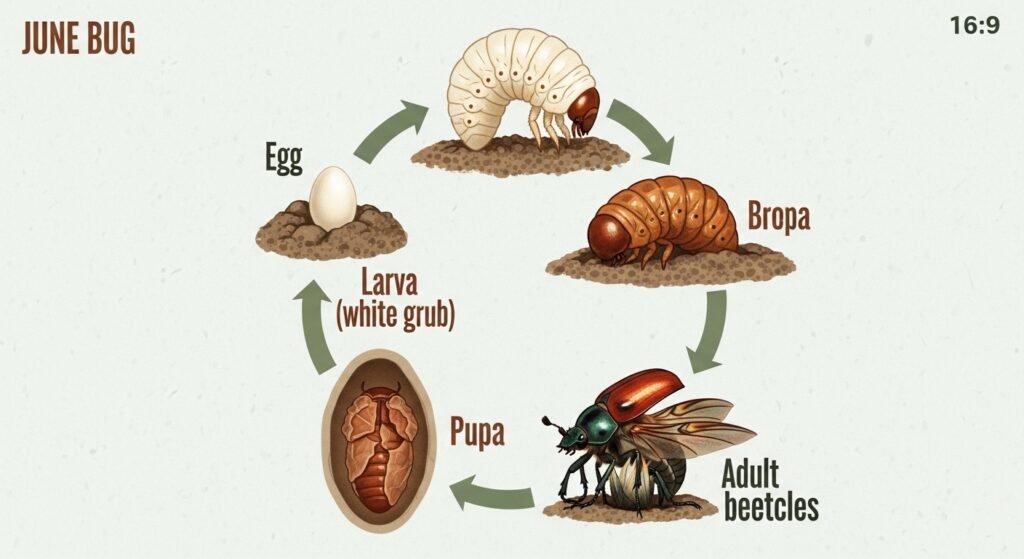
Before we dive into symbolism, it’s essential to understand the creature itself.
Scientific Life Cycle Explained
June bugs are a group of scarab beetles in the genus Phyllophaga, known for:
- Larval Stage: White grubs living underground, feeding on roots for 1–3 years.
- Pupal Stage: Transformation phase inside soil chambers.
- Adult Stage: Aerial beetles that emerge in late spring to summer, especially June.
This distinct metamorphic cycle — from subterranean larva to flying adult — forms the backbone of many spiritual and psychological interpretations. Their emergence aligns with summer warmth, growth, and renewal, making them potent symbols of cyclical change.
Psychological Interpretation — Jungian Symbolism
Swiss psychiatrist Carl Jung pioneered the idea of archetypes and the collective unconscious — shared symbols that appear across cultures and dreams.
In Jungian terms, the June bug’s life cycle mirrors the process of individuation:
- Buried Larva: Hidden potentials and subconscious drives.
- Pupal Transformation: Inner development and integration.
- Emergence as Adult: Realization of self and conscious transformation.
Thus, the June bug can symbolize unconscious material coming to light, the integration of neglected parts of the self, and the maturation of latent abilities.
Key Jungian themes:
| Symbolism Aspect | Interpretation |
|---|---|
| Underground larva | Hidden potential/subconscious |
| Transformation phase | Personal development and integration |
| Flight to light | Conscious awareness and growth |
Cultural Symbolism Around the World
Native American Symbolism
Many Native tribes view beetles as earth caretakers and seasonal messengers. For some Plains tribes, the June bug signaled:
- Warm weather arrival
- Good soil and harvest conditions
- Connection between earth and sky
Their emergence from the earth reflects renewal and continuity — a living reminder that life cycles connect all beings.
Egyptian Symbolism
While the scarab beetle (Scarabaeus sacer) is more famous in Egyptian myth, June bugs belong to the broader scarab family. Egyptians revered scarabs as symbols of:
- Rebirth and regeneration
- Sun movement and creation
- Divine protection
Thus, in ancient Egyptian cultural memory, June bugs resonate with themes of cosmic order and transformation.
Christian Symbolism
Christian symbolism often draws on biblical metaphor rather than specific insects. However, small creatures — including beetles — appear metaphorically in Scripture as signs of:
- Humility
- Life’s fragility
- God’s attention to every creature (Matthew 10:29)
June bugs, appearing with summer warmth, may be interpreted as reminders to align one’s inner life with spiritual growth.
European Folklore
In parts of Europe, June bugs carried folk beliefs such as:
- Good luck when a bug lands on you
- Forecasts for weather patterns
- Signs of fertility and fertile crops
Some traditions even involved counting beetles to predict seasonal outcomes.
Spiritual Meaning — Beyond the Physical

Across spiritual frameworks, June bugs symbolize:
Transformation & Renewal
Their metamorphosis mirrors spiritual rebirth — shedding old habits, embracing inner alchemy, and emerging renewed.
Seasonal Cycles
Active in early summer, June bugs connect to:
- Growth phases
- Fruition of effort
- Celebration of light
Intuition & Hidden Forces
Because they spend years underground before emerging, they represent:
- Hidden strengths
- Intuitive knowledge
- Inner work coming to fruition
Dream Meanings — What It Means When You See a June Bug in Dreams
Dream encounters can vary widely. Here are interpretations based on common dream scenarios:
| Dream Scenario | Symbolic Meaning |
|---|---|
| June bug flying toward light | Seeking awareness, aspiration, or revelation |
| June bug inside home | Inner transformation ready to emerge |
| Killing a June bug | Suppression of potential or inner conflict |
| Many June bugs swarming | Overwhelming emotions or collective influence |
| June bug landing on you | Good luck or personal message |
Flying Toward Light
This often signifies a desire for clarity, purpose, or spiritual connection.
Swarms in Dreams
Too many may feel frightening, pointing to anxiety, unresolved emotions, or mental clutter. The dream urges grounding and focus.
Biblical Meaning — Beetles in Scripture
The Bible doesn’t mention June bugs by name, but insects often symbolize:
- Divine sovereignty over creation
- Humility before God
- Life’s transience
For example, ancient Hebrew poetry uses insect imagery to illustrate human frailty and the greatness of God’s care. Insects remind believers to perceive divine wisdom in creation.
Good or Bad Omens — Myth vs. Meaning
Symbolism is shaped by interpretation and cultural lens.
Good Omens
Many traditions see June bugs as positive:
- Luck and prosperity
- Good soil and harvest
- Seasonal blessings
- Inner growth signs
Negative Interpretations
Some folk beliefs regard swarming beetles as:
- Annoyances
- Signs of too much moisture
- Predictors of crop damage
Scientifically, large populations can harm roots — but in symbolic terms, this tends to reflect imbalance or excess rather than inherent evil.
Spirit Animal Meaning
When the June bug appears as a spirit animal, its message is often:
- “Embrace transformation.”
- “Prepare for emergence.”
- “Cultivate hidden strengths.”
As a totem, it encourages patience and trust in life’s timing. Your inner readiness might not match external conditions — yet when conditions are right, transformation occurs.
Tattoo Symbolism — Ink Meanings
June bug tattoos often express:
| Tattoo Style | Symbolic Meaning |
|---|---|
| Realistic beetle | Connection to nature and seasons |
| Beetle with moonlight | Intuition, cycles, inner light |
| Metamorphosis scene | Personal transformation |
| Beetle with flowers | Fertility, growth, prosperity |
Because these insects are tied to summer and renewal, many choose June bug tattoos to mark a period of change or personal growth.
Love & Relationship Symbolism
In a relationship context, June bugs can symbolize:
- Emerging emotional awareness
- Growth phases within the partnership
- Releasing old patterns
- Renewed commitment or seasonal beginnings
Meeting a partner during the summer or seeing June bugs together could be read as a sign of warmth, fruition, and shared emergence into a deeper emotional phase.
Comparison Table — June Bug Symbolism at a Glance
| Category | Core Meaning | Positive | Negative |
|---|---|---|---|
| Spiritual | Transformation | ✔️ | ✖️ |
| Cultural | Seasonal cycles | ✔️ | ✔️ |
| Jungian Psychology | Individuation | ✔️ | ❓ |
| Scientific | Metamorphosis | ✔️ | ✖️ |
| Dreams | Inner messages | ✔️ | ✔️ |
| Biblical | Creation & humility | ✔️ | ✖️ |
| Omens | Luck or warnings | ✔️ | ✔️ |
| Spirit Animal | Guidance | ✔️ | ✖️ |
| Tattoo | Personal narrative | ✔️ | ✖️ |
| Love | Growth & change | ✔️ | ✖️ |
Frequently Asked Questions
What does a June bug symbolize spiritually?
Spiritually, June bugs represent transformation, life cycles, inner growth, and connection to seasonal rhythms — signaling that a period of change or renewal may be underway.
Are June bugs considered good luck?
In many cultures, yes — especially in contexts tied to fertility, harvest, or emerging potential. However, interpretations vary.
What does it mean to dream of a June bug?
Dreams often reflect inner changes. A June bug in dreams may point to subconscious material rising into awareness or personal transformation.
Is there a biblical meaning for June bugs?
While not explicitly mentioned, biblical themes around insects often point to humility, transience, and divine order in creation — meaning can be derived through metaphor.
What does a June bug tattoo represent?
June bug tattoos typically symbolize change, growth, connection to nature, life cycles, or personal transformation.
Are June bugs bad for plants?
Scientifically, larvae can damage plant roots in large numbers, but the symbolism centers more on cycles than danger.
What does it mean if a June bug lands on you?
Folk interpretations vary — some see it as good luck or a personal message; others may see it as a nudge toward paying attention to inner life.
What is junebug symbolism?
Junebug symbolism represents transformation, renewal, hidden potential, and the natural cycles of growth and emergence.
Final Thoughts — Why June Bug Symbolism Resonates
The June bug’s journey — from underground larva to winged adult — mirrors one of humanity’s oldest narratives: the emergence of potential into form. Whether in myth, psychology, dreams, or art, this unassuming beetle reminds us that change often starts unseen, deep within, and unfolds at just the right moment.
Embrace the symbolism of the June bug as an invitation to reflect on your own cycles of growth, emergence, and transformation.