Symbolic and Spiritual Meaning of Worms in House
Quick Answer
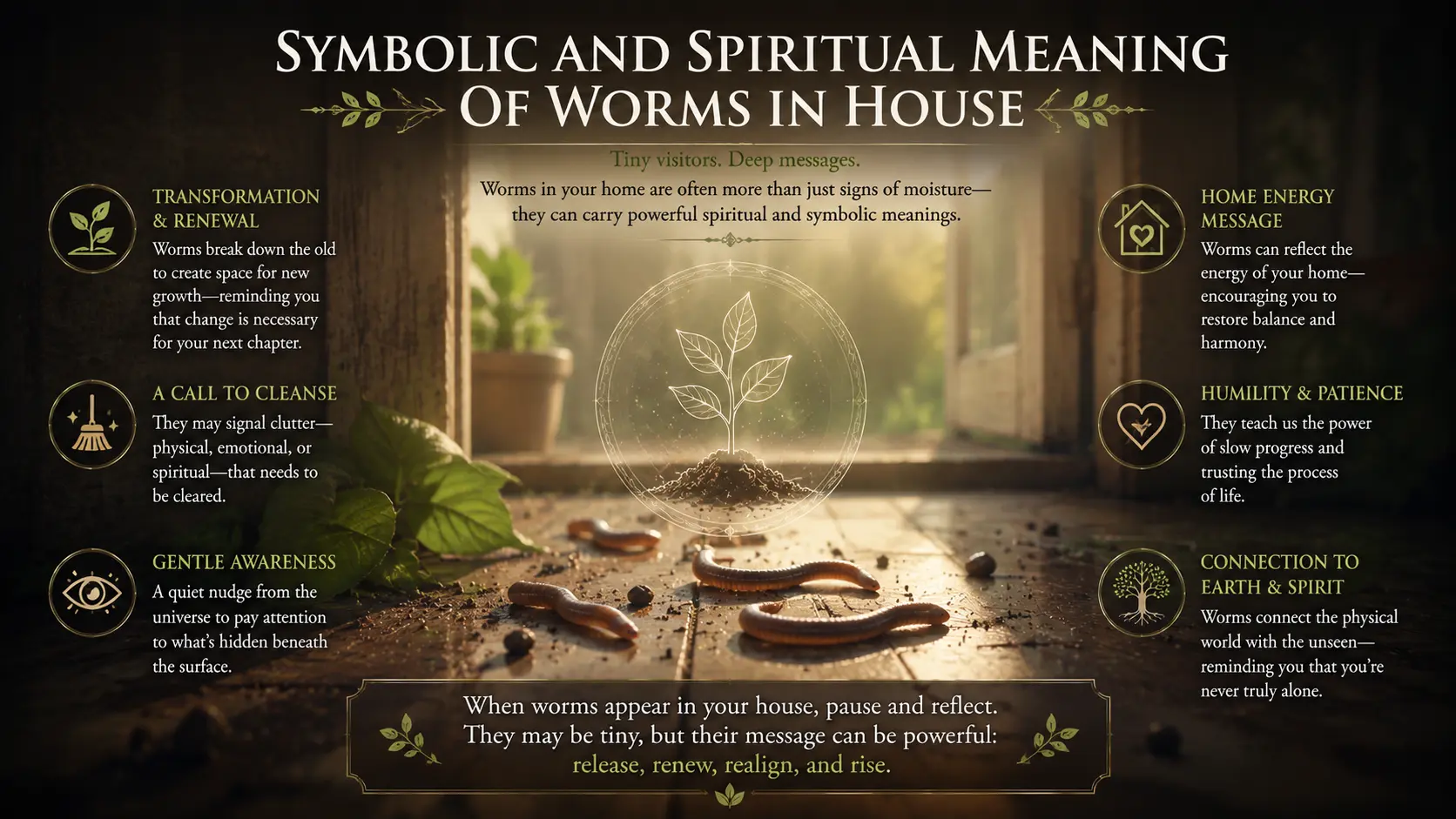
Finding worms in your house can have both a practical explanation and a symbolic interpretation. Spiritually, worms are often associated with transformation, renewal, hidden matters, humility, decay, and the natural cycle of life. Because worms live beneath the surface and help break down organic material, they can symbolize processes that are happening quietly before something new emerges.
A worm inside the home does not automatically indicate bad luck, negative energy, or a spiritual warning. The meaning depends on your beliefs, the circumstances surrounding the discovery, and what the experience personally brings to mind.
TL;DR
The spiritual meaning of worms in the house is commonly connected with change, cleansing, renewal, hidden issues, grounding, and transformation. In some religious traditions, worms can have darker associations with mortality or decay, while other interpretations emphasize their important role in regeneration and the earth.
Before assigning spiritual meaning, consider the practical reason worms may have entered your home. Symbolism can be used as a tool for reflection, but it should not replace ordinary explanations or create unnecessary fear.
What Does It Mean to Find Worms in Your House?
Finding worms indoors can be surprising because worms are normally associated with soil, gardens, compost, moisture, and decomposition. Their unexpected appearance inside a living space naturally attracts attention and may cause someone to wonder whether the event has a deeper meaning.
From a symbolic perspective, the contrast between the worm and the home is especially important. The worm represents something close to the earth, hidden beneath the surface, and connected with natural cycles. The house, meanwhile, commonly represents security, personal life, family, identity, and the inner self.
When these two symbols appear together, some spiritual interpretations suggest that something previously hidden may be asking for attention. This does not necessarily mean something negative. It can simply represent a period of quiet change, emotional processing, or renewal.
Physical Context vs Symbolic Meaning
The first step is always to consider the physical circumstances. Worms can enter through cracks, doors, windows, drains, soil attached to plants, damp areas, or other pathways. Heavy rain and changes in moisture can also cause soil-dwelling creatures to appear where they normally would not.
Once the practical explanation has been considered, symbolism can provide a separate layer of personal reflection. A physical event can have symbolic meaning without being a supernatural message. This distinction helps keep spiritual interpretation balanced and grounded.
Core Symbolism of Worms at a Glance
Worm symbolism is surprisingly complex. Worms may initially appear unpleasant, but their role in nature is essential. They contribute to soil health, decomposition, and the recycling of organic matter.
Because of this, worms can represent both ending and beginning. They are associated with what breaks down, but also with the conditions that allow new growth to occur.
Key Symbolic Themes
Common symbolic associations include:
- Transformation — changing from one state into another.
- Renewal — creating the conditions for new growth.
- Grounding — reconnecting with nature and physical reality.
- Hidden matters — things occurring beneath the surface.
- Patience — gradual progress rather than instant results.
- Humility — recognizing the value of small and overlooked things.
- Decay — the natural ending of a cycle.
- Regeneration — life continuing through change.
- Cleansing — removing what is no longer useful.
- Mortality — awareness of life’s temporary nature.
The strongest interpretation depends on which of these themes best matches your circumstances.
Ancient Roots of Worm Symbolism
Worms have been observed by humans for thousands of years, so their symbolism developed long before modern spiritual blogs and social media. Ancient people noticed that worms lived underground, appeared around decaying organic matter, and seemed to disappear and return with changing environmental conditions.
These observations naturally connected worms with earth, death, fertility, decomposition, and regeneration. The same creature could therefore represent both an ending and the beginning of another natural process.
Pre-Christian and Ancient Views
In many ancient cultures, creatures associated with the earth were connected to the mysterious processes occurring beneath human awareness. Worms were particularly interesting because they lived hidden from view while participating in the transformation of soil and organic material.
This produced an important symbolic tension: the worm could represent decay and mortality, but it could also represent the continuation of life. What appears to be an ending can become nourishment for something new.
This broader natural cycle remains one of the most useful ways to understand worm symbolism today.
Biblical and Early Christian Associations
The Bible contains several references to worms, and their meaning is not always positive. In some passages, worms are associated with decay, mortality, judgment, corruption, or the temporary nature of human life.
Because of these passages, Christian interpretations of worms can sometimes be darker than modern nature-based symbolism. However, it is important not to assume that every worm encountered in everyday life carries a biblical warning.
Religious Symbolism
Biblical worm imagery can function as a reminder of human mortality and humility. The imagery emphasizes that earthly existence is temporary and that pride can ultimately be brought low.
For some Christians, therefore, seeing a worm may inspire reflection on humility, mortality, repentance, or spiritual priorities rather than fear.
At the same time, Christianity does not establish a universal rule stating that finding a worm inside a house is a supernatural omen. The specific interpretation depends on the biblical passage, theological tradition, and personal belief.
Symbolism of Worms in the Home Specifically
The symbolism becomes more personal when worms appear inside a house rather than outdoors. The home is one of the strongest symbols of personal identity and private life.
A worm entering this environment can therefore be interpreted metaphorically as something from the hidden, natural, or subconscious realm entering conscious awareness.
Home as Symbol
Symbolically, a house may represent:
- Your private emotional world
- Family relationships
- Security and stability
- Personal boundaries
- Memories and experiences
- Your sense of identity
- Your inner spiritual life
When worms appear in this symbolic setting, some interpretations connect them with unfinished matters, gradual transformation, or something that needs attention beneath the surface.
For example, someone experiencing a major life transition might view the worm as a reminder that meaningful change often happens slowly. Another person might see it as encouragement to clean up an area of life that has been neglected.
Spiritual Meaning of Worms in House
The spiritual meaning of worms in a house is not fixed. Different traditions and individuals may interpret the same experience differently.
Rather than asking, “Is this a good or bad omen?” a more useful question is: “What does this image symbolize for me right now?”
Common Spiritual Interpretations
1. Transformation
Worms are strongly connected with transformation because they participate in natural processes that turn old organic material into something useful. Their presence can symbolize a period when your life is changing beneath the surface.
2. Hidden Issues Coming to Light
Because worms normally remain underground, they can symbolize things that have been hidden. Finding one inside may metaphorically represent an overlooked thought, relationship, responsibility, or emotion becoming noticeable.
3. Renewal After an Ending
Decomposition is not simply destruction. It creates nutrients that support future growth. Worm symbolism can therefore suggest that an ending may eventually contribute to a new beginning.
4. Grounding
Worms belong to the earth. Their appearance can serve as a symbolic reminder to slow down, reconnect with nature, and focus on practical realities.
5. Patience
A worm’s movement is slow compared with many animals. Spiritually, this can symbolize the value of gradual progress and trusting a process that cannot be rushed.
6. Humility
Worms are small and often overlooked, yet they perform important ecological functions. Symbolically, they can remind us that importance does not always look impressive.
Emotional and Psychological Associations
Spiritual symbolism is often influenced by psychology. People naturally assign meaning to unusual, surprising, or emotionally powerful events.
A worm inside the house can trigger a strong emotional response because it violates expectations about what belongs indoors.
Why Worms Feel Disturbing
Worms can evoke feelings such as:
- Disgust
- Anxiety
- Surprise
- Vulnerability
- Curiosity
- Fear of contamination
- Loss of control
These feelings can influence interpretation. If someone already feels overwhelmed by change, an unexpected worm might seem especially significant.
Instead of treating that reaction as proof of a supernatural warning, it can be useful to ask what the experience reminds you of emotionally.
Sometimes the strongest meaning comes not from the worm itself but from the feelings it brings to the surface.
Worms in American Folklore and Popular Thought
American attitudes toward worms combine practical agricultural knowledge, folklore, children’s stories, gardening culture, and modern symbolism.
Worms are familiar to gardeners, farmers, anglers, educators, and anyone who has encountered soil after rain. Their importance in improving soil has also created a more positive association with fertility, growth, and ecological balance.
Cultural Associations in the USA
In American popular culture, worms can represent very different things depending on context. Earthworms may be viewed positively as helpful garden creatures, while other worm-like creatures may provoke disgust or concern.
Worms are also common in children’s education because they provide an accessible example of decomposition, ecosystems, and soil health.
This mixture of practical and cultural associations means there is no single American interpretation of finding worms indoors.
Modern Usage: Spiritual Blogs, Social Media, and Decor
Today, worm symbolism appears in online spirituality, personal reflection, artwork, tattoos, nature-based spirituality, and social media discussions.
Modern interpretations often combine older symbolism with contemporary concepts such as energy, personal growth, manifestation, emotional healing, and transformation.
Where the Meaning Shows Up Today
You may encounter worm symbolism in:
- Spiritual blogs
- Social media posts
- Symbolic artwork
- Nature-inspired decor
- Tattoo designs
- Dream interpretation
- Personal journaling
- Modern pagan and earth-centered discussions
- Metaphorical discussions about growth
These modern meanings should be treated as interpretive traditions rather than universal facts. A spiritual website or social media post may offer one interpretation while another tradition gives the same symbol a completely different meaning.
Common Misunderstandings and Fear-Based Interpretations
One of the biggest problems with spiritual symbolism is that ordinary events can become unnecessarily frightening when every unusual occurrence is treated as a supernatural warning.
Finding a worm indoors is not, by itself, evidence that something bad is about to happen.
What Worms Do Not Usually Mean
Worms in your home do not automatically mean:
- Someone has cursed you.
- Negative energy has entered your home.
- A disaster is approaching.
- You are spiritually contaminated.
- Something terrible will happen to your family.
- You have been targeted by supernatural forces.
- You are being punished spiritually.
These claims go beyond what symbolism can reasonably establish.
A healthier interpretation treats symbolism as a reflection tool rather than a prediction system.
Shifting Meanings Over Time
Symbolism changes as cultures, religions, environments, and social attitudes change.
A creature once associated primarily with death may later become associated with environmental renewal. Worms provide an excellent example because scientific knowledge has made their ecological importance much more visible.
Then vs Now
| Earlier Associations | Modern Associations |
|---|---|
| Decay | Renewal |
| Mortality | Natural cycles |
| Hidden underground world | Grounding |
| Humility | Simplicity |
| Death | Transformation |
| Fertility of soil | Ecological health |
| Judgment imagery | Personal reflection |
Neither side completely replaces the other. Instead, modern symbolism adds additional layers to older meanings.
Context Matters: Interpreting Worms Without Panic
A symbolic interpretation becomes more meaningful when you consider what was happening around the event.
Instead of immediately searching for an ominous explanation, look at the location, timing, emotional response, and personal circumstances.
Questions Americans Often Ask Themselves
You might ask:
- What was I thinking about immediately before I noticed the worm?
- Am I currently going through a major transition?
- Is there something in my life that I have been avoiding?
- Do I need to slow down and become more grounded?
- Have I recently experienced an ending that could lead to a new beginning?
- Did the worm make me feel afraid, curious, or simply surprised?
- Is there a straightforward physical explanation for why it appeared?
- What meaning feels constructive rather than fear-based?
These questions allow symbolism to become a form of self-reflection instead of superstition.
Symbolism Table: Worms in the House
| Situation or Symbol | Possible Meaning |
|---|---|
| One worm indoors | A small issue demanding attention |
| Several worms | Accumulating or overlooked matters |
| Worm after rain | Renewal and natural cycles |
| Worm near a doorway | Transition or change |
| Worm in a bedroom | Private emotions or personal transformation |
| Worm in a kitchen | Nourishment, household routines, or practical concerns |
| Worm in a garden area | Growth, fertility, and grounding |
| Dead worm | Completion or the end of a cycle |
| Moving worm | Progress and gradual transformation |
| Unexpected worm | Something previously unnoticed becoming visible |
| Repeated encounters | A personal reminder to reflect, rather than proof of an omen |
These meanings are symbolic possibilities, not universal rules.
FAQs
Are worms in the house a bad spiritual sign?
Not necessarily. Worms can symbolize transformation, renewal, grounding, humility, and natural cycles as well as decay or mortality. Their presence should not automatically be interpreted as a negative spiritual sign.
Does finding worms mean something is wrong with me?
No. Finding a worm in your home does not indicate that something is spiritually or personally wrong with you. If you use symbolism for reflection, the experience can simply encourage you to consider what is changing in your life.
Is this belief religious or cultural?
It can be both, depending on the interpretation. Biblical traditions contain worm imagery associated with mortality and judgment, while broader cultural and nature-based symbolism can emphasize earth, decomposition, fertility, and renewal.
Should I ignore the symbolism entirely?
You do not have to. You can appreciate the symbolic meaning while still dealing with the practical cause. Reflection and common sense can coexist. The important thing is not to let symbolism create unnecessary fear.
Do different worms mean different things?
They can. Earthworms, caterpillars, larvae, and other creatures commonly described as worms have different biological characteristics and cultural associations. Their symbolic meanings may therefore vary depending on the creature and context.
Why do people search for meaning at all?
Humans naturally look for patterns and significance in unusual experiences. Symbolism can help people process uncertainty, emotions, transitions, and questions about life. The healthiest approach is to use symbolism for insight rather than fear or prediction.
Conclusion
The symbolic and spiritual meaning of worms in the house is best understood through the themes of transformation, hidden processes, grounding, renewal, humility, and natural cycles. Worms may also carry darker associations with decay and mortality, particularly in some religious and historical contexts.
However, finding a worm indoors does not automatically predict bad luck or spiritual trouble. There may be an entirely ordinary environmental reason for its appearance. If the experience feels meaningful to you, use it as an opportunity to reflect on what is changing, what needs attention, and what may be ready to grow.
Sometimes the most powerful message of the worm is simple: life is constantly transforming beneath the surface, even when we cannot yet see the result.