Rune Symbol Meaning: Ancient Wisdom and Spiritual Power
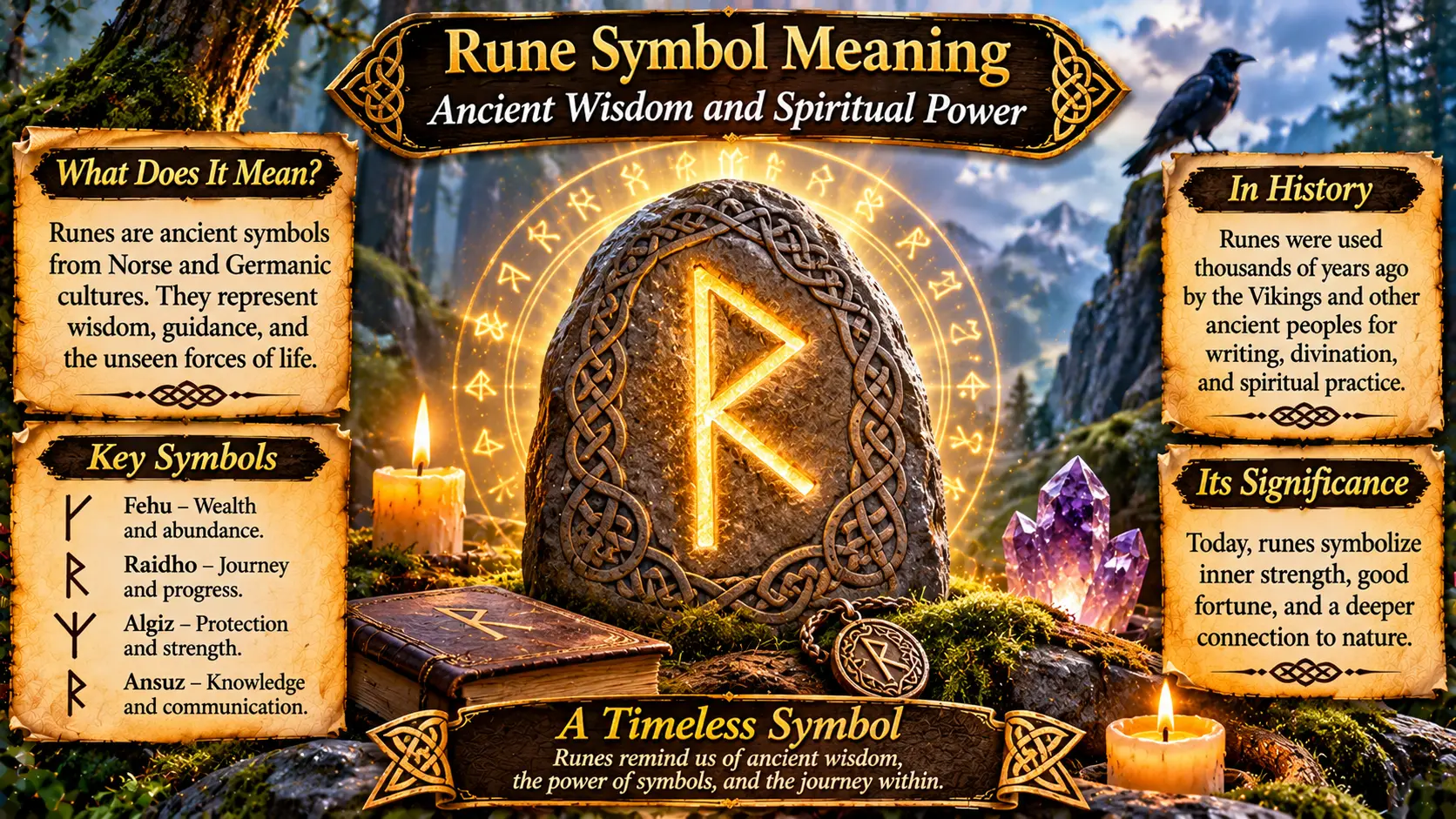
Runes are ancient symbols that have fascinated people for centuries. Originally used as letters in early Germanic writing systems, they gradually became associated with cultural traditions, inscriptions, storytelling, and spiritual interpretations. Each rune has a distinct shape and historical name, and some are connected with ideas such as protection, strength, communication, prosperity, and transformation.
The best-known runic writing system is the Elder Futhark, which contains 24 characters. These symbols were used by Germanic peoples during the early centuries of the Common Era. Runes appeared on stones, weapons, jewelry, tools, and other objects, often recording names, messages, ownership, or commemorations.
Today, runes are also used in modern spiritual practices, including rune readings and symbolic artwork. Their meanings can vary depending on historical evidence, cultural context, and contemporary interpretation. Understanding their origins helps separate their original linguistic purpose from the spiritual meanings associated with them today.
What Is the Rune Symbol?
A rune is a character from an ancient writing system used by Germanic-speaking peoples. The word rune is associated with Old Germanic words connected with mystery or secret knowledge, although runes primarily served as letters for writing.
The earliest widely recognized runic alphabet is the Elder Futhark, named after its first six characters: Fehu, Uruz, Thurisaz, Ansuz, Raidho, and Kenaz.
Runic inscriptions have been discovered throughout northern and central Europe. They appear on memorial stones, everyday objects, weapons, jewelry, and monuments.
Although runes are sometimes described as magical symbols, their original purpose was largely practical: they represented sounds and were used to communicate written information. Their later spiritual and symbolic associations developed through different historical and modern traditions.
What Do Rune Symbols Mean?
Rune meanings depend on the specific character and the tradition in which it is interpreted. Historically, runes represented sounds, while their names were associated with words and concepts.
In modern symbolic and spiritual interpretations, runes may represent:
- Protection: Symbols associated with safety, defense, and boundaries.
- Strength: Resilience, courage, and the ability to overcome challenges.
- Wisdom: Learning, knowledge, and thoughtful decisions.
- Communication: Speech, understanding, and the exchange of ideas.
- Prosperity: Wealth, resources, and opportunities.
- Transformation: Change, personal development, and new experiences.
- Connection: Relationships between people, nature, and the wider world.
These meanings are not identical across all historical sources. Modern rune readings often use symbolic interpretations that go beyond what can be established from ancient inscriptions.
Main Elements of Rune Symbolism
Runic symbols have several features that make them recognizable.
| Element | Description or association |
| Straight lines | Practical shapes suited to carving |
| Angular branches | Distinctive character forms |
| Vertical strokes | Common structural feature of many runes |
| Rune names | Words associated with individual characters |
| Inscriptions | Historical records and written messages |
| Materials | Stone, wood, metal, and other surfaces |
The angular appearance of runes was especially useful for carving letters into materials such as wood and stone.
Each rune has its own form and sound value. Its name may also provide clues about the word or concept associated with it.
The 24 Elder Futhark Runes and Their Meanings
The Elder Futhark is the best-known early runic alphabet. It contains 24 characters divided into three groups of eight, traditionally called ættir.
The following table gives commonly used modern symbolic associations alongside the historical names.
| Rune | Name | Common symbolic association |
| ᚠ | Fehu | Cattle, wealth, resources |
| ᚢ | Uruz | Aurochs, strength, vitality |
| ᚦ | Thurisaz | Thorn or giant, defense and challenge |
| ᚨ | Ansuz | A god, speech, communication |
| ᚱ | Raidho | Riding or journey, movement |
| ᚲ | Kenaz | Torch, knowledge and illumination |
| ᚷ | Gebo | Gift, generosity and exchange |
| ᚹ | Wunjo | Joy, comfort and harmony |
| ᚺ | Hagalaz | Hail, disruption and change |
| ᚾ | Nauthiz | Need, hardship and necessity |
| ᛁ | Isa | Ice, stillness and patience |
| ᛃ | Jera | Year or harvest, cycles and results |
| ᛇ | Eihwaz | Yew, endurance and resilience |
| ᛈ | Perthro | Uncertain historical meaning; often linked with mystery in modern readings |
| ᛉ | Algiz | Uncertain historical meaning; commonly associated with protection today |
| ᛊ | Sowilo | Sun, energy and success |
| ᛏ | Tiwaz | The god Týr, justice and courage |
| ᛒ | Berkano | Birch, growth and renewal |
| ᛖ | Ehwaz | Horse, partnership and movement |
| ᛗ | Mannaz | Human being, community and identity |
| ᛚ | Laguz | Water, flow and intuition |
| ᛜ | Ingwaz | The god Ing, potential and fertility |
| ᛞ | Dagaz | Day, awakening and change |
| ᛟ | Othala | Inherited property, ancestry and heritage |
The historical names and sound values are more firmly established than many modern spiritual meanings. Some rune names have uncertain interpretations, and scholars do not agree on every detail.
Popular Rune Symbols and Their Meanings
Certain runes are especially popular in modern artwork, jewelry, tattoos, and spiritual practices.
Fehu (ᚠ): Historically associated with cattle, Fehu is commonly interpreted as a symbol of wealth, resources, and prosperity.
Uruz (ᚢ): Named after the aurochs, a now-extinct wild ox, Uruz is often connected with strength, vitality, and endurance.
Ansuz (ᚨ): Associated with a god, Ansuz is commonly interpreted through communication, wisdom, speech, and inspiration.
Raidho (ᚱ): Connected with riding or a journey, Raidho is often used to represent movement, travel, and progress.
Gebo (ᚷ): Meaning gift, Gebo is associated with generosity, exchange, and relationships.
Algiz (ᛉ): Often used as a modern protective symbol, Algiz has an uncertain historical interpretation. Its modern association with protection should not be treated as a universally established ancient meaning.
Spiritual Meaning of Rune Symbols
In modern spiritual practices, runes are sometimes used as tools for reflection, meditation, and symbolic interpretation.
People may select a rune to represent a personal goal, a challenge, or a quality they want to develop. For example, Fehu may be used as a reminder of resources and responsibility, while Jera may represent patience and the rewards of consistent effort.
Possible spiritual themes include:
- Self-awareness: Reflecting on personal values and decisions.
- Protection: Thinking about boundaries and personal safety.
- Wisdom: Seeking understanding before taking action.
- Growth: Recognizing that meaningful change takes time.
- Balance: Considering the relationship between effort and rest.
- Transformation: Accepting that life moves through different stages.
These are modern spiritual interpretations. Historical evidence does not establish that every rune was originally used for divination or magical purposes.
Rune Symbolism in Love and Relationships
Some modern rune interpretations connect particular characters with relationships, trust, communication, and emotional development.
| Rune | Common modern relationship interpretation |
| Gebo | Giving, receiving, and mutual respect |
| Wunjo | Happiness and harmony |
| Ehwaz | Partnership and cooperation |
| Mannaz | Understanding and human connection |
| Berkano | Growth and nurturing |
| Ansuz | Honest communication |
Gebo is especially popular in modern relationship symbolism because its name means gift. It can serve as a reminder that healthy relationships involve mutual care rather than one-sided effort.
Rune symbolism does not determine whether a relationship will succeed. Trust, respect, communication, and consistent actions remain important.
Rune Symbol Meaning for Twin Flames
Some contemporary spiritual communities use runes to represent ideas associated with twin-flame journeys. These interpretations often focus on personal development, emotional understanding, and connection.
Possible associations include:
- Gebo: Mutual exchange and balance.
- Wunjo: Harmony and emotional well-being.
- Ehwaz: Cooperation and shared progress.
- Berkano: Personal growth and renewal.
- Ansuz: Communication and understanding.
There is no established ancient Germanic tradition that identifies these runes specifically with twin flames. This connection is a modern spiritual interpretation, not a documented historical meaning.
Historical Origins of Rune Symbols
Runic writing developed among Germanic-speaking peoples during the early centuries of the Common Era. The earliest known inscriptions date from around the second century CE, although the precise origins of the writing system remain a subject of scholarly discussion.
The Elder Futhark was used approximately from the second to the eighth centuries. Later, the Younger Futhark became prominent in Viking Age Scandinavia. Anglo-Saxon communities also developed the Futhorc, an expanded runic alphabet.
Runes were used for practical writing, including personal names, memorial messages, ownership marks, and other inscriptions. Some inscriptions may also have had religious or ritual significance.
During the Viking Age, runes appeared on memorial stones, everyday objects, and monuments. They were an important part of written communication in northern Europe.
Modern interest in runes grew through historical research, literature, popular culture, and contemporary spiritual movements.
Rune Symbols in Norse Mythology
Runes are often connected with Norse mythology, particularly the story of Odin and the acquisition of runic knowledge.
In the Old Norse poem Hávamál, Odin describes a difficult experience through which he gains knowledge of the runes. This story has inspired later interpretations of runes as symbols of wisdom, sacrifice, and hidden knowledge.
However, the poem should not be treated as proof that every historical runic inscription was magical. Runes were also ordinary letters used for everyday communication.
Norse mythology gives runes an important literary and religious dimension, while archaeology and inscriptions help explain how people actually used them.
Rune Symbol Meaning in Dreams
Dreaming about runes may reflect an interest in history, mythology, personal beliefs, or questions that feel difficult to answer. Dream interpretations are personal and are not scientifically established.
| Dream image | Possible interpretation |
| Seeing a single rune | Focusing on a particular idea or concern |
| Seeing several runes | Exploring different choices or possibilities |
| Reading a runic inscription | Interest in knowledge or the past |
| Finding a rune stone | Reflection on heritage or history |
| Seeing runes in an unfamiliar place | Curiosity about something unknown |
| Drawing runic characters | Creative expression or personal reflection |
The meaning may depend on which rune appears and how you feel during the dream.
Rune Symbols in Tattoos, Jewelry, and Modern Culture
Runes are widely used in modern artwork, jewelry, clothing, tattoos, and fantasy-inspired designs.
People may choose a rune because of its historical name, visual appearance, or modern symbolic association.
Common examples include:
- Fehu: Used to represent resources and prosperity.
- Uruz: Chosen for its association with strength and endurance.
- Gebo: Used to express generosity and connection.
- Jera: Associated with patience and natural cycles.
- Sowilo: Connected with the sun and energy.
- Berkano: Often interpreted through growth and renewal.
Before choosing a rune for a permanent design, it is important to research its history and check how it has been used in different contexts. Some runic symbols have also been appropriated by extremist groups, so their appearance and combination with other imagery can affect how they are understood.
What Does It Mean When You See a Rune Symbol?
Seeing a rune may simply mean that you have encountered an ancient writing character. Its meaning depends on the specific rune, the inscription, and the historical or modern setting.
In a historical museum, it may be part of an archaeological record. In a modern spiritual setting, it may represent a personal idea or reflective practice.
You can understand a rune more accurately by considering:
- Which runic alphabet it belongs to.
- Its historical name and sound value.
- The object or inscription on which it appears.
- Its cultural and historical background.
- Whether it is being used in a modern spiritual or artistic context.
This approach helps distinguish historical information from contemporary symbolic interpretations.
Rune Symbols Compared With Other Ancient Symbols
Runes are sometimes compared with other ancient writing systems and symbolic traditions. Although they may share visual or cultural similarities, their origins are different.
| Symbol or system | Historical association |
| Elder Futhark | Early Germanic runic writing |
| Ogham | Early medieval Irish writing system |
| Greek alphabet | Ancient Greek writing |
| Egyptian hieroglyphs | Ancient Egyptian writing and sacred imagery |
| Celtic knotwork | Interlaced decorative designs in Celtic art |
| Norse Mjölnir | Thor’s hammer in Norse mythology |
Runes are primarily letters, while symbols such as Mjölnir and Celtic knotwork belong to different forms of cultural and religious imagery.
Common Misconceptions About Rune Symbols
Several misunderstandings surround runes because of their appearance in modern spiritual and popular culture.
- Every rune is a magical symbol: Runes were primarily letters used for writing, although some inscriptions may have had ritual significance.
- All runes belong to the Viking Age: The Elder Futhark existed before the Viking Age.
- Every rune has one fixed spiritual meaning: Historical meanings and modern interpretations can differ.
- Runes were used only for fortune-telling: Archaeological evidence shows many practical uses, including names, memorials, and ownership marks.
- The Elder Futhark is the only runic alphabet: Other systems include the Younger Futhark and Anglo-Saxon Futhorc.
- Modern rune readings reproduce ancient practices exactly: Contemporary rune divination is not fully documented as a uniform ancient system.
Understanding these differences makes rune symbolism more accurate and meaningful.
Lessons and Significance of Rune Symbolism in Daily Life
Runes can offer useful themes for personal reflection when their historical background is understood.
Value knowledge: Ansuz can serve as a modern reminder to learn, listen, and communicate thoughtfully.
Practice patience: Jera is associated with the yearly cycle and can represent the value of consistent effort.
Respect relationships: Gebo can encourage generosity and mutual understanding.
Develop resilience: Uruz is commonly interpreted as a reminder of strength and endurance.
Accept change: Dagaz can symbolize the transition from one stage of life to another.
These interpretations can make runes meaningful in modern life without assuming that they predict events or possess guaranteed powers.
Frequently Asked Questions About Rune Symbol Meaning
What does a rune symbol mean?
A rune is a character from an ancient Germanic writing system. Its name and modern interpretations may also carry symbolic associations.
What are the 24 Elder Futhark runes?
The Elder Futhark is an early runic alphabet containing 24 characters, beginning with Fehu, Uruz, Thurisaz, Ansuz, Raidho, and Kenaz.
What is the spiritual meaning of runes?
Modern spiritual interpretations connect runes with wisdom, protection, strength, growth, communication, and personal reflection.
Which rune symbolizes protection?
Algiz is commonly associated with protection in modern rune interpretations, although its original historical meaning is uncertain.
Which rune symbolizes love?
Gebo is often connected with giving, receiving, and mutual respect. It is sometimes used in modern interpretations of relationships.
Which rune symbolizes strength?
Uruz is commonly associated with strength, vitality, and endurance because its name refers to the aurochs.
Are runes connected to Norse mythology?
Yes. Runes appear in Old Norse literature, including the Hávamál, which tells a story about Odin gaining knowledge of them.
Were runes used for magic?
Some inscriptions may have had ritual or magical purposes, but runes were also ordinary letters used for everyday writing.
What do runes mean in dreams?
They may reflect curiosity, personal questions, historical interests, or symbolic ideas. Dream interpretations are subjective.
Are runes still used today?
Yes. Runes appear in historical research, cultural education, artwork, jewelry, tattoos, and modern spiritual practices.
Final Thoughts
Rune symbols preserve an important part of ancient European history and culture. Originally developed as writing characters, they were used to record names, messages, memories, and other information. Over time, their names and forms also gained symbolic associations, inspiring modern interpretations connected with strength, wisdom, protection, and transformation. Learning about runes means appreciating both their historical purpose and their later cultural significance. Their lasting appeal comes from the connection they create between language, history, mythology, and human imagination.