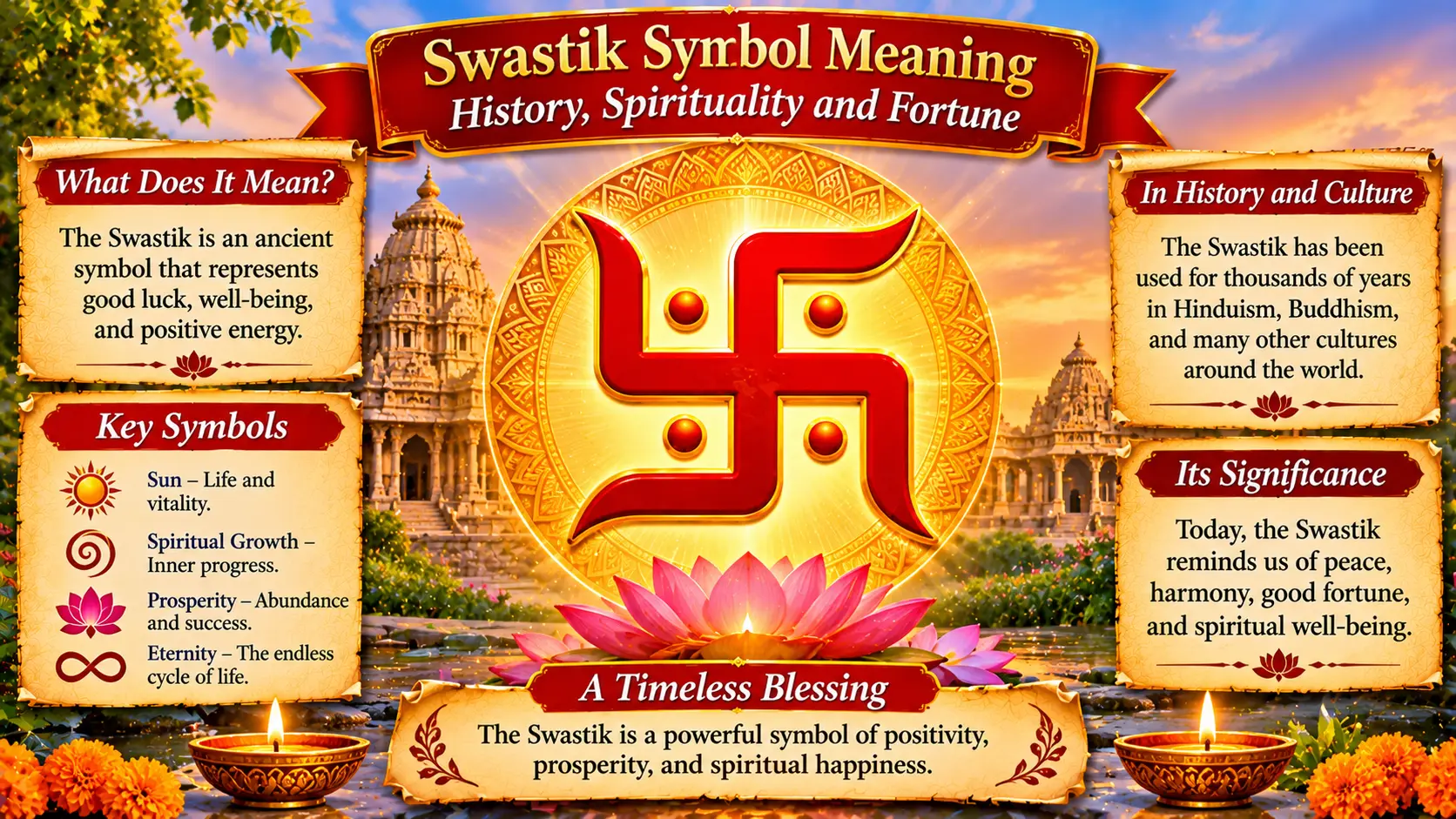
Swastik Symbol Meaning: History, Spirituality and Fortune
The Swastik is one of the oldest known religious and cultural symbols in the world. It has been used for thousands of years in Hinduism, Buddhism, Jainism, and several ancient cultures. Traditionally, it represents good fortune, prosperity, well-being, harmony, and the positive movement of life. Its name comes from the Sanskrit word svastika, which is associated with well-being and good fortune.
In South Asian traditions, the Swastik is commonly displayed during religious ceremonies, festivals, weddings, and celebrations. It is often drawn at the entrance of homes, temples, and places of worship as a symbol of blessings and auspicious beginnings. Its four arms are also interpreted in different traditions as representing balance, direction, and the cycles of existence.
However, the Swastik has a complex modern history. The Nazi Party appropriated a version of this ancient symbol in the twentieth century, turning it into an emblem of hatred, antisemitism, and racial persecution. This association makes it important to understand the difference between the traditional religious Swastik and the Nazi Hakenkreuz.
What Is the Swastik Symbol?
The Swastik is a cross-shaped symbol with four arms that bend at right angles. It is generally presented in two traditional orientations: clockwise and counterclockwise, although their meanings and uses differ between religious and cultural traditions.
The symbol has ancient roots in South Asia and appears in Hindu, Buddhist, and Jain religious practices. It has also been discovered in archaeological sites across different parts of the world.
In Hinduism, the Swastik is widely associated with auspiciousness, prosperity, and blessings. In Buddhism, it can represent the Buddha’s teachings, good fortune, and the continuity of life. In Jainism, it is an important religious emblem connected with the four states of existence.
Although the design is simple, its cultural and religious importance is extensive.
What Does the Swastik Symbol Mean?
The traditional Swastik has several positive meanings in South Asian religious and cultural contexts.
- Good fortune: It is commonly used to invite blessings and positive outcomes.
- Prosperity: It represents abundance, success, and well-being.
- Harmony: Its balanced design can symbolize order and stability.
- Spirituality: It is connected with religious teachings and sacred practices.
- Protection: In some traditions, it is displayed as an auspicious sign for the home or a new beginning.
- Eternity: Its continuous, turning form can represent cycles and the ongoing nature of existence.
- Balance: Its four arms may be interpreted through different ideas of direction, order, and completeness.
These meanings are traditional interpretations and vary among religions and communities.
Main Elements of the Swastik Symbol
The Swastik’s design contains several features that carry religious and cultural interpretations.
| Element | Traditional symbolic association |
| Four arms | Directions, balance, or different aspects of existence |
| Right-angle bends | Movement and continuity |
| Central crossing | Unity and connection |
| Symmetrical design | Harmony and order |
| Red color in many Hindu uses | Auspiciousness, energy, and celebration |
| Yellow or gold | Prosperity and positive beginnings |
The meaning of each feature depends on the tradition and the way the symbol is used. Not every community assigns the same interpretation to its individual parts.
Clockwise and Counterclockwise Swastik Meaning
The orientation of the Swastik can be important in some South Asian religious traditions.
<PRIVATE_PERSON> Clockwise Swastik: In many Hindu traditions, the clockwise form is associated with auspiciousness, prosperity, blessings, and positive beginnings. It is commonly used during religious ceremonies and celebrations.
<PRIVATE_PERSON> Counterclockwise form: A counterclockwise form is sometimes called the sauwastika in English-language discussions. In certain Hindu traditions, it has associations with the goddess Kali, night, or particular ritual practices. Its interpretation is not universal.
In Buddhism and Jainism, orientation and meaning can follow different conventions. Therefore, it is best to understand the symbol within its specific religious and cultural setting rather than assuming that one direction has the same meaning everywhere.
Spiritual Meaning of the Swastik Symbol
The Swastik has an important place in spiritual traditions, especially in Hinduism, Buddhism, and Jainism.
In Hinduism, it is associated with auspiciousness, blessings, prosperity, and divine presence. It is often used during pujas and religious celebrations.
In Buddhism, the symbol can represent the Buddha’s teachings, good fortune, and the eternal nature of existence. It appears in Buddhist art and religious imagery in several Asian cultures.
In Jainism, the Swastik is a significant emblem connected with the four states of existence: heavenly beings, human beings, animals and plants, and beings in the lower realms. It can remind followers of the importance of spiritual progress and liberation.
Some broader spiritual interpretations connect its four arms with balance, life’s cycles, and the relationship between different aspects of existence.
Swastik Symbolism in Love and Relationships
In traditional cultural interpretations, the Swastik can represent harmony, blessings, stability, and a positive beginning. These ideas may also be reflected in how the symbol is used during weddings and family celebrations.
| Symbolic theme | Meaning in relationships |
| Harmony | Peace and mutual understanding |
| Prosperity | Building a stable life together |
| Blessings | Good wishes for a shared future |
| Balance | Respecting each other’s needs |
| Continuity | Commitment and lasting family bonds |
During some Hindu wedding ceremonies, the Swastik is used as an auspicious sign. Its presence reflects hopes for happiness, prosperity, and well-being in married life.
These are cultural and symbolic associations rather than guarantees about a relationship’s future.
Swastik Symbol Meaning for Twin Flames
Some modern spiritual interpretations connect the Swastik’s balanced shape with unity, harmony, and spiritual development. Within twin-flame beliefs, these ideas may be used as metaphors for personal growth and a balanced connection.
Possible interpretations include:
- Unity: Recognizing the importance of mutual understanding.
- Balance: Maintaining emotional stability and individual identity.
- Growth: Learning through meaningful life experiences.
- Harmony: Developing respect and healthy communication.
- Spiritual awareness: Reflecting on personal values and beliefs.
There is no established ancient Hindu, Buddhist, or Jain teaching that identifies the Swastik specifically as a twin-flame symbol. This is a modern interpretation.
Historical Origins of the Swastik Symbol
The Swastik has been used for thousands of years. Archaeological examples have been found in ancient South Asian sites, including those associated with the Indus Valley Civilization. Similar geometric designs have also appeared in ancient European, Central Asian, and other cultural contexts.
The Sanskrit term svastika is connected with the idea of well-being and good fortune. The symbol became especially important in South Asian religious traditions and continued to appear in temples, manuscripts, household decorations, and ceremonial objects.
During the nineteenth and early twentieth centuries, European interest in ancient symbols led to the Swastik being adopted by various organizations. In 1920, the Nazi Party adopted a tilted black Hakenkreuz within a white circle on a red background as its emblem. Under Nazi rule, this design became associated with antisemitism, dictatorship, persecution, and genocide.
This appropriation profoundly changed how the symbol is viewed in many parts of the world. Its traditional religious use, however, continues among Hindu, Buddhist, and Jain communities.
Swastik Symbol Meaning in Dreams
Dreaming about a Swastik can have different personal meanings depending on the dreamer’s background, experiences, and feelings. There is no universally accepted interpretation.
| Dream image | Possible interpretation |
| Seeing a traditional religious Swastik | Thoughts about faith or cultural heritage |
| Seeing it during a ceremony | Reflection on blessings or family traditions |
| Drawing a Swastik | Interest in religious or cultural practices |
| Seeing it at a doorway | Thoughts about protection or a new beginning |
| Seeing it in an unfamiliar setting | Curiosity or uncertainty about its meaning |
| Seeing a Nazi emblem | Reflection on history, prejudice, or difficult historical subjects |
The context is particularly important because the traditional religious symbol and Nazi emblem carry very different meanings.
Swastik Symbol in Art, Architecture, and Culture
The Swastik appears in many forms of traditional South Asian art and religious architecture.
In Hindu homes and temples, it may be drawn near entrances, on walls, or on ceremonial objects. It is also used in rangoli designs and during festivals such as Diwali.
In Buddhist cultures, the symbol appears in religious artwork, sculptures, manuscripts, and temple decoration. In some East Asian contexts, a related form is used on maps to mark Buddhist temples.
Jain religious art also gives the Swastik an important place. It appears in temple decorations and is used in ceremonies and religious teaching.
Its appearance in different cultures demonstrates its long history, but each use should be understood within its own religious and historical context.
What Does It Mean When You See a Swastik Symbol?
The meaning depends on the symbol’s design, orientation, location, and cultural setting.
If you see a traditional Swastik in a Hindu temple, home, or religious ceremony, it may represent good fortune, blessings, prosperity, and auspicious beginnings.
In a Buddhist or Jain setting, it may have specific religious meanings connected with teachings, existence, and spiritual life.
If you see a tilted black Hakenkreuz on a red background or in Nazi historical material, it is generally associated with Nazi ideology, antisemitism, and the persecution carried out by the Nazi regime.
Recognizing the context is essential because the two uses should not be treated as interchangeable.
Swastik Compared With Other Religious Symbols
The Swastik is one of several symbols used across major religious traditions. Although some symbols share themes of spirituality and good fortune, their histories and meanings are different.
| Symbol | Religious or cultural association |
| Swastik | Auspiciousness in Hinduism, Buddhism, and Jainism |
| Om | Sacred sound and spiritual reality in Hindu traditions |
| Dharma Wheel | Buddhist teachings and the path to enlightenment |
| Jain Hand | Nonviolence, protection, and spiritual discipline |
| Lotus | Purity, spiritual growth, and enlightenment |
| Cross | Central symbol of Christianity |
These symbols have their own religious histories and should be understood on their own terms.
Common Misconceptions About the Swastik Symbol
The Swastik’s long history has led to several misunderstandings.
- The Swastik was originally a Nazi symbol: No. It existed thousands of years before the Nazi Party adopted a version of it.
- Every Swastik has the same meaning: Its meaning changes across religions, cultures, orientations, and historical settings.
- The traditional religious Swastik and Nazi Hakenkreuz are identical in meaning: They have different historical and cultural contexts.
- It belongs only to Hinduism: It is also important in Buddhism and Jainism, among other cultural traditions.
- Its orientation always determines whether it is good or bad: Different traditions use and interpret orientations in different ways.
- Its ancient use should be ignored because of its modern history: Both its ancient religious importance and its twentieth-century appropriation are essential to understanding the symbol.
A balanced explanation recognizes its traditional significance while acknowledging the serious harm associated with its Nazi appropriation.
Lessons and Significance of the Swastik Symbol in Daily Life
The traditional Swastik can offer several cultural and spiritual reminders.
Value harmony: Its balanced design can encourage reflection on peace and order.
Respect cultural traditions: Understanding its religious background helps people appreciate the communities that continue to use it.
Welcome positive beginnings: Its traditional use during ceremonies reflects hopes for prosperity and well-being.
Recognize historical context: Symbols can change in meaning when they are adopted by different groups.
Practice awareness: Understanding the difference between religious and extremist uses helps prevent confusion and disrespect.
The Swastik’s history shows why it is important to consider both a symbol’s original context and its later associations.
Frequently Asked Questions About Swastik Symbol Meaning
What does the Swastik symbol mean?
Traditionally, the Swastik represents good fortune, prosperity, well-being, harmony, and auspicious beginnings in several South Asian religious traditions.
What is the spiritual meaning of the Swastik?
In Hinduism, Buddhism, and Jainism, it has religious meanings connected with blessings, spiritual teachings, existence, and well-being.
Is the Swastik a Hindu symbol?
It is especially important in Hinduism, but it is also a significant religious symbol in Buddhism and Jainism.
What do the four arms of the Swastik represent?
Interpretations vary. They may represent the four directions, balance, different states of existence, or other religious ideas.
What is the difference between clockwise and counterclockwise Swastik?
Some Hindu traditions associate different orientations with different religious meanings. Their interpretation varies across communities and should not be generalized.
Why is the Swastik associated with the Nazi Party?
The Nazi Party adopted a version of the symbol in 1920. It later became an emblem of Nazi ideology, antisemitism, and persecution.
Is the traditional Swastik the same as the Nazi symbol?
They share a basic geometric form, but their historical contexts and meanings are different. The Nazi Hakenkreuz is associated with hatred and genocide.
What does the Swastik mean in Buddhism?
In Buddhist traditions, it can represent good fortune, the Buddha’s teachings, and the continuity of existence. Its use varies across Buddhist cultures.
What does the Swastik mean in Jainism?
It is an important Jain religious emblem associated with the four states of existence and the spiritual journey toward liberation.
Why is the Swastik used during festivals and weddings?
In many Hindu communities, it is displayed as an auspicious sign representing blessings, prosperity, and positive beginnings.
Final Thoughts
The Swastik is an ancient symbol with deep religious and cultural significance. In Hinduism, Buddhism, and Jainism, it has traditionally represented good fortune, harmony, prosperity, and spiritual ideas. Its history also includes a painful twentieth-century chapter when the Nazi Party appropriated a version of the design as an emblem of hatred and persecution. Understanding both histories is essential. By recognizing its cultural context, we can discuss the Swastik accurately and respectfully.