Symbolism for Change: Spiritual Meaning & Life Lesson
Change is one of the most universal experiences in human life. Seasons shift, relationships evolve, people grow, and familiar chapters eventually come to an end. Because change can bring both excitement and uncertainty, people across cultures have used symbols to express transformation, renewal, endings, and new beginnings.
From the changing phases of the moon to the transformation of a butterfly, nature provides countless images that represent life’s transitions. Religious traditions, mythology, art, literature, dreams, colors, and modern personal symbols also give change different layers of meaning.
Symbolism does not have one universal interpretation. The meaning of a particular symbol can depend on culture, personal experience, religious tradition, and the circumstances surrounding it. Understanding these differences can make symbolism more meaningful without treating it as a prediction of what will happen.
Quick Answer: What Does Change Symbolize?
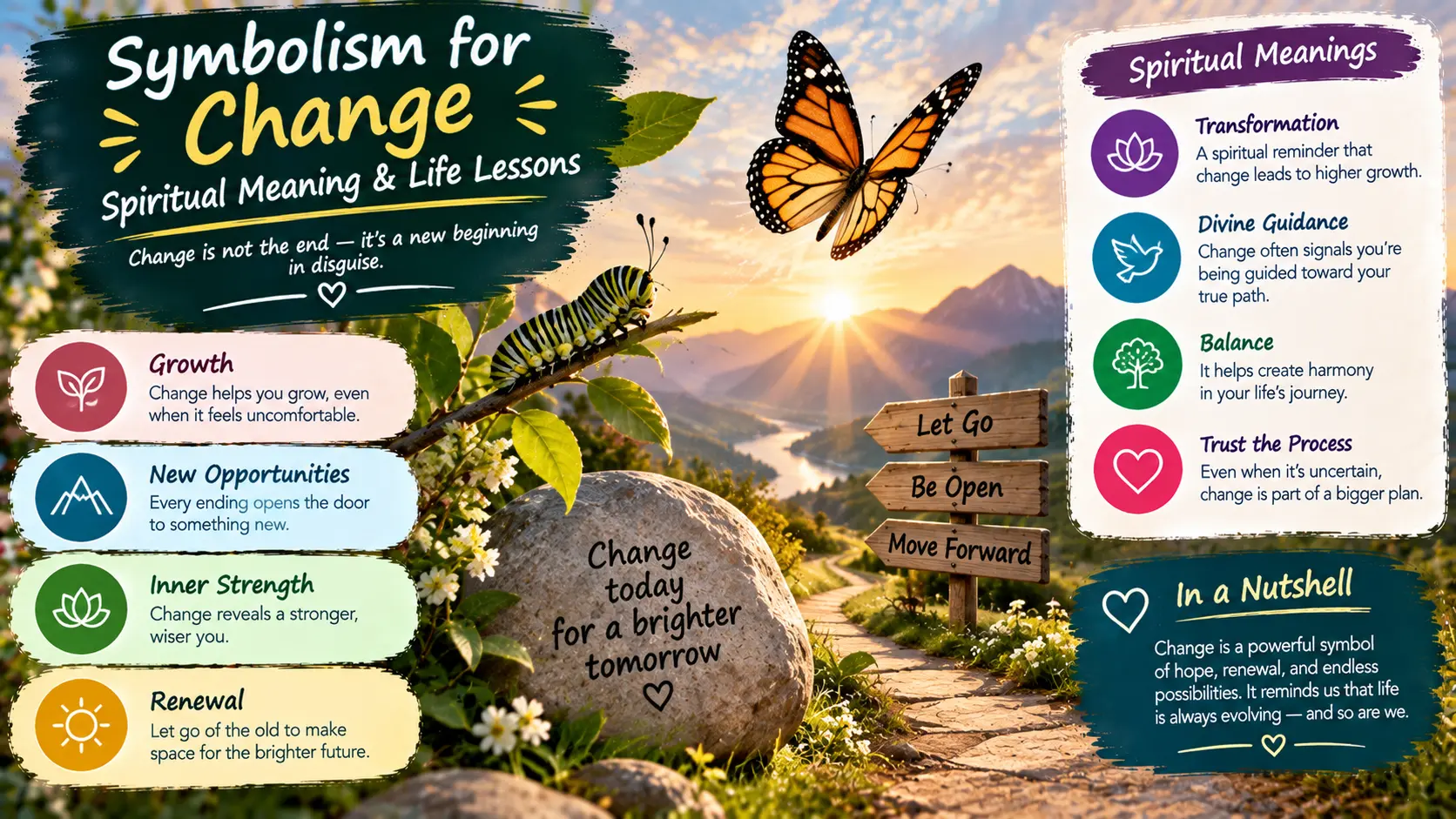
Symbolically, change is often associated with transformation, growth, renewal, endings, new beginnings, adaptation, and personal development. Common symbols include butterflies, changing seasons, flowing water, fire, the moon, sunrise, and falling leaves.
Spiritually, change may be viewed as part of a larger journey. Some traditions emphasize cycles of death and rebirth, while others focus on impermanence, surrender, purification, or personal growth. The same symbol can therefore carry different meanings depending on the tradition.
TL;DR: Key Symbols and Meanings of Change
- Butterfly: transformation, freedom, and personal growth
- Moon: cycles, phases, and renewal
- Seasons: natural transitions and the passage of time
- Water: movement, adaptation, and emotional transformation
- Fire: purification, destruction, and rebirth
- Sunrise: hope and a new beginning
- Sunset: completion, closure, and transition
- Falling leaves: release and acceptance
- Green: growth and renewal
- White: fresh starts and purity
- Purple: spiritual transformation
- Orange: energy, creativity, and transition
These interpretations are symbolic rather than universal rules. Personal circumstances and cultural context matter when interpreting them.
What Does Change Symbolize Spiritually and Symbolically?
Change can represent much more than something becoming different. In symbolic language, it often describes the movement from one stage of life to another.
Transformation and Personal Growth
Transformation is one of the strongest meanings connected with change. A person may symbolically move from one version of themselves to another through experience, learning, relationships, challenges, or new opportunities.
The butterfly is a familiar example because its life cycle visually represents a dramatic transformation. In a broader symbolic sense, transformation suggests that change does not necessarily mean losing who you are. It can represent developing qualities that were previously hidden or unused.
Endings and New Beginnings
Change often involves an ending before a beginning becomes visible. Graduation ends one phase while opening another. Moving to a new place can close one chapter while creating opportunities for a different lifestyle.
Symbols such as sunsets, closing doors, autumn leaves, and completed journeys often communicate this idea. They remind us that an ending and a beginning can be parts of the same transition.
Renewal and Rebirth
Renewal represents returning with new energy after a period of difficulty, rest, or completion. Spring is one of the clearest natural examples.
Plants that appeared dormant during winter begin producing new growth. Symbolically, this can represent recovery, hope, fresh motivation, and the opportunity to begin again.
Letting Go of the Past
Some forms of change require releasing something familiar. Falling leaves are often used as a metaphor for this process because trees naturally release leaves that are no longer needed.
The symbolism can be applied to habits, expectations, old identities, or memories. Letting go does not necessarily mean forgetting; it can mean allowing the past to occupy a different place in your life.
Adaptation and Inner Strength
Change also symbolizes adaptability. Water is especially useful as a metaphor because it can flow around obstacles while changing shape according to its environment.
This symbolism suggests that flexibility can coexist with strength. Adapting to circumstances does not always mean abandoning your values. Sometimes it means finding a new way to express them.
Natural Symbols of Change in Everyday Life
Nature provides some of the oldest and most recognizable symbols of transformation. These symbols are powerful because people can observe their cycles directly.
The Moon: Cycles, Phases, and Renewal
The moon changes appearance throughout its cycle, making it a natural symbol of phases, transition, and renewal.
A full moon and a new moon can therefore be interpreted symbolically as different stages rather than fixed states. The changing moon can remind us that life also contains periods of visibility, quietness, growth, and rest.
The Seasons: Life’s Natural Transitions
Spring, summer, autumn, and winter provide a simple symbolic model for change. Spring often represents beginnings, summer abundance, autumn release, and winter rest.
This symbolism can encourage people to recognize that not every stage of life is supposed to look the same. Different seasons can have different purposes, and periods of slowing down can be just as meaningful as periods of rapid growth.
Water: Flow, Adaptation, and Transformation
Water frequently symbolizes movement because it rarely remains completely still in nature. Rivers travel, rain falls, oceans shift, and streams change direction.
Symbolically, water can represent emotional movement, flexibility, cleansing, and adaptation. Its ability to take different forms also makes it a strong metaphor for responding to circumstances without losing one’s essential nature.
Fire: Destruction, Purification, and Rebirth
Fire has a complicated symbolism. It can destroy, but it can also provide warmth, light, energy, and transformation.
Because fire changes the material it touches, it has often been used symbolically for purification and renewal. Its meaning depends heavily on context. In one setting it may represent destruction, while in another it may symbolize cleansing, passion, or the beginning of something new.
The Butterfly: Transformation and Freedom
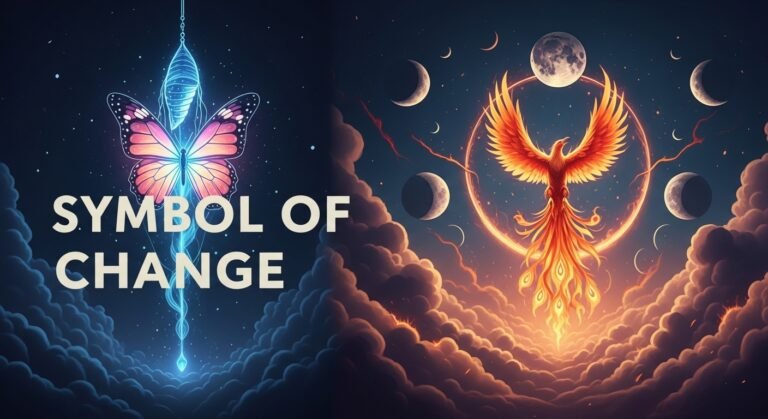
The butterfly is perhaps one of the most recognizable modern symbols of transformation. Its movement from caterpillar to chrysalis to winged insect creates a clear image of dramatic change.
It is commonly associated with personal transformation, freedom, beauty, growth, and emergence. Butterfly symbolism is especially popular when someone wants to represent a major life transition.
Sunrise and Sunset: Endings and New Beginnings
Sunrise naturally suggests the beginning of a new day. It can symbolize hope, opportunity, awakening, and renewed energy.
Sunset carries a different but connected meaning. It can represent completion, reflection, closure, and the peaceful ending of a phase. Together, sunrise and sunset demonstrate how endings and beginnings form a continuous cycle.
Falling Leaves: Release and Acceptance
Falling leaves are strongly associated with autumn and seasonal transition. They can symbolize the process of releasing what has completed its purpose.
Because trees naturally shed leaves, the image can represent acceptance rather than forced change. It reminds us that letting go can be a natural part of growth.
Cultural and Historical Symbols of Change
Symbols of change appear throughout human history, but their meanings are not identical everywhere. A symbol meaningful in one culture may carry a completely different association in another.
Ancient Greek and Roman Symbolism
Greek and Roman traditions contained many stories involving transformation, cycles, fate, nature, and rebirth. Mythological stories frequently described gods, humans, and natural beings undergoing dramatic changes.
Figures such as Janus in Roman tradition are especially relevant to transition because Janus was associated with beginnings, endings, entrances, and passages. His two-faced imagery is often interpreted as looking toward both the past and the future.
Aztec and Maya Traditions
Mesoamerican cultures developed sophisticated understandings of time, astronomy, ritual, and cyclical existence. Symbols connected with celestial movements and agricultural cycles could carry meanings involving time, renewal, death, fertility, and transformation.
However, Aztec and Maya traditions were diverse rather than one single belief system. Their symbolism should therefore be understood within specific historical and cultural contexts rather than treated as a universal Mesoamerican interpretation.
Chinese Symbolism
Chinese symbolism frequently emphasizes balance, cycles, harmony, and the relationship between opposing forces. The concept of yin and yang is commonly associated with complementary forces that continuously interact.
Rather than presenting change as simple destruction or replacement, this framework can suggest that change is part of an ongoing balance between different states.
Japanese Culture
Japanese cultural symbolism contains many examples of impermanence and seasonal transition. Cherry blossoms are particularly famous because their brief blooming period can evoke the beauty and temporary nature of life.
This association is connected with the broader aesthetic idea of appreciating impermanence. Change can therefore be viewed not simply as something to resist, but as something that gives moments their particular value.
Native American and Indigenous Traditions
There is no single Native American system of symbolism because Indigenous peoples in North America represent many distinct nations, languages, histories, and spiritual traditions.
Some Indigenous traditions place strong emphasis on relationships among people, animals, land, seasons, ancestors, and community. In contexts where seasonal cycles or natural beings carry symbolic meaning, change may be understood through relationships, responsibilities, cycles, and continuity.
It is important not to assign one symbolic interpretation to every Native American tradition. Specific meanings belong to particular communities and cultural contexts.
Victorian-Era Symbolism
Victorian culture developed an extensive language of flowers, colors, jewelry, mourning objects, and visual motifs. Flowers could communicate emotions and social messages that were not always spoken directly.
Because Victorian society placed considerable importance on symbolic communication, flowers associated with growth, farewell, remembrance, love, or renewal could become meaningful representations of life transitions.
Spiritual and Religious Symbolism for Change
Religious traditions approach change in different ways. Some emphasize spiritual transformation, some focus on impermanence, while others discuss repentance, renewal, surrender, or cycles of existence.
Christianity and Transformation
Christianity contains strong themes of transformation and renewal. Spiritual change can be associated with repentance, new life, faith, forgiveness, and becoming a different person through one’s relationship with God.
The imagery of death and resurrection is particularly important to Christian theology. Symbolically, this can represent the movement from an old state toward new life, although theological meanings are deeper than simple motivational symbolism.
Hinduism and Cycles of Life
Hindu traditions contain diverse teachings concerning life, death, rebirth, karma, dharma, and liberation. Because Hinduism encompasses many philosophical and religious schools, interpretations are not identical.
The broader idea of cycles can make change an important part of spiritual existence. Life transitions may be understood within a much larger framework involving actions, consequences, duty, spiritual development, and liberation.
Buddhism and Impermanence
Impermanence is a central Buddhist concept. Everything conditioned is understood as subject to change rather than remaining permanently fixed.
From this perspective, change is not simply an unusual event. It is a basic characteristic of ordinary existence. Recognizing impermanence can encourage awareness, non-attachment, and a more realistic relationship with changing circumstances.
Judaism and Renewal
Jewish traditions contain many themes of renewal, return, remembrance, repentance, and transformation. The concept of teshuvah, often translated in contexts as repentance or return, can involve turning away from harmful behavior and returning toward a better path.
Change in this context can involve moral reflection, responsibility, repair, and renewed commitment rather than merely external transformation.
Islam and Spiritual Growth
Islamic teachings emphasize accountability, repentance, patience, gratitude, and trust in God. Personal change can therefore be connected with improving one’s character and actions.
Repentance, or tawbah, represents turning back to God after wrongdoing. This provides a powerful spiritual example of change as recognition, correction, and renewed direction.
Why Religious Interpretations of Change Differ
Religious symbolism should not be reduced to a single universal message. Two traditions may use similar imagery while assigning different theological meanings to it.
For this reason, spiritual interpretations are best understood within their own traditions. Context matters as much as the symbol itself.
Symbols of Change in Art and Literature
Artists and writers have long used symbols because abstract ideas can become easier to understand when represented through images, objects, characters, or natural processes.
Change as a Theme in Literature
Literature frequently follows characters through transformation. A protagonist may begin with one worldview and end with another after experiencing conflict, loss, love, discovery, or responsibility.
Journeys are particularly common symbols of change. Leaving home, crossing a boundary, entering a forest, climbing a mountain, or returning after a long absence can represent an internal transformation as much as a physical journey.
Change in Poetry and Metaphor
Poetry often uses nature to express emotional transitions. A fading flower can represent temporary beauty, while rain can suggest sadness, cleansing, renewal, or emotional release.
Metaphors allow poets to communicate complicated feelings without explaining them directly. A changing landscape can become a mirror for a changing inner world.
Change in Visual Art
Visual artists may represent change through movement, seasons, aging, decay, transformation, broken objects, or contrasting colors.
Before-and-after compositions can make transformation immediately visible. Abstract art can also use changing forms and textures to communicate movement or instability.
Why Artists Use Transformation Symbols
Symbols provide a way to communicate ideas that are difficult to express literally. Change is especially suitable for symbolic representation because it can involve emotions that are contradictory.
A single image may communicate grief about what is ending while also expressing hope for what is beginning.
See Also: Seychelles Meaning: Origin, History & Modern Usage
Colors That Symbolize Change and Transformation
Colors have different meanings across cultures, but certain associations appear frequently in modern symbolic language.
Green: Growth and Renewal
Green is strongly connected with vegetation, spring, nature, and new growth. It can therefore symbolize renewal, development, healing, and fresh opportunities.
Its association with change often comes from observing plants grow and regenerate.
Blue: Flow and Emotional Change
Blue can symbolize calmness, depth, reflection, water, and emotional awareness. Because water itself is commonly associated with movement and adaptation, blue may become connected with emotional transition.
However, blue can also symbolize sadness in some cultural contexts, showing why color meanings depend on setting.
White: Fresh Starts and Purity
White is frequently associated with cleanliness, simplicity, peace, and new beginnings. In symbolic contexts, it can represent a blank page or an opportunity to begin again.
Its meaning is not universal, however. In some cultures, white also has strong associations with mourning and death.
Purple: Spiritual Transformation
Purple has historically been connected with spirituality, mystery, royalty, and reflection in various cultural settings.
As a symbol of change, it can represent inner transformation, wisdom, spiritual exploration, or a transition into a deeper stage of understanding.
Orange: Energy, Creativity, and Transition
Orange combines associations commonly linked with the warmth of red and the brightness of yellow. It can represent energy, enthusiasm, creativity, and movement.
Because of its connection with autumn foliage and changing landscapes, orange can also symbolize seasonal transition.
Black: Endings and the Unknown
Black may symbolize mystery, endings, grief, the unknown, power, or transformation depending on context.
When associated with change, it can represent the uncertainty that exists before a new stage becomes clear. It does not necessarily have a negative meaning; sometimes it represents the unknown space between chapters.
Symbols of Change in Modern Life
People continue to use traditional symbols while creating personal interpretations that reflect modern experiences.
Change Symbolism in Tattoos
Tattoos are often chosen to commemorate major transitions. Butterflies, phoenixes, flowers, waves, moons, arrows, and trees are common examples of imagery that can represent transformation.
A tattoo can have a highly personal meaning. For one person, a butterfly may symbolize freedom; for another, it may represent surviving a difficult chapter or becoming more confident.
Change Symbolism in Home Décor
People may use artwork, plants, seasonal decorations, candles, stones, photographs, or symbolic objects to represent personal intentions.
A plant, for example, can serve as a visible reminder of gradual growth. A sunrise image may represent optimism, while natural wood or botanical designs can evoke renewal and connection with nature.
Change Symbolism in Mindfulness and Healing Practices
Symbolic objects are sometimes incorporated into journaling, meditation, visualization, and other reflective practices.
A person might choose a particular image to represent something they want to release or a quality they want to develop. The psychological value may come from giving an abstract intention a concrete visual reminder.
Change Symbolism in Weddings and Life Milestones
Weddings, graduations, anniversaries, birthdays, retirements, and other milestones naturally involve transitions.
Flowers, rings, candles, photographs, trees, and ceremonial objects can represent the movement from one stage to another. These symbols help people mark important moments and create a sense of continuity.
Change Symbols on Jewelry and Personal Objects
Jewelry can carry symbolic meaning because it stays physically close to the wearer. Pendants shaped like butterflies, moons, trees, arrows, or circles may serve as reminders of transformation.
The meaning often becomes personal over time. A symbol becomes powerful not only because of its traditional meaning, but because of the memories attached to it.
Symbolism of Change in Dreams
Dreams often use images, settings, and events in unusual combinations. Symbolic interpretations can be useful for reflection, but dreams should not automatically be treated as predictions or supernatural messages.
Dreaming About Butterflies
A butterfly in a dream may be interpreted symbolically as transformation, freedom, personal development, or a changing identity.
The emotional tone of the dream matters. A peaceful butterfly may feel very different from one associated with fear or confusion.
Dreaming About Water
Water can symbolize emotional movement, uncertainty, cleansing, or adaptation. Calm water may evoke peace, while turbulent water can represent emotional intensity.
These interpretations are not fixed. The dreamer’s personal relationship with water and the specific circumstances of the dream can change its significance.
Dreaming About Fire
Fire may symbolize intense emotions, destruction, purification, passion, or transformation.
A controlled fire may have a different symbolic meaning from an uncontrollable one. Looking at what the fire was doing and how the dreamer felt can provide a more useful interpretation.
Dreaming About Seasons or Falling Leaves
Dreams involving autumn, winter, falling leaves, or changing weather may naturally evoke transitions and endings.
They can be especially meaningful when someone is already experiencing a major life transition. Rather than assuming a supernatural explanation, the dream can be considered a reflection of thoughts, emotions, and experiences.
Dreaming About Moving or Starting Over
Moving homes, traveling, crossing bridges, entering unfamiliar places, or beginning new activities can symbolize transition.
Such dreams may reflect anticipation, uncertainty, excitement, or the psychological process of adjusting to change.
Common Signs That People Associate With Change
People sometimes notice recurring symbols during important periods of life and interpret them as meaningful signs. Such experiences can be personally significant without proving that an external force is predicting an event.
Repeating Natural Symbols
Repeated encounters with butterflies, certain flowers, changing moon phases, rainbows, or falling leaves may become personally meaningful.
Keeping a journal can help identify whether the symbol appears during particular emotional or life circumstances.
Unexpected Encounters With Animals
Animals are frequently given symbolic meanings in folklore and spiritual traditions. A repeated animal encounter may therefore feel significant to someone.
The most useful interpretation should consider the animal’s actual behavior, the person’s cultural background, and the circumstances of the encounter rather than assuming one universal message.
Finding Symbolic Objects
Finding a feather, old photograph, unusual stone, flower, or other object may become meaningful when it appears during a major life transition.
Personal associations can be stronger than generalized symbolism. An object connected to a loved one, memory, or previous chapter may carry unique significance.
Recurring Dreams and Images
Recurring dreams or images can draw attention to themes that a person may already be processing emotionally.
Writing them down can reveal patterns involving relationships, work, identity, fears, or goals.
Important Life Events and Transitions
Symbolic experiences often become more noticeable around major transitions such as moving, changing careers, entering relationships, ending relationships, graduating, or beginning a new stage of adulthood.
The symbol may provide a useful framework for reflection, even when there is no objective evidence that it caused or predicted the event.
What Different Types of Change Can Symbolize
Not every change carries the same emotional or symbolic meaning. Identifying the type of transition can make interpretation more specific.
Emotional Change
Emotional change may symbolize healing, maturity, acceptance, or the development of new coping strategies.
Symbols such as water, flowers, rain, or sunrise can represent movement from emotional heaviness toward greater clarity.
Relationship Change
Changes in relationships can symbolize attachment, separation, commitment, forgiveness, or personal boundaries.
A bridge can represent connection, while a closing door can symbolize the end of a relationship or phase. These meanings are metaphorical and depend on the individual’s experience.
Career and Financial Change
Career transitions often involve uncertainty and identity changes. Symbols such as roads, mountains, ladders, arrows, and sunrise imagery can represent movement toward a new direction.
The road is particularly powerful because it suggests that change is not always about reaching a particular destination. Sometimes the journey itself is the transformation.
Spiritual Change
Spiritual change may involve questioning old assumptions, developing new practices, deepening faith, or exploring philosophical ideas.
Symbols such as light, stars, mountains, water, circles, and butterflies can represent different aspects of spiritual exploration.
Personal Identity and Growth
Perhaps the deepest form of change involves how a person understands themselves.
Growth can mean becoming more confident, changing priorities, setting healthier boundaries, discovering new interests, or developing a different understanding of one’s values.
Life Lessons From the Symbolism of Change
Symbolism can be more than decoration. It can provide useful metaphors for thinking about real-life transitions.
Change Can Create Growth
Growth rarely happens without some degree of movement. A seed must change before it becomes a plant, and a person often develops through experiences that challenge familiar assumptions.
Change may be uncomfortable while it is happening, but discomfort does not automatically mean that something is going wrong.
Endings Can Make Room for Beginnings
An ending can create physical, emotional, or psychological space for something different.
This does not mean every ending should be celebrated. Some endings involve genuine loss. The symbolic lesson is simply that life often moves forward by closing one chapter and opening another.
Adaptability Is a Form of Strength
Flexibility can help people respond to circumstances they cannot control.
Water provides a useful metaphor: it can change direction without ceasing to be water. In human life, adaptability can mean adjusting methods while preserving important principles.
Letting Go Can Bring Freedom
Holding onto an old identity, expectation, relationship, or habit can sometimes make change more difficult.
The symbolism of falling leaves offers a gentle reminder that release can be part of a natural process rather than a personal failure.
Transformation Takes Time
Many powerful symbols of change involve gradual processes. A tree grows over years, seasons shift slowly, and a butterfly develops through multiple stages.
This can remind us that meaningful personal transformation does not need to happen instantly. Progress can be gradual and still be significant.
How to Interpret a Personal Symbol of Change
A symbol becomes most useful when it helps you reflect rather than when it dictates what you should believe.
Consider What Is Happening in Your Life
Start with the transition you are experiencing. Are you beginning something, ending something, recovering from something, or questioning an old direction?
The surrounding circumstances can reveal why a particular symbol feels important.
Pay Attention to Your Emotional Response
Ask yourself what the symbol makes you feel. A butterfly may represent freedom for one person and vulnerability for another.
Your emotional response can provide valuable information about the personal meaning of the symbol.
Understand the Cultural Context
Before applying a traditional interpretation, consider where that interpretation comes from.
A color, animal, flower, or religious image can carry different meanings across cultures. Understanding the original context helps avoid oversimplification.
Avoid Treating Symbols as Absolute Predictions
Symbols can support reflection, storytelling, creativity, and spiritual practice, but they should not automatically be treated as guaranteed predictions.
A meaningful symbol can help you think about your life without determining what will happen next.
FAQ About the Symbolism of Change
What Is the Most Common Symbol of Change?
The butterfly is one of the most widely recognized symbols of transformation and personal change. Other common symbols include the moon, seasons, water, fire, sunrise, and falling leaves.
What Animal Symbolizes Transformation?
The butterfly is particularly associated with transformation because of its dramatic life cycle. Other animals can also symbolize change depending on cultural or personal context.
What Color Represents Change?
Green is commonly associated with growth and renewal, while purple can represent spiritual transformation and orange can represent energy and transition. Color meanings vary across cultures.
What Flower Symbolizes New Beginnings?
Flowers associated with spring and renewal are often used symbolically for new beginnings. Specific flower meanings vary considerably between cultures and historical periods.
What Does Change Mean Spiritually?
Spiritually, change can symbolize transformation, renewal, growth, surrender, impermanence, or movement into a new stage of life. Different religious traditions understand these ideas in different ways.
What Does It Mean to Keep Seeing Symbols of Change?
Repeated symbols may feel meaningful, especially during a major transition. They can be approached as opportunities for personal reflection, while recognizing that repetition does not necessarily establish a supernatural prediction.
Conclusion: Embracing the Beauty and Meaning of Change
Change is woven into nearly every part of life. The moon changes phases, seasons turn, water flows, leaves fall, flowers bloom, and living beings develop through different stages.
For this reason, symbols of change appear across nature, religion, mythology, art, literature, dreams, and everyday life. The butterfly can represent transformation, water can suggest adaptation, fire can represent renewal or destruction, and the changing seasons can remind us that every stage has a beginning and an ending.
The most meaningful interpretation is often the one that connects the symbol with the person’s circumstances without ignoring cultural context. A symbol does not have to predict the future to be valuable. It can simply provide a language for understanding experiences that are difficult to express directly.
Ultimately, the symbolism of change encourages a balanced perspective: some changes deserve celebration, others require patience and grief, and many involve both. Change can mark an ending, but it can also create the space in which growth, renewal, and new possibilities become possible.