Whitney Meaning: Name Origin, History & Modern Symbolism
Quick Answer
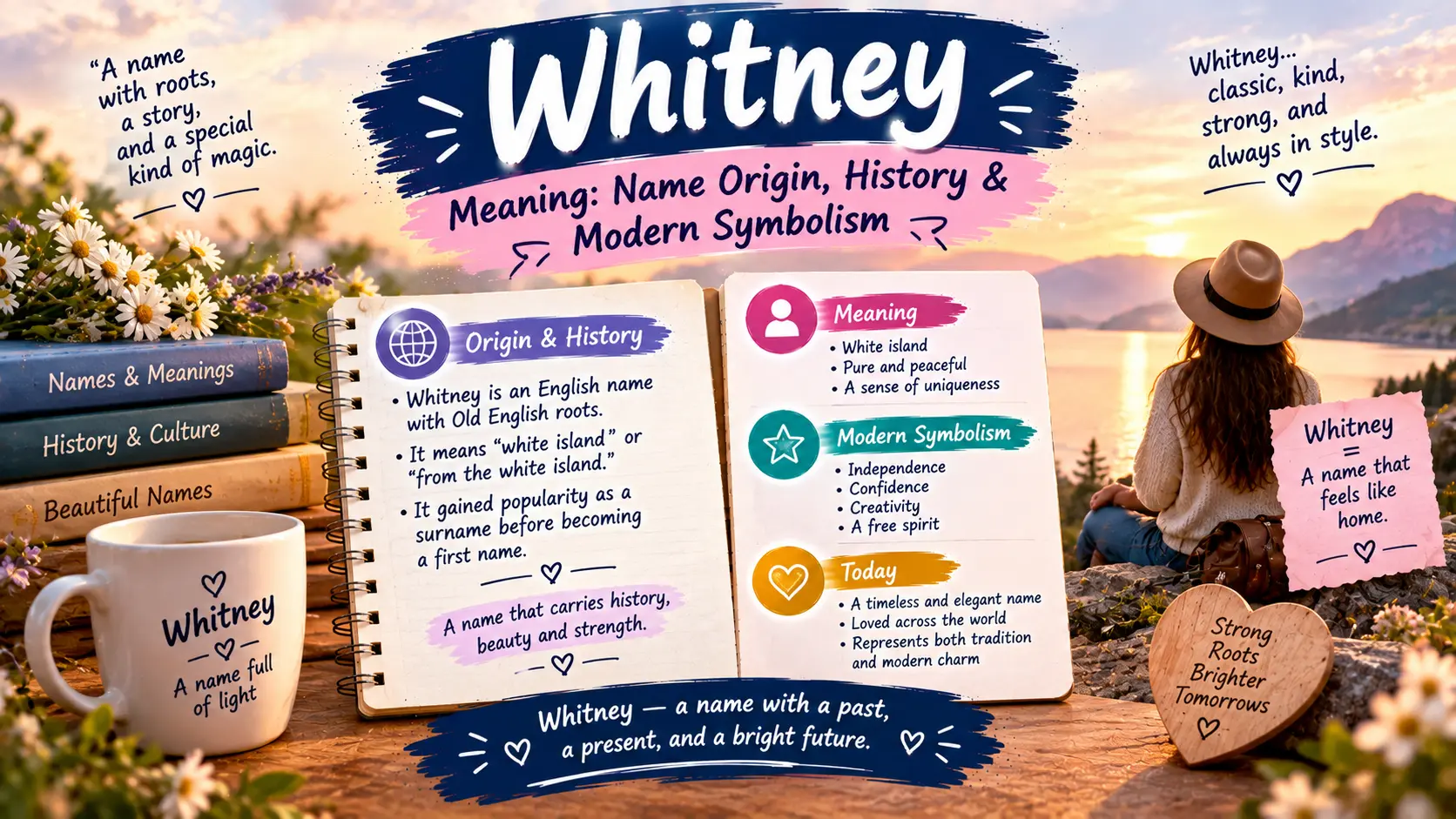
The name Whitney is traditionally an English name derived from an Old English place name. It is generally connected with the idea of “white island” or “white meadow/island,” based on Old English elements associated with white and an island or dry land. Whitney originally developed as a place name and surname before becoming a popular given name.
In modern American usage, Whitney is most commonly recognized as a feminine first name, although it has historically been used for both males and females. The name can suggest elegance, individuality, confidence, calmness, and independence because of its sound and cultural associations.
Whitney does not literally mean “hiatus.” Any connection between Whitney and the idea of a hiatus is metaphorical rather than linguistic. A symbolic interpretation can associate Whitney with pausing, reflection, reinvention, and beginning again, but those ideas should not be confused with the name’s historical definition.
TL;DR
- Whitney has Old English roots.
- It began primarily as an English place name and surname.
- The traditional meaning is commonly explained through Old English elements associated with white and an island or piece of dry land.
- Whitney became established as a given name, particularly in the United States.
- Today, it is more commonly perceived as a feminine name, although it can be unisex.
- Whitney does not literally mean hiatus.
- A modern symbolic interpretation may connect the name with reflection, pauses, growth, and reinvention.
- Its emotional impression is often described as graceful, polished, calm, and independent.
What Does the Name Whitney Mean?
Basic Definition
Whitney is an English name with geographical origins. Unlike names that began as descriptions of personality traits or religious concepts, Whitney originally referred to a particular location. This makes its meaning closely connected with the landscape and naming traditions of medieval England.
The name is generally traced to the English place name Whitney, particularly the historic settlement in Herefordshire. Over time, the place name became a surname for people associated with the area. Eventually, Whitney developed into a personal given name.
Because of this history, the name carries several layers of meaning today. Its literal meaning relates to its Old English construction, while its modern associations come from language, history, culture, famous individuals, and personal identity.
Literal and Traditional Meaning
Whitney is commonly interpreted from Old English elements associated with “white” and an island or piece of elevated/dry land. Depending on the linguistic explanation used, the name may therefore be rendered as “white island” or interpreted in relation to a white or pale landscape.
The word white can also create modern symbolic associations with clarity, brightness, purity, simplicity, and openness. These are symbolic interpretations rather than the literal historical definition.
This distinction matters because name meanings often develop beyond their original linguistic roots. A name can begin as a geographical description and later acquire emotional or cultural meanings through generations of use.
Linguistic Roots
Whitney developed from Old English place-name elements. English place names were frequently constructed from descriptions of landscapes, settlements, rivers, hills, islands, vegetation, and other geographical features.
The first element is generally connected with an Old English word meaning white. The second element is associated with a term describing an island or elevated piece of land. Together, these elements produced the historical place name from which Whitney eventually developed.
The exact interpretation of old place names can vary because spellings and pronunciations changed over centuries. Modern English speakers therefore encounter Whitney in a form that has evolved considerably from its medieval origins.
Where Does the Name Whitney Come From?
Old English Origins
The roots of Whitney reach back to Anglo-Saxon England, when Old English was widely spoken. During this period, many settlements received names based on their physical surroundings.
Whitney’s linguistic structure reflects this tradition. Instead of being created specifically as a personal name, it began as a geographical identifier. Such names could later become surnames when people needed to be distinguished according to where they lived or originated.
This gives Whitney a strong connection with English heritage and medieval naming customs.
Place Name and Surname Roots
Whitney is historically associated with a place in Herefordshire, England. Someone connected with that location could eventually be identified by the place name, creating the surname Whitney.
This process was common throughout England. Surnames frequently developed from occupations, personal characteristics, family relationships, and geographical locations.
As a surname, Whitney therefore carried an implicit connection to place, ancestry, and belonging. This historical layer continues to influence the name’s modern character.
From Surname to Given Name
Over time, Whitney moved beyond its use as a surname and became a given name. The transition reflects a broader naming tradition in English-speaking societies where established surnames become first names.
By becoming a first name, Whitney acquired a more personal identity. Instead of simply indicating someone’s geographical background, it became a name chosen for its sound, familiarity, cultural associations, and individuality.
The surname-to-first-name transition also helped make Whitney feel both traditional and modern.
Historical Origins and Early Use
Medieval England
During medieval England, place names played an important role in identifying communities and individuals. Whitney’s origins belong to this broader linguistic environment.
The name’s geographical beginning means that its earliest history is not primarily about a particular personality or symbolic quality. It is about landscape and location.
As English developed, spellings became standardized differently across regions and documents. This helps explain why historical names can have several recorded forms while eventually developing into a familiar modern spelling.
Whitney as an English Surname
Whitney became established as an English surname. Families carrying the surname could have historical connections with the place from which the name originated, although surname origins can become complicated over many generations.
The surname also contributed to the name’s later association with heritage and established identity. When Whitney eventually became a first name, these older associations remained in the background.
Early Use in America
English surnames and naming customs traveled to North America through migration and settlement. Whitney consequently became part of the wider American naming landscape.
In the United States, the name eventually became more strongly associated with use as a given name. Its familiar pronunciation and elegant sound helped it move comfortably from family surname traditions into mainstream first-name usage.
Whitney Meaning in the United States
American Naming Traditions
In the United States, Whitney developed a distinctive identity as a personal name. While its roots are English, its modern cultural meaning is heavily influenced by American naming patterns.
American parents have often chosen Whitney because it sounds polished, approachable, and established without being extremely traditional. It can also carry a sense of individuality because it is recognizable without being one of the most universal first names.
The American interpretation of Whitney is therefore partly historical and partly cultural.
Cultural Associations
Many people associate Whitney with qualities such as confidence, sophistication, friendliness, independence, and creativity. These associations do not constitute an official meaning; they are impressions shaped by sound, usage, and cultural exposure.
The beginning sound of Whitney can feel soft and approachable, while the overall rhythm gives the name a polished quality. These linguistic impressions can influence how people emotionally perceive a name.
Influence of Famous Whitneys
Public figures can strongly influence the cultural identity of a name. One of the most significant examples is Whitney Houston, whose international career made Whitney widely recognizable around the world.
Her influence added associations with music, talent, confidence, emotional expression, and cultural impact. These associations belong to the cultural history of the name rather than its original etymology.
See Also: Cariño Meaning: Definition, Usage & Emotional Meaning
Is Whitney a Unisex Name?
Whitney as a Feminine Name
In contemporary American culture, Whitney is most commonly perceived as a feminine given name. This perception became especially established during the modern period.
The name’s popularity among girls and women has influenced its current cultural identity. When many Americans hear Whitney as a first name, they are likely to imagine it as feminine.
Whitney as a Masculine Name
Whitney has also been used as a masculine given name, particularly because of its surname origins. Historically, English surnames that became first names were not always restricted by gender.
This historical flexibility means that calling Whitney exclusively feminine would overlook part of its naming history.
Modern Gender-Neutral Use
Although modern American usage tends to make Whitney feminine, it can still function as a gender-neutral or unisex name in the broader historical sense.
Its surname background gives it a natural connection to the tradition of names that can cross gender boundaries. Individual families may therefore interpret Whitney differently depending on personal, cultural, and family preferences.
The Symbolic Meaning of Whitney
Themes of Identity and Individuality
Because Whitney developed from a place name and later became a surname and given name, it can symbolically represent identity and belonging.
A place name tells us where something comes from. A surname connects that origin to family history. A first name transforms that heritage into an individual’s identity.
For this reason, Whitney can be viewed symbolically as a name that connects past and present.
Strength, Grace, and Independence
Modern impressions of Whitney often include grace and independence. The name has a refined sound without being overly formal, which can create an image of someone who is composed yet confident.
These qualities are cultural associations rather than fixed personality traits. A person’s name does not determine their character, but names can develop emotional impressions through repeated use.
Connection to Heritage
Whitney’s English place-name origins give it a strong symbolic connection with heritage, roots, ancestry, and continuity.
Someone interested in family history may find this aspect particularly meaningful. The name can represent the idea of carrying something from the past into a new generation.
Whitney and the Idea of a Hiatus
Where the Association Comes From
The word hiatus means a pause, interruption, or temporary break. It is a completely separate word from Whitney and does not come from the same linguistic root.
Any connection between Whitney and hiatus is therefore best understood as a modern symbolic association rather than a dictionary definition.
A person might creatively interpret Whitney as representing a pause before change, especially when discussing personal growth or reinvention. That interpretation can be meaningful, but it should be clearly identified as metaphorical.
Is “Hiatus” an Actual Meaning of Whitney?
No. Whitney does not literally mean “hiatus.”
The historical meaning of Whitney comes from Old English geographical elements. Hiatus comes from a different linguistic history and refers to a gap, interruption, or pause.
Confusing the two can create an inaccurate name definition. For an SEO or educational article, it is useful to separate etymology from symbolism.
Modern Metaphorical Interpretation
Even though hiatus is not Whitney’s literal meaning, the concept of a pause can be used symbolically with the name.
A pause can represent reflection, recovery, preparation, transformation, or a change of direction. In that metaphorical sense, Whitney may be interpreted as a name associated with the ability to step back, reconsider, and move forward.
This is a creative modern interpretation rather than a historical name meaning.
Emotional and Psychological Associations
Common Emotional Impressions
Whitney can evoke impressions of calm confidence, friendliness, elegance, and individuality. Its sound is relatively smooth, which may contribute to its approachable character.
Names often generate emotional reactions before people consciously analyze their meanings. Familiarity, personal memories, media exposure, and experiences with people who have that name can all influence perception.
Calm and Reflective Qualities
The name Whitney may feel reflective because of its balanced sound and cultural associations. It is neither extremely short nor unusually elaborate, giving it a steady rhythm.
The reflective quality becomes even stronger when Whitney is connected metaphorically with ideas such as pausing, observing, and beginning again.
Personality Associations
Some people may associate Whitney with qualities such as:
- Independence
- Grace
- Confidence
- Creativity
- Warmth
- Self-awareness
- Adaptability
These are symbolic impressions, not scientific predictions. A name can influence perception, but it does not determine personality.
See Also: ATP Meaning in Texting: What Does ATP Mean in 2026?
Whitney in Popular Culture
Music, Film, and Television
Popular culture has played a major role in shaping how Americans perceive personal names. Whitney became especially recognizable through music and entertainment.
The global prominence of Whitney Houston gave the name a strong association with artistic achievement and emotional expression. Other fictional and public figures have contributed additional interpretations over time.
Public Figures Named Whitney
The name Whitney has been carried by artists, athletes, writers, performers, and other public figures. Each individual can add a different layer to the cultural image of the name.
This is one reason name meanings can feel richer than dictionary definitions. A name becomes part of a cultural story through the people who carry it.
How Media Shapes Name Perception
Media exposure can make a name feel sophisticated, youthful, traditional, creative, or contemporary. These perceptions can change from one generation to another.
Whitney’s cultural image has therefore developed through a combination of historical roots, American naming patterns, entertainment, and personal experience.
Cross-Cultural and Spiritual Perspectives
Similar Themes Across Cultures
The exact meaning of Whitney is English, but some of its symbolic themes can be understood more broadly.
Ideas such as light, clarity, heritage, renewal, identity, and personal transformation appear in many cultural traditions. These shared themes can provide symbolic interpretations without claiming that Whitney itself has an ancient spiritual meaning.
Spiritual Interpretations
Whitney is not inherently a religious name. Its origins are geographical rather than specifically biblical or theological.
However, individuals may personally give the name spiritual significance. Someone might associate its traditional connection with brightness or landscape with clarity, hope, renewal, or finding one’s path.
Personal spirituality can therefore add meaning to Whitney without changing its historical etymology.
Meaning Without a Religious Connection
A name does not need to be religious to carry deep personal meaning.
Whitney can symbolize family heritage, individuality, growth, confidence, or a connection to the past without being connected to a particular faith tradition.
Modern Usage of the Name Whitney
Naming Trends
Whitney became especially recognizable as a first name in modern American naming culture. Its popularity has shifted over generations, as happens with many names.
Names can move through periods of high visibility and quieter use. A name does not need to be among the most popular choices to remain culturally familiar.
Social and Cultural Identity
Today, Whitney can communicate a combination of familiarity and individuality. Most people recognize it immediately, yet it does not necessarily feel generic.
Its surname heritage also gives it a slightly established character, while its use as a first name makes it personal and contemporary.
Style and Personal Branding
Whitney can work well in contexts where a name needs to feel professional, memorable, polished, and approachable.
Because it is recognizable and relatively easy to pronounce, it can function comfortably across personal, professional, and digital settings.
Contextual Meanings of Whitney Today
The meaning people attach to Whitney can change depending on context.
As a first name, it usually represents an individual’s identity. As a surname, it can suggest family heritage. As a historical place name, it points back toward English geography.
In creative or spiritual writing, Whitney can also become a metaphor for identity, reflection, renewal, and reinvention. The key is to distinguish these symbolic meanings from the name’s historical etymology.
Common Misunderstandings About Whitney
Whitney Does Not Literally Mean Hiatus
The most important clarification is that Whitney and hiatus are not synonyms.
Whitney comes from English place-name traditions, while hiatus refers to a gap or interruption. Connecting Whitney with hiatus can be used creatively, but it should not be presented as the literal dictionary meaning.
Name Meaning vs. Symbolic Interpretation
There is an important difference between etymology and symbolism.
Etymology explains where a word or name comes from. Symbolism explains what people may associate with it emotionally or culturally. Both can be interesting, but they answer different questions.
Avoiding Over-Romanticized Meanings
Online name content sometimes assigns elaborate spiritual meanings to ordinary historical names. These interpretations can be enjoyable, but they should not replace documented linguistic history.
For Whitney, the strongest approach is to recognize its English geographical origin while allowing modern symbolic interpretations to explore ideas such as identity and renewal.
How the Meaning of Whitney Has Changed Over Time
From Place Name to Surname
Whitney first functioned primarily as a geographical name. It identified a place and, eventually, people associated with that place.
The transition from location to surname created a connection between the word and family identity.
From Surname to First Name
When Whitney became a given name, its function changed again. Instead of identifying where a family came from, it became a name selected for an individual.
This transformation gave Whitney a new emotional dimension while preserving its historical roots.
Then vs. Now
Then: Whitney primarily reflected English geography and family origin.
Now: Whitney is recognized mainly as a personal name, particularly in the United States, with associations involving individuality, confidence, elegance, and cultural familiarity.
This evolution demonstrates how names can preserve historical roots while gaining entirely new meanings through everyday use.
Whitney as a Symbol of Reinvention
Identity and Personal Growth
Whitney’s journey from place name to surname to first name provides a natural metaphor for transformation.
The name itself has moved through different identities over time. Symbolically, that can represent the human ability to grow beyond an earlier role without completely abandoning one’s roots.
The Power of Taking a Pause
The idea of a hiatus can be useful as a metaphor even though it is not the literal meaning of Whitney.
A pause can create space for reflection and change. In this symbolic interpretation, Whitney can represent someone who does not view a temporary interruption as failure but instead sees it as an opportunity to reconsider the next direction.
Beginning Again With Confidence
Reinvention does not necessarily mean becoming a completely different person. It can mean taking existing strengths, experiences, and values and using them in a new way.
In that sense, Whitney can symbolically represent continuity combined with change—honoring the past while confidently moving toward something new.
FAQs About the Name Whitney
What does the name Whitney mean?
Whitney is an English name originating from a place name. It is commonly connected with Old English elements referring to white and an island or piece of dry land. It later developed as a surname and given name.
Is Whitney a unisex name in the USA?
Yes. Whitney has historical use as both a masculine and feminine name because of its surname origins. In contemporary American culture, however, Whitney is more commonly perceived as a feminine first name.
Does Whitney literally mean hiatus?
No. Whitney does not literally mean hiatus. The two words have different linguistic origins. Any relationship between them is a modern metaphorical interpretation involving ideas such as pausing, reflection, or reinvention.
Is Whitney still a popular name today?
Whitney remains a recognizable American given name, although its popularity has changed over time. Its familiarity is reinforced by its long history and prominent public figures who have carried the name.
Is Whitney a religious name?
Whitney is not specifically a religious or biblical name. It has English geographical origins. People can give the name personal spiritual meaning, but spirituality is not part of its original etymology.
Why does Whitney feel calm or reflective?
The perception may come from the name’s smooth sound, balanced rhythm, familiarity, and cultural associations. Personal experiences and associations with people named Whitney can also affect how the name feels emotionally.
Can Whitney symbolize reinvention?
Yes, as a symbolic interpretation. Whitney’s historical journey from place name to surname and then given name can metaphorically represent identity, adaptation, growth, and reinvention.
Is Whitney an English name?
Yes. Whitney is traditionally considered an English name with Old English place-name origins. Its history is closely connected with English geography and surname traditions.
Conclusion: The Meaning and Symbolism of Whitney
The name Whitney has a long history that begins in England. Its roots are geographical, developing from an Old English place name before becoming a surname and eventually a widely recognized first name.
Its traditional meaning is connected with white and an island or piece of dry land, while its modern cultural associations have expanded to include qualities such as grace, confidence, individuality, heritage, and independence.
One important clarification is that Whitney does not literally mean “hiatus.” The connection between Whitney and hiatus is best understood as a creative metaphor. When used symbolically, however, the idea of a pause can represent reflection, personal growth, and the courage to begin again.
Ultimately, Whitney is a name that beautifully demonstrates how meaning evolves. Its historical roots connect it to place and heritage, while its modern identity can represent individuality, transformation, and a confident sense of self.