Lily Symbolism: Spiritual, Biblical & Cultural Meaning
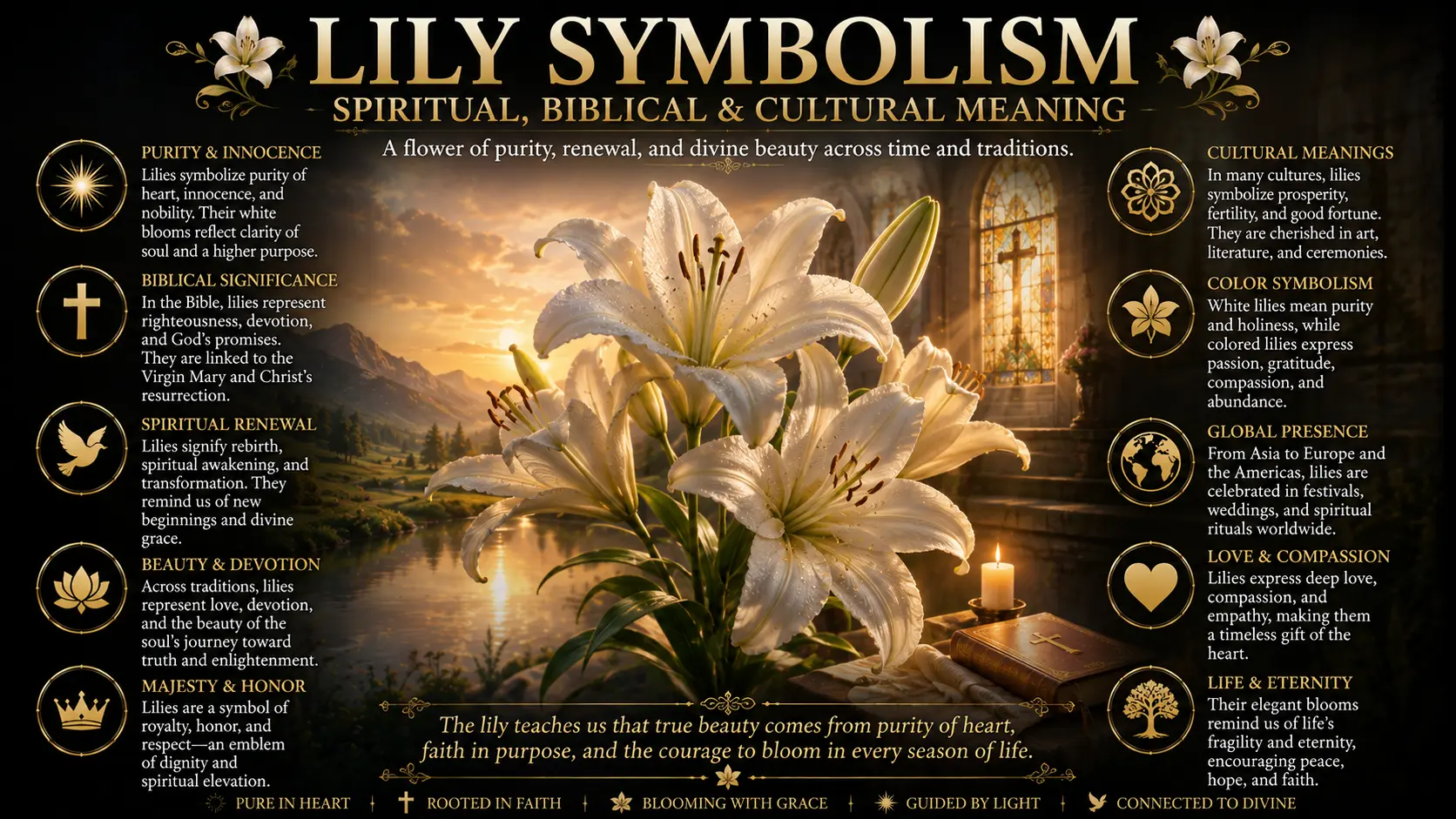
Lilies have fascinated people for centuries because of their graceful appearance, fragrant blooms, and association with important moments in life. Across different cultures and traditions, lilies have come to represent purity, peace, renewal, love, hope, remembrance, and spiritual transformation.
The meaning of a lily can change depending on its color, cultural setting, religious tradition, personal experience, or the situation in which it appears. A white lily may suggest innocence and peace, while an orange lily can represent confidence, energy, or passion.
Whether you encounter lilies in a garden, dream about them, receive them as a gift, or see them at a religious or memorial ceremony, their symbolism can offer a meaningful way to reflect on life, change, relationships, and inner growth.
What Do Lilies Symbolize?
Lilies commonly symbolize purity, beauty, renewal, compassion, devotion, peace, and new beginnings. Their upward-growing stems and dramatic blossoms often make them natural symbols of growth and spiritual elevation.
At the same time, lilies can represent remembrance and the transition from one stage of life to another. Their connection with both celebrations and funerals shows how one flower can carry meanings related to birth, love, faith, loss, and hope.
The Core Meaning of Lily Symbolism
At its heart, lily symbolism is often connected with purity and transformation. A lily begins as a closed bud and eventually opens into a striking flower, making it an appealing metaphor for personal development.
The flower can therefore represent the process of becoming: moving through challenges, opening to new possibilities, and discovering beauty that may not have been visible at first.
Why Lilies Are Powerful Symbols
Lilies combine delicate beauty with impressive resilience. Many varieties return year after year, while their blossoms can appear remarkably elegant despite changing environmental conditions.
This contrast gives the lily a symbolic quality of gentleness with strength. It can remind us that being calm, compassionate, or sensitive does not mean being weak.
Lily Symbolism at a Glance
| Symbolic Meaning | What It Can Represent |
|---|---|
| Purity | Innocence, sincerity, spiritual cleanliness |
| Renewal | Fresh starts and personal transformation |
| Peace | Calmness, harmony, and comfort |
| Love | Affection, devotion, and emotional connection |
| Hope | Optimism and brighter possibilities |
| Remembrance | Honoring someone or preserving memories |
| Beauty | Grace, elegance, and appreciation |
| Growth | Personal development and resilience |
Cultural Symbolism of Lilies
Lilies have acquired different meanings across cultures. Their symbolism has been shaped by mythology, religion, art, ceremonies, literature, and everyday traditions.
Although interpretations vary, several themes appear repeatedly: beauty, fertility, purity, devotion, prosperity, and renewal.
Lilies in Ancient Cultures
Lilies appear in the artistic and symbolic traditions of several ancient civilizations. Their striking form made them suitable for decorative artwork, religious imagery, and representations of beauty.
In ancient Greek tradition, the lily became associated with Hera, and classical mythology connected the flower with ideas of divine beauty and motherhood. The flower’s elegant appearance helped strengthen its association with femininity and sacred beauty.
Lily Symbolism in Eastern Traditions
In various East Asian cultural contexts, lilies may be associated with beauty, harmony, prosperity, and favorable relationships. The exact meaning depends heavily on the specific culture and lily variety.
Flowers generally hold an important place in many East Asian artistic traditions, where their seasonal appearance and visual characteristics can communicate ideas about character, impermanence, balance, and life.
Lily Symbolism in Western Culture
Western symbolism has been strongly influenced by Christianity and European artistic traditions. Lilies, particularly white lilies, became closely connected with purity, innocence, devotion, and sacred beauty.
Over time, their use expanded beyond religious settings. Lilies became common in weddings, gardens, floral arrangements, celebrations, and memorial ceremonies, giving them a broad emotional vocabulary.
Lilies in Weddings and Celebrations
Lilies can symbolize love, commitment, beauty, and the beginning of a new chapter, making them suitable for celebrations.
Their elegant shape can also communicate sophistication and grace. Depending on the variety and color, lilies may add meanings ranging from romantic affection to friendship, joy, and prosperity.
Lily Symbolism in the Bible and Christianity
Lilies have an especially important place in Christian symbolism. Biblical passages about flowers and lilies have contributed significantly to the flower’s association with trust, beauty, purity, and divine care.
It is important to distinguish between the specific botanical lilies known today and the broader flower imagery translated as “lilies” in biblical texts.
Lilies in the Bible
One of the best-known biblical references appears in Jesus’ teaching in the Gospel of Matthew, where listeners are encouraged to consider the lilies of the field and God’s care for creation.
The passage is commonly interpreted as a lesson about trusting divine providence rather than becoming consumed by anxiety about material needs.
Lilies and Purity in Christianity
White lilies became particularly powerful Christian symbols of purity and innocence. Their clean appearance and fragrant blossoms contributed to their religious associations.
In Christian art, lilies can therefore represent a life devoted to faith, moral purity, humility, and spiritual sincerity.
Lilies and the Virgin Mary
The white lily has long been associated with the Virgin Mary in Christian art and tradition. The flower’s symbolism of purity helped reinforce its connection with Mary’s traditional portrayal.
Paintings and religious artworks have frequently used lilies as visual symbols rather than merely decorative flowers.
Easter Lily Symbolism
The Easter lily is strongly associated with Easter and Christian celebration. Its white trumpet-shaped flower is commonly interpreted as representing purity, hope, and the resurrection.
Because Easter focuses on resurrection and renewed life, the blooming lily naturally fits the season’s symbolism of transformation and new beginnings.
Birds Flying in a Circle: Spiritual Meaning and Symbolism
Lilies and Resurrection
Lilies can symbolize resurrection because a flower emerges, blooms, fades, and can return through another growing season.
Within Christian symbolism, this natural cycle can serve as a visual reminder of renewed life, hope, and spiritual continuation.
Spiritual Meaning of Lilies
From a spiritual perspective, lilies often represent the movement from difficulty toward peace and from an unopened state toward greater awareness.
Their symbolism does not have one universal spiritual interpretation. Instead, people may find different meanings based on their beliefs, experiences, and circumstances.
Purity and Innocence
Lilies, especially white varieties, are widely associated with purity. Spiritually, this can refer to a sincere heart, clear intentions, innocence, or a desire to live authentically.
The symbolism can also encourage emotional cleansing—letting go of resentment, unnecessary guilt, or negative patterns.
Renewal and Transformation
A lily’s bloom can symbolize the emergence of something new. Spiritually, it may represent personal transformation and the courage to enter a new stage of life.
Seeing a lily can become a reminder that growth often happens gradually before becoming visible.
Peace and Inner Healing
The soft appearance and fragrance of lilies can evoke feelings of calmness. Symbolically, they may represent inner peace, emotional healing, forgiveness, and acceptance.
For someone moving through a difficult period, the flower can serve as a gentle reminder that peace can develop slowly.
Love and Compassion
Lilies can symbolize love that extends beyond romance. They may represent compassion, kindness, devotion, family affection, and emotional generosity.
Their graceful appearance can remind us that meaningful relationships often grow through patience and care rather than dramatic gestures.
Hope and New Beginnings
A blooming lily can represent hope after uncertainty. Its appearance may symbolize a fresh beginning, renewed confidence, or the possibility of positive change.
This interpretation is especially powerful when a person is entering a new phase after hardship or loss.
Lily Symbolism and Death
Lilies are frequently associated with funerals and memorials, particularly white lilies. This connection has created a strong symbolic relationship between lilies and death.
However, their meaning in these settings is not simply sadness. Lilies can also communicate peace, dignity, remembrance, spiritual hope, and the continuation of love.
Lilies at Funerals
White lilies are commonly used in funeral arrangements because they can convey serenity and reverence.
Their presence may express sympathy while creating an atmosphere of calm and dignity during a difficult farewell.
Lilies as Symbols of the Soul
In Christian-influenced symbolism, white lilies can represent the soul’s purity and hope for spiritual peace.
This interpretation helps explain why lilies appear frequently in religious memorial artwork and funeral ceremonies.
Grief, Peace, and Remembrance
Flowers cannot remove grief, but they can provide a visual language for emotions that are difficult to express.
Lilies can symbolize the idea that although someone may be physically absent, love, memories, and influence can remain.
Symbols of Growth and Progress: Meaning, Culture & Spirituality
Why White Lilies Are Associated With Death
The association comes partly from their traditional connection with purity and spiritual peace. Their calm appearance can also create a sense of dignity appropriate for memorial settings.
Rather than representing death alone, white lilies often communicate peaceful remembrance and hope beyond loss.
Lily Color Symbolism
The color of a lily can significantly influence its symbolic interpretation. Different colors can communicate different emotional qualities.
These meanings are symbolic rather than universal rules, so cultural and personal interpretations may differ.
White Lily Meaning
White lilies are perhaps the most strongly symbolic variety. They commonly represent purity, innocence, peace, spirituality, sincerity, and remembrance.
They are frequently associated with weddings, religious ceremonies, Easter, funerals, and moments requiring a sense of grace and dignity.
Pink Lily Meaning
Pink lilies often symbolize affection, admiration, tenderness, friendship, and appreciation.
They can be appropriate when expressing warm feelings without the intensity traditionally associated with deep romantic passion.
Red Lily Meaning
Red lilies can symbolize passion, love, confidence, courage, and strong emotion.
Their bold appearance naturally lends itself to interpretations involving energy and emotional intensity.
Orange Lily Meaning
Orange lilies are often associated with enthusiasm, confidence, vitality, creativity, and passion.
Their bright color can symbolize an energetic approach to life and the willingness to embrace opportunities.
Yellow Lily Meaning
Yellow lilies can represent happiness, friendship, optimism, warmth, and positive energy.
They may symbolize appreciation for a friendship or the joy associated with a bright new chapter.
Purple Lily Meaning
Purple lilies can suggest royalty, admiration, dignity, spirituality, and mystery.
Because purple has historically been associated with prestige and depth, purple lilies can carry an especially elegant and contemplative meaning.
Lily Symbolism in Dreams
Dream symbolism is highly personal. A lily appearing in a dream does not have one fixed meaning for everyone.
The dreamer’s emotions, relationships, memories, and circumstances can influence what the flower represents. Still, lilies often provide themes of peace, beauty, healing, love, and transformation.
Dreaming of White Lilies
Dreaming about white lilies may symbolize a desire for peace, emotional clarity, innocence, forgiveness, or spiritual comfort.
If the dream feels peaceful, the lily may reflect acceptance or emotional healing. If the dream feels sad, it could instead connect with remembrance or unresolved grief.
Receiving Lilies in a Dream
Receiving lilies may symbolize feeling valued, appreciated, forgiven, or emotionally supported.
The identity of the person giving the flowers can provide important context. The dream may reflect a real relationship or symbolize an aspect of yourself that needs attention.
Giving Someone Lilies in a Dream
Giving lilies can represent love, forgiveness, respect, gratitude, or a desire to offer emotional support.
The dream may also symbolize your willingness to release something from the past and move toward emotional peace.
Seeing Blooming or Withered Lilies
Blooming lilies commonly suggest growth, renewal, opportunity, and emotional flourishing.
Withered lilies can symbolize the end of a phase, fading emotions, disappointment, or the need to accept change. They do not necessarily predict something negative; they may simply reflect transition.
What Lily Dreams May Represent
Consider the following questions when interpreting a lily dream:
- What color was the lily?
- Was it blooming or fading?
- Who was present?
- How did you feel during the dream?
- Was the setting peaceful, joyful, or sad?
- What is currently changing in your life?
These details often provide more useful insight than relying on a single symbolic definition.
Lily Symbolism in Love and Relationships
Lilies can represent many forms of love, from romance and marriage to friendship and family devotion.
Their symbolism often emphasizes beauty, sincerity, tenderness, commitment, and emotional growth rather than only physical attraction.
Lilies as Symbols of Romantic Love
Certain lily colors can symbolize passion and affection. Red and pink varieties can communicate romantic feelings, admiration, and emotional closeness.
White lilies can represent a more serene form of love based on sincerity, devotion, and trust.
Lilies and Marriage
Lilies can symbolize the beginning of a shared journey. Their associations with purity, devotion, beauty, and renewal make them meaningful wedding flowers.
They can represent the hope that a relationship will continue to grow through different seasons of life.
Giving Lilies as a Gift
The meaning of gifted lilies depends partly on their color and the relationship between the giver and receiver.
A bouquet may express admiration, affection, congratulations, sympathy, gratitude, or encouragement. The surrounding occasion is often the strongest clue.
Lily Symbolism After a Relationship Ends
Lilies can also represent emotional closure. Their connection with transformation and renewal may encourage someone to recognize that an ending can create space for personal growth.
In this sense, the lily symbolizes not forgetting the past, but learning from it while continuing forward.
Lilies in Art, Literature, and Popular Culture
Lilies have been used extensively in visual art, religious imagery, poetry, literature, gardens, fashion, and modern design.
Their distinctive shape makes them visually recognizable, while their symbolic associations give artists a rich language for expressing emotion.
Lilies in Paintings and Visual Art
Artists have used lilies to communicate purity, beauty, femininity, spirituality, nature, and transience.
A lily can function as both a beautiful object and a symbolic element that adds meaning to the larger composition.
Lilies in Poetry and Literature
In literature, flowers frequently become metaphors for human experiences. Lilies can represent innocence, beauty, love, mortality, or renewal.
Their short-lived bloom also makes them suitable for reflecting on the temporary nature of beauty and life.
Lilies in Religious Art
Christian art has particularly strong associations with white lilies. Artists have used them to communicate purity and devotion, especially in depictions connected with Mary and sacred events.
The flower’s presence can immediately introduce a spiritual dimension to a scene.
Modern Uses of Lily Symbolism
Today, lily symbolism appears in weddings, memorials, tattoos, floral designs, jewelry, home décor, branding, and personal artwork.
Modern interpretations often combine traditional meanings with personal ones, allowing the lily to symbolize an individual’s own journey, relationships, or values.
Lily Symbolism by Life Situation
The meaning of a lily can become more personal when it appears during a particular life event.
Instead of asking only, “What does a lily symbolize?” it can be helpful to ask, “What does this lily mean in my current situation?”
Seeing a Lily in Nature
Encountering a lily unexpectedly may inspire thoughts about beauty, patience, growth, or renewal.
For some people, the experience can become a reminder to slow down and appreciate the natural world.
Receiving a Lily as a Gift
A gifted lily may communicate appreciation, affection, sympathy, encouragement, or congratulations.
The flower’s color and the occasion can help clarify the intended message.
Growing Lilies at Home
Growing lilies can symbolize patience and nurturing. A gardener must provide the right conditions and allow time for growth.
Symbolically, this can serve as a reminder that meaningful results often require consistent care.
Seeing Lilies During a Difficult Time
During hardship, lilies may become symbols of hope and resilience.
Their bloom can represent the possibility that difficult seasons do not last forever and that beauty can emerge after uncertainty.
Finding Meaning in a Lily’s Bloom
A blooming lily can encourage appreciation of the present moment. Its beauty is temporary, which makes it a natural reminder to value experiences while they are happening.
It can also symbolize the moment when hidden potential finally becomes visible.
Life Lessons from Lily Symbolism
Lily symbolism can offer more than definitions. It can provide simple metaphors for approaching change, relationships, hardship, and personal development.
Growing Through Difficult Seasons
A flower does not bloom immediately. It develops through stages, and this can represent the patience required for personal growth.
The lily reminds us that progress can be happening even when the final result is not yet visible.
Embracing Change and Renewal
Lilies can symbolize the courage to move from one stage to another.
Instead of viewing change only as an ending, lily symbolism encourages us to see transformation as part of the natural rhythm of life.
Finding Beauty in Simplicity
Lilies do not need complicated symbolism to make an impression. Their natural form demonstrates how simplicity can be powerful.
This can inspire us to appreciate ordinary moments, genuine relationships, and uncomplicated forms of beauty.
Staying Strong While Remaining Gentle
One of the most meaningful lessons of the lily is the balance between delicacy and strength.
Its appearance can symbolize a valuable life principle: you can remain gentle and compassionate while still being resilient.
Creating Peace and Balance
The lily’s association with peace encourages us to create more emotional balance in everyday life.
That may mean forgiving someone, setting healthy boundaries, appreciating nature, or simply making time for quiet reflection.
Frequently Asked Questions About Lily Symbolism
What Is the Spiritual Meaning of a Lily?
Spiritually, lilies commonly symbolize purity, renewal, peace, healing, hope, and transformation. Their blooming process can represent personal growth and a new beginning.
What Does a Lily Symbolize in the Bible?
Biblical lily imagery is often connected with beauty, divine care, trust, and freedom from excessive worry. Christian traditions later developed strong associations between white lilies and purity.
What Do White Lilies Symbolize?
White lilies commonly symbolize purity, innocence, peace, spirituality, remembrance, and hope. They are used in both joyful and solemn ceremonies.
What Does a Lily Symbolize in Death?
Lilies can symbolize peace, remembrance, purity, spiritual hope, and the continuation of love. Their use at funerals does not mean the flower represents death alone.
What Does It Mean to Dream About Lilies?
Dreaming about lilies may reflect peace, emotional healing, love, renewal, remembrance, or transformation. The color, condition of the flower, and emotions in the dream can change the interpretation.
What Does Each Lily Color Symbolize?
White commonly represents purity and peace; pink suggests affection and admiration; red can symbolize passion; orange often represents energy; yellow suggests happiness and friendship; and purple may represent dignity and spirituality.
Final Thoughts on Lily Symbolism
Lily symbolism is powerful because the flower can represent both beauty and transition. Across religious, cultural, artistic, and personal contexts, lilies have become symbols of purity, love, peace, hope, remembrance, and renewal.
Their meanings may differ from one tradition to another, but the central message remains remarkably universal: life changes, beauty can emerge through transformation, and even difficult seasons can lead toward renewal.
Whether a lily appears in a garden, a dream, a wedding bouquet, a religious ceremony, or a memorial arrangement, its symbolism invites reflection. It can remind us to appreciate beauty, nurture what matters, accept change, and continue growing with grace.