Casi Algo Meaning: What It Means in Love and Dating
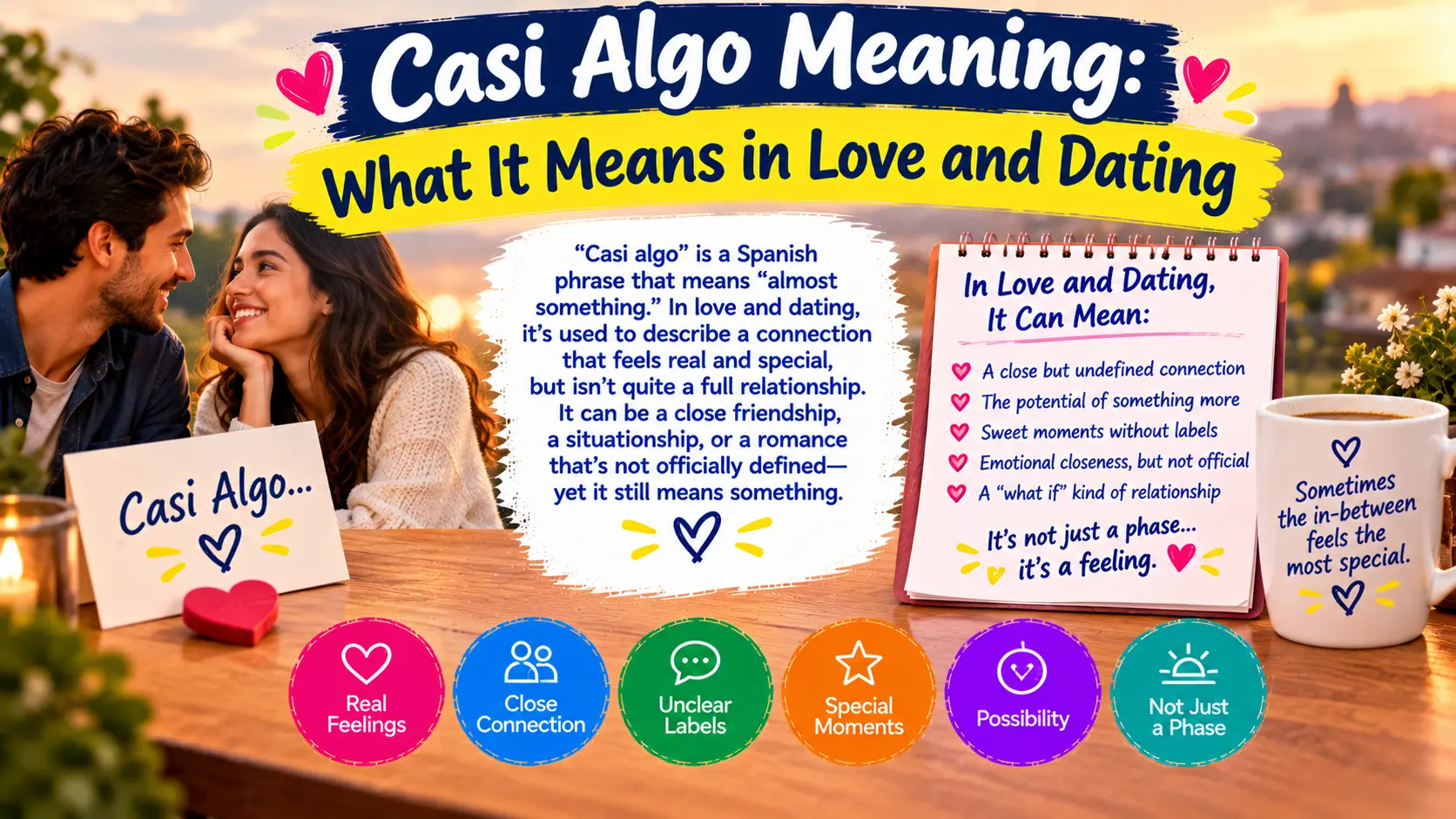
The casi algo meaning describes a romantic connection that feels like a relationship but never officially becomes one. The Spanish expression translates to “almost something” in English, capturing the experience of two people who share feelings, emotional intimacy, attraction, or romantic moments without establishing a committed relationship.
Have you ever felt deeply connected to someone, talked to them every day, shared personal secrets, and imagined a future together, only to realize that you were never officially a couple? Perhaps you went on dates, flirted constantly, or treated each other like partners, but neither person clearly defined what was happening. This is the kind of experience people often describe as a casi algo.
What makes a casi algo different is the sense of possibility. Something meaningful seemed to be developing, but circumstances, timing, uncertainty, or mismatched expectations prevented it from becoming official. It acknowledges that a connection can matter emotionally even if it never becomes a traditional relationship.
Casi Algo Meaning: Quick Answer
Casi algo literally means “almost something” in Spanish. In romantic relationships, it refers to someone you nearly dated or had a meaningful romantic connection with but never officially became a couple with.
The expression can describe:
- An almost-relationship: Someone you came close to dating officially.
- An undefined romantic connection: Two people who act like a couple without agreeing on a relationship label.
- An almost-ex: Someone you miss or think about even though you never officially dated.
- An unfinished romance: A connection that ended before it developed into a committed relationship.
- A meaningful situationship: A romantic connection involving feelings, attraction, or intimacy without a clearly established status.
Casi Algo Meaning Examples
Here are a few natural examples of how people use the expression in everyday conversations:
- “He was my casi algo. We talked for months, but we never became official.”
- “I still think about my casi algo sometimes.”
- “She wasn’t my ex; she was my casi algo.”
- “My casi algo came back after six months like nothing happened.”
- “We had feelings for each other, but our timing was never right.”
The key distinction is that casi algo describes a romantic possibility rather than a clearly established relationship status. It does not necessarily mean the two people were in love, physically intimate, or equally interested in one another. The exact meaning depends on their experiences and how they describe the connection.
Origin and Background of Casi Algo
The expression casi algo comes from Spanish. The word casi means “almost,” while algo means “something.” Together, the words literally translate to “almost something.”
Although the literal translation is straightforward, its relationship meaning reflects a more specific emotional experience. Spanish speakers use the expression to describe a person or connection that nearly became a romantic relationship but never fully developed into one.
The phrase has become recognizable in conversations about modern dating, particularly among younger Spanish-speaking people. It offers a simple way to describe a connection that does not fit comfortably into categories such as novio (boyfriend), novia (girlfriend), ex (former partner), or amigo (friend).
How Social Media Popularized the Expression
Social media has helped introduce casi algo to wider audiences through TikTok videos, Instagram captions, memes, music discussions, and posts about heartbreak and dating experiences.
People often use the phrase when sharing relatable situations, such as missing someone they never officially dated, seeing an almost-partner move on, or reconnecting with a person who once seemed romantically interested.
Its appeal comes from its emotional precision. Calling someone an ex may suggest a relationship that never actually existed, while calling them a friend may overlook the romantic feelings involved.
Casi algo gives people a way to acknowledge that something meaningful happened without claiming that it became an official relationship.
Modern dating has also made the expression especially relevant. People may spend weeks or months getting to know one another, communicating regularly, and developing feelings without discussing exclusivity or long-term intentions. When the connection ends, casi algo can describe the experience more accurately than a conventional relationship label.
Real-Life Conversations Using Casi Algo
Understanding the phrase becomes easier when you see how it appears in everyday messages. These examples illustrate different tones, from playful conversations to more emotionally serious discussions.
WhatsApp Conversation
Person A: Do you remember Daniel?
Person B: Of course. What happened?
Person A: We stopped talking last month.
Person B: Were you two together?
Person A: Not officially. He was my casi algo.
Person B: Oh, the person who was almost your boyfriend?
Person A: Exactly. That’s what makes it so complicated.
In this conversation, casi algo explains why Daniel was important without suggesting that the two people had an official relationship.
Instagram DM
Person A: I saw your story. Are you dating someone now?
Person B: No 😂 I’m single.
Person A: What happened to that guy you were always posting?
Person B: My casi algo.
Person A: So, basically, a relationship without the relationship?
Person B: That is painfully accurate.
Here, the expression is used humorously to describe a connection that looked romantic from the outside but never became official.
TikTok Comments
Person A: This song reminds me of my casi algo.
Person B: Not the casi algo heartbreak 😭
Person A: You understand.
Person B: Unfortunately, yes.
This example shows how the term can create an immediate sense of shared experience among people who have gone through similar romantic situations.
Text Messages Between Former Almost-Partners
Person A: Do you regret what happened between us?
Person B: No. I just wish we had been honest about what we wanted.
Person A: Same.
Person B: Maybe we were always a casi algo.
Person A: Maybe that’s why it was so hard to let go.
In this example, the expression carries a more serious meaning. It acknowledges that both people may have valued the connection, even though they never defined it as a committed relationship.
Emotional and Psychological Meaning of Casi Algo
The emotional meaning of casi algo goes beyond its literal translation. It often describes the difficulty of processing a connection that felt important but never received a clear definition.
When two people share personal conversations, affection, regular communication, and romantic expectations, emotional attachment can develop naturally. An official label is not required for someone to become an important part of your daily life.
That is why a casi algo can sometimes be surprisingly difficult to move on from. You may miss the person, the routine, the emotional closeness, or the future you imagined together.
Why Can a Casi Algo Hurt So Much?
One reason an almost-relationship can hurt is that its ending may feel unclear. There might be no official breakup, no final conversation, and no shared understanding of what the connection meant.
A person may wonder:
- Was the connection real, or did I misunderstand it?
- Why do I miss someone I never officially dated?
- Did the other person feel the same way?
- Was I waiting for a relationship that was never going to happen?
- Should I move on, or is there still a possibility?
These questions can make it harder to find closure. When expectations remain unspoken, people may develop different interpretations of the same experience.
For example, one person may believe they are gradually building a serious relationship, while the other sees the connection as casual. When those expectations finally become clear, disappointment can follow.
The pain of a casi algo is not proof that the relationship was destined to happen. It reflects the emotional significance the connection had for the people involved.
The Role of Uncertainty and Unspoken Expectations
Uncertainty can make an undefined relationship feel especially intense. When you do not know where you stand, a delayed message, a change in tone, or a sudden increase in attention may seem more meaningful than it would in a clearly defined relationship.
You may spend time interpreting small signals instead of having a direct conversation about intentions. This can create a cycle of hope, confusion, and disappointment.
A healthier approach is to communicate openly. Asking what the other person wants does not force a relationship to happen, but it can help you decide whether the connection meets your needs.
If the other person consistently avoids clarity, it is reasonable to consider whether remaining in the situation is emotionally healthy for you.
How to Move On From a Casi Algo
Moving on does not require pretending that the connection meant nothing. You can appreciate the good moments while recognizing that the relationship did not develop into what you wanted.
Consider these practical steps:
- Acknowledge your feelings. You do not need an official relationship label to recognize disappointment or attachment.
- Accept what actually happened. Separate the relationship you experienced from the future you imagined.
- Create healthy boundaries. If repeated messages or social media updates keep you emotionally stuck, consider taking some distance.
- Reflect on your needs. Think about whether you want clearer communication, mutual commitment, or more consistent effort in future relationships.
- Allow yourself to move forward. You can value the experience without waiting indefinitely for the other person to change their mind.
The most important lesson is that you deserve clarity, respect, and mutual effort in a relationship, whether it begins casually or develops into something serious.
Casi Algo Usage in Different Contexts
Although casi algo is closely associated with romance, its tone can change depending on where and how someone uses it.
Social Media
On Instagram, TikTok, and other platforms, casi algo frequently appears in captions, comments, videos, and relationship memes.
Examples include:
- “POV: Your casi algo texts you again after months.”
- “Healing from my casi algo era.”
- “That one song that reminds you of your casi algo.”
- “When your casi algo starts dating someone else.”
The expression is useful online because it communicates a complicated relationship experience in just two words. It can be humorous, nostalgic, dramatic, or sincere.
Among Friends
Friends may use casi algo to describe someone they almost dated or a person with whom they shared romantic feelings.
For example, someone might say, “I ran into my casi algo at the mall yesterday.”
The phrase allows the speaker to explain the connection without having to describe the entire history. Friends who understand the term can immediately recognize that the person was more than an ordinary crush but not necessarily an official partner.
In Romantic Conversations
When used directly between two people, casi algo can acknowledge an undefined relationship or describe what happened in the past.
However, it is important to remember that both people may interpret the connection differently. One person might see it as a mutual almost-relationship, while the other may not believe there was a realistic possibility of becoming a couple.
The phrase describes someone’s interpretation of a connection; it does not automatically prove that both people shared the same feelings or expectations.
Work and Professional Settings
Casi algo is informal relationship slang and is generally unsuitable for formal workplace communication, business documents, or professional reports.
If you need to describe a personal connection in a professional setting, expressions such as “a former romantic interest,” “someone I was seeing,” or “an undefined romantic relationship” are usually clearer.
Casual Versus Serious Tone
The phrase can be playful:
“My casi algo just liked my story again 😂.”
It can also express genuine sadness:
“My casi algo hurt me more than I expected.”
The difference depends on the surrounding conversation, the speaker’s feelings, and the relationship’s history.
When Not to Use Casi Algo
Avoid using the expression without explanation when speaking to someone who may not understand Spanish or relationship slang.
It may also be inappropriate to label another person’s experience without knowing how they understood the connection. A person may consider someone a friend, a crush, or a former dating partner rather than a casi algo.
Finally, not every close friendship is a casi algo. The term generally implies romantic interest or the possibility of a romantic relationship, rather than friendship alone.
Common Misunderstandings About Casi Algo
Several expressions overlap with casi algo, but they do not always mean the same thing.
1. Casi Algo Does Not Always Mean an Ex
An ex is generally someone with whom you previously had a recognized romantic relationship. A casi algo may never have reached that stage.
For example, someone you dated exclusively for six months before breaking up would generally be considered an ex. Someone you talked to romantically for six months without establishing a relationship might be described as a casi algo.
The distinction is about the nature of the connection, not how long it lasted or how strongly you felt.
2. Casi Algo Is Not Exactly the Same as a Situationship
A situationship usually describes an ongoing romantic or intimate connection without a clearly defined commitment. Casi algo emphasizes the idea of an almost-relationship.
The terms can overlap. A situationship may eventually end as a casi algo in someone’s memory, especially if they hoped it would become an official partnership.
However, not every situationship is necessarily an almost-relationship. Some people intentionally prefer an undefined or casual arrangement.
3. Casi Algo Does Not Literally Mean Almost Love
The direct translation of casi algo is “almost something,” not “almost love.”
Its romantic meaning comes from how people use the expression in dating conversations. Some casi algo connections involve deep affection, while others involve attraction, flirting, curiosity, or unfulfilled romantic potential.
It is therefore more accurate to understand the phrase as an almost-relationship than to assume that it always describes love.
4. Casi Algo Is Not Always Negative
Some people use the phrase with affection or humor when remembering someone they nearly dated. Others associate it with regret, confusion, or heartbreak.
For example, “My casi algo was a great person, but our timing was wrong” expresses a different feeling from “I’m glad my casi algo never became official.”
The expression itself is emotionally neutral; the speaker’s experience determines whether it sounds happy, sad, funny, or bittersweet.
5. It Does Not Guarantee Mutual Feelings
Two people may have different interpretations of the same connection. One person might believe they were almost a couple, while the other may have viewed their interactions as casual flirting.
Using casi algo does not establish that both people wanted a relationship. Clear communication is necessary to understand what each person actually felt.
Casi Algo Compared With Other Relationship Terms
The following comparison explains how casi algo differs from other common dating expressions.
| Expression | Meaning | Typical context |
|---|---|---|
| Casi algo | A romantic connection that almost became an official relationship | Almost-relationships |
| Situationship | An ongoing, undefined romantic or intimate connection | Modern dating |
| Talking stage | The early period when two people are getting to know each other romantically | New connections |
| Crush | Someone you feel attracted to or have romantic feelings for | Attraction |
| Ex | A former romantic partner | Past relationships |
| Friends with benefits | Friends who have a sexual relationship without necessarily having a committed romantic partnership | Casual relationships |
| Just friends | People who share a friendship without a romantic relationship | Friendship |
| Committed partner | Someone in an established romantic relationship with you | Serious relationships |
| Almost dating | A connection that came close to becoming a dating relationship | Informal relationship descriptions |
The Biggest Difference Between Casi Algo and a Situationship
The distinction often comes down to emphasis.
Casi algo highlights the possibility of a relationship that never fully happened. Situationship highlights the undefined nature of a connection, often while it is still ongoing.
For example, if you spent several months talking to someone, but the relationship never became official and eventually ended, you might describe that person as your casi algo.
If you are currently seeing someone regularly, sharing romantic moments, and avoiding a discussion about commitment, situationship may be the more natural term.
There is no strict universal boundary between the expressions, and people may use them differently depending on their language, community, and personal experiences.
Variations and Types of Casi Algo
Casi algo can describe several romantic situations. These categories are informal descriptions rather than official relationship classifications.
1. Almost-Relationship Casi Algo
This is one of the clearest uses of the phrase. Two people share romantic interest and may even discuss becoming a couple, but they never officially establish a relationship.
For example, they might go on several dates and talk about a future together before deciding that they want different things.
2. Unofficial Romance
An unofficial romance involves romantic behavior without a clear relationship label.
The people may flirt, communicate daily, share personal details, and spend time together like a couple. However, they may never discuss exclusivity or commitment.
3. Almost-Ex Casi Algo
An almost-ex is someone who feels like a former partner despite never having been an official boyfriend or girlfriend.
This description often appears when an undefined connection ends and one person realizes how emotionally attached they became.
4. Long-Term Casi Algo
A long-term casi algo is an undefined romantic connection that continues for months or even years.
The extended period may create strong attachment, especially when the people repeatedly discuss the possibility of becoming a couple without making a clear decision.
However, duration alone does not guarantee that a relationship will eventually become official.
5. Unrequited Casi Algo
This situation occurs when one person sees romantic potential but the other does not share the same feelings or intentions.
The expression may reflect the first person’s experience more than a mutual understanding of the relationship. This is why it is important not to assume that romantic interest is always equally shared.
6. Mutual Casi Algo
A mutual casi algo describes a connection in which both people recognize some romantic possibility but never establish a committed relationship.
Timing, distance, personal priorities, uncertainty, or conflicting expectations may prevent the connection from progressing.
7. On-and-Off Casi Algo
An on-and-off casi algo involves repeated periods of communication, flirting, distance, and reconnection.
The people may return to each other several times without addressing the underlying reasons they never became a couple.
Without honest communication, the same pattern can continue even when both people want something different.
8. Past Casi Algo
A past casi algo is someone you once had romantic potential with but no longer pursue.
People often use the expression when reflecting on an old connection, sharing memories with friends, or explaining why a particular song reminds them of someone.
9. Social Media Casi Algo
This type of connection develops partly through online interaction, such as direct messages, story replies, comments, and frequent likes.
These interactions may create a sense of closeness, but online attention alone does not establish romantic interest or commitment. Direct communication remains the clearest way to understand someone’s intentions.
10. Casi Algo Crush
A casi algo crush is someone who has become more significant than an ordinary crush but has not become an official romantic partner.
There may have been mutual flirting, emotional intimacy, or opportunities to date. The phrase highlights the space between simple attraction and an established relationship.
How to Respond When Someone Uses Casi Algo
Your response should depend on the conversation’s tone and how comfortable the other person feels discussing their romantic history.
Casual Replies
- “Oh, you mean your almost-relationship?”
- “Got it. The one that never became official?”
- “Ah, your complicated person 😂.”
- “Okay, now I understand.”
Funny Replies
- “So, basically, a relationship with no subscription?”
- “The almost-boyfriend or almost-girlfriend strikes again 😂.”
- “Sounds like emotional DLC.”
- “Not the casi algo making a comeback!”
These replies work best when you know the person is comfortable joking about the experience.
Mature Replies
- “It sounds like the connection meant something to you.”
- “Sometimes undefined relationships can be complicated.”
- “It sounds like there were real feelings involved.”
- “I can understand why it was difficult to move on.”
Respectful Replies
- “Thanks for explaining what you mean.”
- “I understand the distinction now.”
- “That sounds like it was important to you.”
- “I respect how you describe the relationship.”
If someone is discussing a painful experience, a thoughtful response is usually more helpful than a joke. Let them explain what happened instead of assuming you already know the entire story.
Regional and Cultural Usage of Casi Algo
Casi algo is a Spanish expression, but its relationship meaning can be understood across different languages and cultures. Its use and familiarity vary according to language, community, age, and exposure to social media.
Spanish-Speaking Communities
In Spanish-speaking communities, casi algo can be used in informal conversations about dating, romantic uncertainty, and connections that never became official.
The exact connotations may vary between countries and social groups. Some speakers use it casually, while others associate it with the emotional difficulty of an almost-relationship.
It is best not to assume that every Spanish-speaking person uses the expression in exactly the same way.
English-Speaking Communities
In the United States and other English-speaking communities, people may encounter casi algo through Spanish-language music, social media, friends, or online dating discussions.
English equivalents include “almost-relationship,” “someone I almost dated,” and “the person I never officially dated.”
The Spanish phrase may sound more concise or expressive to someone familiar with it, but the underlying experience is not limited to Spanish-speaking cultures.
Asian Communities
Relationship terminology varies considerably across Asian countries, languages, and communities. Family expectations, social norms, personal preferences, and attitudes toward public dating can influence how people describe romantic connections.
Some people may relate to the concept of casi algo even if they use a different local expression. However, there is no single Asian interpretation of almost-relationships.
Middle Eastern Communities
In Middle Eastern communities, attitudes toward dating and public relationships differ by country, family, religion, generation, and individual circumstances.
Someone might use casi algo casually in an online conversation while choosing different language in family or formal settings. The phrase itself does not imply any particular cultural or religious belief.
Global Internet Usage
Social media allows relationship vocabulary to cross language boundaries quickly. A person who does not speak Spanish may discover casi algo in a video, caption, meme, or conversation and adopt it because it captures an experience they recognize.
The expression is culturally specific in origin, but the idea of an almost-relationship is widely relatable.
Gen Z Versus Millennials
Younger social media users may encounter casi algo alongside terms such as situationship, talking stage, and soft launch. These expressions can help people discuss relationship experiences that do not fit traditional labels.
Millennials may be more familiar with phrases such as “seeing someone,” “almost dating,” or “friends with benefits,” although many also recognize newer dating terminology.
These are general observations, not strict generational rules. Language spreads quickly online, and familiarity depends more on individual experience than age alone.
Is Casi Algo Appropriate for Kids?
The phrase itself is not inherently offensive or explicit. It literally means “almost something” and is commonly used to describe an almost-relationship or an undefined romantic connection.
Children and younger teenagers may encounter it in songs, memes, videos, or discussions about dating and heartbreak. The surrounding content matters more than the expression itself.
Parents and educators can explain the phrase in an age-appropriate way, such as describing it as someone you liked or nearly dated but never became a couple with.
It can also provide an opportunity to discuss healthy relationships, including honest communication, mutual respect, personal boundaries, and the importance of never assuming that another person shares your feelings.
FAQs About Casi Algo Meaning
What does casi algo mean in English?
Casi algo literally translates to “almost something.” In relationship slang, it describes someone you had a romantic connection with but never officially became a couple with.
Is casi algo the same as a situationship?
Not exactly. A situationship usually describes an ongoing, undefined romantic connection, while casi algo emphasizes an almost-relationship. The two expressions can overlap depending on the situation.
Is a casi algo an ex?
Usually, no. An ex is generally someone you previously had an established romantic relationship with. A casi algo may have involved strong feelings without ever becoming official.
Can you have more than one casi algo?
Yes. The phrase describes a type of romantic experience rather than a specific person. Someone can have several almost-relationships throughout their life.
Why does a casi algo hurt so much?
A casi algo can involve emotional attachment, shared routines, romantic expectations, and imagined future plans. When the connection ends without clarity, it may be difficult to understand what happened or find closure.
Is casi algo Spanish slang?
It is a Spanish expression that is commonly used in informal conversations about romantic connections. Its literal meaning is “almost something,” while its dating meaning refers to a relationship that never fully developed.
Can I use casi algo in an English sentence?
Yes. People may use it as a borrowed expression in casual conversations, captions, and social media posts. If your audience is unfamiliar with Spanish, briefly explaining the term can make your meaning clearer.
Does casi algo mean someone you love but cannot have?
It can describe that experience, but it does not necessarily mean love. A casi algo may involve attraction, affection, emotional closeness, or romantic potential without a committed relationship.
How is casi algo different from a crush?
A crush is someone you feel attracted to, even if you have little or no personal connection with them. A casi algo usually implies that something more developed between two people, although it never became an official relationship.
Can a casi algo become a real relationship?
Yes, it is possible for an almost-relationship to develop into a committed partnership if both people want the same thing and communicate clearly. However, having feelings or history together does not guarantee that the relationship will progress.
Conclusion
The casi algo meaning captures the emotional space between friendship and a committed romantic relationship. It describes a connection that seemed capable of becoming something more but never fully crossed that line.
Ultimately, casi algo reminds us that emotional connections do not always fit neatly into relationship categories. You can appreciate what a connection meant while recognizing what it was, accepting what it could not become, and making room for relationships built on clarity, mutual effort, and commitment.