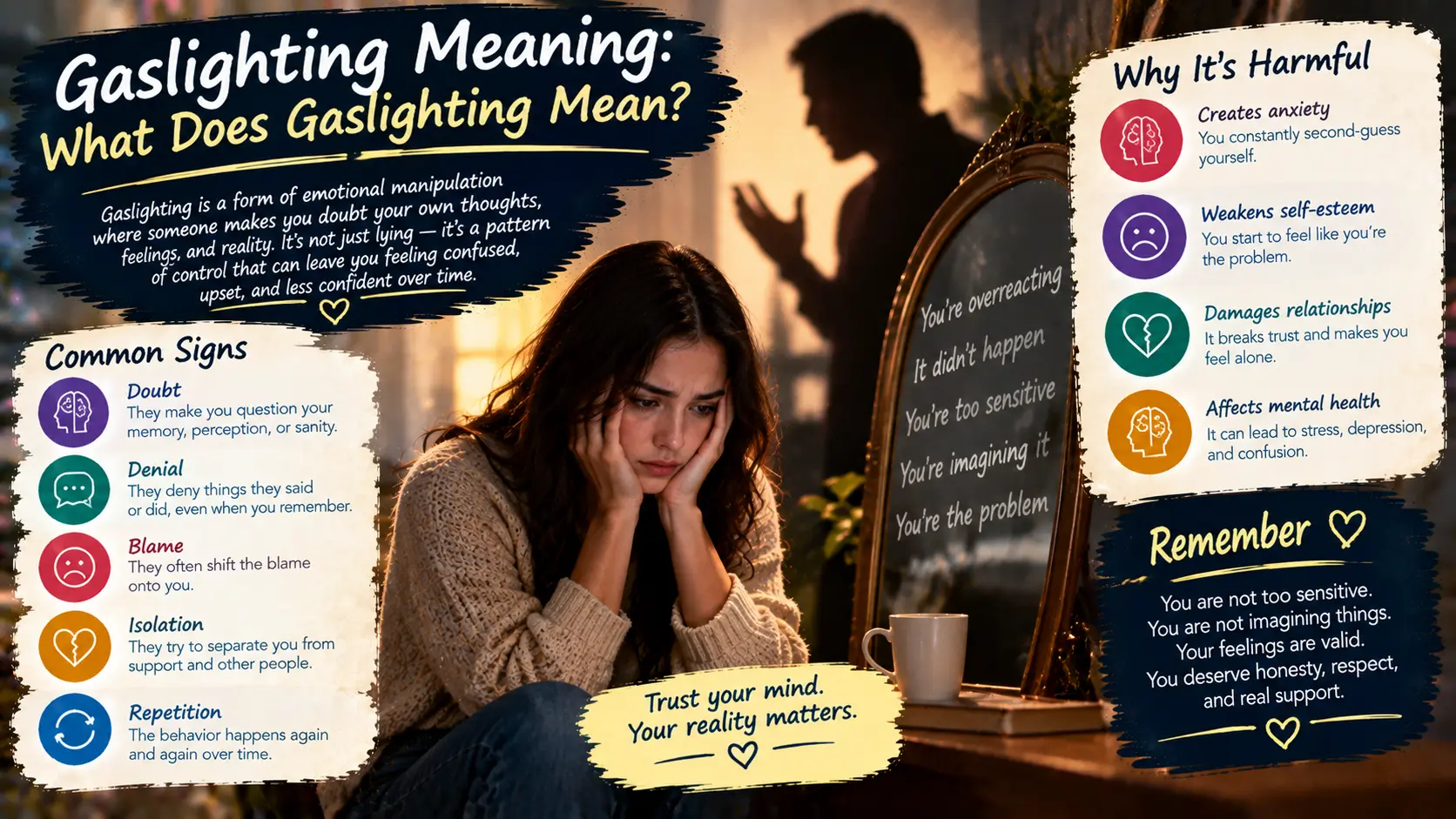
Gaslighting Meaning: What Does Gaslighting Mean?
Gaslighting is a word you may hear in conversations about relationships, friendships, family, work, and social media. But what does gaslighting actually mean?
Gaslighting generally describes a repeated pattern of communication or behavior that causes someone to question their own memory, perception, feelings, or understanding of events.
For example, if someone repeatedly denies something that happened, changes their version of events, dismisses your feelings, and insists that you are imagining things, the behavior may be described as gaslighting.
However, not every disagreement, lie, misunderstanding, or difference in memory is gaslighting. Context and repeated patterns matter.
What Does Gaslighting Mean?
Gaslighting means attempting to make another person doubt their own perception, memory, feelings, or understanding of reality. The term is commonly used when this happens repeatedly as part of a broader pattern of manipulation or control.
A person experiencing gaslighting may begin wondering whether they remembered a conversation correctly or whether their reaction to an event was reasonable.
Gaslighting can occur in romantic relationships, friendships, families, workplaces, and online conversations. It can also look different depending on the situation.
Gaslighting Meaning in Simple Words
In simple words, gaslighting is when someone repeatedly makes you question what you saw, heard, experienced, or remember.
For example, imagine you clearly remember someone making a particular statement. When you mention it later, they repeatedly say, “I never said that. You must have imagined it.” If this becomes a recurring pattern that causes you to distrust your own memory, it may be described as gaslighting.
A single disagreement about what someone said does not necessarily mean gaslighting. People can genuinely remember the same event differently.
Gaslighting Definition
A simple definition is:
Gaslighting is a pattern of behavior that undermines a person’s confidence in their own perceptions, memories, feelings, or interpretation of events.
The word is often used in psychology, relationships, workplace discussions, and everyday communication. In casual conversation, however, people sometimes use the term more broadly than its traditional meaning.
Where Did the Term Gaslighting Come From?
The word gaslighting comes from the title of the 1938 stage play Gas Light and its later film adaptations.
The story involves a husband whose behavior causes his wife to question her own perception of what is happening around her. One detail associated with the story is the changing brightness of gas-powered lights. When she notices the change, he denies that anything has happened.
The fictional situation became associated with the idea of deliberately making another person doubt their perception.
The Origin of the Word Gaslighting
The term became especially well known through the 1944 film Gaslight. Over time, “gaslighting” moved beyond the original story and became a term used to describe certain forms of psychological manipulation.
Today, people use the word in discussions about relationships, emotional abuse, workplace behavior, politics, media, and online communication.
How Gaslighting Became a Modern Term
Modern use of the word is broader than the original story.
People may use gaslighting when describing repeated denial, distortion, blame shifting, or dismissal that makes another person question their own understanding of events.
Because the word has become popular, it is important to use it carefully. A disagreement or incorrect statement is not automatically gaslighting.
How Does Gaslighting Work?
Gaslighting can involve several communication patterns. These behaviors may occur separately or together.
Denying Events
One common pattern involves repeatedly denying that an event happened.
For example:
“That conversation never happened.”
If two people simply remember an event differently, that alone does not establish gaslighting. The concern arises when denial becomes part of a repeated pattern intended to undermine someone’s confidence in their own memory or perception.
Rewriting What Happened
Another pattern involves presenting a dramatically different version of an event.
Someone may insist that a conversation happened differently, even when the other person remembers specific details or has evidence showing otherwise.
Repeatedly changing the story can leave the other person confused about what actually occurred.
Dismissing Feelings
Gaslighting can also involve repeatedly dismissing someone’s emotional response.
Statements such as “You’re too sensitive” or “You’re making a big deal out of nothing” may become problematic when they are consistently used to invalidate legitimate concerns rather than discuss them.
Blaming the Other Person
A person may respond to a concern by immediately making the other person responsible for the problem.
Instead of addressing the original issue, the conversation becomes focused on the person’s personality, emotions, or supposed flaws.
Creating Self-Doubt
One of the central effects associated with gaslighting is self-doubt.
After repeated interactions, someone may begin questioning their memory, judgment, feelings, or ability to interpret situations accurately.
Common Examples of Gaslighting
Gaslighting can appear in many types of relationships and environments.
Gaslighting in a Romantic Relationship
Imagine someone discovers that their partner made a promise and later asks about it. Instead of discussing the promise, the partner repeatedly says, “You always remember things incorrectly. I never said that.”
If this happens repeatedly and causes the person to constantly question their own memory, the pattern may be described as gaslighting.
A normal disagreement might sound different. Two people may say, “I remember that conversation differently,” and then discuss what each person remembers.
Gaslighting Between Friends
Friendships can also involve these patterns.
For example, a friend repeatedly makes hurtful comments and later insists that the comments never happened. When confronted, they tell the other person that they are imagining the entire situation.
One isolated misunderstanding does not necessarily indicate gaslighting. The repeated pattern is important.
Gaslighting in a Family
Gaslighting can also occur within families.
A family member might repeatedly deny statements, dismiss another person’s memories, or insist that events happened differently.
Family relationships can be especially complicated because people often share years of history and may have different memories of the same experiences.
Gaslighting at Work
Gaslighting may also be discussed in workplace situations.
For example, a colleague or manager might repeatedly deny giving an instruction and then insist that the employee misunderstood the conversation.
Workplace disagreements should not automatically be labeled gaslighting. Written records, emails, messages, meeting notes, and other documentation can sometimes help clarify what was actually communicated.
Gaslighting Through Text Messages
Gaslighting can happen through texting and messaging apps as well.
Someone might deny sending a message even though it remains in the conversation, or repeatedly tell another person that they misunderstood obvious statements.
Online communication can be particularly difficult to interpret because tone, timing, deleted messages, and missing context can affect how conversations are understood.
Signs of Gaslighting
Gaslighting does not always look the same. Some commonly discussed signs include:
Someone Repeatedly Denies Things You Remember
A person consistently insists that events did not happen the way you remember them.
Your Feelings Are Constantly Dismissed
Your emotional reactions are repeatedly described as irrational, exaggerated, or meaningless instead of being discussed respectfully.
Conversations Keep Getting Turned Against You
Whenever you raise a concern, the discussion shifts away from the original issue and becomes an attack on your character or memory.
You Are Frequently Blamed for Problems
The other person repeatedly avoids discussing their behavior by making you responsible for everything that went wrong.
You Begin Questioning Your Own Memory
You may start wondering whether you remembered conversations correctly, even when you previously felt confident about what happened.
You Feel the Need to Constantly Prove What Happened
You may begin saving messages, screenshots, notes, or other information simply because you no longer trust that your recollection will be accepted.
The Same Pattern Happens Repeatedly
Pattern is important. A single argument or memory difference does not automatically establish gaslighting.
Gaslighting vs. Lying
Gaslighting and lying can overlap, but they are not identical.
Lying generally means deliberately giving false information.
Gaslighting generally refers to a broader pattern that causes another person to question their own perception, memory, feelings, or understanding.
For example, someone could lie about where they were without gaslighting another person.
Gaslighting may involve lying, but the behavior goes beyond a single false statement when it repeatedly undermines another person’s confidence in their own experience.
Gaslighting vs. Manipulation
Manipulation is a broad term for influencing someone through indirect, deceptive, or unfair methods.
Gaslighting is often described as a particular type of psychological manipulation involving a person’s perception or understanding of reality.
Not all manipulation is gaslighting.
For example, someone might manipulate another person into making a purchase without questioning that person’s memory or perception. That could be manipulation without being gaslighting.
Gaslighting vs. Disagreement
Disagreement is not automatically gaslighting.
Two people can remember the same conversation differently. Human memory is not perfect, and people can genuinely interpret events in different ways.
A healthy disagreement may involve statements such as:
“I remember it differently.”
“I don’t think that is what I said.”
“Let’s go back and look at the messages.”
Gaslighting is generally discussed in situations where there is a repeated pattern of undermining another person’s confidence in their own perception or memory.
Gaslighting vs. Miscommunication
Miscommunication happens when people misunderstand each other.
A message may be unclear. Someone may misunderstand someone’s tone. Two people may interpret the same statement differently.
That does not automatically mean gaslighting.
The difference often comes down to the broader pattern. Good-faith clarification and honest mistakes are different from repeated behavior that undermines another person’s understanding of events.
Why Do People Gaslight Others?
There is no single reason why someone might engage in gaslighting behavior, and a person’s private motivation cannot always be known.
Desire for Control
In some situations, manipulation may be connected with attempts to control a relationship or conversation.
Avoiding Responsibility
A person may deny an event or shift blame because they do not want to acknowledge responsibility for their actions.
Protecting Their Image
Someone may distort or deny events to protect how they are perceived by another person.
Conflict and Power Dynamics
Power differences can sometimes influence how people communicate, particularly in relationships where one person has significantly more authority or control.
Learned Communication Patterns
Some people may have learned unhealthy communication habits from previous relationships or environments.
Deliberate Manipulation
In some cases, the behavior may be intentional. However, it is important not to assume a person’s motivation without evidence.
What Does Gaslighting Feel Like?
People who experience repeated invalidation may describe a range of emotional reactions.
Confusion
Repeatedly hearing conflicting explanations can make a situation difficult to understand.
Self-Doubt
A person may begin questioning their own memory or judgment.
Frustration
Repeatedly trying to explain the same event can become exhausting.
Anxiety
Uncertainty about what happened or whether one’s perception can be trusted may contribute to emotional distress.
Emotional Exhaustion
Constantly defending your memory or feelings can require significant emotional energy.
Loss of Confidence
Over time, repeated invalidation may affect a person’s confidence in their own decisions and perceptions.
These experiences are not proof that gaslighting has occurred. They are possible reactions that should be considered alongside the actual circumstances.
Gaslighting in Relationships
Gaslighting can be discussed in many types of interpersonal relationships.
Romantic Relationships
Partners may experience conflicts about promises, conversations, money, boundaries, or past events.
The important distinction is between ordinary relationship conflict and a repeated pattern that undermines one person’s confidence in their own perception.
Friendships
Friends may disagree about what happened or how something was intended.
Repeatedly denying events or using someone’s uncertainty against them can create an unhealthy communication pattern.
Family Relationships
Family members may have very different memories of the past.
Because family histories are complicated, it is especially important to distinguish genuine differences in memory from deliberate patterns of manipulation.
Professional Relationships
Workplace communication can involve disagreements about instructions, deadlines, responsibilities, and meetings.
Keeping communication clear and using written records when appropriate can help reduce confusion.
How to Respond to Gaslighting
If you believe you are experiencing a repeated pattern of reality-denying or manipulative communication, several practical approaches may help.
Stay Focused on Specific Events
Try to discuss concrete statements, actions, dates, or messages rather than getting pulled into broad arguments about your personality.
Keep Important Records When Appropriate
For workplace or other situations where documentation is appropriate, save relevant emails, messages, meeting notes, or other records.
Documentation should be handled responsibly and in accordance with applicable rules and policies.
Communicate Clearly
Use direct language to explain what you remember, what concerns you, and what you need from the conversation.
Set Personal Boundaries
You can decide what communication you are willing to participate in and what behavior you will not accept.
Avoid Endless Arguments About Reality
If a conversation repeatedly becomes circular, continuing the same argument may not resolve the underlying problem.
Talk to Someone You Trust
A trusted friend, family member, counselor, or other appropriate support person can provide another perspective.
Seek Professional Support When Needed
If a relationship or situation is causing significant distress, speaking with a qualified mental health professional or another appropriate professional may be useful.
If there is immediate danger or a serious threat to your safety, prioritize getting to a safe place and contacting appropriate local emergency or support services.
How to Tell If You Are Being Gaslighted
There is no single phrase or behavior that can automatically establish that someone is gaslighting you.
Instead, look at the overall pattern.
Consider whether the person repeatedly denies events that you clearly remember or that can otherwise be verified. Notice whether concerns are consistently redirected into attacks against you.
Consider whether the person can discuss disagreements in good faith or whether every conversation leaves you questioning your own ability to understand what happened.
Independent perspectives can also help. Talking with a trusted person may give you additional context when you feel confused.
Can Someone Gaslight Without Realizing It?
It is possible for people to communicate in unhealthy or dismissive ways without fully understanding the effect of their behavior.
For example, someone may automatically reject another person’s interpretation because they genuinely remember an event differently.
That is different from knowingly attempting to make another person doubt reality.
Because motivation is difficult to determine from the outside, it is often more useful to focus on observable behavior, repeated patterns, and their effects on communication.
Is Gaslighting Always Intentional?
The word is often used to describe deliberate manipulation, but everyday usage can vary.
Some people use “gaslighting” broadly for repeated invalidation or denial, while others reserve it for more deliberate attempts to undermine someone’s perception.
Intent can be important, but it is not always possible to know another person’s intentions.
That is why concrete examples and context are more useful than labeling someone based on a single interaction.
Gaslighting and Mental Health
Gaslighting is commonly discussed alongside emotional abuse and psychological manipulation, but gaslighting itself is not a formal mental health diagnosis.
Repeated invalidation or manipulation can be emotionally distressing, and people may experience confusion, anxiety, self-doubt, or other difficult emotions.
It is important not to diagnose either the person accused of gaslighting or the person experiencing the behavior based solely on these interactions.
A qualified professional can help someone understand their experiences and determine what type of support may be appropriate.
Gaslighting in Social Media and Online Conversations
Social media has created new environments where people can accuse one another of gaslighting.
Gaslighting in Group Chats
Arguments in group chats can become confusing when people remember messages differently or when conversations move quickly.
Gaslighting in Comments
Online disagreements sometimes involve claims that another person misunderstood, imagined, or fabricated an event.
Gaslighting in DMs
Private messages can contain repeated denial or manipulation, but screenshots and complete conversation history can sometimes provide important context.
Public Denial and Rewriting Events
Public discussions can become especially complicated when multiple people have different versions of an event.
Why Online Context Can Be Difficult to Judge
Screenshots may leave out earlier messages. Posts can be deleted. Sarcasm and tone can be difficult to identify.
For these reasons, not every online disagreement should be called gaslighting.
Common Gaslighting Phrases
Certain phrases are frequently associated with gaslighting discussions. However, a phrase by itself does not prove that gaslighting is happening.
“That Never Happened.”
This can be part of a gaslighting pattern when someone repeatedly denies events in a way that causes another person to doubt their memory.
“You’re Remembering It Wrong.”
People can genuinely remember events differently. The concern arises when this statement becomes part of a repeated pattern of undermining someone’s perception.
“You’re Too Sensitive.”
This phrase may dismiss someone’s feelings rather than addressing the issue they raised.
“You’re Making This Up.”
Repeatedly accusing someone of inventing events can contribute to self-doubt, particularly when the claim is unsupported and occurs repeatedly.
“You’re Overreacting.”
People can have different emotional responses. Repeatedly using this phrase to avoid discussing legitimate concerns may contribute to an unhealthy communication pattern.
“Everyone Thinks You’re the Problem.”
This statement can be particularly powerful because it invokes unnamed people to undermine someone’s confidence. The claim should not automatically be accepted without evidence.
“You’re Just Imagining Things.”
Repeatedly telling someone that their experiences are imaginary can be part of a pattern that undermines their confidence in their own perception.
Examples of Gaslighting vs. Healthy Communication
| Situation | Potentially Manipulative Pattern | Healthier Communication |
|---|---|---|
| Different memories | Repeatedly insisting the other person is irrational | Acknowledging that memories differ |
| Hurt feelings | Dismissing the feelings entirely | Discussing why the person felt hurt |
| Mistake | Denying responsibility despite clear evidence | Taking responsibility when appropriate |
| Conflict | Turning every concern into an attack on the other person | Addressing the specific issue |
| Misunderstanding | Repeatedly denying what was communicated | Clarifying what each person meant |
The table illustrates a general distinction rather than a diagnostic test. Context matters in every individual situation.
Frequently Asked Questions About Gaslighting
What is the simple meaning of gaslighting?
Gaslighting generally means a repeated pattern of behavior that causes someone to question their memory, perception, feelings, or understanding of events. It is often discussed as a form of psychological manipulation.
What does gaslighting mean in a relationship?
In a relationship, gaslighting can refer to repeated behavior that makes one partner question their own memories, feelings, or understanding of what happened. A normal disagreement or different memory does not automatically mean gaslighting.
What are the main signs of gaslighting?
Commonly discussed signs include repeated denial of events, dismissal of feelings, blame shifting, rewriting conversations, and causing someone to consistently question their own memory or judgment.
Is gaslighting the same as lying?
No. Lying involves giving false information, while gaslighting generally refers to a broader pattern that undermines another person’s confidence in their own perception or memory.
Is gaslighting emotional abuse?
Gaslighting is often discussed as a form of emotional or psychological manipulation and may occur within abusive relationships. However, the term should be applied based on the broader pattern and circumstances rather than one isolated interaction.
Can someone gaslight without realizing it?
A person can communicate in dismissive or invalidating ways without fully understanding the effect. Whether something should be called gaslighting depends on the behavior, pattern, context, and sometimes intent.
What are common gaslighting phrases?
Examples often associated with gaslighting include “That never happened,” “You’re remembering it wrong,” “You’re too sensitive,” and “You’re imagining things.” However, the phrase alone does not establish gaslighting.
How do you respond to gaslighting?
Focus on specific events, communicate clearly, maintain appropriate boundaries, keep relevant records when appropriate, and consider speaking with a trusted person or qualified professional for support.
Can gaslighting happen over text?
Yes. People may use repeated denial, blame shifting, or dismissal through text messages and online chats. However, online conversations can also contain misunderstandings, missing context, and genuine differences in interpretation.
What is the difference between gaslighting and disagreement?
A disagreement involves different opinions, memories, or interpretations. Gaslighting generally refers to a repeated pattern in which one person’s perception, memory, or understanding is undermined.
Gaslighting Meaning in One Sentence
Gaslighting is a repeated pattern of behavior that can cause someone to doubt their own memory, perception, feelings, or understanding of events.
The most important point is that one disagreement, mistake, lie, or misunderstanding is not automatically gaslighting. The larger pattern and context matter.
Conclusion
Understanding the gaslighting meaning can make conversations about manipulation and unhealthy communication easier to understand.
Gaslighting generally refers to a repeated pattern of behavior that undermines someone’s confidence in their own perception, memory, feelings, or interpretation of events. It can appear in romantic relationships, friendships, families, workplaces, and online communication.
At the same time, the term should be used carefully. People can have different memories, misunderstand each other, make mistakes, or disagree without anyone intentionally manipulating the other person.
Looking at specific behavior, repeated patterns, available evidence, communication context, and personal boundaries can provide a clearer understanding than relying on a label alone.