What Does Ick Mean? Texting Meaning & Examples
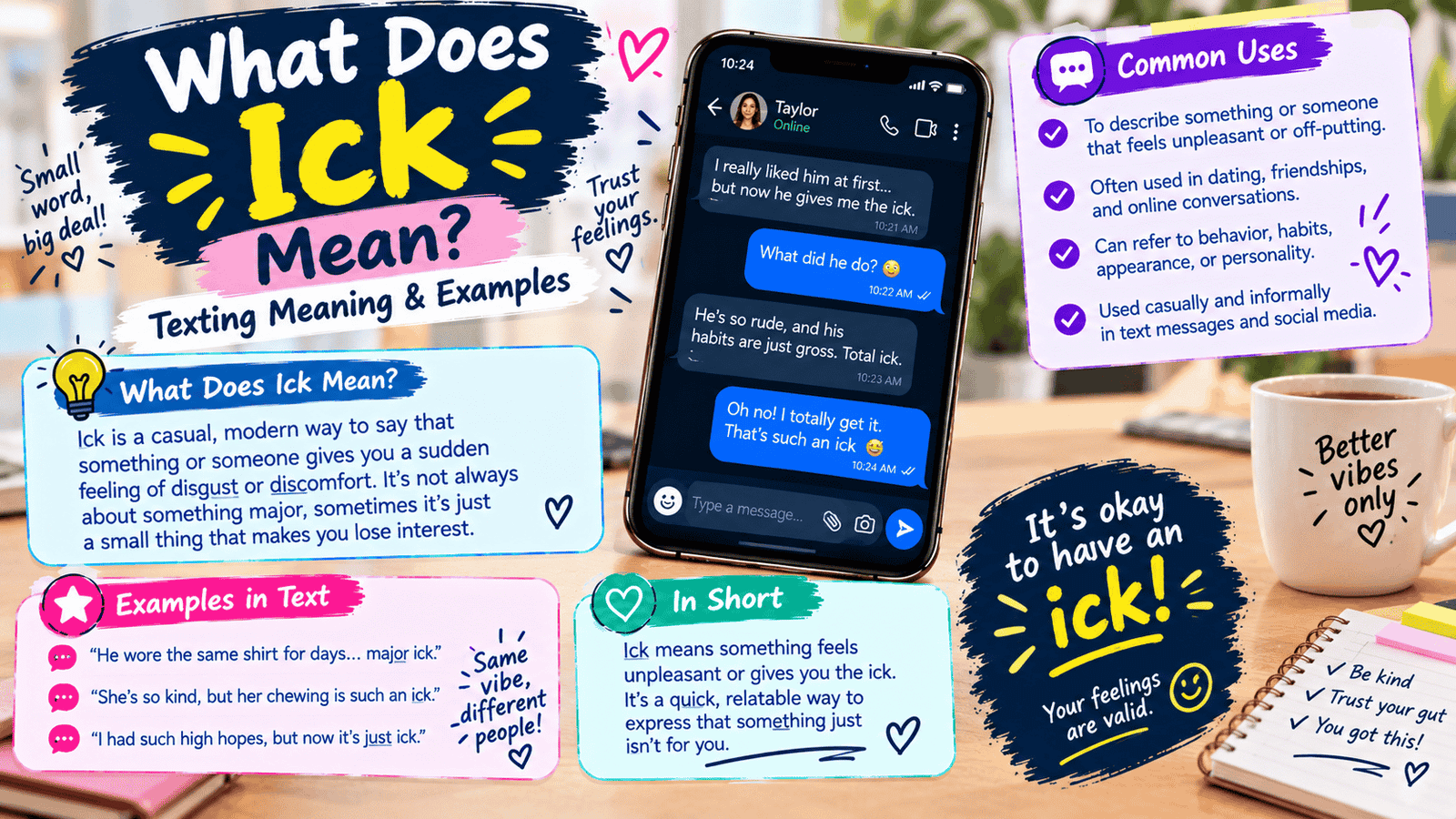
If someone says, “That gives me the ick,” they usually mean that something about a person, behavior, situation, or interaction suddenly makes them feel uncomfortable, unattracted, embarrassed, or put off.
The expression “ick” is especially common in American texting, dating conversations, TikTok posts, Instagram captions, and casual chats. It can describe anything from a small annoying habit to a surprisingly specific behavior that instantly changes how someone feels about another person.
For example, someone might say, “He was really sweet, but the way he treated the waiter gave me the ick.” Here, the ick describes a sudden negative emotional reaction that can make romantic attraction disappear or become weaker.
The word is informal, expressive, and highly dependent on context. Understanding the tone is important because saying something “gives me the ick” can range from playful teasing to a genuine loss of interest.
Quick Answer: What Does Ick Mean?
“Ick” means a sudden feeling of discomfort, annoyance, embarrassment, or loss of attraction toward someone or something.
When people say “I got the ick,” they usually mean that something unexpectedly turned them off.
When someone says “That gives me the ick,” they mean that a particular behavior or situation makes them feel uncomfortable or unattracted.
Example:
“He kept interrupting everyone at dinner. It gave me the ick.”
In this sentence, the ick refers to a strong negative reaction to the person’s behavior.
The word is usually casual and conversational. It is particularly common when discussing dating, relationships, social behavior, and personal preferences.
Meaning of Ick at a Glance
| Expression | Meaning | Typical Tone |
|---|---|---|
| Ick | A feeling of discomfort or dislike | Casual |
| The ick | A sudden loss of attraction or interest | Informal |
| Get the ick | Suddenly become turned off | Casual |
| Give me the ick | Make me feel uncomfortable or unattracted | Casual |
| That gave me the ick | That behavior caused a negative reaction | Informal |
| Major ick | A particularly strong negative reaction | Playful/informal |
What Does “The Ick” Mean in Dating?
In dating, the ick usually refers to a sudden feeling that makes someone lose romantic or physical attraction.
It can happen because of a person’s behavior, mannerisms, communication style, or something that conflicts with the other person’s preferences.
For example:
“Everything was going well until he started making fun of the server. Instant ick.”
The speaker is saying that the person’s behavior changed how attractive or appealing they seemed.
The ick does not necessarily mean that someone has done something objectively wrong. Sometimes it is simply a personal reaction. One person may find a particular habit adorable, while another person may find exactly the same habit unattractive.
That is why “the ick” is often subjective. It describes a feeling rather than an objective judgment about someone’s character.
What Is the Full Form of Ick?
“Ick” does not have a standard full form or acronym expansion.
It is a standalone informal English expression rather than an abbreviation such as “LOL” or “BRB.”
The word functions as an exclamation or noun depending on how it is used.
For example:
- “Ick!” expresses immediate disgust or discomfort.
- “That is such an ick.” uses “ick” as a noun.
- “He gave me the ick.” refers to a negative emotional reaction.
- “I got the ick.” means the speaker suddenly became turned off.
Because it is informal, its exact emotional intensity depends heavily on context.
What Does “Ick” Mean in Texting?
In texting, ick usually communicates a quick emotional reaction without requiring a long explanation.
Someone might simply text:
“Ick.”
That could mean, “That is unattractive,” “That makes me uncomfortable,” or “I really do not like that.”
The meaning becomes clearer when additional words or emojis are included.
For example:
“He sent me 12 messages in a row 😭 Ick.”
The speaker probably finds the behavior overwhelming or unattractive.
“You actually like pineapple on pizza? Ick 😂”
Here, the word is probably playful rather than serious.
“He lied to me about something important. Major ick.”
In this case, the expression carries a more serious emotional reaction.
Common American English Examples
Example 1: Dating
“She was really nice, but she kept bragging about how much money she made. It gave me the ick.”
The speaker experienced a sudden loss of attraction because of the person’s behavior.
Example 2: Friendship
“My friend chews with her mouth open. I love her, but it is such an ick.”
Here, “ick” describes an annoying or unpleasant habit rather than romantic attraction.
Example 3: Social Media
“When someone comments ‘first’ under every post, I get the ick.”
This is an informal way to describe a personal dislike of a particular online behavior.
Where Did the Word “Ick” Come From?
The basic expression “ick” has long been used in English as an exclamation associated with disgust, unpleasantness, or something off-putting.
The modern expression “the ick”, especially its dating-related meaning, became much more prominent in contemporary popular culture and social media.
A notable influence was the British reality television series Love Island, where the phrase was used to describe a sudden loss of romantic attraction. The expression subsequently became widely recognizable in online dating discussions and social-media language.
However, it is important not to treat one television program as the absolute origin of the word itself. “Ick” existed in English before its modern dating usage became widely popular.
Today, social media has helped expand the expression into a broader term for behaviors, habits, interactions, and situations that produce an immediate feeling of discomfort or dislike.
How Social Media Changed “Ick”
Social media has made the ick especially useful because it gives people a short way to describe complicated emotional reactions.
TikTok, Instagram, Snapchat, group chats, and other platforms encourage users to share highly specific personal preferences.
A person might post a list titled:
“Things That Give Me the Ick.”
The examples could be serious, humorous, romantic, or completely personal.
Common online discussions may involve:
- Dating habits
- Texting behavior
- First-date behavior
- Fashion choices
- Social-media habits
- Awkward mannerisms
- Unusual eating habits
- Overly competitive behavior
- Excessive bragging
- Embarrassing public behavior
The expression works particularly well online because “ick” is short, emotionally expressive, and easy to understand from context.
4 Realistic Conversations Using “Ick”
1. Text Messages
Alex: How was your date?
Mia: Pretty good until he started talking badly about his coworkers.
Alex: Seriously?
Mia: Yeah. Instant ick.
Meaning and tone:
Mia means that the person’s behavior suddenly made him less attractive to her. The phrase is casual and likely refers to a romantic loss of interest.
2. Instagram
Sam: Why did you delete that guy from your followers?
Jordan: He commented “you up?” on every single picture.
Sam: 😂
Jordan: It was giving me the ick.
Meaning and tone:
Jordan is describing an online behavior that felt unattractive or uncomfortable. The laughing emoji makes the exchange sound relatively playful.
3. TikTok
Creator: My biggest ick is when someone records themselves arguing with customer-service workers.
Comment: That is such a real ick.
Meaning and tone:
Here, “ick” describes a behavior that the speakers personally find unattractive or unpleasant. It does not necessarily mean the behavior is universally unacceptable.
4. Group Chat
Chris: Would you date someone who sends voice messages for everything?
Taylor: Honestly, yes.
Morgan: Absolutely not. Ick 😭
Chris: You guys are impossible.
Meaning and tone:
Morgan is expressing a personal preference. The crying emoji suggests exaggeration and humor rather than serious criticism.
Emotional Meaning of “Ick”
The emotional meaning of ick can change depending on the situation.
It may communicate:
- Discomfort
- Mild disgust
- Embarrassment
- Loss of attraction
- Annoyance
- Awkwardness
- Secondhand embarrassment
- Personal dislike
Punctuation also matters.
“Ick.” can sound blunt.
“Ick 😂” usually sounds playful.
“Ick 😭” may communicate exaggerated embarrassment or amusement.
“That gives me the ick.” sounds more explanatory.
“I got the ick.” often suggests a sudden personal change in attraction.
Relationships matter too. A close friend saying “ick” may be joking, while the same phrase from a romantic partner could communicate genuine discomfort.
How “Ick” Is Used in Different Situations
Friends
Friends commonly use “ick” when joking about habits, preferences, dating experiences, or embarrassing moments.
Romantic Relationships
In dating, “the ick” is frequently connected with attraction and sudden loss of interest.
Family
It can be used casually with family members, although the dating meaning may depend on the age and context of the speakers.
School
Teenagers may use “ick” in casual conversations and group chats. It is not appropriate for formal school assignments unless discussing informal language itself.
Gaming
Gamers may use “ick” to describe an annoying behavior, strategy, character choice, or social interaction. The meaning remains context-dependent.
Social Media
Social platforms are one of the most common environments for the expression. Users frequently use it in captions, comments, videos, memes, and discussions about relationships.
“Ick” on Popular Platforms
TikTok
TikTok frequently uses “the ick” in dating discussions, humorous videos, personal stories, and lists of unpopular preferences.
On Instagram, the word may appear in captions, comments, Stories, Reels, and direct messages.
Snapchat
Snapchat users may use “ick” in quick conversations about dating, friends, or everyday experiences.
On WhatsApp, it generally appears in informal one-to-one conversations and group chats.
Discord
Discord users may use “ick” casually when discussing games, communities, relationships, or awkward interactions.
Facebook users may encounter the expression in comments, relationship discussions, memes, and younger users’ posts.
When Should You Not Use “Ick”?
Ick is informal language, so it should generally be avoided in professional or highly formal communication.
For example, instead of writing:
“Your behavior gave me the ick.”
in a professional complaint, a clearer alternative might be:
“I found the behavior uncomfortable and would prefer that it not happen again.”
Avoid using “ick” in:
- Formal business emails
- Academic papers
- Professional reports
- Job applications
- Legal documents
- Formal customer complaints
- Official workplace communication
It can be perfectly natural in casual conversation but inappropriate in situations that require precise, professional wording.
Common Misunderstandings About “Ick”
One common misunderstanding is assuming that “ick” always means disgust. It can mean disgust, but in modern slang it often refers more broadly to feeling turned off, uncomfortable, embarrassed, or unattracted.
Another misunderstanding is assuming that getting the ick proves someone has done something objectively bad. Usually, it describes the speaker’s personal reaction.
For example, someone might say:
“He wears socks with sandals. Ick.”
That does not establish that wearing socks with sandals is inherently wrong. It simply communicates the speaker’s preference.
Another important distinction is between a temporary annoyance and a genuine loss of attraction. Context determines which meaning is intended.
Similar Expressions Compared
| Expression | Meaning | Typical Tone |
|---|---|---|
| Ick | Sudden discomfort or dislike | Informal |
| Turn-off | Something that reduces attraction | Casual |
| Cringe | Something embarrassing or awkward | Casual |
| Gross | Something unpleasant or disgusting | Casual |
| Weird | Something unusual or uncomfortable | Casual |
| Off-putting | Something that creates dislike or discomfort | Neutral |
| Not my thing | Something personally disliked | Mild/casual |
Key Insight
“Ick” is broader than a simple synonym for “gross.” In modern dating and social-media language, it often describes a sudden emotional shift in how someone perceives another person.
10 Common Variations of “Ick”
1. The Ick
Meaning: A sudden feeling of being turned off.
Example: “I got the ick after that conversation.”
Tone: Casual and conversational.
2. Get the Ick
Meaning: To suddenly become uncomfortable or lose attraction.
Example: “I usually get the ick when someone is rude to waiters.”
Tone: Personal and informal.
3. Give Me the Ick
Meaning: To make someone feel uncomfortable or unattracted.
Example: “Constant bragging gives me the ick.”
Tone: Direct and casual.
4. Got the Ick
Meaning: Experienced a sudden negative reaction.
Example: “I was interested, but then I got the ick.”
Tone: Common in dating conversations.
5. Major Ick
Meaning: A particularly strong turn-off.
Example: “Lying about small things is a major ick for me.”
Tone: Emphatic and informal.
6. Instant Ick
Meaning: An immediate negative reaction.
Example: “Being disrespectful to staff is an instant ick.”
Tone: Strong but conversational.
7. Icky
Meaning: Unpleasant, uncomfortable, or gross.
Example: “That whole situation felt icky.”
Tone: Informal.
8. Such an Ick
Meaning: Something that feels particularly unattractive or unpleasant.
Example: “That was such an ick.”
Tone: Casual and expressive.
9. Biggest Ick
Meaning: A person’s strongest or most noticeable personal turn-off.
Example: “My biggest ick is constant bragging.”
Tone: Common in social-media discussions.
10. Ick Factor
Meaning: The quality of something that makes it feel unpleasant or off-putting.
Example: “That story has a serious ick factor.”
Tone: Casual, sometimes humorous.
How to Respond to “Ick”
Your response depends on the relationship and the tone.
Casual Reply
“Honestly, same.”
This agrees without making the conversation too serious.
Friendly Reply
“Okay, I can totally see why 😂”
This acknowledges the person’s reaction while keeping things light.
Funny Reply
“You have officially ruined it for me too 😭”
This works well when both people are joking.
Mature Reply
“I get what you mean. Everyone has different turn-offs.”
This recognizes that personal preferences vary.
Respectful Reply
“Fair enough. It may not bother me, but I understand why it bothers you.”
This avoids turning a personal preference into an argument.
Generational Differences in “Ick”
The word “ick” is especially recognizable in contemporary online and dating language, particularly among younger internet users. Gen Z frequently uses it in social-media conversations, although the expression is not exclusive to one generation.
Millennials who participate in online dating and social-media culture may also use the term naturally.
Older internet users may understand “ick” as an expression of disgust or unpleasantness without necessarily using the newer dating-specific sense as frequently.
These differences are not absolute. Age does not determine whether someone understands or uses the expression. Exposure to social media, online communities, and contemporary dating vocabulary can influence familiarity more than generation alone.
Cultural and Global Usage
Although “ick” is strongly associated with contemporary English-language internet culture, its meaning can be understood by many English-speaking social-media users around the world.
The exact frequency and preferred expressions can vary by community.
People may also use alternatives such as “turn-off,” “cringe,” “gross,” “awkward,” or “off-putting.”
It is better to understand “ick” as part of modern informal digital English rather than assuming that everyone in a particular country or age group uses it in exactly the same way.
Is “Ick” Appropriate for Kids and Teenagers?
“Ick” is generally a mild, non-profane informal expression, so teenagers may encounter and use it in everyday conversations and online communication.
However, context matters. Teenagers may use the word when discussing dating, friendships, appearance, habits, or social situations.
Parents, teachers, and younger users should understand that “the ick” can sometimes involve judging another person’s behavior or appearance. Using the expression does not automatically make the underlying judgment fair or accurate.
The word itself is not inherently offensive, but the way it is directed at another person can affect how the message is received.
Casual vs. Formal English
| Casual English | More Standard/Formal Alternative |
|---|---|
| “That gives me the ick.” | “I find that uncomfortable.” |
| “I got the ick.” | “I suddenly lost interest.” |
| “That is such an ick.” | “I find that quite off-putting.” |
| “Major ick.” | “That is a significant turn-off for me.” |
| “Icky.” | “Unpleasant” or “uncomfortable” |
The casual versions sound more natural in texts, social media, and conversations with friends. The formal alternatives are better suited to professional, academic, or official settings.
Frequently Asked Questions
1. What does “ick” mean in texting?
In texting, ick usually means a sudden feeling of discomfort, dislike, embarrassment, or loss of attraction. Its exact meaning depends on the surrounding conversation.
2. What does “I got the ick” mean?
“I got the ick” means someone suddenly became turned off, uncomfortable, or less attracted to another person because of something they said or did.
3. Is “ick” a bad word?
No. “Ick” is generally considered a mild, informal expression, although using it to criticize someone can still hurt their feelings depending on the context.
4. What does “give me the ick” mean?
“Give me the ick” means that something causes a strong feeling of discomfort, unattraction, annoyance, or unpleasantness.
5. Is “ick” the same as “cringe”?
Not exactly. “Cringe” usually emphasizes embarrassment or awkwardness, while “ick” can describe discomfort, disgust, or a sudden loss of attraction.
6. Can you use “ick” for things other than dating?
Yes. People can use ick for habits, situations, online behavior, food, social interactions, and other personal dislikes. Dating is simply one of its most recognizable modern contexts.
7. Is “ick” appropriate in professional communication?
Generally, no. Ick is informal slang, so professional communication is usually clearer with words such as “uncomfortable,” “off-putting,” “inappropriate,” or “unpleasant.”
The Bottom Line
“Ick” is an informal English expression for a sudden feeling of discomfort, dislike, embarrassment, or loss of attraction. In modern American texting and social-media language, “the ick” is especially common when someone describes a behavior that suddenly makes another person seem less attractive.
The expression can be playful or serious. “Ick 😂” may be a joke between friends, while “I got the ick” in a dating conversation may signal a genuine change in attraction.
Understanding the context, punctuation, emojis, relationship between the speakers, and surrounding words helps reveal the intended tone. In casual conversations, “ick” sounds natural and expressive. In formal communication, a more precise standard-English phrase is usually better.